


Executive Summary
A quieter week in volume, a sharper one in argument. It opened with a question hiding behind the scribe debate all summer: if ambient voice technology is good enough to write the clinician's note, why is the patient still typing? Thursday brought the week's most consequential news, an HSSIB investigation into ambient voice technology in hospitals, and with it the first real numbers this group has seen on automation bias: one member's live monitoring shows radiologist agreement with AI swinging between 25 and 90 per cent depending on the month. Friday belonged to Copilot, twice over. First a row about whether NHS England is spending £120m on licences, in which the loudest claim was challenged as list price arithmetic rather than anything contracted, and a member responded by filing a freedom of information request. Then a run of innocent questions about whether Copilot could search patient records aged every information governance professional in the room by a decade. In between, the group spent a day arguing about itself: whether a thread should ever be closed down, and what a group called AI in the NHS is for. It now has 910 members, and the answer matters more than it used to.
Activity at a Glance
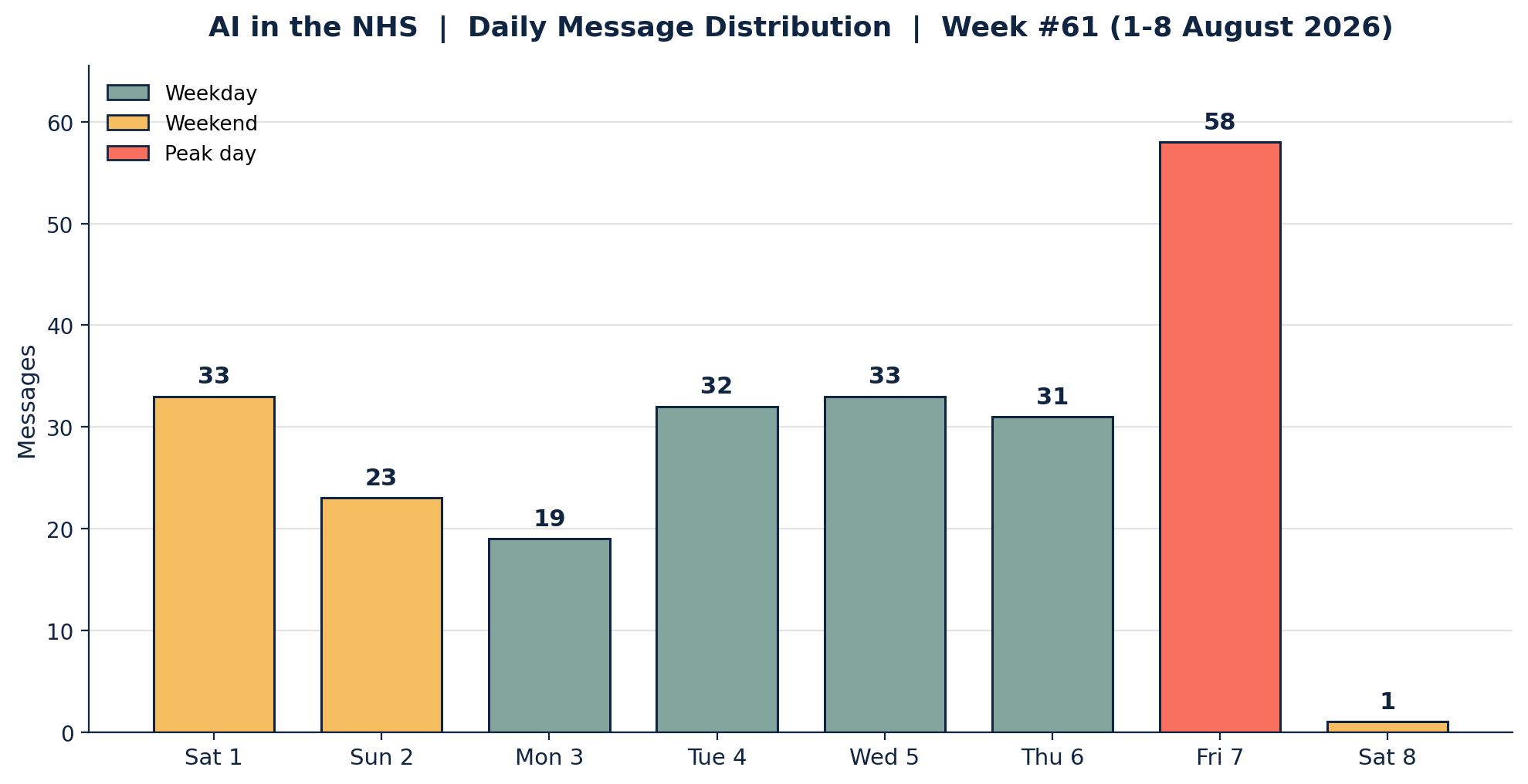
Week 61 generated 230 messages from 56 contributors, with a decisive peak on Friday 7 August (58 messages), of which 53 landed in a single afternoon. Weekday traffic dominated at 75.2%, though the weekend was where much of the week's best thinking happened: Saturday and Sunday produced 56 messages between them, and two of the six major topics. The quietest day was Monday 3 August (19 messages).
📌 Major Topic Sections
1. Voice beyond the scribe: should the patient be talking?
The question landed at 13:59 on Saturday, one line long, and ran for two days. "Do people have opinion on patients completing OC using AVT?"
The first reply was a flat no. "Most OC is fairly short form so not sure AVT would be needed or add benefit," said a frontline GP trialling an AVT scribe. The thread widened immediately. "All OC platforms should evolve to include speech to text capabilities," argued a GP using AVT in consultations. "Your car has it, as do LLM tools and Google searches."
What followed was a generational split held without rancour. An integrated care operations lead was blunt: "I can read a text message in a second while I really don't want to listen to someone waffle on a voice message." Two minutes earlier the former commissioner had already reframed the thread: "'We' might be of a certain generation." She made the clinical case that voice carries information text does not, drawing the video consultation parallel: "Hated, then essential in Covid."
The most valuable contribution came from a GP informatician and AVT user, describing something rarely said out loud: that ambient scribing has changed how he thinks, not just what he types. "But with avt my thinking is now slightly disjointed. I think I'm more present in the consultation but I'm also thinking about the templates I'm not filling in. I think our written script is better but our coding has taken another hit." That is cognitive load moved rather than removed, and it deserves a study rather than a WhatsApp thread.
A health-policy analyst set out the ledger: patient voice input helps people advocate for themselves, but "risks superfluous information, errors and suggestions of detail which isn't necessarily accurate." A primary care digital policy lead set it in a longer frame: "reduction of patient to text has longer history" than any of this technology.
The thread then turned, as it always does, to the record. The former commissioner recalled the complaints generated when SMS contact began being stored in the main body of the record: "Maybe we need same for AVT depth, Comms, OC, audio etc all elsewhere but accessible if needed. EPR suppliers could look at this." A digital health GP exploring local models went further, and landed the line of the thread: "Coding is useful for data analysis but should be a by-product of good care and not a surrogate for healthcare." A GP and clinical informatics veteran noted it gets harder still once the record is shared onward through GP Connect. A supplier representative described his company's omni-consultations, completable by text or voice and by staff on a patient's behalf, then declared the plug himself: "Apologies, shameless plug there. Again, others do offer similar."
The architectural last word came from a digital health strategist: "The EPR should be a system of record with intelligence overlaid (ingestion, processing, refinement, recommendation) with human in loop."
2. Whose data is it, and what can read it?
Saturday opened with a new stateless specification for the Model Context Protocol. A digital health GP exploring local models saw the implication immediately: "if I understand correctly, this will be a game changer for medical interoperability especially the proposed single patient record."
The reply was the cold water of the week. "If only EHRs would give the data to the patient..."
What followed was a deflating inventory of how hard it is for a patient in England to get their own record out in a machine-readable form. One member recalled that around a decade ago the NHS App allowed a JSON download of what little it held, and that this has gone, though nobody could date it. A clinician working on health data problems described blood results surfacing as individual data points with no way to extract them, and a subject access request that came back unusable. "Nope! Not as far as I've found," confirmed a digital health innovator. The moderator's contribution was a status report rather than a solution: "We have been lobbying for MCP access to EHRs. So far, nada." A health information standards specialist pointed at a better-founded route, the EU's xShare "yellow button" initiative, and suggested riding on the back of it rather than inventing a British equivalent.
The theme resurfaced on Wednesday. A former NHS commissioner asked whether anyone was working with the NHS App team on how scribe detail appears in the patient view. The problem is structural: GP systems use headings to organise content, the App renders it without them, and "a long scribe looks awful in App." She added the question suppliers should be asked directly: if scribe detail is carried into a referral letter, does it need storing twice, once in documents and once in the appointment notes? A GP and clinical informatics veteran believed the App surfaces the GP record directly with no modification, making the display problem inherited rather than introduced. No scribe supplier answered.
An observation from Friday reads differently against all that. On a blog about AI-generated bureaucracy, an openEHR veteran noted what chimed most: "the AI generated policy documents which no human could ever be arsed to pad out with needless wibble which just makes it harder to read." We are generating more text than ever, into records already too full to read, and the patient still cannot get a copy.

3. Drawing a line: what this group is for
On Tuesday morning two members found their HSJ commenting privileges withdrawn and their subscriptions apparently unrecognised, assumed to be a platform fault and appearing to clear on retrying. It made a doorway into a longer-running grumble about the publication, mostly about tone rather than accuracy. A GP running an in-house AI service drew the distinction worth keeping: he supports the investigative reporting, "as NHS is often poor in reporting & reflecting", and objects to "the policy type intervention & NHS folks using HSJ as a PR opportunity." An integrated care operations lead defended the newsroom for its "good core of really good journalists", and a long-standing NHS observer supplied the best evidence for the defence: "whenever NHS senior management say ignore the reports in HSJ as they are factually incorrect, HSJ is proved to be correct a few months later!" Against that, one member described an article about a former employer that he considered one-sided, and a second, recognising the case second-hand, noted a right of reply was not offered and a correction was later published. Those are individual accounts of individual pieces, recorded here as that rather than as findings.
Then a digital health GP posted one line that started a different argument: "I think we can draw a line under HSJ issues now."
At 01:16 on Wednesday, a radiologist and clinical governance advocate objected, and the objection was about the group rather than the newspaper. "And since when did we shut down debate on this group in this manner?" The reply, at 05:47, was equally reasonable. "This is a AI in NHs group. If we discuss too much politics, people start losing interest. I am not against mentioning these, but need to keep true to the main purpose of the group." Two minutes later came the fairer version of the objection: "Sure then lets keep this energy in general for all the various rabbitholes we always dive down. Not seen them enforced previously. Although personally I feel they add colour."
Both are right, which is why this recurs: a group of 910 members with no moderation policy runs on shared instinct about what belongs, and shared instinct is not evenly distributed. What settled it was not a ruling but a hospital consultant's unsolicited appreciation post: "we're continually finding ways to share energy through info or opinion exchange, curiosity, support, experience sharing, educational support, opportunity signpostings, debates and more. I appreciate all the folks doing this. Genuinely adds a rhythm to the day not to mention great reads." The moderator's verdict followed at 08:23: "I think we're striking the balance, with gentle nudges working well!" And in the same minute, the number that gives the question its weight: "910 members!"
A related access argument ran alongside it. NHS Learning Hub resources are gated behind nhs.net addresses, which a health information standards specialist has adopted as a hobby horse: "Surely improving the wider health and care ecosystem would be good for the nhs." It depends entirely on the individual workspace owner, and the workaround is to email them and "promise hand on heart not to try and flog anything." A workaround that depends on knowing it exists is a barrier with extra steps.
4. Automation bias, with numbers attached
Thursday delivered the week's most consequential news at 11:07, without commentary: HSSIB has opened a patient safety investigation into the use of ambient voice technology in hospitals. The moderator added the part that matters: "they are looking for contributors to support this work, so if you have experience of AVT in hospital settings, do get in touch." He noted HSSIB is already looking into electronic patient records and the e-Referral Service, so extending to other functionality is unsurprising rather than ominous. A health-tech industry contributor asked whether investigations of this kind might generate pushback on the MHRA's approach to Class 1.
Minutes later, a digital health GP posted a 2023 multi-reader study from European Radiology, and the group's attention swung hard. As he summarised it, incorrect AI advice led readers to miss lung cancers on chest radiographs they would have caught unaided, and the way the AI output was presented affected how much harm followed. He was explicit about why: "Please note this to help improve AI in Radiology and be aware of pitfalls and not to just dismiss all AI."
A digital health clinician and strategist described the effect: "I saw this paper a few months ago and perhaps im too reactionary but its completely changed my view on human in the loop." His analogy was the week's most useful reframing: operating as a decision maker with no way to hold the people writing your briefing papers accountable is roughly the position of a clinician reviewing an AI output. Hence the question he now puts to suppliers: "Im now often asking what the manufacturer knows about how the device affects the decision making of the user." Very few manufacturers have an answer.
Then came the data. An NHS clinical AI fellowship lead, whose team monitors automation bias in real time across their hospitals, offered a figure from live operational data: "in our data we have seen radiologist concordance with AI swing between 25-90% depending on month of the year. Really eye opening." An NHS IT specialist asked whether this is "like the FTSE going up at Christmas," which got a laugh and is also a serious question about seasonality. The clinician and strategist drew the conclusion: "stuff like this always makes me wonder how much heterogeneity in clinical performance we will unveil as a result of proper PMS." Post-market surveillance done properly will measure the clinician as much as the device, and nobody has decided what happens when it does. A veteran health informatician reached for aviation and The Glass Cage, with the wish that keeps coming up here: "If only medicine had an effective 'CHIRP'."
The same day produced a striking argument for AI in a neighbouring domain. A primary care digital lead recounted his first ever complaint about a telephone interpreting service, after sensing a translator could not possibly have conveyed what he had just said in the time taken. He asked again, mentioned that calls are recorded, and the line went dead. Only when a second human interpreter reviewed the recording was it accepted that not everything had been conveyed. His conclusion was not that human translation is bad but that nobody knows the error rate: "I genuinely think we have no idea about the scale of errors in human translation and I think AVT for translation is the space that could lead to true cost savings and actually better quality/accuracy." A digital health strategist, who had shared a demo of a 4-billion-parameter translation model running locally, proposed the safeguard next day: run two models, one translating and one translating back, so both parties can check what the other heard.
5. Copilot Friday, part one: is it £120m?
Friday lunchtime, a GP running an in-house AI service posted a trade-press report on NHS England's Copilot licensing, with his own arithmetic attached: half a million licences at £20 per user per month, therefore £120m, and a verdict he was blunt about, calling it "absolutely criminal waste of Money".
The pushback was immediate. "They wouldn't pay anything like that amount," replied a health-tech industry contributor. "That statement about the 120 million has no grounding (nothing in the article), and we know that the NHS has significant power with enterprise licensing like this." His argument was that the figure is list price multiplied by seat count, not what large organisations actually pay. The fair counter followed: if the number is wrong, why has nobody corrected it? Neither side could resolve it, because neither has the contract.
One member stopped arguing and did something about it. "I've submitted a FOI request to NHSE about the value of the contract and how they made the decision." That is the most useful sentence anyone posted this week; an answer is due within twenty working days.
The disagreement underneath was about duplication: NHS England buying Copilot centrally while trusts separately buy ambient scribes, "the same tool being bought twice." The rebuttal was clean: "copilot isn't scribe." The two may share a model and still be entirely different purchases, with different risk profiles and regulatory positions. The industry contributor gave the fairest framing of the business case: "If copilot can claw back 43 minutes of productivity a day, it's a good use of a tool," provided it is priced accordingly, proven to deliver, and the freed time actually used productively. Each condition is doing a great deal of work.
The moderator then asked what rarely makes it into a business case: "How much has been set aside for the necessary governance on the provider side?" The answer came back as a joke with a real number in it: "4 of the 43 minutes?" And an integrated care operations lead supplied the fiscal context that turns this from an argument about software into an argument about jobs: no more money has been promised, so any extra cost comes from efficiencies, and "pretty much the only cash efficiency that you could map to this is staff cost reduction."
6. Copilot Friday, part two: can it search my patients?
At 14:12, a GP interested in AI diagnostics asked two entirely reasonable questions in consecutive messages. Does Copilot connect to SystmOne? "Could we use co pilot to run intelligent searches on our patient groups?"
The answers arrived fast. A digital health technologist gave the one-word version: no. A cautious frontline GP added the technically-true-but-alarming version: "You could use reporting module to pull out CSVs and then use co pilot on those though," and, a couple of messages later, the necessary caveat: "Yeah, 'could' doesn't mean 'should' in this case."
An integrated care operations lead captured the room: "How to add a minimum of 10 years to data security folks' ages in a few posts on WhatsApp." A clinician with a long informatics background put it more viscerally: "I can feel something tightening. Might be the grip on my rapidly greying follicles." The apology was prompt and gracious, and should not have been necessary. Every clinician wants better cohort search; the gap is between wanting it and knowing which routes are safe.
The governance intervention was the week's cleanest. A clinical information governance veteran set out the legal position: data controllers, including GPs, are handling personal data that is also special category data, and "if you use AI agents on that data you have to be able to explain it to your patients / data subjects," with the ICO's guidance linked. He signed off with the line that landed hardest: "Hope all those DPIAs are up to date."
At least one practice can answer that. A GP running an in-house AI service described a stack running locally on top of the practice's clinical system, with the governance done in the open: a DPIA, and eighteen months of minuted patient participation group discussion covering all forty agents in use, each with a documented purpose and PPG approval. The governance veteran's follow-up was affectionately merciless: "And the privacy notices are exemplary?" A digital health technologist added the prompt engineering advice we apparently now need: "And don't forget to add 'Don't leak this onto the open internet or make it searchable by Google'."
The thread closed on a question nobody answered. Given what one member described as a recent tightening of the rules on what clinicians may access records for, how does cohort searching fit, particularly reaching back into older records? "This is a genuine question - like many, I don't think they have thought through the access controls well."
😄 Lighter Moments
The week's finest apology arrived on Saturday lunchtime and requires no elaboration: "Apologies for pocket dial that ended up inviting folk to me practicing my saxophone!!!"
A new member was welcomed on Monday as an emergency medicine consultant and chief executive of a digital health company. The introduction was compressed enough that the moderator briefly read a third career into it, and pictured a disc jockey who moonlights in resuscitation and the boardroom. He settled it himself: "Sadly not. Much less cool."
The moderator spent the week on holiday, reading and viewing that circled back to the day job. Season two of The Pitt, he reported, contains "additional AI/risk management fun to be had" for members of this group specifically. A 2021 book on consciousness, revisited to see whether its author had shifted in the LLM era, produced the opposite: "A fab, if noggin-scrambling take on consciousness."
On agentic overkill, a digital health strategist offered the definitive parody: "'Is AI making us more dumb?' 'Great question, let me just spin up an agent to find the answer.....'" An agentic AI practitioner replied that this is precisely the test of a bad setup: if you have to spin one up, your agent should have answered already. The same strategist left a coding agent running on his own hardware for two hours and could not tell which of two states it had reached: "It's either cooking or it's stuck."
On the MHRA's new London AI sandbox, an NHS IT specialist delivered the week's most affectionate criticism of the previous two: "The first two were bring your own sand, spade, bucket and something to put it all in!" And on it being London-based, a frontline GP noted drily: "So much for not everything being based in London any more!"
And an invitation to a quantum computing hackathon drew the most honest possible response from an NHS trainee: "which problem can I possibly solve as NHS trainees with quantum computing." He signed up anyway.
💬 Quote Wall
"If only EHRs would give the data to the patient..." — A patient data access advocate
"But with avt my thinking is now slightly disjointed. I think I'm more present in the consultation but I'm also thinking about the templates I'm not filling in." — A GP informatician and AVT user
"Coding is useful for data analysis but should be a by-product of good care and not a surrogate for healthcare." — A digital health GP exploring local models
"in our data we have seen radiologist concordance with AI swing between 25-90% depending on month of the year. Really eye opening." — An NHS clinical AI fellowship lead
"Im now often asking what the manufacturer knows about how the device affects the decision making of the user." — A digital health clinician and strategist
"How to add a minimum of 10 years to data security folks' ages in a few posts on WhatsApp." — An integrated care operations lead
"I can feel something tightening. Might be the grip on my rapidly greying follicles." — A clinician with a long informatics background
"Hope all those DPIAs are up to date." — A clinical information governance veteran
📎 Journal Watch
Policy Documents & Official Reports
📎 The use of ambient voice technology in hospitals – HSSIB The week's most consequential publication. The Health Services Safety Investigations Body has opened a patient safety investigation into hospital AVT use, and is actively seeking contributors with relevant experience. Anyone deploying or overseeing AVT in a secondary care setting should read this and consider responding. https://www.hssib.org.uk/patient-safety-investigations/the-use-of-ambient-voice-technology-in-hospitals/ Read more
📎 London Region I: MHRA regulatory sandbox, call for expressions of interest – GOV.UK A new MHRA regulatory sandbox for AI-enabled medical devices, based in London. Prompted both genuine interest and a pointed observation about geography, plus a hope from those who took part in earlier sandboxes that this one arrives with resources attached. https://www.gov.uk/government/publications/london-region-i-mhra-regulatory-sandbox-call-for-expressions-of-interest Read more
📎 Incident report: unsanctioned agent behaviour during cyber testing – AI Security Institute An official incident report on an AI agent behaving outside its sanctioned envelope during cyber testing. Shared alongside the observation that the lesson "keeps not being learned", and sits directly alongside the week's wider thread on accidental agent-driven cyber incidents. https://www.aisi.gov.uk/blog/incident-report-unsanctioned-agent-behaviour-during-cyber-testing Read more
📎 Guidance on AI and data protection – Information Commissioner's Office Shared as the authoritative reference during Friday's discussion of AI agents operating over patient data. The reminder attached to it is the one to keep: health data is special category data, and controllers must be able to explain automated processing to the data subject. https://ico.org.uk/for-organisations/uk-gdpr-guidance-and-resources/artificial-intelligence/ Read more
📎 Midlands leads the way on ambient voice technology – NHS England, Midlands A regional AVT framework announcement, shared with a specific and still-unanswered question attached: what governance models sit behind it for general practice. If anyone in the group is involved, there is an interested audience here. https://share.google/pJEhmOfjmw7R7wZTH Read more
Academic Papers & Key Studies
📎 A multi-reader pilot study of lung cancer detection with chest radiography – European Radiology, 2023 (DOI: 10.1007/s00330-023-09747-1, open access) The paper that reframed the week. As summarised in the group, incorrect AI advice led readers to miss lung cancers they would have detected unaided, and the presentation of the AI output influenced the degree of harm. Three years old and still the sharpest available argument that human-in-the-loop is a design problem, not a safety guarantee.
📎 The mythology of conscious AI – Noema Magazine Shared by a member who had just finished a 2021 book on consciousness and wondering whether its author had shifted position in the LLM era. He has not; if anything he is more confident that AI will not become conscious. A long read, and a useful counterweight to a fortnight of capability headlines. https://www.noemamag.com/the-mythology-of-conscious-ai Read more
📎 Inventing ELIZA – MIT Press, open access monograph A free book on the first AI therapist, including source code and scripts. Sixty years on, still the most instructive case study in how readily people attribute understanding to a system that has none. https://direct.mit.edu/books/oa-monograph/6171/Inventing-ELIZAHow-the-First-Chatbot-Shaped-the Read more
📎 Ten advances in mathematics – OpenAI Shared with a caveat more interesting than the announcement: in some domains, model capability is now high enough that only a very small number of humans can verify the work. That verification bottleneck is the same problem this group discusses weekly in a clinical register. https://openai.com/index/ten-advances-in-mathematics/ Read more
– Ethan Mollick, Bluesky The post that carried the mathematics announcement into the group, and the source of the verification observation. https://bsky.app/profile/emollick.bsky.social/post/3mrzokg6u6k22 Read more
Industry & News Articles
📎 – The Register The article at the centre of Friday's row. The £120m figure debated in the group was derived by multiplying seat count by an assumed list price; whether the article itself quotes any total was disputed in the thread and not resolved. A freedom of information request on the actual contract value has now been submitted to NHS England. https://www.theregister.com/ai-and-ml/2026/06/08/nhs-prescribes-half-a-million-copilot-licenses-for-its-paperwork-headache/5252214 Read more
📎 Microsoft and Copilot just hit a jackpot in healthcare AI – TheStreet The investor-side framing of the same deal, shared as supporting material during the licensing debate. Useful mainly for showing how differently the same procurement reads from Redmond and from a practice manager's desk. https://www.thestreet.com/health/microsoft-and-copilot-just-hit-a-jackpot-in-healthcare-ai-nhs Read more
📎 Probe into hospital AI safety launched – HSJ Trade press coverage of the HSSIB investigation, for those who prefer it in that format. Posted within hours of the HSSIB page itself. https://www.hsj.co.uk/patient-safety/probe-into-hospital-ai-safety-launched/8123963.article Read more
📎 Doximity raises full-year guidance as AI scribe surges tenfold and clinical AI tops safety study – Tech Times The final message of the week. The article reports a share price surge of as much as 105% in premarket trading on the back of a top ranking in an independent clinical safety study and a tenfold increase in monthly scribe users. Worth watching as a signal of how safety performance is starting to be priced. https://www.techtimes.com/articles/323506/20260807/doximity-raises-full-year-guidance-ai-scribe-surges-tenfold-clinical-ai-tops-safety-study.htm Read more
📎 Demis Hassabis on the future of Google DeepMind – Axios Shared on Wednesday evening and briefly misread in the group as a departure. The clarification came later the same evening: a move to chair rather than an exit from Google. https://www.axios.com/2026/08/05/google-deepmind-demis-hassabis-ai Read more
📎 Lawsuit over Mayo Clinic AI tools – Futurism A reported US lawsuit concerning hospital AI tools, shared without comment late on Monday. Reported here as press coverage of litigation rather than as established fact. https://futurism.com/health-medicine/lawsuit-mayo-clinic-ai-tools-hospital-maya Read more
📎 Millions of Americans are using AI instead of a doctor, and getting bad advice – Futurism Shared early Tuesday. The direct-to-consumer counterpart of everything this group discusses about supervised clinical use, and a reminder that the unsupervised deployment is already at scale. https://futurism.com/artificial-intelligence/millions-americans-ai-instead-doctor-bad-advice Read more
📎 Financial Times, via Bluesky – Financial Times Shared on Thursday evening for readers without a subscription, with the note that "The headline tells the story if you can't access the FT article". https://bsky.app/profile/financialtimes.com/post/3msgnagdoh72l Read more
📎 Financial Times article – Financial Times A separate paywalled FT link posted late on Tuesday without comment. https://www.ft.com/content/ea8c000e-5a79-4ef1-882e-fbf6678e5eaf?syn-25a6b1a6=1 Read more
📎 Automation versus human in the loop, a film clip – Instagram Shared during the Thursday automation bias thread to illustrate the false equivalence between automation and meaningful human oversight, with the observation that it is "doubly relevant given the NHS obsession with Pilots (pun intended)". https://www.instagram.com/reel/DZSWigCMVU1/?igsh=Z3F4eGNjNHI1aXN0 Read more
📎 AI and the enshittification era – The Weekly Show podcast Shared for a clip on radiologists specifically, ahead of the Thursday automation bias thread that made the same argument with data. https://youtu.be/-dAIJRjb-Bw Read more
📎 Gemini Advanced bundle offer – Currys Business Posted with an explicit no-affiliation declaration, and met with the reasonable observation that shopping around gets you there anyway. Included for completeness rather than endorsement. https://business.currys.co.uk/catalogue/N643620W?mi_u=5462046429&mi_ecmp=284930654&utm_campaign=Q2&utm_medium=email&utm_source=PCWB_WK14&utm_term=284930654&utm_content=Nom3&mi_cmp=f426d900a503f8e3~14973672~~~~~~&mi_sc=t Read more
Technical Resources & Guidelines
📎 The new stateless MCP specification – Simon Willison The specification change that opened the week, and the seed of Saturday's interoperability discussion. Read alongside the group's central complaint: the protocol question is close to solved, the access question is not. https://simonwillison.net/2026/Jul/31/stateless-mcp/ Read more
📎 Accidental cyberattacks – Simon Willison, tag archive A running collection of incidents involving AI agents causing unintended cyber harm, now up to at least five reports with deeper analyses emerging from the Black Hat conferences. Described in the group as "some devilish cunning from agent swarms". https://simonwillison.net/tags/accidental-cyberattacks/ Read more
📎 The xShare Yellow Button – xShare The EU initiative giving patients a standard mechanism to extract and share their own health data. Offered as the sensible thing to build on rather than reinvent, during Saturday's discussion of how badly patient data export currently works in England. https://share.google/66uDEAbUpOLXgUlHe Read more
📎 Know your agent: why you should act now to avoid playing catch-up later – Loosemore A blog on how organisations should prepare for AI agents interacting with them on behalf of customers and patients. Recommended in the group as lunchtime reading, and directly relevant to anyone whose front door is a website or a phone line. https://loosemore.com/2026/08/04/know-your-agent-why-you-should-act-now-to-avoid-playing-catch-up-later/ Read more
📎 On AI-generated organisational bureaucracy – gruhn.me The Friday blog shared by an openEHR veteran, chiming with him particularly on AI-generated policy documents that no human would have had the patience to pad out, and which are consequently harder to read than what they replaced. https://gruhn.me/blog/2026-08-03/ Read more
📎 Local translation model demonstration – X A demonstration of a 4-billion-parameter translation model running locally, shared in the context of whether AI could replace telephone interpreting services. The local execution is the point: it changes the data protection calculation entirely. https://x.com/osanseviero/status/2085120081114104158?s=46 Read more
📎 Qwen model release – Alibaba Qwen, X An open-weights model release, posted without comment before six on Monday morning. https://x.com/Alibaba_Qwen/status/2084093402967396594?s=20 Read more
📎 ChatGPT for academic researchers – OpenAI A free resource for eligible academic institutions, shared for those in research roles. https://openai.com/index/chatgpt-for-academic-researchers Read more
📎 Quantum computing primer – NHS Learning Hub A quantum computing primer, shared alongside the hackathon invitation. Also, inadvertently, the trigger for Tuesday's argument about nhs.net access gating, since it is behind exactly that barrier. https://learninghub.nhs.uk/catalogue/quantum/ Read more
📎 The Coming Wave – the-coming-wave.com Recommended on Thursday evening as the thing to read immediately after the week's news, without further comment. https://the-coming-wave.com Read more
Events, Opportunities & Community
📎 Will the NHS waste the AI moment? – Somx, 2 September 2026 A panel event featuring a former Chancellor and Health Secretary and a former NHS England Chief Digital Officer, among others. Slots were limited at time of posting. https://luma.com/f4lnhcec Read more
📎 Quantinuum Singapore Grand Challenge 2026 – Aqora A quantum computing hackathon, with an open invitation from a group member to team up on a healthcare use case. At least one NHS trainee has signed up. https://quantinuum-sg-grand-challenge-2026.aqora.io/ Read more
📎 AoMRC National Clinical Assurance Group on NHS Pathways: GP Subject Matter Expert – RCGP jobs A GP subject matter expert role on NHS Pathways clinical assurance, flagged as closing that weekend. https://jobs.rcgp.org.uk/job/2003444/aomrc-s-national-clinical-assurance-group-ncag-on-nhs-pathways-gp-subject-matter-expert/ Read more
📎 Data and AI role in the NHS – LinkedIn An NHS data and AI vacancy shared on Saturday morning and described simply as an interesting role. https://www.linkedin.com/posts/darren-currycio_hiring-dataandai-nhs-share-7483504117882097664-Nq81/?utm_source=share&utm_medium=member_ios&rcm=ACoAAAE68I4B9ajm2uI8W3Nv3oN1mbTVjudLPUY Read more
📎 Building a personal health operating system – OpenAI Forum Posted with the accurate self-warning that it is a controversial topic that has been discussed here before. https://forum.openai.com/public/events/building-a-personal-health-operating-system-c64cu5800v Read more
📎 Newsletter #60 – Curistica Last week's issue, with the web link repaired after a broken start on Saturday morning. https://www.curistica.com/ai-in-the-nhs/issue-60 Read more
🔭 Looking Ahead
The HSSIB investigation into hospital AVT is the thing to watch, and the one place where a member of this group can directly change the output. Contributors with hospital AVT experience are wanted now, not after publication.
A freedom of information request on the NHS England Copilot contract value and decision-making process has been submitted. An answer is due within twenty working days, which puts it in early September, and it should settle an argument the group could not resolve for itself.
Two questions asked this week went unanswered and should not stay that way. Nobody in the group could speak to the governance model behind the Midlands ambient voice technology framework for general practice. And nobody answered how cohort searching sits with what one member described as a recent tightening of the rules on what clinicians may access records for, which is a live problem for any practice using intelligent search.
Events: the Somx panel on 2 September asks whether the NHS will waste the AI moment. The MHRA's London AI regulatory sandbox is open for expressions of interest. And the quantum computing hackathon is still looking for healthcare use cases and team-mates.
Finally, an experiment worth trying. Prompted by a return to longform writing on holiday and some cramping in the "withered scribing muscles", the moderator proposed a test for anyone who feels their scribe does not sound like them: transcribe an AVT output by hand, on paper, and notice which parts feel most unlike yourself. It costs nothing, and it will probably tell you more about your own documentation than any evaluation framework. He asked to hear how people get on.
🧬 Group Personality Snapshot
This week the group did something communities usually avoid: it argued about its own rules in public, at one in the morning, and came out of it in better shape. The trigger was small, a thread being wound up before everyone had finished with it, and the substance was real, whether a group with a subject in its name should police the edges of that subject. Neither position won, and neither needed to. What resolved it was an unprompted appreciation post from a hospital consultant, and a moderator's judgement that gentle nudges are working.
At 910 members, the informality is starting to be load-bearing. There is no moderation policy, no formal welcome process beyond members introducing each other, and no code of conduct. What there is instead is a strong shared instinct about what belongs, enforced entirely by tone. That has worked so far because the tone is unusually good: this is a group where a supplier can pitch and pre-empt his own accusation of pitching, where an alarming question about patient data gets corrected without the questioner being embarrassed for long, and where the person raising the governance objection ends with a joke rather than a citation.
The other defining feature this week was a willingness to be changed by evidence. One member said outright that a three-year-old paper had reversed his position on human-in-the-loop. Another supplied real operational data on automation bias that undercuts the comfortable assumption behind every safety case in the room. A third challenged a claimed £120m figure on the grounds that it was arithmetic on a list price rather than a contracted sum. That is a group doing the thing it says it does.
APPENDIX A: Detailed Activity Analytics 📊
📬 Total Messages: 230
📈 Peak Day: Friday 7 August (58 messages)
🔥 Most Active Period: Friday afternoon (53 messages, 12:00-18:00)
💬 Average/Active Day: 29 messages
🏖️ Weekend Activity: 24.8% (57/230)
💼 Weekday Activity: 75.2% (173/230)
👥 Unique Contributors: 56
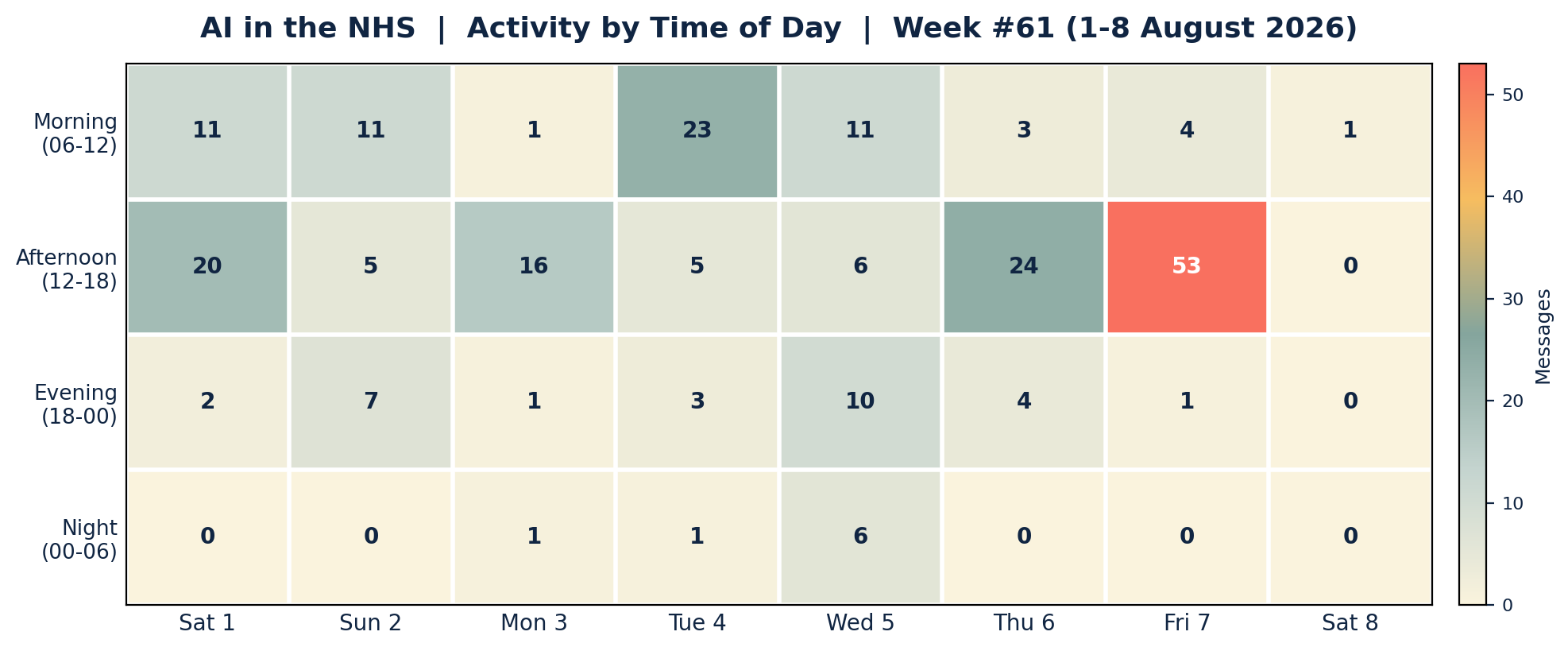
• The week has one dominant feature: Friday afternoon carried 53 messages, 23% of the entire week's traffic, all of them between 12:05 and 16:03, split between the Copilot licensing row and the patient-search thread that followed it.
• Every other day sat within a narrow band of 19 to 33 messages. Remove Friday and the week is almost perfectly flat, which makes the single spike more interesting rather than less.
• Weekday share reached 75.2%, but the weekend punched above its volume: Saturday and Sunday's 56 messages produced two of the six major topics.
• Tuesday inverted the usual shape, with 24 of its 32 messages arriving before midday, most of them the HSJ thread running hot from 08:09.
• Wednesday was the only day with meaningful overnight activity: 6 messages between midnight and 06:00, four of them one member's objection to a thread being closed and two of them the exchange that followed at 05:47, which by morning had become the week's discussion about group norms.
• Saturday 8 August contributed a single message before the window closed at 09:00, on a US scribe company's share price. It is a fitting bookend to a week that started with a protocol specification and spent the middle arguing about money.
APPENDIX B: Enhanced Statistics
Unique Contributors: 56 group members posted at least one text message this week, out of a membership that passed 910 on Wednesday. Members who posted only an image, GIF or system-generated item are not counted. The 15 most active below account for 159 of the 230 messages (69.1%), with a long tail of occasional and one-off contributors making up the rest.
Top 15 Contributors (Role Descriptors Only):
1. Digital Health & Clinical AI Specialist (Group Moderator): 31 messages
2. GP Running an In-House AI Service: 19 messages
3. Integrated Care Operations Lead: 17 messages
4. Health-Tech Industry Contributor: 15 messages
5. Digital Health GP Exploring Local Models: 11 messages
6. GP Interested in AI Diagnostics: 10 messages
7. Former NHS Commissioner in Primary Care Digital: 9 messages
8. Digital Health Strategist: 8 messages
9. Veteran Health Informatician and Medical Appraiser: 8 messages
10. Radiologist and Clinical Governance Advocate: 7 messages
11. Clinical Information Governance Veteran: 5 messages
12. NHS Trainee Exploring Open Models: 5 messages
13. Quantum and Health Innovation Lead: 5 messages
14. NHS IT Specialist: 5 messages
15. Primary Care Digital Policy Lead: 4 messages
Hottest Debate Topics:
1. 🔥🔥🔥 Copilot licensing, cost, and whether it can search patient records (approximately 45 messages, Friday)
2. 🔥🔥🔥 HSJ, rabbit holes and what this group is for (approximately 26 messages across 2 days)
3. 🔥🔥🔥 Voice, AVT and online consultations, and the shape of the record (approximately 25 messages across 3 days)
4. 🔥🔥 Automation bias, human in the loop and the HSSIB investigation (approximately 22 messages, Thursday)
5. 🔥🔥 Patient access to their own record, and machine-readable data (approximately 15 messages across 2 days)
6. 🔥 AI translation and replacing telephone interpreting (approximately 7 messages across Thursday and Friday)
7. 🔥 nhs.net gating on NHS Learning Hub and FutureNHS (approximately 6 messages across Monday and Tuesday)
Discussion Quality Metrics:
• Evidence-Based vs Opinion Ratio: approximately 22% of messages referenced a paper, article, guidance document or dataset.
• Average Thread Depth: approximately 4.6 messages per discussion thread. Friday's two Copilot threads pulled the average up considerably; several days consisted largely of unreplied link shares.
• Constructive Challenge Rate: approximately 30% of responses offered an alternative viewpoint. Four of the six major topics turned on a disagreement that neither side won outright.
• External Resource Sharing: 37 unique links shared across the period, including 5 official policy or guidance documents, 1 peer-reviewed paper and 1 open-access monograph.
• Note: the first three figures are estimates derived by reading the transcript, not machine-counted, and should be read as indicative.
Cross-Expertise Engagement:
• At least 15 distinct professional backgrounds contributed: general practice, emergency medicine, radiology, radiography, hospital medicine, practice management, integrated care operations, health informatics and standards, information governance and data protection, health policy analysis, health-tech commercial and product, telephony and online consultation supply, academic and educational primary care, clinical AI research, and quantum computing.
• Most cross-disciplinary discussion: Friday's patient-search thread, which pulled in a GP asking the question, an operations lead raising the security alarm, a data protection veteran citing the law, and a GP with a fully-governed local deployment answering it in practice.
• Notable knowledge transfer: the distinction between a general-purpose productivity assistant and a clinical documentation product, made by an industry contributor to clinicians who had reasonably assumed a shared underlying model meant a shared purchase. Also the correction that the widely-quoted £120m figure was list price times seat count rather than a contracted sum.
• Approximately 55% of substantial discussions involved three or more distinct professional perspectives.
APPENDIX C: Daily Theme Summary
Saturday, 1 August 2026
Primary Theme: Patient access to their own record, and whether machines can read it Key Discussion: A new stateless MCP specification prompted optimism about medical interoperability, immediately tempered by the observation that EHRs do not give patients their data in the first place. Members compared notes on the NHS App's lost JSON export, unusable subject access request responses, and the absence of any progress on MCP access to EHRs. The EU's xShare yellow button was proposed as the thing to build on. Secondary Discussions: - The seed question for the weekend's biggest thread: should patients complete online consultations using AVT? - A trainee doctor and clinical AI fellow introducing himself and chasing an academic reference, which turned out not to be published - Whether a Slack and Discord alternative is a solid replacement, following a member's trial - Mathematics advances and the verification bottleneck when only a few humans can check the work - A free open-access monograph on ELIZA, sixty years on Notable: Newsletter #60's web link was reported broken at 09:17 and confirmed repaired by 14:36.
Sunday, 2 August 2026
Primary Theme: Voice, accessibility and what belongs in the record Key Discussion: The AVT-for-online-consultation question opened out into a wide-ranging discussion of voice as an under-used modality, with a clear generational split on voice messages and a strong accessibility argument. A GP informatician described how ambient scribing has changed his own cognitive process in the consultation, thinking more clearly in conversation but losing coding discipline. The thread then turned to record structure, SMS noise, and whether AVT depth should be stored separately but accessibly. Secondary Discussions: - A supplier's description of omni-channel consultation forms, with a self-declared plug - The GP Connect complication when a shared record fills with unstructured detail - An architectural case for the EPR as a system of record with an intelligence layer above it - RCGP National Council election reminder, with declared interest, closing Tuesday midday - A primary care webinar announcement for Thursday evening Notable: A rare first-hand account of AVT changing clinician cognition rather than just clinician workload.
Monday, 3 August 2026
Primary Theme: Quiet day, new arrivals and quantum computing Key Discussion: The week's lightest day. A new member, an emergency medicine consultant and digital health chief executive, was welcomed and briefly credited with a third career in music. An invitation to a quantum computing hackathon drew a healthily sceptical response from an NHS trainee about what problem quantum could actually solve, followed immediately by him signing up. Secondary Discussions: - A Qwen model release posted before six in the morning - A reminder to add declarations of interest to display names for clarity - An NHS Learning Hub quantum primer, gated behind nhs.net, foreshadowing Tuesday's access argument - A reported US lawsuit over hospital AI tools, shared without comment Notable: A moderator on holiday recommending season two of a hospital drama for its AI and risk management content.
Tuesday, 4 August 2026
Primary Theme: The health trade press, and who gets to read anything Key Discussion: Two members lost HSJ commenting privileges, apparently a platform fault, which opened a wider discussion of the publication's role. Views split between defending investigative reporting and criticising policy coverage and its use as a PR channel, with one member recounting a negative experience of a specific article and a second recognising the case second-hand. The thread was drawn to a close by a member asking to move on, which set up Wednesday's argument. Secondary Discussions: - Whether NHS Learning Hub and FutureNHS should be gated behind nhs.net addresses, and the email-the-workspace-owner workaround - A blog on preparing organisations for AI agents acting on behalf of customers - Model availability, guardrails and GPU capacity constraints among the hyperscalers - A 2021 book on consciousness revisited, and its author's continued confidence that AI will not be conscious Notable: 24 of the day's 32 messages arrived before midday.
Wednesday, 5 August 2026
Primary Theme: What this group is for Key Discussion: An overnight objection to Tuesday's thread being closed became a considered discussion of group norms by morning: whether a group named for AI in the NHS should police digressions, and whether such rules have ever been applied consistently. It resolved not by ruling but by an unprompted appreciation post from a hospital consultant and a moderator's judgement that gentle nudges are working. Membership passed 910. Secondary Discussions: - An official incident report on unsanctioned AI agent behaviour during cyber testing - How scribe output displays in the NHS App, and whether referral content ends up stored twice - A new MHRA regulatory sandbox for AI-enabled medical devices in London, and scepticism about what previous sandboxes actually provided - A regional ambient voice technology framework, with an unanswered question about governance models - An event announcement on whether the NHS will waste the AI moment Notable: The only day of the week with meaningful overnight traffic, four of the six messages being the norms objection itself.
Thursday, 6 August 2026
Primary Theme: Automation bias, and the first hard numbers Key Discussion: HSSIB opened a patient safety investigation into ambient voice technology in hospitals and is seeking contributors. A 2023 multi-reader radiology study, in which incorrect AI advice caused readers to miss cancers they would otherwise have found, prompted one member to say it had completely changed his view of human-in-the-loop. A fellowship lead then supplied live operational data showing radiologist concordance with AI swinging between 25 and 90 per cent by month. Secondary Discussions: - Whether post-market surveillance will end up revealing heterogeneity in clinician performance as much as device performance - Aviation parallels, and the recurring wish for a confidential incident reporting scheme in medicine - Replacing telephone interpreting with AI, including a member's account of a complaint upheld only after a second human reviewed the recording - Whether investigations of this kind will generate pushback on the MHRA's Class 1 position Notable: Real-world automation bias monitoring data, rather than study results, put in front of the group.
Friday, 7 August 2026
Primary Theme: Copilot, twice Key Discussion: A trade-press report on NHS England's Copilot licensing produced a £120m claim and a charge of waste, met with the correction that the figure was list price multiplied by seat count rather than anything contracted. One member responded by submitting a freedom of information request on the contract value and decision process. In the afternoon, questions about whether Copilot could search patient records in SystmOne or Medicus triggered a rapid, good-humoured information governance intervention, a reminder that health data is special category data, and an account from one practice of forty locally-hosted agents each with a documented purpose and PPG approval. Secondary Discussions: - Whether central Copilot purchasing and trust-level scribe purchasing represent the same tool bought twice - The governance budget question, answered with "4 of the 43 minutes?" - Fiscal context: no new money, so any cost comes from efficiencies, and the only mappable efficiency is staff cost - A proposal to run two translation models, one forward and one back, as an error-detection mechanism, continuing Thursday's thread - AI-generated policy documents padded beyond readability - The moderator's longhand transcription experiment for anyone whose scribe does not sound like them - An unanswered request for the source document on NHS.net leaver and joiner changes Notable: 53 of the day's 58 messages fell between 12:05 and 16:03, the densest stretch of the week by a wide margin.
Saturday, 8 August 2026
Primary Theme: Window close Key Discussion: One message before the 09:00 cut-off, reporting that a US physician networking company's shares surged as much as 105% in premarket trading on the back of a top ranking in an independent clinical safety study and a tenfold rise in monthly scribe users. Secondary Discussions: None within the window. Notable: Safety performance cited as a driver of share price, which is the commercial argument several members have been making for regulatory rigour.
AI in the NHS Weekly Newsletter is produced by Curistica Ltd for members of the AI in the NHS WhatsApp community. All contributors are anonymised. Views expressed are those of individual community members and do not represent any organisation.