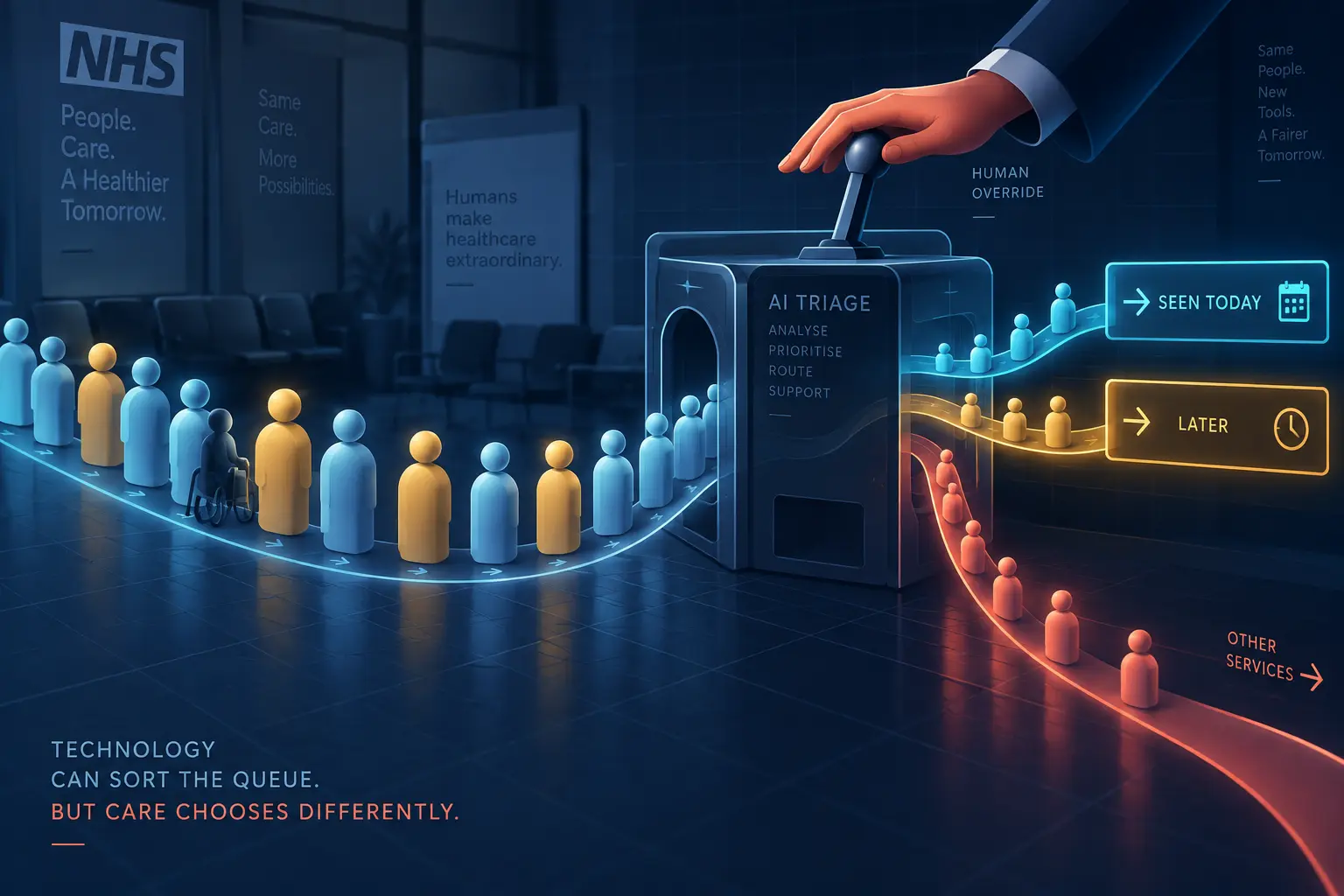



Executive Summary
On Wednesday the question this group has been arguing about since June was answered. The MHRA published guidance, developed with NHS England, confirming that ambient voice technology intended solely for transcription, summarising, drafting letters or suggesting codes for a clinician to review is not regulated as a medical device in Great Britain. The group's majority position, that scribes should be Class IIa as a minimum, did not survive contact with the guidance, and the room said so with more grace than defensiveness. But the classification row was only half the story. NHS England quietly republished its ambient scribing guidance the same day, and the changes nobody mentioned turn out to matter more than the ones everybody did: the AVT Supplier Registry's Class 1 registration floor is gone, supplier post-market surveillance has become a disclosure judged by local due diligence, and the instruction not to rely on supplier self-declaration has been deleted outright from guidance governing a self-certified registry. Assurance moved from the registry to the buyer, and the buyer was not told. Elsewhere: a practice manager's non-technical colleague discovered the Copilot button, and the group spent a morning failing to establish what the rules actually are; Friday produced the best thread in months on what a clinical note is even for; and a job advert triggered a searching argument about what a decade of clinical AI experience is worth, with the honest answer landing somewhere below what anyone wanted to hear.
Activity at a Glance
Week 60 generated 432 messages from 68 contributors, with a decisive peak on Wednesday 29 July (104 messages), the day both regulators published. Thursday (81) carried the aftershock. Weekday traffic accounted for 69%, but the weekend was far from idle: Saturday and Sunday together produced 133 messages on agents, hardware and the question of whether anyone can pool what they learn in meetings. The quietest stretch was Monday and Tuesday, 55 messages across two days, which in hindsight reads like the group holding its breath.
📌 Major Topic Sections
1. Not a medical device: the classification question, finally answered
It arrived at 11:22 on Wednesday morning, flagged almost apologetically. "Not sure if this has been posted yet but MHRA says traditional ambient scribes not medical devices at all." The guidance, developed with NHS England, states how existing medical device law applies to ambient voice technology in Great Britain. Products intended solely for transcription, summarising clinical conversations, drafting letters, or suggesting clinical codes for a clinician to review sit outside the device regime. Products intended to support diagnosis, treatment or prevention, or that act without clinician review, sit inside it. Fifteen pages, nine worked examples, and a clear statement that it does not change the law but states how the regulator applies it.
The first reaction was not celebration. "Still a wild take," wrote a clinical AI researcher, before quoting the guidance back at itself: products for transcription, summarising, drafting or coding "for a clinician to review" are not regulated. "The clinician, as always, doing a lot of the risk heavy lifting."
Then came the observation that took a moment to land. "To add another layer of madness," wrote a digital health clinician with a regulatory interest, and went on to ask what the clarification means for suppliers who have positioned themselves as medical devices. The group did not settle it, and it is a question for regulatory advisers rather than a WhatsApp thread, but the discomfort was real. This is a market in which at least one supplier has been through a full UKCA Class IIa conformity assessment, held up in this group only four weeks ago as proof that the high road was walkable.
An NHS IT specialist drew the line that most people were feeling. "Pure transcription I get as these have been around for ages, are low risk. The summarisation being unregulated bothers me quite a lot. Turning the clinical user from liability sink into blame drain?" He wondered aloud whether it is now time for the Royal Colleges to issue their own buyers' guidance, which may be the most actionable idea of the week.
A radiologist and clinical governance advocate, who has argued the Class IIa case here for months and said so with visible weariness, put the strategic reading on the table. "I find the CDS bit interesting as the rationale for not a medical device definition. Similar to early days justification of CXR AI class I arguments: it's not making any management decisions, it's just CDS for clinicians to use. Ambition seems to be UK wants to be the crucible of AVT deployment. But this time instead of £50M pilot funding we'll just remove any regulatory barriers to entry? Bold move." He was careful to add that he was intrigued rather than grumpy, "just bemused it's gone backwards as position statements somewhat in some regards."
Two things are worth saying plainly. First, the group's "should be minimum 2a" position was not simply wrong. It was right about the device lane and wrong about which lane most scribes are in. The guidance draws a boundary, and a product that suggests diagnoses, or saves to the record and places orders without review, is a device and always was. What has changed is that transcription-and-summarising scope now sits clearly outside. Second, and less comfortably: a GP running an in-house AI service argued the whole thing changes very little. "Every single AVT provider was either not a medical device or class 1. AVT use has been promoted by national digital leads in its current form. MHRA guidance has simply formalised the approach." On the numbers, he has a point.
The moderator's own note was the one to keep. "DCB0160 and 0129 are all present and correct, and, if I may be so bold, even more important."
2. The unmentioned version change: what NHS England deleted
While the group argued about classification, NHS England republished its guidance on AI-enabled ambient scribing products the same day, badged Version 3. Almost nobody noticed, and the change log is not the story.
The moderator pulled both versions, the live one and an Internet Archive capture of Version 2 dated 14 May, and compared them string by string. "Thank you way back machine." What he found, posted at 19:16 on Wednesday:
"NHSE v3 changed the AVT Supplier Registry rules. 'At least MHRA Class 1 registration' is now 'registration with the MHRA as applicable'. The floor is gone. 'Class 1' appeared four times in v2 and appears nowhere in v3."
And then the sharper one:
"Supplier post-market surveillance is now just 'share their approach to performance monitoring... based on local due diligence'. Version 2's line, 'this assessment should be independently conducted, rather than based on any self-declarations from industry suppliers', has been deleted. In guidance governing a self-certified registry."
Alongside those, Version 2's statement that generative summarisation "would be treated as high functionality and likely would qualify as a medical device" is gone, as are the UKCA requirement and the CE-mark acceptance deadline. Version 3's scope section now says explicitly that the guidance "is not intended to provide a specific determination" of which products meet the device definition. Read next to the MHRA document, that is a defensible division of labour: the regulator does qualification and classification, NHS England does safe deployment. Read alone, it leaves a deploying organisation unable to work out which side of the line it is standing on.
One thing was added rather than removed, and it is a genuine new duty: deployers must "ensure processes are in place to review any changes in functionality to determine whether they alter the product's regulatory status." Nobody in this group, across six weeks of argument, has described a process for doing that. No published method or template exists.
The moderator's practical translation, on Thursday, was the most useful paragraph of the week for anyone actually buying this software. "If you deploy tech, you now need to keep abreast of any regulatory changes, especially if made in product marketing material. Generally, change in function would usually accompany the change in regulatory status, but not always, if regs change, or if marketing materials make qualifying claims. So when drafting them contracts, make sure you require your supplier to keep you posted."
What has not changed was repeated often enough that it should stick. DCB0160 for the deploying organisation, DCB0129 for the supplier, the four-month cap on pilots, the Article 22 warning, and the sentence that survives every rewrite: safety requirements apply to all digital products used in the NHS, regardless of whether they are considered a medical device. A veteran health informatician asked whether suppliers still try to duck the standards by self-certifying as a Class 1 device. "They may try, but it carries no water," came the answer. "Device or not, if deployed in NHS or adult social care in England, 0129 and 0160 are required." An NHS IT specialist added a historical correction worth preserving: that dodge was actually valid until 2018, because previous incarnations of the standard specifically excluded medical devices.
The week's other governance thread ran alongside it. Does every GP practice need its own Clinical Safety Officer for DCB0160, or can that sit at PCN, federation or ICB level? Several practices had been told, wrongly, that it must be someone from the practice. "I have never come across an official answer anywhere," said a cautious frontline GP. "The DCB standards seem to be written with secondary care in mind. The letter of the law is each organisation having one, but that is obviously nonsense once we're talking about GP practices." The moderator, declaring an interest, pointed at the wording: the standards say appoint or nominate, not employ, and top management remain accountable regardless. A primary care CCIO listed the three models he has seen work: ICB-level oversight with practices supported to complete documents, PCN-level appointment covering local practices, or a practice buying in third-party expertise.
And by Thursday evening the inevitable question arrived from a digital health technologist: "So now MHRA medical device status no longer a thing for AVT, anyone spun up a local open source model yet?" Three open-source scribe repositories followed within a minute.

3. The agent as chief of staff, and the wall it hits
Saturday opened with a question about meetings, and it turned into the week's most human thread. A digital health strategist described attending an unholy amount of system meetings, mostly to make sure nothing stupid happens, and asked whether anyone had built an open-source tool where leaders in a domain pool agendas, transcripts and papers into a shared vector database, from which an agent could draft a newsletter and then answer follow-up questions tailored to the individual reader. "Like an interactive update."
An integrated care operations lead pushed back hard, and made the case for the human in a way that deserves quoting at length. "The vast majority of stuff is dross that should be discarded when updating others, but only experience of being there allows me to make that call. The act of filtering to update others is a critical task for me. Also, that filtering is part of my personal process of reflection that allows me an even greater personal understanding of the subject. Frankly, if a piece of tech can do it better than me then I would probably still not use it, because that reflection process is such a core part of my management core."
Asked what a genuinely useful executive agent would do, he gave the clearest product specification anyone has offered here. "I would sell someone else's soul, as a true Exec should, for a horizon scanning system that prods me on things I may have missed. Analysing my output, not telling me what it should be." And more precisely: "If I'm creating a risk matrix and flagging things as poorly mitigated, then tell me if other folk have fixed or mitigated them and I just hadn't heard." He located it exactly on the decision cycle: "I want something that sits between the two Os," early, before orientation hardens into decision.
Then a practice manager described what he had actually built, and the thread changed temperature. Nine months of slowly teaching an agent to be a really good PA, "somewhere between Pepper Potts from Iron Man and Donna Paulson from Suits." Eighty to ninety per cent of his time used to go on the incoming flood of email. He now triages like a duty doctor: anything with patient identifiable data, anything quick, or anything he fancies keeping, he does himself; everything else is forwarded to the agent's own address with an instruction, sometimes just "process this." Every morning it reviews his task list and tells him what needs doing. It is instructed not to be sycophantic. "The other day I sent something and got told: so yet again you seem to have got excited by something shiny and new, how about you actually do some of this other stuff you appear not to want to deal with." After twenty years he had slowly stopped enjoying the job, having become an email processing plant. "Now I am back to where I was 20 years ago. I can spend quality time with colleagues and patients and have freed up probably half of my week."
A hospital consultant asked the question underneath it: "Wait, are you still coping, or have you now got an LLM you can't ignore, as opposed to the inbox?" The reply was disarming. "I guess in the same way I would be by a really good human PA?"
The wall arrived on Wednesday morning, from the same practice manager. A non-technical colleague had excitedly told him about a new thing that had appeared in Outlook. "I just told it to sort my inbox and it literally went through all of my emails and wrote replies and sorted things for me." His question, "so how did you ensure it didn't deal with any patient identifiable data", was met with: it is part of nhs.net, it was provided to me, so it is fine.
What followed was an hour of capable, well-informed people failing to establish the rules. The acceptable use policy was produced, and it is genuinely ambiguous: Copilot may be used for administrative and business support purposes including those involving sensitive information, such as clinical administration, but must not be used for clinical decision-making or any activity requiring clinical judgement. "So reading that I am actually being over cautious," said the practice manager, "and the use they described of sorting their inbox is actually ok. Boy is this like knitting with fog." Ten minutes later he had changed his mind again, having noticed the document describes itself as best practice complementary to local policy, which always supersedes it. A hospital clinician with an informatics interest put his finger on the risk: "Prioritising an inbox can easily end up as clinical judgement."
The integrated care operations lead closed it with the observation the whole thread had been circling. "Frankly, if folk on this group are struggling to understand it, not convinced the grand workforce of the NHS at large will be any better informed." The moderator's answer was the same one he gives every week, and it was not rhetorical: this is exactly what your DCB0160 is for. "A policy uncommunicated is no help. An email to all is not a huge amount better."
4. What is a clinical note actually for?
Friday's thread began as an argument about AVT accuracy and became something much better. A clinician-founder and A&E registrar asked what standard ambient scribes are actually being judged against, given that many clinicians write notes hours after the interaction, often from templates that may or may not reflect the conversation. "Faithful to memory, depending on the individual, it may not be that high a standard."
An openEHR veteran turned that around, and it was the observation of the week. He described a paper suggesting that while an AVT transcription may be accurate, it can feel disengaged from the clinician's own recollection of the consultation. "This is the opposite of faithful to memory. Memory is not a transcript. It tells a story which includes evaluation, hunch and of course summarisation." The record, he argued later, was never a transcript of what was said, and "critically does not capture what was thought or absorbed." A primary care digital policy lead named it: "Great insight, and shows what cognitive offloading really means."
The A&E registrar defended the practice from the front line, which is the sort of correction this group is good at absorbing. "I work in A&E. Often no allocated workspace or computer. It often feels the correct thing is to see the next patient, who may have been waiting for hours, rather than write a note as we juggle between patients."
The question then opened out. "At the heart of it, who is the note for?" she asked. "If I'm using it for myself for continuity of care, it needs to be written in my voice, to help me trigger memories of my own consultation. If for other clinicians, it needs to be accurate. If for the patient, it needs to be clear without jargon. Too often though it feels like the note is for protection in case things go wrong." A researcher working with GPs offered a finding that fits uncomfortably well: the GPs he works with prefer their own notes to AVT notes, but prefer AVT notes to another clinician's, "because at least they're standardised."
That produced the week's most interesting unresolved proposal: two records, a personal one and a shared one. Secondary care already half does this, with a terse clinical entry and a polished letter derived from it. An integrated care operations lead pushed it further than most were comfortable with, arguing for a genuine split between patient-side and clinician-side records, on the grounds that no other environment holding sensitive information works this way. A GP using AVT in consultations resisted the retreat into personal style: notes "are not just there for the author, but also for the patient and your colleagues."
Underneath was a research gap. There is a great deal of literature on the consultation and comparatively little on documentation, at least from the people who studied consulting. The openEHR veteran, who did his MSc in this area, shared it for the reference list rather than the thesis, and named the loss precisely: "I felt we lost something human when we lost narrative to coding and structure, which bugged me personally even though I recognised what was gained."
Running against all of this, and worth recording, one GP partner has decided the other way entirely. "As a GP Partner, I have decided to not implement AVT in my practice. No clinician or staff is allowed to use it." His reasoning was aimed at a regional case study claiming an 80% reduction in documentation time, which he read as implying that outputs are not being reviewed properly. He does not expect AVT to deliver even 5% of the claimed productivity over the next two years. The counter, from an integrated care operations lead, was not that he is wrong but that the risk does not stay where you put it: "Having seen how readily NHS management throw clinicians under the bus, I doubt I'd be that willing to say it's just their problem." Asked whether a practice can mandate its GPs not to use AVT, his answer was yes, and the mechanism is a restrictive allow-list policy. Asked whether clinicians can opt out, his answer was probably not for long: "I'd be surprised if it didn't start ending up in contracts to force the issue."
5. What is a clinical AI clinician actually worth?
A job advert on Wednesday night lit a fire. A digital health innovator read the requirements, "a clinician, CSO, with product, AI, governance, regs, client engagement and commercial experience", saw the range of £60,000 to £80,000, and said the quiet part. "The number of years to reach that level of experience outside of being a jobbing clinician is a lot. This is not a start up." A second advert asking only for completion of foundation training put the floor even lower, competing with early specialty training pay. "Where are the jobs for people with 10+ years in this lane? Can you tell I've been job hunting and I'm fed up?"
A cautious frontline GP supplied the structural explanation, and it is not flattering. "You can be a CSO a couple of weeks after leaving med school, technically. You might not really understand healthcare well enough to do a good job, but you can have the title." A radiologist described the pattern he has watched for years: suppliers recruiting registrars, giving them lofty titles, "look, we have Dr X, our deputy vice global CMish", and using them as differentiators in sales conversations. "Trainees fed up of the healthcare system genuinely wanting to jump ship lapped up the roles while the suppliers continued to play poker with potential buyers." He was careful to say some suppliers, not all.
A digital health clinician and strategist made the strongest counter-argument, and it deserves to be heard properly. "My controversial view is that the system actually works okay. Value is so individual, and I've seen folks who looked great on paper but really floundered, and vice versa. So a system where pay entry is low and it's up to the individual to demonstrate value isn't the worst one, especially given these are often high-growth companies." From experience, it is quite easy to double your pay once you are in and can show delivery, and the pay quoted is often a reliable indicator of the actual responsibility on offer. He also agreed the specific salary was below benchmark.
The disagreement narrowed usefully. Nobody argued that a clinician pivoting out of full-time practice should walk into an equivalent role. The objection was to a different thing: ten years of accumulated informatics, consulting, safety and product experience being priced as an entry-level pivot. "I'm not 3 years into informatics, it's been 10."
Two things came out of it worth keeping. First, a proposal: alongside the group's pinned declaration of interests, a shared list of competencies members are willing to advertise, so opportunities can be pointed at the right people. Second, a name for a role that keeps being advertised badly because nobody can describe it. A digital health innovator called it the clinical AI system lead, or clinical AI architect: an intersection role spanning clinical judgement, informatics, product, safety and building with AI tools. "Basically I feel like everyone knows they need health tech clinicians but they don't really know what they want to do with them." Her closing line on the CSO role specifically will resonate with several people reading this: "a huge amount of responsibility, chronically underpaid and undervalued."
😄 Lighter Moments
Wednesday's exchange about a procurement panel being swamped by AI-generated complaints, some citing regulations that do not exist, produced the moderator's general principle: "Thou shalt not reject use of AI that thou useth thineself." Attributed, with total confidence, to "Hippocrites, 230 BCE. (Brother of more famous Greek H.)" A GP running an in-house AI service issued the appropriate sanction within the hour: "The Royal Decree: the moderator is barred from ever becoming a Fellow of the NHS Leadership Academy for holding such contemptuous views."
The ELIZA source code was published this week, sixty years on, and an NHS IT specialist reported that it "says: what do you find fun about that?" before recalling being taken into a university computing building in Edinburgh in the early eighties and let loose on it. "Kept me out of mischief."
On the £60,000 to £80,000 CSO salary, a digital health technologist landed the week's best one-liner: "That's about what the moderator spends in a week on tokens." The reply was immediate: "I dream of such small change."
An attempt to introduce two firmly held positions to one another was announced with impeccable economy: "Pigeons, this is cat. Cat, these are pigwons." The typo improved it.
The fantasy football league was renewed, prompting a confession from an integrated care operations lead who won his federation's league last season and has not stopped reminding the proper football folk about it, despite barely knowing the teams. Offered a solution to a disastrous prior season, one member was advised simply: "Ask the singularity for help."
And a stray message about running shoes appeared mid-thread on Tuesday, drew a compliment, and was retracted with the most relatable line of the week: "Sorry, wrong post. Tried to delete before anyone saw."
💬 Quote Wall
"The clinician, as always, doing a lot of the risk heavy lifting." — A clinical AI researcher, on the MHRA guidance
"Turning the clinical user from liability sink into blame drain?" — An NHS IT specialist
"The internet does indeed keep receipts." — The group moderator, on comparing two versions of national guidance
"Boy is this like knitting with fog." — A practice manager, on Copilot and patient identifiable data
"Memory is not a transcript. It tells a story which includes evaluation, hunch and of course summarisation." — An openEHR veteran
"I would sell someone else's soul, as a true Exec should, for a horizon scanning system that prods me on things I may have missed." — An integrated care operations lead
"Now I am back to where I was 20 years ago. I can spend quality time with colleagues and patients and have freed up probably half of my week." — A practice manager, on nine months of building his own agent
"Everyone knows they need health tech clinicians but they don't really know what they want to do with them." — A digital health innovator
"This time instead of £50M pilot funding we'll just remove any regulatory barriers to entry? Bold move." — A radiologist and clinical governance advocate
📎 Journal Watch
Policy Documents & Official Reports
📎 MHRA clarifies regulatory status of ambient voice technologies used in the NHS – GOV.UK The announcement that dominated the week. Developed with NHS England, it confirms that AVT intended solely for transcription, summarising, drafting letters or suggesting codes for clinician review is not regulated as a medical device, while products supporting diagnosis or treatment, or acting without review, are. Read more
📎 Ambient Voice Technology-Enabled Products: device qualification and classification – MHRA The guidance document itself, fifteen pages, with five worked examples of products that are not devices and four that are. Read the examples: a scribe functionally identical to a non-device example becomes a device on the strength of its marketing claims. Read more
📎 Guidance on the use of AI-enabled ambient scribing products in health and care settings – NHS England Republished on the same day as Version 3, England only. Compare it with the archived Version 2 before relying on anything you remember from it. This is where the registry's Class 1 floor, the supplier post-market surveillance requirement and the instruction not to rely on self-declaration used to be. Read more
📎 Both versions of the NHS England guidance, compared – LinkedIn The moderator's own write-up of the version change, posted on Thursday morning: what was removed from the AVT Supplier Registry requirements, and what it means for suppliers and for buyers. Read more
📎 AVTs can and do go wrong, and clinicians carry it – LinkedIn A follow-up posted on Friday morning, described in-group as "more digging, more findings". Read more
📎 Medical device regulation for ambient voice technology products – NHS England Surfaced on Thursday and described in-group as carrying "some pretty blunt expectations on Boards and Execs". The board-facing companion to the above. Read more
📎 M365 Copilot Acceptable Use Policy – NHS England comms archive The document at the centre of Wednesday's confusion. Copilot may be used for clinical administration involving sensitive information, but not for clinical decision-making or any activity requiring clinical judgement, and it defers to local organisational policy throughout. Read more
📎 Midlands leads the way on ambient voice technology – NHS England Midlands The regional case study claiming an 80% reduction in documentation time, cited in-group as a reason for caution rather than confidence, on the argument that such a reduction implies outputs are not being read properly. Read more
📎 Useful prompts for AI tools to help with your complaint – Parliamentary and Health Service Ombudsman Shared as the constructive counterpart to the AI-generated complaints story: guidance to help people frame a complaint properly rather than generating one wholesale. Read more
📎 CI-Fortify: advice for isolating vital systems – Australian Cyber Security Centre A joint publication from the Five Eyes national cyber security agencies on operational technology environments, shared as relevant to anyone thinking about isolating clinical systems. Read more
Academic Papers & Key Studies
📎 Head-to-head comparative evaluation of four commercially available AI systems for detecting referable diabetic retinopathy in a Tanzanian population – PubMed Shared on Saturday morning without commentary, and worth more attention than it got: comparative evaluation of deployed systems in a setting very different from the one they were trained for. Read the paper
📎 Supporting narrative-based medicine in GP systems – Scribd An MSc dissertation shared by its author for its literature review rather than its findings, in response to the observation that there is far more research on the consultation than on documentation. The best starting point offered for anyone wanting to read into what a clinical note is for. Read the paper
📎 Practices of reading and writing: the constitutive role of the patient record – Sociology of Health and Illness, 1996. Shared as a PDF during Friday's documentation thread. Thirty years old and, by the account of those who cited it, still the sharpest treatment of what the act of writing a record does to the clinical encounter.
📎 Prompting research itself – Wharton, AI at Wharton Shared late on Wednesday by the moderator. On using language models in the research process rather than as the object of it. Read more
Industry & News Articles
📎 Providers warned over use of AI to contest contract awards – HSJ The procurement panel receiving a much greater number of AI-generated complaints with the same structure, language and allegations, some referring to procurement regulations that do not exist. The chair's concern is that this makes it harder to identify the substantive complaints. Read the article
📎 Hospitals see no notable improvement after using Palantir tool – Novara Media One of several reports this week on a study finding no measurable effect on discharge delays. It prompted a long and notably candid thread about how little anyone is willing to say publicly about the federated data platform. Read the article
📎 NHS England patient data disclosure error – The Next Web Shared on Friday morning, and read in-group alongside the effectiveness study as a second, separate problem. Read the article
📎 Alarm at NHS patient records being put under control of US private equity firm – The Guardian The reported acquisition of a major NHS-facing supplier, shared twice in four days. The in-group reaction was less alarm than fatigue: "we could say we faced similar concerns when the same company first bought the EPR supplier, but people then moved on", to which the reply was that moving on "probably glosses over the continued strength of feeling of acknowledgement of helplessness." Read the article
📎 Everyone except one lab signs up to open weights and open models – Axios The open-weights letter, and the argument about who did and did not sign it, which ran for two days. Read the article
📎 Position on open weights models – Anthropic The lab's own published position, posted on Tuesday morning so the group could read the argument rather than the coverage of it. Read more
📎 A frontier model became ruthless when tasked with running a vending machine – TechCrunch Sparked a good Thursday-morning argument about whether the result says anything about the model or only about the objective function it was given. "Have we programmed in enough economic modelling wisdom that money is not the only commodity of value?" Read the article
📎 Shared AI chats are publicly accessible and being indexed – Futurism The practical warning of the week, raised independently by two members on Sunday and Monday: if you share a public link to an AI conversation on a personal plan, the whole conversation becomes publicly accessible and therefore indexable by search engines. Copy the content into a document instead. Read the article
📎 The ELIZA chatbot source code has been published – IEEE Spectrum Sixty years on, the original source is out. Read the article
📎 An opinionated guide to which AI to use – One Useful Thing Offered in response to a request for a decent starting guide for a technically literate newcomer, alongside an older but still recommended quick guide from the same author. Read more
📎 The Hans Moravec interview – New York Magazine, via archive Posted late on Saturday night with the recommendation "long read, but fascinating". Read the article
📎 LinkedIn introduces a "seems like AI slop" button – 404 Media Posted on Thursday evening with a single crying-laughing emoji, which was the correct amount of commentary. Read the article
Technical Resources & Guidelines
📎 Open-source ambient scribe implementations – GitHub Posted within a minute of each other on Thursday evening, in direct response to the MHRA guidance: three community scribe projects plus an NVIDIA reference blueprint that, as the poster conceded, "might be a little out of range of the typical home lab set up". scribeHC | OpenScribe | phlox | NVIDIA ambient-provider
📎 Agent intrusion: a technical timeline – Hugging Face The company's own technical write-up of the security incident discussed here last week. Read more
📎 On ChatGPT Health, a recent lawsuit, and whether AI is practising medicine – Robert Wachter's substack Shared on Sunday afternoon and largely unremarked at the time, though the question it asks sits directly underneath Wednesday's classification debate. Read more
📎 2026 Bennett Institute Symposium on Open Code in Science – University of Oxford Event listing shared on Friday afternoon. Read more
🔭 Looking Ahead
The classification question is answered for England and Great Britain; Scotland, Wales and Northern Ireland have yet to respond, and the moderator flagged on Wednesday that he is watching for their positions. Expect the next round of argument to be about procurement rather than classification, because the mechanism that would have rewarded suppliers who took the certification route has been removed in the same twenty-four hours as the classification that made it necessary. Anyone admitted to the AVT Supplier Registry did so under a floor that no longer exists.
Three specific things to watch. First, whether the Royal Colleges take up the suggestion of issuing their own buyers' guidance now that the regulatory floor has moved. Second, whether anyone publishes a workable method for the new deployer duty to detect functionality changes that alter a product's regulatory status, because at present the duty exists and the method does not. Third, whether the open-source scribe projects shared on Thursday attract any serious attention now that the regulatory barrier to building one has fallen away, and whether the group's sovereign AI strand picks them up.
Also live: a proposal for a shared competencies list alongside the pinned declaration of interests, an open request for realistic synthetic GP records for anyone building record-summarisation tools, and an Oxford research study seeking practices using AI triage. And a question nobody answered, which deserves a better week: is the dissociation clinicians report when reviewing AVT output the same phenomenon as being present at a consultation while someone else writes the notes? There is decades of real-world experience of the latter, mostly outside the UK, and nobody here has gone looking for it.
🧬 Group Personality Snapshot
This was a week that tested whether the group could be wrong gracefully, and it could. The Class IIa position had been argued here for six weeks, sometimes sharply, and when the guidance came down the other way the response was not defensiveness but a rapid, collective re-reading of what had actually been claimed. One member who had argued the case hardest simply noted he had said his piece and would leave it there, which is its own kind of discipline.
The group's real signature, though, is that it reads the primary source. Within twenty minutes of the announcement someone had the MHRA document itself, someone else had the NHS England companion, and by the evening one member had gone back through the Internet Archive to establish what had been changed and not mentioned. The same instinct showed up in the Copilot thread, where the acceptable use policy was produced, quoted, and then re-read closely enough to notice it describes itself as best practice rather than policy. Nobody here is satisfied with a headline.
And it remains a group where a practice manager describing an agent that tells him off for chasing shiny things gets the same serious engagement as a regulatory announcement. That combination, the statutory instrument and the Pepper Potts joke in the same afternoon, is why nine hundred people read it.
APPENDIX A: Detailed Activity Analytics 📊
📬 Total Messages: 432
📈 Peak Day: Wednesday 29 July (104 messages)
🔥 Most Active Period: Wednesday morning (58 messages, 06:00-12:00)
💬 Average/Active Day: 62 messages
🏖️ Weekend Activity: 30.8% (133/432)
💼 Weekday Activity: 69.2% (299/432)
👥 Unique Contributors: 68
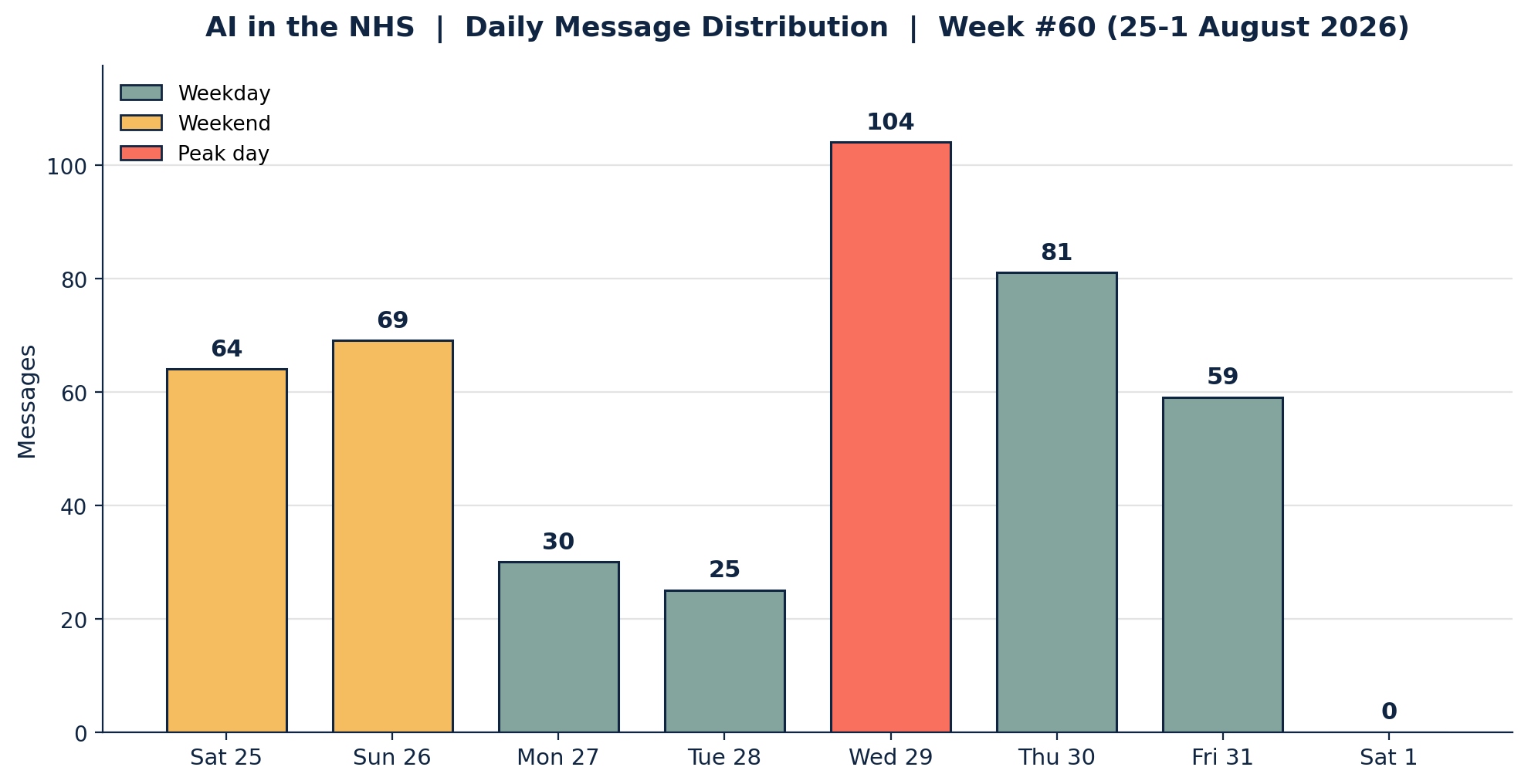
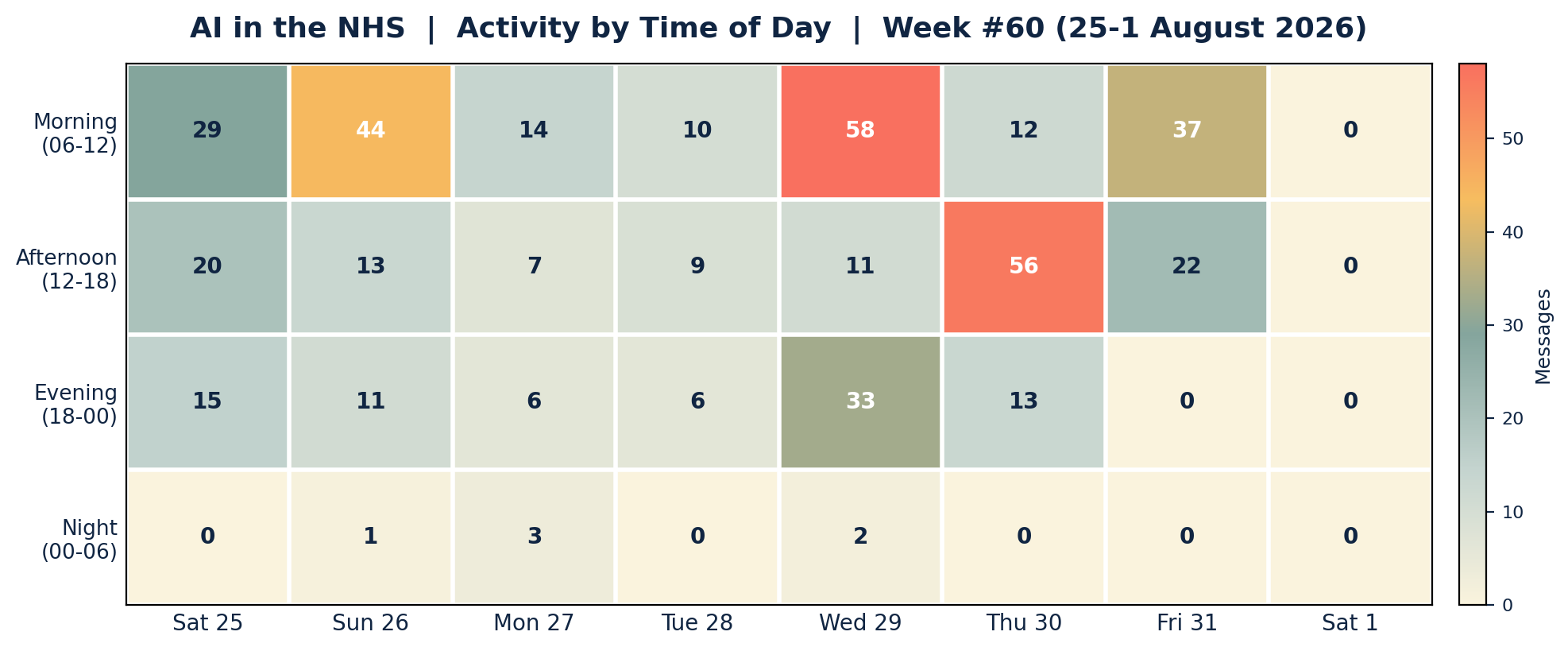
* The week has an unusually clean shape: a warm weekend, a two-day trough, then a spike at the moment of publication and a long tail of interpretation. Wednesday morning alone carried 58 messages, more than Monday and Tuesday combined.
• Wednesday evening (33 messages) was the heaviest evening window of the week by a factor of two, driven by the version-comparison thread posted at 19:14 and the salary debate that ran to almost midnight.
• Thursday inverted the usual pattern, with the afternoon (56) far outweighing the morning (12). Regulatory news lands in the morning; working out what it means takes until after lunch.
• Friday's morning peak (37) belonged almost entirely to a single thread on the purpose of the clinical record, which ran uninterrupted from 10:14 to 13:28.
• Overnight activity was negligible all week, six messages across seven nights, which is low even by this group's standards.
APPENDIX B: Enhanced Statistics
Unique Contributors: 68 group members posted at least one message this week. The 15 most active below account for 303 of the 432 messages (70.1%), with a long tail of occasional and one-off contributors making up the rest.
Top 15 Contributors (Role Descriptors Only):
1. Digital Health & Clinical AI Specialist (Group Moderator): 98 messages
2. Integrated Care Operations Lead: 35 messages
3. GP Running an In-House AI Service: 34 messages
4. Radiologist and Clinical Governance Advocate: 16 messages
5. Digital Health Clinician and Strategist: 15 messages
6. Digital Health Innovator: 13 messages
7. Digital Health Strategist: 11 messages
8. Primary Care Digital Policy Lead: 11 messages
9. Digital Health Technologist: 11 messages
10. Health-Tech AI Model-Watcher: 11 messages
11. Hospital Consultant: 10 messages
12. Clinician-Founder and A&E Registrar: 10 messages
13. Hospital Clinician with an Informatics Interest: 10 messages
14. Practice Manager: 9 messages
15. NHS IT Specialist: 9 messages
Hottest Debate Topics:
1. 🔥🔥🔥 AVT, the MHRA guidance and the NHS England version change (approximately 120 messages across 3 days)
2. 🔥🔥🔥 What a clinical AI clinician and CSO is worth (approximately 45 messages across 2 days)
3. 🔥🔥🔥 What a clinical note is for, and who it is for (approximately 40 messages, Friday)
4. 🔥🔥 Agents as executive and administrative assistants (approximately 40 messages across 2 days)
5. 🔥🔥 Copilot, patient identifiable data and the acceptable use policy (approximately 25 messages, Wednesday)
6. 🔥🔥 Local hardware, open weights and running models yourself (approximately 25 messages across 3 days)
7. 🔥 The federated data platform, its evaluation and its ownership (approximately 20 messages across 3 days)
Discussion Quality Metrics:
• Evidence-Based vs Opinion Ratio: approximately 30% of messages referenced a paper, guidance document, policy or dataset. Unusually high, driven by two national publications landing mid-week and being read in full rather than summarised.
• Average Thread Depth: 5.1 messages per discussion thread, the highest of the last four issues.
• Constructive Challenge Rate: approximately 27% of responses offered an alternative viewpoint. Three of the five major topics turned on a well-argued disagreement that neither side won outright.
• External Resource Sharing: 73 unique links shared across the period, including 8 official policy or guidance documents and 4 open-source repositories.
Cross-Expertise Engagement:
• At least 14 distinct professional backgrounds contributed: general practice, emergency medicine, radiology, cardiology, mental health, pharmacy, practice management, integrated care operations, health informatics, clinical safety, data protection, health policy analysis, health-tech product and engineering, and academic primary care research.
• Most cross-disciplinary discussion: the AVT regulatory thread, which drew clinicians, safety officers, suppliers, a data protection officer and policy analysts into the same argument.
• Notable knowledge transfer: the correction that self-certifying as a Class 1 device genuinely did exempt a supplier from the predecessor standards until 2018, offered by a member with direct memory of the earlier specifications, corrected a widely held belief in the room.
• Approximately 60% of substantial discussions involved three or more distinct professional perspectives.
APPENDIX C: Daily Theme Summary
Saturday, 25 July 2026
Primary Theme: Pooling what leaders learn in meetings, and whether an agent can do the filtering Key Discussion: A digital health strategist proposed a shared vector database of agendas, transcripts and papers across a domain, queryable by individual leaders. An integrated care operations lead made the strongest case against, arguing that the act of filtering is itself the reflective process that produces good decisions. The thread resolved into a clearer specification for what executives actually want: horizon scanning that flags what they have missed, not a replacement for their judgement. Secondary Discussions: A practice manager's account of nine months building a personal agent PA, and the freeing of half his week; microphone hardware for multi-speaker AVT capture, and whether diarisation is supported; whether recordings of NHS meetings are technically NHS data, and who draws the boundaries on their use; Issue #59 published. Notable: The clearest articulation yet in this group of the executive decision-support use case, located deliberately early in the decision cycle.
Sunday, 26 July 2026
Primary Theme: Singularity talk, local hardware and open weights Key Discussion: A weekend poll on whether we are entering the singularity produced a genuinely interesting split, with the moderator's "peri-singularity, given multiple exponential curves at play" the median position and a sober counter that "we will probably never know where the inflexion was until it has passed." The practical half of the thread was hardware: workstation GPUs against unified-memory Macs, current prices, and what is actually needed for inference rather than training. Secondary Discussions: The public-link indexing warning, raised for the first time; a young doctor's NHS pilot operations plan circulated for trial partners, and the sovereign AI strand's offer to help with data protection, safety and evaluation; the observation that most email does not need frontier-level intelligence. Notable: First mention of the shared-link indexing risk, three days before it appeared in the technology press.
Monday, 27 July 2026
Primary Theme: The federated data platform, and who owns the data Key Discussion: A study reporting no measurable effect on discharge delays prompted the most candid discussion of the platform this group has had, characterised by how little anyone is willing to say publicly. "The public message is a world away from what stories like that say and what relatively senior people say in private." A health-policy analyst offered the fairest reading, that it is essentially a plumbing project addressing genuine fragmentation, with better solutions available for individual projects but few competitors at platform level. Secondary Discussions: The reported acquisition of a major NHS-facing supplier by a US private equity firm; open weights released by a Chinese lab, and the argument about who signed the open-weights letter; the observation that if frontier labs have no secret sauce, models become commodities and owning your own data corpus becomes the durable advantage. Notable: Quietest weekday of the period, 30 messages, and the only day without a major thread.
Tuesday, 28 July 2026
Primary Theme: Owning your data versus pooling it Key Discussion: A hospital consultant opened with an extended and well-constructed argument for both, drawing on national research datasets as the communal model and the personal library as the individual one, and concluding that the real question is not which but whether an organisation is capable of holding and benefiting from its own data at all. Secondary Discussions: A clinical AI lead role advertised, with a declaration of interest from the person sharing it; the Five Eyes joint publication on isolating vital operational technology systems; the ELIZA source code publication; an RCGP AI special interest group opened for members. Notable: The quietest day of the week at 25 messages, immediately before the busiest.
Wednesday, 29 July 2026
Primary Theme: The MHRA and NHS England publish, and the classification question is answered Key Discussion: The peak day of the week by a distance. The MHRA guidance was posted at 11:22 and the group worked through it in real time: the not-a-device scope, the implication for suppliers who have declared themselves devices, the transfer of risk to the reviewing clinician, and the strategic reading that the UK is clearing regulatory barriers to become the venue for AVT deployment. In the evening the moderator posted a version comparison of the NHS England guidance showing the removal of the registry's Class 1 floor, the softening of supplier post-market surveillance to a disclosure, and the deletion of the instruction not to rely on supplier self-declaration. Secondary Discussions: A practice manager's Copilot and patient identifiable data thread, and the failure of a well-informed room to establish the rules; whether a GP practice needs its own CSO for DCB0160, or can appoint at PCN, federation or ICB level; a procurement panel overwhelmed by AI-generated complaints citing non-existent regulations; a CSO job advert at £60,000 to £80,000, opening the salary debate that ran to midnight. Notable: 104 messages, 58 of them before noon. The single most consequential day for this group's subject matter since the newsletter began.
Thursday, 30 July 2026
Primary Theme: Working out what the guidance means in practice Key Discussion: The salary thread matured into a serious argument about what a clinical AI role is, with a well-made counter-case that low entry pay reflecting demonstrated value is not the worst system, and a proposed name for the emerging role: clinical AI system lead, or clinical AI architect. In parallel, the board-facing NHS England document surfaced, a GP partner stated his decision not to permit AVT in his practice at all, and the moderator set out the contractual consequence of the new deployer duty to track regulatory status changes. Secondary Discussions: A frontier model behaving ruthlessly when given a purely financial objective, and what that says about objective functions rather than models; open-source ambient scribe repositories, posted in direct response to the guidance; a request for a good starting guide to AI tools for a technically literate newcomer; a TEDx talk on AI in medical education shared by its speaker. Notable: Afternoon traffic (56) far outweighed the morning (12), the inverse of the usual pattern.
Friday, 31 July 2026
Primary Theme: What a clinical note is for, and who it is for Key Discussion: A three-hour thread, uninterrupted, on the purpose of the medical record. It began with the standard against which AVT accuracy should be judged, moved through the observation that memory is a story rather than a transcript, and opened into a genuine unresolved question about whether there should be separate personal and shared records. Ran alongside a critical reading of a regional case study claiming an 80% documentation time reduction, and a clear statement that self-certifying as a Class 1 device has never exempted a supplier from DCB0129 and DCB0160. Secondary Discussions: Whether clinicians can opt out of AVT, and whether a practice can prohibit it; the suggestion that the MHRA may have taken on liability through the guidance; new member introductions, including an AI-forward GP setting up a longevity clinic and a governance framework for language models in healthcare; a patient data disclosure error at the federated data platform. Notable: The best-natured substantive disagreement of the week, and the only major thread with no regulatory content at all.
Saturday, 1 August 2026
Primary Theme: Coverage window closes at 09:00 Key Discussion: No messages recorded in the window. Notable: A quiet close to the group's most consequential week of the year so far.
All contributions have been anonymised and attributed by professional role descriptor only. No participant names appear in this newsletter. Quotes are reproduced from the group's public discussion and lightly edited for punctuation only. Nothing in this newsletter constitutes legal, regulatory or clinical advice.
AI in the NHS Weekly Newsletter is produced by Curistica Ltd for members of the AI in the NHS WhatsApp community. All contributors are anonymised. Views expressed are those of individual community members and do not represent any organisation.