

Executive Summary
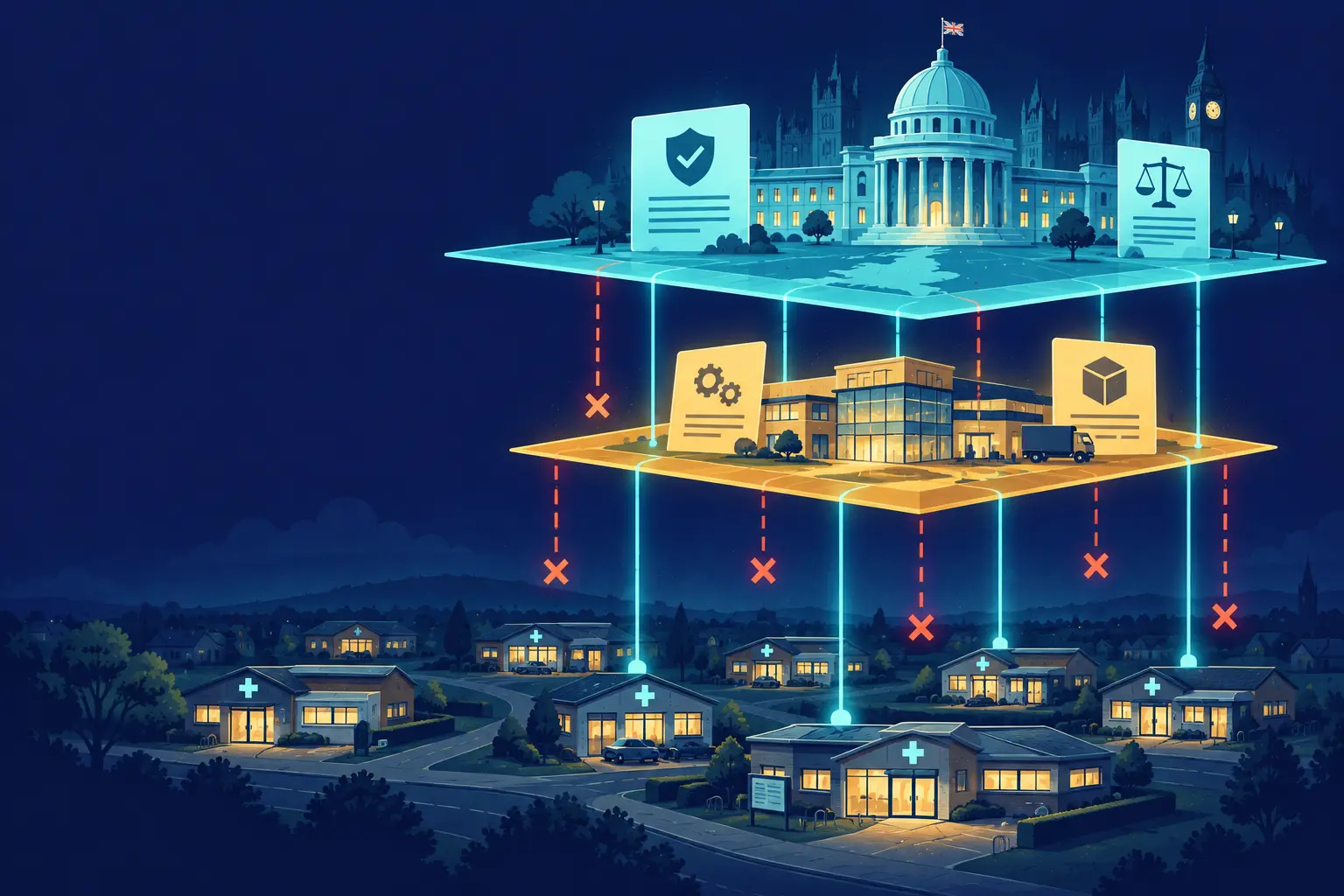
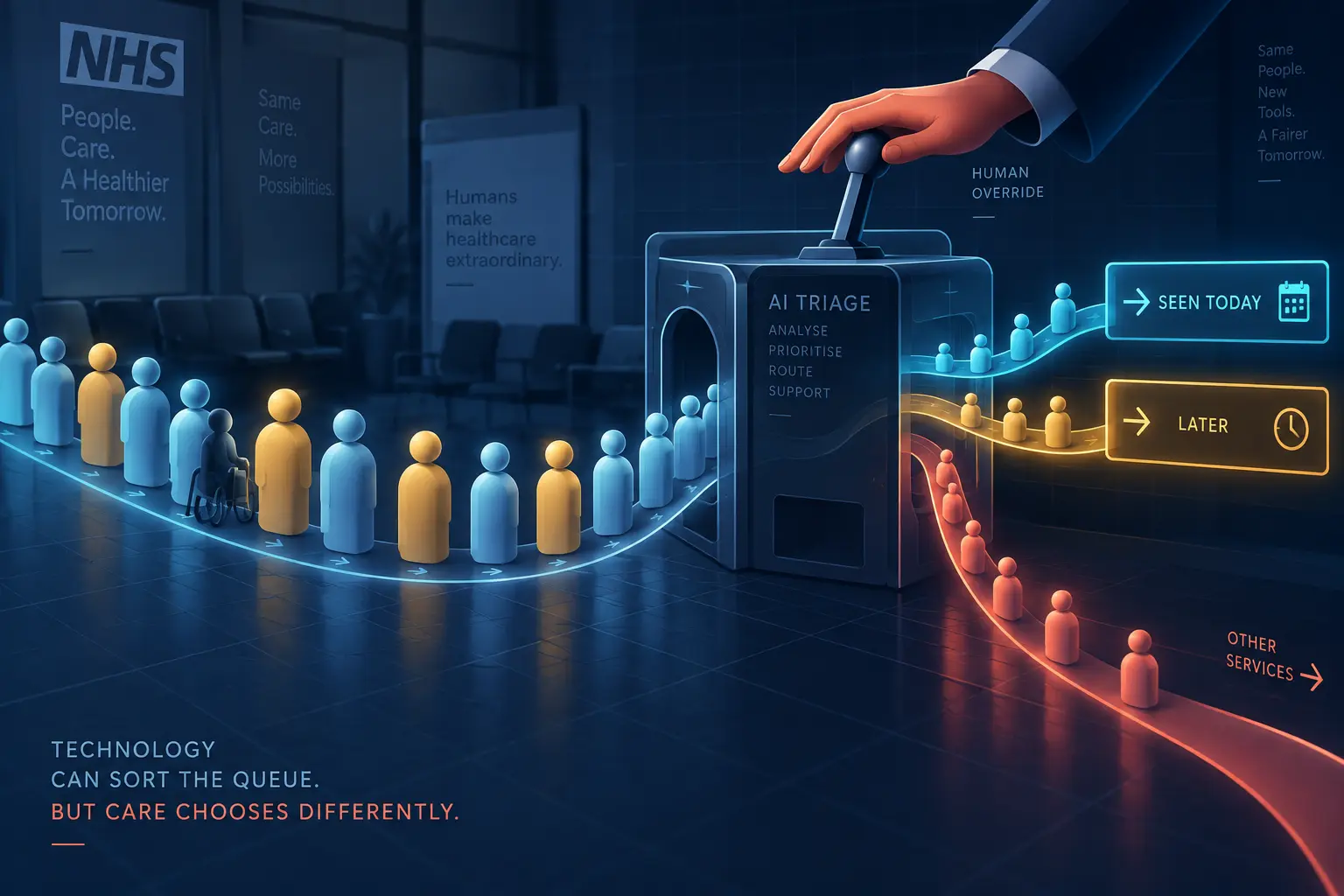
A busier and more spread-out week than the last, with 549 messages from 80 contributors and the weekend carrying nearly a third of the traffic. The argument that dominated was about triage: an AI triage supplier confirmed a Class IIb device partnership, a GP asked what that classification actually means on the ground, and the group spent Wednesday afternoon and evening working out whether the MHRA's decision not to regulate summarising scribes now lowers the bar for the tools that decide who gets seen. Around it sat two data challenges to published case studies, one on a national press release about AI triage and one on a supplier's own 31% figure, both resolved in-thread. Saturday carried over the liability argument from the previous week and reached a genuinely new proposal: scribes that deliberately insert errors to measure whether clinicians are still checking. The National Commission on the regulation of AI in healthcare published its recommendations on Thursday, the DCB0129 and DCB0160 consultation closed on Friday, and HSJ reported the first AI clinical negligence claims the same afternoon. In between, members put agents in their cars, their kitchens and their phone lines, and asked whether they were giving them too much.
Activity at a Glance
Week 66 generated 549 messages, up 56% on the previous issue, with a peak of 150 on Wednesday 9 September. Weekend traffic returned to 29.1% after last week's near-total working-week concentration, with Saturday and Sunday both busier than most weekdays. Monday was the quiet outlier at 9 messages. Morning was the most active period across the week (226 messages between 06:00 and 12:00), and the week's single busiest window was Wednesday afternoon, when the triage classification thread ran alongside a digital health community reunion.
📌 Major Topic Sections
1. What does "Class IIb" mean to a GP on the ground? The triage classification argument
The week's central thread began on Wednesday lunchtime when an innovation-focused GP shared an AI triage supplier's announcement that its logic engine partner was confirming device status and a strengthened UK partnership (https://infermedica.com/blog/articles/gp-triage-and-infermedica-standardising-triage-in-nhs-practices). A practice lead asked, minutes later, whether anyone had recommendations for trialling AI triage, because two advanced practitioners were triaging all day and struggling. A member of the supplier's team then joined the conversation openly, and stayed to answer questions for the rest of the afternoon.
The question that gave the thread its shape came from a GP: the announcement said "MDR Class IIb-certified medical device, and is registered with the MHRA", so what does that mean to a GP on the ground? The supplier's representative gave a careful, four-class explainer (syringes and otoscopes at Class I, blood pressure monitors at IIa, ventilators and apnoea monitors at IIb, pacemakers and implants at III), noted that reaching Class II or above requires "an extraordinary amount of evidence, safety data, and an independent external audit from a notified body", and was candid that the rest of his answer was where he might be biased: he would only be assured by a triage tool that had been through what IIb demands.
That prompted the sharper question, from a clinician with a signal-processing background: how does the MHRA's decision not to regulate AVTs that summarise affect the regulatory position of AI triage? His own answer was that summarising is lossy compression, that "one could argue that AVT does make clinical decisions by dropping info, masked by arguing it's just summarising" (the supplier's words, agreeing with him), and that if triage builds on AVT summaries and triage is a device, each step surely must be too. He thought the MHRA should revisit its AVT decision. He later extended the argument at length: if a pulse oximeter is a device because it turns light absorption into a number a doctor acts on, then a transcriber that turns "conscious thought to neuronal activity to muscular activation to sound waves" into a written account that influences care is hard to exclude on principle, and without post-market surveillance nobody will know if a tool that is 95% accurate at population level is 50% accurate for patients from Yorkshire. He flagged the last number as made up. He also raised Article 22, noting that breast screening handles automated decisions by seeking consent at the outset, with two human readers for anyone who declines.
A clinical informatician with supplier-side experience drew the distinction the group mostly settled on: triage is regarded as higher risk "because there's an element of autonomy and delay before clinical judgement has been exercised", whether the queue is a radiology worklist or an appointment request, whereas AVT in theory has clinical review at the moment the summary is produced. A GP with a long out-of-hours and informatics background put it more bluntly: AVT is low probability and lower risk, AI triage is moderate risk and higher probability, so "AI triage IMHO should be at least 2a. Healthcare delayed is healthcare denied." An integrated care operations lead added the condition that matters: if the decision to downgrade someone's access is not checked by a human, "that's closer to 2a being inadequate", unless a human has willingly signed off to accept the whole consequence of harm. The innovation-focused GP asked, deadpan, what class of device secondary care should be.
The supplier's own view was that the AVT decision should not lower expectations for triage, "but it's difficult to not see the bar being lowered", and that the MHRA's workload is only going to grow. He also announced a webinar on 23 September on the growing burden of triage and the coming contract changes (https://luma.com/nu1qv957), and a primary care digital policy lead immediately gave him a list of questions to cover: whether a patient advised to self-care can still request GP assessment, who monitors the dashboard and what triggers clinician review, the disposition mix and how much it varies by practice, whether requests directed away are still visible and followed up, and what happens when the practice runs out of appointments. He said he would try, and pointed in the meantime to a recorded deep-dive with his company's CTO (https://www.youtube.com/watch?v=QV7JyvoNhcI).
A GP with a long out-of-hours and informatics background then proposed something more useful than a webinar: a comparison shoot-out between triage platforms on features, ease of use and outcomes. The supplier said yes. If that happens, this newsletter will report it.
2. Two case studies, two data challenges, two different answers
Twice this week a published claim about AI triage was checked against the underlying data by a primary care digital policy lead, and the two episodes make an instructive pair.
The first, on Sunday evening, concerned the NHS England press release about AI triage at a practice in the South East. She had reproduced the 29% fall in telephone queue volumes from the historic telephony data in July, and her reading was that it happened because the practice moved to total triage on an online platform, with the platform's AI prioritisation making no contribution she could find to that reduction, and nothing in the data connecting it to routing patients automatically to urgent care. She read it "as a cockup not conspiracy but fascinating nonetheless", and pointed to the supplementary data that NHS England published on Friday (https://digital.nhs.uk/supplementary-information/2026/volume-of-calls-that-queued-at-wealden-ridge-medical-partnership?utm_source=chatgpt.com), which is essentially the same telephony data released last November. Another member said it would be interesting to see the statistics regulator's follow-up after NHS England's response. The innovation-focused GP asked, more broadly, whether any NHS England case study has correct data, listing the challenged virtual ward figures, the challenged FDP case study and what he called dubious claims in a scribe case study, and suggested they "just ask co-pilot to check the data, next time they publish". A GP who builds his own tools drew the quieter lesson: quite a lot of moving parts, then, to say one bit did x.
The second challenge landed on Wednesday, mid-thread, and was resolved within twenty minutes. The same policy lead quoted the supplier's own case study ("Weekly appointment volumes grew 31% over the four weeks, rising from 1,104 to 1,445") and said she could not find a 30% rise in appointments in the national appointment data for that practice, only a 7.8% rise in GP appointments between February and March. The supplier's representative answered directly: the 31% referred to the increase in online bookings that did not require clinician input, not a change in appointment volume, "hence why the GPAD would be static". It was a clarification, not a retraction, and it is exactly what a group with a data-literate policy lead and a supplier willing to answer in public can produce.
The thread also surfaced a measurement gap that will not resolve itself. She asked why neither of the two products under discussion appears in the national online consultation datasets. A primary care digital access specialist explained that online consultation is counted as form submission activity, whereas triage is treated as decision support and "not countable in the same way", a disconnect the data people have struggled with since early adopters were two-way messaging before the pandemic. The policy lead also noted that the NHS England press release, and the suppliers, describe two different functions under one word: autonomous navigation away from the practice, and prioritisation within the GP queue. "Sometimes it looks like we are talking about 1 when the product as is used in the GP practice is delivering 2." She proposed the group develop terminology for the functions and use it consistently. Given the week, that seems overdue.

3. Seatbelts, deliberate errors and "human in the loop is just a get-out clause"
Saturday morning carried straight on from the previous issue's argument about who is liable when a scribe gets it wrong, and it went somewhere new.
The innovation-focused GP, arguing from the position of someone who "build[s] the product & deploy[s] the product & maintain[s] liability across all domains", extended the group's car analogy: organisations mandate seatbelts, vans have speed limiters, drivers get mandatory breaks. An integrated care operations lead took the other side of the same analogy. If a car has a material fault that causes harm, the manufacturer carries the bulk of the liability even if "the meatsack driving it is negligent", and given that AVT is still immature and has known faults, "shoving all the liability to the user is a severe distortion of the liability balance". He wanted guard-rails ranging from "are you REALLY sure you want to accept this 0.1 seconds after I displayed it" upwards, and would be tempted, as an AVT builder, to run a second, more risk-averse model over the same consultation and produce a difference report.
The idea that split the room came from a digital health community director: build a scale into the AVT that tells the user how likely it is to have made an error, colour-coding sections red, amber and green so that only the risky ones need a human check. A hospital doctor pushed back that flagging performance is fine but creating deliberate mistakes is something else, and asked whether the literature suggests pushing deliberate errors degrades clinical performance. The moderator likened it to the fake gun that airport security screening slips into the X-ray feed. Another member laid it out as a design: the AVT deliberately inserts an error into one in twenty consultations, prompts the clinician immediately if it is not corrected, and feeds the detection rate back to management to assure both the deployment and the individual. "NHS cyber teams are doing something similar by sending fake phishing emails." The integrated care operations lead went further still, with escalating warnings, a note to the supervisor, and restricted access pending remedial training. A human factors specialist agreed with the general approach, on the grounds that "we know the behaviour tends towards disengagement when errors become less frequent" and that "well staff will have to check" without changing the technology is not good enough.
The philosophical turn was the innovation-focused GP's insistence that hallucinations are not accidental: "It is exactly how model works. We know it." Petrol is kept away from spark plugs by a clear deterministic barrier, "No such barrier exists to prevent hallucinations from entering medical records. Human in the Loop is just a get out clause for companies." The moderator's reply was that we have depended on non-deterministic colleagues since the dawn of time, human scribes included, and have layered controls and training over them rather than fixing them. The GP with a long out-of-hours background noted that private out-of-hours providers have monitored per-shift activity, note quality and complaints for more than fifteen years, and that surgeon league tables since Mid Staffs have brought allegations of gaming and cherry-picking with them.
Friday gave the argument its footnote. HSJ reported that the first AI clinical negligence claims have been lodged (https://www.hsj.co.uk/patient-safety/exclusive-first-ai-clinical-negligence-claims-lodged/8124278.article), posted twice within a minute, once with "Your middle name could be Nostradamus!" attached. Earlier that morning the moderator had shared a round-up of US legal cases and asked how long before a UK complaint or claim that care was delayed or denied because an algorithm bounced a referral. Saturday's EFF piece on Medicare's AI prior-authorisation experiment (https://www.eff.org/deeplinks/2026/09/new-records-reveal-problems-medicares-ai-prior-authorization-experiment) was shared as "chilling reading" with the same question attached.
4. Agents in the car, the kitchen and on the phone, and "am I giving it too much?"
The lighter half of the week was about what happens when you let an agent loose on your own life, and it was not entirely light.
On Sunday a GP who builds his own tools shared a personal voice agent that makes boring calls to utilities for "single figure £ a month" (https://x.ai/bot/zqWxv4Mn6DqmMZkD16_zl), thanked another member for pretending to be a hotel during testing, and reported it had booked a tracker fitting with 10% off and found a discontinued jet boil lid by ringing the UK parts supplier. A clinician who evaluates voice agents asked the right questions: is it obvious to the recipient they are talking to AI, what is the latency, how do you feed in your goals? The answers were yes, it does not pretend to be him, and he voice-notes the goal and boundaries before the call. The same evaluator had assessed voice agents in MSK and mental health triage in one region and found a five-second reply latency "really irritating"; the innovation-focused GP's diagnosis was the model, and "a whole host of orchestration & fine tuning needed to make the conversation real time".
The moderator reported a household agent that had coordinated roof repair quotes, diagnosed a solar fault by working out when sunrise would hit a panel from its alignment and location, and chided him for running a dehumidifier overnight because "you're paying around £1 to try and dehumidify sussex". On Tuesday he described testing an assistant through CarPlay on the commute: it retrieved a newsletter article from his email, summarised it, discussed the consequences for predicate AVT hazard logs, and wrote a briefing to the company drive, "15 mins end to end... Like sitting next to a thoughtful CSO on the way to work." He was clear the actual writing should still be human only. A GP's response set the tone for the EV thread that followed: "I am going to have to get a new car in that case. Sigh. This group is costing me far too much."
The hazard that came with it was the moderator's, on Sunday: more evidence of agent swarms using public boards to communicate, which he called infestation-type behaviour, and the question of whether anyone maintaining a public board had this in mind. "I can imagine agents outside the NHS communicating to insecure agents within the NHS through coded repeat prescription requests, or submitted e-consult forms!" Friday's version of the same question was personal. A new member developing a weight management service asked whether anyone else was letting their AI into their calendar, note taker and fitness data, because it had revolutionised her life, "but am I giving it too much?" A doctor and documentary maker's answer was "Into the insatiable belly of the beast. It must be fed! More!" An integrated care operations lead's was no: once your data are in the system you are not getting them out, and he trusts the tech companies with his data "almost as much as I trust those scam callers who are very interested in whether I've had a car accident or not". The moderator's was yes, with care, and for the anxious, a local model can do some of this on your own device.
Wednesday morning gave that caution a concrete example. Following a widely discussed mathematics result, a human factors specialist shared a blog post on what the AI companies are and are not answering about training data (https://simonwillison.net/2026/Sep/8/on-navier-stokes/). The moderator's point was that the company's response did not clarify whether the user had opted out of training, and looked worded to match the language of the app's settings; he encouraged everyone to check that setting, and noted that API use can differ. The innovation-focused GP took it as further proof that sending sensitive data to closed labs via API is not fine, and told deployers to take note.
5. Millennium problems, resignations and the end of cheap AI
The frontier did not stay quiet either. Saturday evening brought the report that a model had formalised Fermat's Last Theorem in eleven days (https://www.anthropic.com/research/formalizing-fermats-last-theorem), and Tuesday evening a claimed solution to Navier-Stokes (https://openai.com/index/navier-stokes-solution/), immediately followed by a member's report of an allegation circulating on social media that a mathematics professor's private chats had been used to get there. By Wednesday morning the group had a full argument going. The innovation-focused GP thought it was brute force and billions of tokens, "a PR stunt as model did not solve the problem". The moderator agreed the method was brute force and thought the outcome impressive anyway: "Human's escape gravity well using brute force!" and, later, "evolution is bruteforcing over long timescale". A practice GP made the point that if the professor's work had succeeded he would have published it, since solving a millennium prize problem is as close to permanent fame as mathematics offers, so the model must have made a leap he had not. A human factors specialist noted it took mathematicians to direct the models, and that the split between pure AI and people shaping it was unclear. The moderator observed that a prediction market now records "weakly general AI" as achieved, a year ahead of forecast (https://www.metaculus.com/questions/3479/date-weakly-general-ai-is-publicly-known/).
The same week produced two reported resignations from a frontier lab, one over UK AI policy and conflict of interest (https://www.theguardian.com/technology/2026/sep/07/architect-uk-ai-policy-quits-anthropic-conflict-of-interest-concerns) and one over safety fears (https://www.wsj.com/tech/ai/anthropic-researcher-quits-over-out-of-control-ai-fears-707b7628), plus an FT piece whose headline, an integrated care operations lead said, tells the story (https://www.ft.com/content/560e1c8b-f163-4fd6-b604-e905550ac870). A radiologist read the timing as a carefully planned PR campaign coinciding with the Skynet launch date from Terminator. The operations lead reported that another group he belongs to had that day raised the risk that access to AI becomes a US trade weapon: not the most likely outcome, but "a whole lot more likely than this time last year". The conflict-of-interest story drew a personal aside from the moderator on how "noodly" managing conflicts becomes when a commissioning role explicitly requires industry liaison but forbids accepting a coffee, and from the radiologist, who had once been on the receiving end of a harassment incident by a multinational over a glass of diet coke.
Money ran under all of it. The newest model's API cost was "eye watering", a member reported hitting "this model is busy try a diff one" constantly, and a technology-minded member suspected "we are starting to see the end of cheap AI", with free tiers likely to be throttled. The moderator asked whether tokens might end up as a new currency (a medical imaging AI commercial lead: "Hard no..."), and shared a piece on China turning tokens into consumer rewards. The practical answer, which another member said he already uses, was to spend the expensive model on writing the instructions and let a cheaper one do the work.
6. The Commission reports, the consultation closes, and a community regroups
Thursday morning the National Commission into the regulation of AI in healthcare published its recommendations (https://www.gov.uk/government/publications/national-commission-into-the-regulation-of-ai-in-healthcare-recommendations-for-a-future-regulatory-framework), with the BBC's coverage (https://www.bbc.co.uk/news/articles/c3wjn3pl63xo) repeating the figure that scribes are reportedly used by 40% of UK GPs. A first reading from one member: the commission appears to be suggesting FDA-style enforcement discretion for low-risk clinical decision support. A doctor launching AI products shared it on Friday as an update for anyone in the same position. The moderator was at an innovation forum in Cambridge that afternoon talking about safety and AI, and a former health minister's call for a forensic review of a large data platform contract (https://www.lbc.co.uk/article/former-health-minister-calls-for-forensic-review-of-nhs-contract-palantir-5HjdhDh_2/) came in from the morning traffic.
Friday was the DCB0129 and DCB0160 consultation deadline (https://digital.nhs.uk/data-and-information/information-standards/governance/latest-activity/standards-and-collections/review-of-digital-clinical-safety-standards-dcb0129-and-dcb0160). "Submit submit submit," said the moderator at 11:30. "Hit submit about 20 mins ago!" said a clinical informatician at 14:15. Also on Friday: a regulator's paid two-hour AI and digital webinar at £300 drew a practice GP's "steep", a commercial lead's puzzlement that a taxpayer-funded body would not share the session widely, and a health tech developer's explanation that it comes from the regulator's commercial advisory arm and is priced for VC-backed startups with money to burn, which the commercial lead observed do not really exist in that form any more.
Wednesday afternoon, alongside the triage thread, an offhand question about BCS Fellowship turned into a reunion of sorts. Several members had been involved in the Faculty of Clinical Informatics and were still sad, and in one case angry, about its demise; two directors of a digital health community set up afterwards (basic membership free at www.ukdhc.org) described a revamped site, around thirty interns and the same purpose, helping SMEs "survive the gauntlet of NHS penetration and commissioning. It shouldn't have to be as hard." An independent clinical informatician had let his BCS membership lapse for lack of benefit, then kept it for appraisal and revalidation when a professional membership scheme for the NHS digital workforce was announced (https://digital-transformation.hee.nhs.uk/news/professional-membership-for-the-nhs-digital%2C-data-and-technology-workforce). An integrated care operations lead, chartered since 2004, still did not really get what upgrading to Fellow would add. The best answer he got was "save your money".
😄 Lighter Moments
The EV thread. A single joke about needing a CarPlay-compatible car on Tuesday lunchtime produced forty-odd messages on lease deals, benefit-in-kind, the £40,000 threshold ("upped to £50k now"), which Chinese seven-seaters are coming when, overnight tariffs, and whether it is worth running your AI server farm between 11pm and 6am. A technology-minded member, writing from Czechia in the electric car an AI had found him by searching every manufacturer's approved-used site, was asked not to gatekeep the prompt. A member running the numbers on his own lease closed it with "I'm sure someone can design an AI tool to help find a deal". The moderator's shopping list: a new car that supports CarPlay, massive amounts of GPU memory or a filthy expensive Mac, and money for someone to do your job while you play with all of this.
An EPR supplier demonstrated native Stream Deck integration: physical buttons for triage, "Twenty five years of nothing new in GP IT. Now this, shipped in weeks." A GP who had tried it called it a 5x productivity gain at least, the innovation-focused GP replied that he did not want to be 5x more productive, "We need something that allows coasting", and the moderator invoked Jevons' paradox. Another member coupled it with Parkinson's Law.
The moderator gave two new models the same task, a game of Breakout, and one of them named its version Prism Break. The innovation-focused GP reported that a model he had tasked with breaking something was on round 22 of trying and had destroyed his Sunday. A doctor launching AI products offered this on Sunday afternoon: "We regret to inform you that today's GP clinic is overbooked. We are currently looking for patients who'd be willing to see a PA instead..." A GP asked why not an AI PA. The GP with a long out-of-hours and informatics background shared a 2016 screenshot of a WiFi drone disabler built on a Raspberry Pi, "The things we could do then", and a Ryanair-style overbooking suggestion for DNAs was made, and not entirely in jest.
A member posted a video that, they said, made them think of the moderator's CarPlay week, hoping he had had more success. He laughed. The video was not of a successful in-car assistant.
💬 Quote Wall
"Human in the Loop is just a get out clause for companies." — Innovation-focused GP
"Shoving all the liability to the user is a severe distortion of the liability balance." — Integrated care operations lead
"AI triage IMHO should be at least 2a. Healthcare delayed is healthcare denied." — GP with a long out-of-hours and informatics background
"One could argue that AVT does make clinical decisions by dropping info, masked by arguing it's just summarising." — Member of an AI triage supplier's team
"The biggest competitor was not the other suppliers, it was 'Do Nothing'. We lost more opportunities to him than anything else." — Clinical informatician with supplier-side experience
"I read this as a cockup not conspiracy but fascinating nonetheless." — Primary care digital policy lead, on a national AI triage case study
"15 mins end to end, all during a commute. Unbelievable. Like sitting next to a thoughtful CSO on the way to work." — Group moderator
"I am going to have to get a new car in that case. Sigh. This group is costing me far too much." — GP
"Yes, with care, and it is transformative." — Group moderator, on giving an AI access to your life
📎 Journal Watch
Academic Papers and Key Studies
📎 Formalising Fermat's Last Theorem – Anthropic Research https://www.anthropic.com/research/formalizing-fermats-last-theorem. Shared Saturday night as the model having "proved" the theorem in eleven days, and again on Wednesday morning. The group's consensus was brute force plus an impressive outcome, with disagreement about how much credit the model deserves.
📎 A claimed Navier-Stokes solution – OpenAI https://openai.com/index/navier-stokes-solution/. Posted Tuesday evening with "Exciting if not scary times!", and with a member's report of an allegation, circulating on social media, that a mathematician's private chats were used. Read alongside the next entry.
📎 On Navier-Stokes: what the AI companies are and are not answering – Simon Willison https://simonwillison.net/2026/Sep/8/on-navier-stokes/. Recommended as a good summary of the training-data questions. The moderator's reading was that the company's answer did not settle whether the user had opted out, and that everyone should check that setting.
📎 Economic scenarios: what will our economic future look like? – Anthropic Institute https://www.anthropic.com/institute/econ-scenarios. Shared with the observation that it leaves out the small matter of whether humans are still around. Later offered as the frame against which to read Friday's surprise UK growth figure.
📎 Research acceleration: a view inside OpenAI – OpenAI https://openai.com/index/research-acceleration-view-inside-openai/. Reporting on the adoption of agentic co-working by its own teams, shared for the level of detail.
📎 Date weakly general AI is publicly known – Metaculus https://www.metaculus.com/questions/3479/date-weakly-general-ai-is-publicly-known/. Now resolved, a year ahead of predictions, according to the moderator. Two members replied with https://ai-2027.com/ and https://ai-2040.com respectively.
Industry and News Articles
📎 Exclusive: first AI clinical negligence claims lodged – HSJ https://www.hsj.co.uk/patient-safety/exclusive-first-ai-clinical-negligence-claims-lodged/8124278.article. Posted twice on Friday lunchtime, once with a Nostradamus reference for the moderator's Friday morning question about algorithmic referral bounces. The footnote to Saturday's liability argument.
📎 New records reveal problems with Medicare's AI prior-authorisation experiment – EFF https://www.eff.org/deeplinks/2026/09/new-records-reveal-problems-medicares-ai-prior-authorization-experiment. Shared Saturday morning as chilling reading, with the observation that pre-authorisation is similar in many ways to referral triage and management.
📎 GP Triage and Infermedica: standardising triage in NHS practices – Infermedica blog https://infermedica.com/blog/articles/gp-triage-and-infermedica-standardising-triage-in-nhs-practices. The post that started Wednesday's classification thread. A member of the supplier's team confirmed in-group that the partnership is longstanding and newly strengthened, and that the triage module is Class IIb.
📎 Architect of UK AI policy quits Anthropic over conflict of interest concerns – The Guardian https://www.theguardian.com/technology/2026/sep/07/architect-uk-ai-policy-quits-anthropic-conflict-of-interest-concerns. Prompted a side conversation on how weaponised, and how noodly, conflict-of-interest management has become.
📎 Anthropic researcher quits over out-of-control AI fears – Wall Street Journal https://www.wsj.com/tech/ai/anthropic-researcher-quits-over-out-of-control-ai-fears-707b7628. Read by one member as a carefully planned PR campaign. Companion FT piece: https://www.ft.com/content/560e1c8b-f163-4fd6-b604-e905550ac870, whose headline, the sharer said, tells the story.
📎 Former Labour health minister calls for "forensic" review of £330m NHS contract with Palantir – LBC https://www.lbc.co.uk/article/former-health-minister-calls-for-forensic-review-of-nhs-contract-palantir-5HjdhDh_2/. Heard in the morning traffic on Thursday.
📎 One of our two most prominent medical AI startups is in trouble – Health Services Daily (Australia) https://www.healthservicesdaily.com.au/one-of-our-two-most-prominent-medical-ai-startups-is-in-trouble/52185. Shared by a medical imaging AI commercial lead as a description of two Australian companies on different paths: "Selling novel technology is hard... and in Healthcare its even harder."
📎 There is no money in AI drug discovery – Fix Health https://www.fixhealth.ai/p/there-is-no-money-in-ai-drug-discovery?utm_source=post-email-title&publication_id=1905226&post_id=214501699&utm_campaign=email-post-title&isFreemail=true&r=83ecoj&triedRedirect=true&utm_medium=email. Spend versus return: so far they all burn more than they generate. A member offered https://healx.ai as a counter-example doing a good job.
📎 How China is turning AI tokens into everyday consumer rewards – Rest of World https://share.google/Ug78GpqJoOlOCBKFm. Background to the moderator's question about tokens as currency.
📎 Nvidia wants to turn your idle PCs into a personal home data centre with PAIR. https://share.google/xhXdNiMkvmaOk2gCf. "NHS IT departments go wild." It reminded several members of SETI@home, Folding@home and a PlayStation 3 whose electricity bill was solved in a minute by a spouse.
📎 Perplexity open-sources Lily, a Rust and Metal inference engine for Apple Silicon – MarkTechPost https://www.marktechpost.com/2026/09/02/perplexity-open-sources-lily-a-rust-metal-inference-engine-for-qwen3-6-35b-a3b-on-apple-silicon/. For the local-model contingent. One member would rather have had another twelve months free of the paid tier.
📎 UK economy defies forecasts with surprise 0.4% growth in July – The Guardian https://www.theguardian.com/business/2026/sep/11/uk-economy-defies-forecasts-with-surprise-04-growth-in-july. Shared Friday with "Consider against Anthropic economic report".
📎 The AI apocalypse, as reported on social media: an agent-swarm sighting (https://bsky.app/profile/gracekind.net/post/3musysyhjpc2t), a model behaving like a colonial-era Brit (https://bsky.app/profile/ceej.online/post/3muuzapi6m22s), a tweet on API data handling (https://x.com/ns123abc/status/2097287342402711800?s=20) and one that "doesn't sound encouraging" (https://x.com/EvanHub/status/2097497037956891126).
Technical Resources and Tools
📎 A personal voice agent for boring phone calls. https://x.ai/bot/zqWxv4Mn6DqmMZkD16_zl. A weekend project by a GP who builds his own tools, with the skill included so others can set it up. Best done on the desktop app.
📎 reMarkable MCP server – GitHub https://github.com/SamMorrowDrums/remarkable-mcp. Tested by the moderator and reported to work very nicely, local, cloud or over USB, and to pass a frontier-grade security review. The ensuing thread was a small love-in for the device, with one dissenter who had switched to a rival.
📎 AccuRx desktop: how to use batch self-book – AccuRx support https://support.accurx.com/en/articles/768481-accurx-desktop-how-to-use-batch-self-book. The answer to a practice GP's question about tracking patients who have not booked. The follow-up ask: the same "not booked" list for individually sent links, so it can be used for total triage.
📎 Native Stream Deck integration for an EPR – YouTube https://youtu.be/fWxAYjvMFcQ?si=Oirm2YfWaxDhe22R. "It has to be seen to be believed." Physical buttons for triage, one of hundreds of possible uses, and no software for IT to take three weeks installing.
📎 An AI triage supplier's CTO deep-dive – YouTube https://www.youtube.com/watch?v=QV7JyvoNhcI. Offered in answer to the policy lead's list of questions about patient journeys, dispositions and what the practice sees.
📎 A podcast episode on AGI, what is real and what the future might hold. https://pca.st/ds5gqrw5. Well timed, and without the presenter some find annoying.
📎 An RSM podcast series – Spotify https://open.spotify.com/show/4woi67ntL0Ke0Rykn7h2lp. Recommended, alongside the free tiers of the usual no-code tools, to a member about to build her first app, with the reminder that building it yourself does not exempt you from any of the regulations, laws or standards.
📎 A tracker of web-scraping and AI-agent legal cases. https://chatgptiseatingtheworld.com/web-scraping-ai-agents-case-tracker/. A good site to track legal cases about AI more generally, alongside a LinkedIn round-up of US cases with several of interest to the group (https://lnkd.in/p/eAnKMYnS).
📎 A trailer for a documentary on technology, AI and tuberculosis – YouTube https://youtu.be/aD5AJ9UAYcs?is=A-_20NoMHcSHzixU. Made by a member, dropping next week. AI diagnostics, a digital stethoscope, a vaccine, and a community health worker and TB survivor on the other broken things that have to be fixed: "You can have the best AI to find more TB, but if we can't fix the conditions that lead to 2nd line treatments being unaffordable then what's the point."
📎 A home battery at launch discount. https://www.ankersolix.com/uk/products/ae103?gad_campaignid=24178590846&gad_source=1&gbraid=0AAAAABVgOKl5aEWycmx-Z1GRLYe1KZwC9&gclid=Cj0KCQjw--7UBhCpARIsAGJBptgNCzx_QY03IKQVGpMXFg95Ky1oxQ-KerH9LVf1ta9Kd-chpO_RLMUaAjugEALw_wcB&o_c=&s_main=AE1032Z1&utm_campaign=uk_ankersolix_hes_m3_google-search_launch_AE103_purchase_web_brand_external_meetsocial_260827&utm_content=brand&utm_medium=search&utm_source=google&utm_term=24178590846_200315962995_822328279119&varId=53468034466128. Included for completeness from the EV thread: fill it overnight on cheap power, and there is a business case with or without solar.
Policy Documents and Official Reports
📎 National Commission into the Regulation of AI in Healthcare: recommendations for a future regulatory framework – GOV.UK https://www.gov.uk/government/publications/national-commission-into-the-regulation-of-ai-in-healthcare-recommendations-for-a-future-regulatory-framework. Published Thursday. Full report PDF: https://assets.publishing.service.gov.uk/media/6aa2662962ec7fe7bedf52b9/Full_National_Commission_Report_-_Publication__1_.pdf. BBC coverage: https://www.bbc.co.uk/news/articles/c3wjn3pl63xo. An early read from one member: FDA-style enforcement discretion for low-risk clinical decision support appears to be on the table.
📎 Review of digital clinical safety standards DCB0129 and DCB0160 – NHS England Digital https://digital.nhs.uk/data-and-information/information-standards/governance/latest-activity/standards-and-collections/review-of-digital-clinical-safety-standards-dcb0129-and-dcb0160. The consultation closed on Friday 11 September. At least two members submitted on the day.
📎 Volume of calls that queued at a South East practice – NHS England supplementary information https://digital.nhs.uk/supplementary-information/2026/volume-of-calls-that-queued-at-wealden-ridge-medical-partnership?utm_source=chatgpt.com. The data behind the AI triage press release, published Friday. A policy lead's reading: essentially the telephony data released last November, and the fall predates any AI prioritisation. Related: the supplier's urgent care page (https://www.visibagroup.co.uk/for-who/urgent-emergency-care), a think-tank piece on smarter triage and navigation (https://institute.global/insights/public-services/preparing-the-nhs-for-the-ai-era-why-smarter-triage-and-navigation-mean-better-health-care) and a 2024 regional case study that may be the source of a much-repeated "three minutes" figure (https://healthinnovation-kss.com/wp-content/uploads/2024/03/AI-Triage-Case-Study.pdf), which describes less than three minutes spent processing a request, not a three-minute saving per patient.
📎 Professional membership for the NHS digital, data and technology workforce – NHS England Digital Transformation https://digital-transformation.hee.nhs.uk/news/professional-membership-for-the-nhs-digital%2C-data-and-technology-workforce. The announcement that made one independent clinical informatician keep his lapsed BCS membership after all.
📎 A call for NHS views on an Oxford research project – LinkedIn https://www.linkedin.com/posts/sara-shaw-oxford_if-you-work-in-the-nhs-and-have-thoughts-share-7503573283259375616-ybcR?utm_source=social_share_send&utm_medium=android_app&rcm=ACoAAADdvfYBKAS6SeYQp5-LHAvTIX4tSQ95_s4&utm_campaign=whatsapp. If you work in the NHS and have thoughts, share them.
📎 NICE AI and digital webinar – LinkedIn https://www.linkedin.com/posts/national-institute-for-health-and-care-excellence_only-one-week-to-go-until-our-ai-and-digital-activity-7503059717548625922--UGz?utm_source=social_share_send&utm_medium=android_app&rcm=ACoAAADdvfYBKAS6SeYQp5-LHAvTIX4tSQ95_s4&utm_campaign=whatsapp. One week to go, £300 for two hours, and a small argument about who it is for.
📎 A GP Triage webinar on the burden of triage and the contract changes – Luma https://luma.com/nu1qv957. 23 September. See the policy lead's list of questions under Topic 1 for what the group hopes it covers.
📎 NHS Clinical Entrepreneur Programme 2027. www.nhscep.com. Applications open 19 October at 8am and close 20 November at 4pm, across the Clinical, Patient and Dementia Innovators programmes. Programme starts March 2027.
🔭 Looking Ahead
The AI triage shoot-out. A GP proposed a comparison across triage platforms on features, ease of use and outcomes, and the first supplier has said yes. Watch this space, and if you supply or use a competing product, say so.
The GP Triage webinar on 23 September, ideally answering the five questions set out under Topic 1. The NICE AI and digital webinar the week after this issue, for those with £300. The NHS Clinical Entrepreneur Programme 2027 opens for applications on 19 October.
The MHRA held what the moderator trailed on Wednesday as "big event and announcements" on Thursday. Nothing from it reached the group by Saturday morning, so expect it next issue.
A digital health community is recruiting (basic membership free), a member is looking for Welsh NHS research contacts, and a new member is looking for someone to talk her through device registration for an AI-enabled body composition app. DMs, as ever.
Unresolved and worth returning to: a shared vocabulary for "triage" that separates autonomous navigation from prioritisation within the GP queue; whether deliberate-error injection is an assurance method or a hazard; and whether the National Commission's recommendations, once read properly, move the DCB0129 and DCB0160 review in a direction the group would want.
🧬 Group Personality Snapshot
Two things this group does better than most happened on the same Wednesday afternoon. A supplier turned up in the middle of a discussion of its own product, declared itself, answered a pointed data question with a straight clarification inside twenty minutes, was handed a list of five hard questions for its webinar, and left with a proposal for a public head-to-head against its competitors. And a GP asked what a regulatory classification means in practice, got a proper answer, and then watched the group take that answer apart and put it back together around the question that actually matters: where is the human, and when?
The rest of the week shows the other side. This is a community that will build a phone-calling agent over a Sunday coffee, hand the setup to everyone else by lunchtime, and spend the afternoon being interrogated about latency and consent by someone who evaluates the same technology professionally. It will turn a joke about needing a new car into forty messages of tax advice and then thank whoever brings it back to AI. And it will, on the day a consultation closes, post "Submit submit submit" and then "Hit submit about 20 mins ago!", which is the whole culture in two messages.
APPENDIX A: Detailed Activity Analytics 📊
📬 Total Messages: 549
📈 Peak Day: Wednesday 9 September (150 messages)
🔥 Most Active Period: Morning, 06:00-12:00 (226 messages)
💬 Average/Active Day: 69 messages
🏖️ Weekend Activity: 29.1% (160/549)
💼 Weekday Activity: 70.9% (389/549)
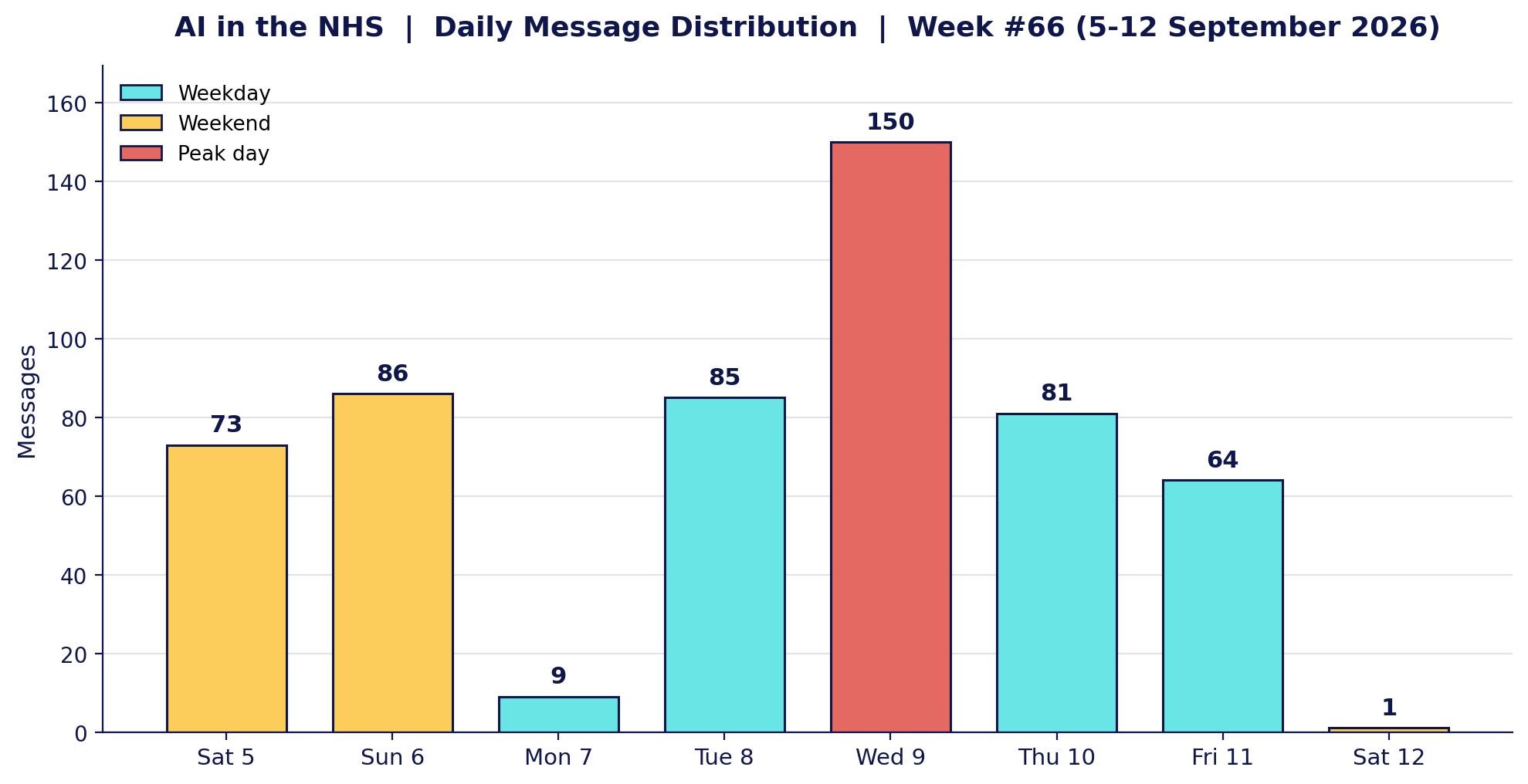
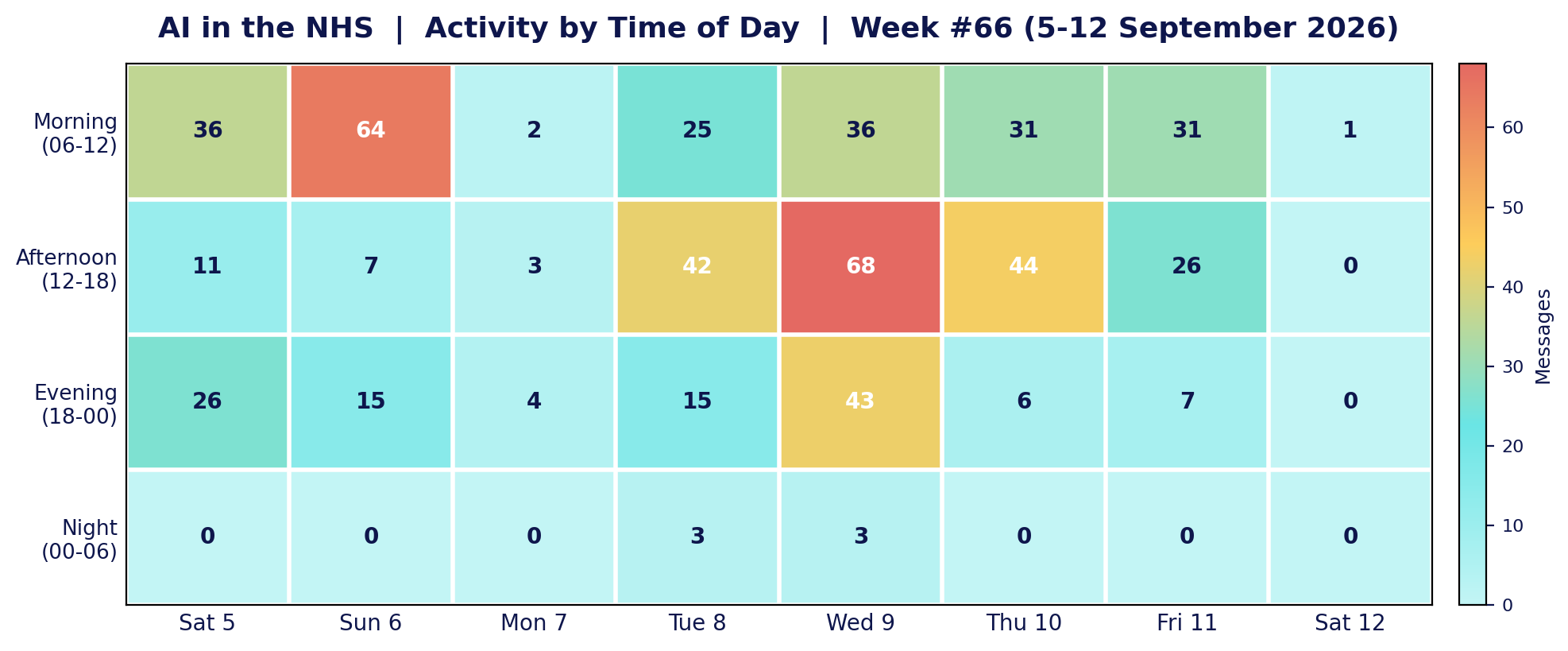
Patterns worth noting. The weekend was back this week: Sunday morning alone produced 64 messages, the busiest morning of the period, as the DNA question, the voice agent and the household agents overlapped before 11:00. Wednesday's 150 was built in two blocks, a 68-message afternoon around triage classification and the digital health community reunion, then a 43-message evening as the Stream Deck demonstration and the Article 22 argument ran in parallel. Monday's 9 messages is the lowest single-day count in recent issues and sits between two busy days, which is unusual enough to be worth checking against the group in the app. Night activity was six messages across the whole week, all on Tuesday and Wednesday.
APPENDIX B: Enhanced Statistics
80 group members posted at least one message this week, the highest contributor count in the issue index, which runs back to June. The 15 most active below account for 387 of the 549 messages (70.5%), with a long tail of 65 occasional and one-off contributors making up the rest.
Top 15 Contributors (Role Descriptors Only):
1. The group moderator: 122 messages
2. An innovation-focused GP: 37 messages
3. A radiologist and clinical governance advocate: 33 messages
4. A medical imaging AI commercial lead: 32 messages
5. A GP who builds his own tools: 32 messages
6. An integrated care operations lead: 30 messages
7. A primary care digital policy lead: 24 messages
8. A GP with a long out-of-hours and informatics background: 20 messages
9. A member of an AI triage supplier's team: 10 messages
10. A technology-minded member with solar panels and an electric car: 9 messages
11. A GP and digital health enthusiast: 9 messages
12. A clinician who evaluates voice agents: 8 messages
13. A human factors specialist: 7 messages
14. A clinical informatician with supplier-side experience: 7 messages
15. A practice GP working on total triage: 7 messages
Hottest Debate Topics:
1. 🔥🔥🔥 AI triage: Class IIb, what it means on the ground, whether the AVT decision lowers the bar, and the case study data (approximately 75 messages across Sunday, Wednesday and Thursday)
2. 🔥🔥🔥 Cars, leases, benefit-in-kind and overnight tariffs (approximately 45 messages across Tuesday)
3. 🔥🔥 Agents in the car, the house and on the phone, and how much access to give them (approximately 45 messages across Sunday, Tuesday and Friday)
4. 🔥🔥 AVT liability, deliberate error injection and "human in the loop is a get-out clause" (approximately 35 messages across Saturday)
5. 🔥🔥 Fermat, Navier-Stokes, training data and the end of cheap AI (approximately 35 messages across Saturday, Tuesday and Wednesday)
6. 🔥 FCI, UKDHC and whether BCS membership is worth it (approximately 20 messages across Wednesday)
7. 🔥 The National Commission report, the DCB consultation deadline and the £300 webinar (approximately 15 messages across Thursday and Friday)
Discussion Quality Metrics:
• Evidence-Based vs Opinion Ratio: roughly 12% of messages carried a link to a paper, report, product source or news article
• Average Thread Depth: approximately 7 messages per sustained discussion thread, with the Wednesday triage thread running past 50
• Constructive Challenge Rate: high, with two published figures challenged against source data in-thread and one supplier clarification produced as a result
• External Resource Sharing: 61 unique links shared across the period
Cross-Expertise Engagement:
Contributions came from general practice, hospital medicine, radiology, clinical informatics, human factors, ICB and operations roles, health policy, medical imaging commercial leadership, an AI triage supplier, an EPR supplier, voice agent evaluation, documentary making and a good number of first-time posters. The Wednesday classification thread was the most cross-disciplinary, with a supplier, a signal-processing clinician, an informatician with supplier-side history, a GP, a radiologist and an operations lead all in the same argument. The clearest instance of knowledge transfer was the supplier's four-class explainer of device classification for a GP audience, immediately tested by the group against the MHRA's AVT position.
APPENDIX C: Daily Theme Summary
Saturday, 5 September 2026
Primary Theme: AVT liability, seatbelts and deliberate error injection
Key Discussion: The previous week's liability argument continued from 09:06, with the innovation-focused GP defending "I build it, I deploy it, I carry the liability" and the integrated care operations lead arguing that the manufacturer should carry the bulk of it for a product with known faults. The deliberate-error proposal was made, designed in detail, and challenged on whether it degrades performance.
Secondary Discussions:
• New model costs: eye-watering API pricing, "model is busy" messages, and the end of cheap AI
• Two new models given the same Breakout task, one of which named its game Prism Break
• A model formalising Fermat's Last Theorem in eleven days
• Self-referral MRI advertising spotted at a tattoo convention
Notable: 73 messages on a Saturday, the busiest opening day in several issues.
Sunday, 6 September 2026
Primary Theme: Agents that make phone calls, run households and infest message boards
Key Discussion: A GP's personal voice agent for utility calls, tested by another member pretending to be a hotel, drew detailed questions on disclosure, latency and goal-setting from a clinician who evaluates voice agents professionally. The moderator's household agent diagnosed a solar fault and objected to a dehumidifier.
Secondary Discussions:
• Reducing DNAs: same-day appointments, patient-chosen slots, Ryanair-style overbooking, and the difficulty of tracking unbooked self-book links
• Agent swarms using public boards to communicate, and what that means for e-consult forms
• A policy lead's data challenge to the NHS England AI triage press release
• Perplexity open-sourcing an inference engine; OpenAI on internal agentic adoption
Notable: 64 messages before noon, the busiest morning of the week. 86 messages on a Sunday.
Monday, 7 September 2026
Primary Theme: A quiet day
Key Discussion: Nine messages. A lurker and late adopter asked for tips on getting better output from a messaging tool in primary care, and got a pointer to the batch self-book documentation.
Secondary Discussions:
• A model behaving like a colonial-era Brit, and what that says about training data and alignment
Notable: The lowest single-day count in recent issues, between two busy days.
Tuesday, 8 September 2026
Primary Theme: Claude in the car, and the car that followed
Key Discussion: The moderator's CarPlay commute, retrieving, summarising and writing up a newsletter article into a hazard log briefing in fifteen minutes, prompted a GP to sigh that he would need a new car, which produced forty-odd messages on EV leasing, tax thresholds and overnight tariffs.
Secondary Discussions:
• A UK AI policy architect's reported resignation over conflict of interest, and the weaponisation of COI
• Nvidia's home data centre proposal and memories of SETI@home
• OpenAI's claimed Navier-Stokes solution and the allegation that a professor's private chats were used
• "Weakly general AI" resolved on a prediction market a year early
Notable: The only night-time activity of the week began here, with a late-evening exchange on AI timelines.
Wednesday, 9 September 2026
Primary Theme: What Class IIb means to a GP, and whether the AVT decision lowers the bar
Key Discussion: A triage supplier's device-status announcement, a GP's question about what IIb means on the ground, and the supplier's own explainer led into the week's most substantial argument on autonomy, delay, Article 22, lossy compression and where the human sits. A data challenge to the supplier's 31% figure was clarified inside twenty minutes.
Secondary Discussions:
• Training data and the opt-out setting, following the Navier-Stokes blog
• FCI's demise, the digital health community that followed it, and whether BCS Fellowship is worth anything
• Stream Deck integration for an EPR, and Jevons' paradox
• Frictions in a questionnaire notification via the NHS App
• Tokens as currency, the money in AI drug discovery, and two Australian medical AI companies on different paths
Notable: Peak day at 150 messages. Two new members welcomed, and a first-time app builder given a reading list and a warning about regulation.
Thursday, 10 September 2026
Primary Theme: The National Commission reports
Key Discussion: The commission's recommendations for a future regulatory framework were published and shared with the BBC coverage, an early read suggesting FDA-style enforcement discretion for low-risk decision support. A former health minister's call for a forensic review of a data platform contract arrived the same morning.
Secondary Discussions:
• A member's documentary trailer on AI, technology and TB, and a discussion of chest X-ray AI that detects findings rather than diagnosing
• LLMs that cannot count characters, and whether a language model should be expected to
• A three-model round robin on an airline dispute
• Medical device registration for an AI-enabled body composition app
• Welsh NHS research contacts
Notable: The moderator spoke on safety and AI at an innovation forum in Cambridge; a paediatrician and consulting-group co-founder joined.
Friday, 11 September 2026
Primary Theme: Consultation deadline day, and the first AI negligence claims
Key Discussion: The DCB0129 and DCB0160 consultation closed, HSJ reported the first AI clinical negligence claims lodged, and a morning round-up of US algorithmic-denial cases had already asked how long before a UK referral bounce produced a claim.
Secondary Discussions:
• Giving an AI access to your calendar, notes and fitness data, and whether that is too much
• A £300 regulator webinar and who it is priced for
• A reMarkable MCP server, and a small thread on the device itself
• Historic algorithmic bias cases in US healthcare and credit
• NHS Clinical Entrepreneur Programme 2027 dates
• Exposed reasoning traces and models being tested without chain-of-thought
Notable: At least two members submitted to the consultation on the day; the moderator's CarPlay week ended with a video of a less successful in-car assistant.
Saturday, 12 September 2026
Primary Theme: Prior authorisation as a preview of referral triage
Key Discussion: A single early message sharing the EFF's records on Medicare's AI prior-authorisation experiment, with the question of whether the UK will face the same.
Secondary Discussions: None before the 09:00 cut-off.
Notable: Coverage period closed at 09:00.
AI in the NHS Weekly Newsletter is produced by Curistica Ltd for members of the AI in the NHS WhatsApp community. All contributors are anonymised. Views expressed are those of individual community members and do not represent any organisation.