



Executive Summary
A new member arrived on Thursday, apologised in advance for covering old ground, and then set out the clearest statement of the clinical safety problem in general practice the group has produced in months: small businesses with no capacity, high-risk tools sold direct, and a hazard-scoring method that cannot honestly answer how likely an AI receptionist is to miss a cauda equina. What followed was better than agreement. A regulatory specialist took partial issue with two of his premises, explained what a Notified Body actually inspects, and he publicly revised his position within four hours. Elsewhere the NHS watchdog reported that AI scribes are getting drug names and diagnoses wrong, which surprised nobody and prompted the more useful question of what the feedback loop actually is, one member having already discovered there is no Yellow Card category to report an AI coding incident into. A superhuman heart-disease headline ran into the group's standing objection that the tech is never the bottleneck, the pathway is. And a quiet run of hardware questions turned into the week's most practical thread: what you can actually run at home, and why pseudonymisation is not the get-out that people think it is.
Activity at a Glance
351 messages from 52 contributors, with Thursday 3 September the clear peak at 109 messages and Tuesday 1 September close behind at 97. The working week dominated more heavily than in any recent issue at 94.6%, with the two Saturdays and the Sunday contributing just 19 messages between them. Afternoons were the busiest window overall, and 52 unique links were shared.
📌 Major Topic Sections
1. The clinical safety problem in general practice, stated plainly and then corrected
Thursday belonged to one thread, and it started somewhere else entirely. A radiologist shared a new register from the Royal College of Radiologists, and a primary care digital policy lead asked whether there would be appetite for the same in general practice. The answer was instructive. A GP partner said flatly that he would not engage with it, "as I do not have trust that it won't be used to beat GPs", and set out what he saw as a history of: college support for the agencies replacing GPs, alignment with groups asking GPs to do more without mentioning resource. He allowed that recent leadership changes had been positive. A GP with an RCGP leadership role replied that change only comes from inside an organisation, listed the AI special interest group, the new digital clinical lead post and the forthcoming conference, and the policy lead added that she was three months into the job and would "do EVERYTHING I can to help frontline GPs".
The register question then turned into a much bigger one about who assures anything. A GP calling for national CSO support argued that practices are shouldering safety case work that is being duplicated elsewhere. An ICB primary care digital lead pointed out that CSO support from the ICB is already in the GMS contract, much like IG support and a DPO, but that ICBs were given no extra resource to provide it, "which is why some are more helpful than others". An ICB clinical safety officer described standardising the DCB0160 at ICB level and then having to hand-hold practices through localising it anyway: training, admin oversight, meeting regularity. His verdict on a single national deployment was blunt: "I don't see how we can do single standardised deployment - safely."
Then the new member posted. He described a clinical safety crisis in general practice and said so as someone who wants these tools deployed faster, not slower. His argument had four parts: practices are small businesses with little CSO capacity; high-risk tools such as AI triage, AI receptionists and AI document management are sold direct with no independent assurance; upstream assurance is of limited help because a Class IIa+ registration is opaque and does not remove the deploying organisation's duty; and, crucially, the hazard method itself is straining. "How can a practice CSO possibly assess the likelihood that an AI receptionist will miss a cauda equina case?" His proposed answer was a national function, perhaps MHRA and DHSC together, producing assured DCB0160 blueprints. "Expensive? Yes. But cheaper than each of 36 ICBs doing this independently - or 6000 practices."
The correction that followed is the part worth keeping. A medical device regulatory specialist with a radiology background took partial issue with two premises. On opacity, she argued the whole point of UKCA and CE marking is to give assurance for products that need niche skills to assess, and that at Class IIa+ a manufacturer has submitted a technical file and clinical evidence for a representative product. "If it's opaque, it's a) because even national buyers like Supply Chain and SBS do not appear to have invested time in understanding medical device assurance, especially for software and b) there isn't a requirement for that clinical evidence to be published." On the claim that a manufacturer's DCB0129 has not been independently assured, she was firmer still: for Class IIa+, the Approved Body has already reviewed the risk log and the risk management processes against ISO 14971 inside ISO 13485, and because DCB0129 is largely based on ISO 14971, most such suppliers are reformatting an existing risk register into the NHS hazard log shape and mapping risk classes, "as the standard NHS one-to-five risk rank isn't generally used in ISO14971". Her suggestion, which deserves an organiser's attention: get Notified and Approved Body speakers onto AI conference platforms to explain what they actually demand of suppliers.
Four hours later the new member wrote: "This is very helpful, thanks - I'll revise my position." He kept two conditions: that the DCB0129 is actually provided and can be passed onward, and that the version handed to the practice is the version the Approved Body saw, noting that DCB0129 updates on significant change whilst Approved Body notification triggers on substantial change judged first by the manufacturer. The group moderator agreed on the asymmetry, observing that converting ISO 14971 material into a DCB0160 "is no easy feat, and multiplies the effort manifold". The recurring note underneath all of it was money: "It needs to be funded. How it should be done comes next."
The consultation on DCB0129 and DCB0160 closes on 11 September. It was flagged twice in the thread. It is now flagged a third time here.
2. The watchdog says scribes get drugs and diagnoses wrong. Now what?
On Monday a Guardian report landed on the group: an NHS watchdog warning that AI scribes are getting names of drugs and diagnoses wrong. The moderator's response was that there was "nothing that should come as any surprise at all in there". That AVT hallucinates is known. That performance varies across standard, medical and drug terminology is known. And crucially, "the defining control mechanism is the human checking, so where errors have been sighted by a patient the failure path has been through all known controls". His unanswered question was whether the reporting organisation had checked that each instance was reported to the provider and the manufacturer, and what "minor psychological harm" actually carries as a weight.
A GP with an RCGP leadership role, who had contributed to a Pulse piece on inaccurate AI-generated hospital letters, agreed there is a training need. A hospital-side member argued the group was overcomplicating it: any transcription tool requires proper scrutiny before sign-off, "the issue as predicted is human nature to cut corners and not check properly". A clinical safety consultant put the same point less kindly and more accurately: "as much as I am a proponent of properly done safety cases - ultimately the human is going to human and that means clicking through...."
The two questions nobody answered were the important ones, asked by a GP running an in-house AI service in his own practice: "What is the feedback loop? What is the QA process?" A partial answer arrived the next day from a clinician with a patient-safety reporting interest who had tried to file a Yellow Card about an AI coding incident and found there was no category for it. "brilliant." The moderator suspected the coding set for AI and digital health incidents is loose right now. A cardiology-focused clinician has been proposing a blue card system to the MHRA. Meanwhile, from Northern Ireland, a report that IT problems affected 44,657 referrals including 1,423 suspected cancer cases prompted the moderator to note that DCB is not mandated there, only considered good practice, and that "failure of response to referring individual has a clear path to patient harm, and here we have it at scale".
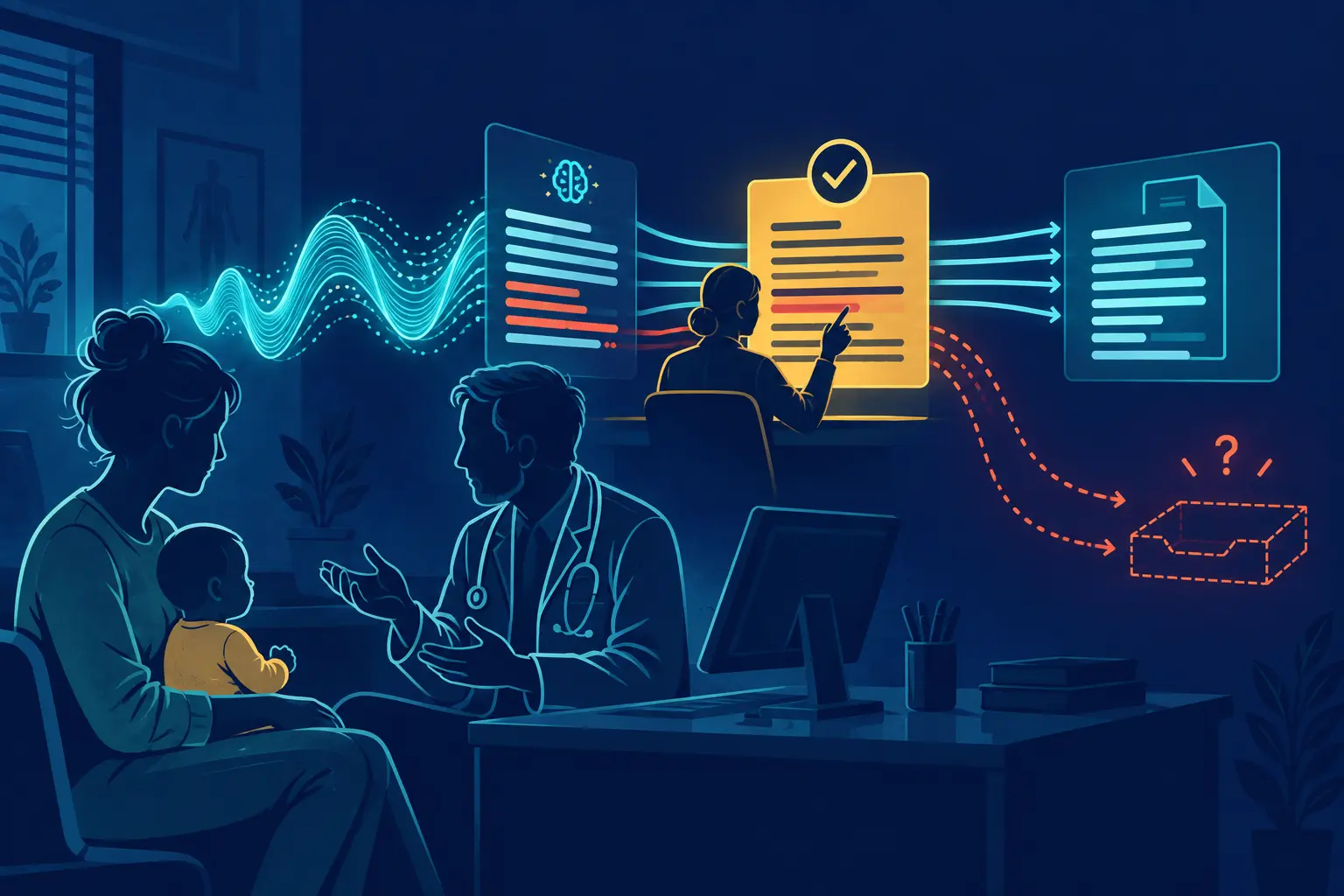
3. Superhuman heart disease detection, and the pathway that has to carry it
Tuesday opened with a Guardian piece on an AI tool spotting heart disease, followed quickly by the Telegraph version and links to the underlying work. The group liked the technology and immediately stopped talking about it. A hospital clinician who has just been given a comparable device to play with named the real hurdle: "ensuring there's a business case within existing NHS services to make using such tech financially viable." A member with a workforce interest extended it: if the patient hits bottlenecks downstream then the chance of better outcomes decreases, so it "needs a pathway view not just 'tech in this bit'". An integrated care operations lead was less measured: the NHS habit of putting everything in a silo "just wrecks innovation because of these bottlenecks and refusals to invest in both up- and down-stream prerequisites and dependencies", and offered as evidence a local emergency department that cannot see 111 referrals because the new EPR did not include them.
The clinical detail was good. A GP interested in AI diagnostics set out his intended pathway, BNP if heart failure is suggested and echo if the BNP is raised or valvular disease suspected, and drew the distinction that matters: this is screening in asymptomatic high-risk patients, not the usual testing of symptomatic ones. Asked what happens when new tech generates a referral, whether those referrals get bounced, the honest answer was that nobody has run it on real patients yet.
4. Running it yourself: hardware, local models and the pseudonymisation trap
A short question on Wednesday, what would you buy with £5,000 to £7,000 to run local models, opened the week's most practical thread. Suggestions ranged over the NVIDIA DGX Spark, EXO Labs tooling, and a comparison of a Spark against a Mac Studio by a well-known independent AI blogger who runs both. A member tracking hardware asked how the Spark's power draw compares with a rival at sub-400W with more GPU and CPU performance but less unified memory. Later in the week a member reported a call with a large server provider suggesting AI hardware costs will rise 15 to 17% over the next six months, with the obvious implication: if you are buying, do not wait.
Perplexity's hybrid compute announcement drew the most interest, with the promise of running a model locally and sending only what needs to go to the cloud. A GP partner deadpanned that "this will solve doing SARs inside of General Practice", then immediately clarified he was joking, for the benefit of several clinical safety officers in the room. A GP interested in AI diagnostics raised the serious version: whether you can define which fields and values get pseudonymised before anything leaves the building, because "any PII leakage would be catastrophic". The moderator was sceptical that the local model is doing much beyond PII handling and small agent tasks, with "grunt work still probably cloud".
Two members closed the loophole. A medicolegal commentator noted that pseudonymisation is fraught from an AI medicolegal perspective and is likely to be low-hanging regulatory fruit. The regulatory specialist made it concrete: "psedonymised data is still personal data, so you still need a DPIA etc etc. All you've done is add an extra control to your DPIA (pseuding), which is after all, basically a risk assessment." The ICO's own consultation on draft anonymisation guidance was shared the following day.
5. Documents you cannot search, and the practice that fixed it itself
The naive question is often the best one. On Tuesday a GP working in the digital health space asked why documents are stored in EPRs as file types that cannot be text searched, and why every document is not OCR converted so the whole record is keyword searchable. One member's cynical answer arrived first, that you cannot then sell a proprietary search engine and an ingestion tool, and was received warmly: "This is the level of cynicism that I can stand behind". The moderator offered the more boring explanation, processing and storage cost, plus the risk of introducing OCR errors, before suggesting the workaround of downloading, converting locally and reuploading, with the caveat that a parallel stack invites a data protection problem.
At which point a GP running an in-house AI service said his practice had already built it, as part of a document management suite, and that the blocker was never primary care: "it is SC & their IT leads / epr etc". The use case he described, consolidated summaries for complex patients under multiple teams, matched exactly what the original questioner had in mind, which was safeguarding and DWP reports and finding hidden information in patients with 500 or more letters.
On Friday the safety question caught up. A clinician asked what the regulations are, reasoning that scanning a letter and converting it introduces risk, especially from poor quality paper, and those letters then inform management. The practical answer was that they do not use OCR in the traditional sense but validate the output with a combination of techniques, that most letters arrive as digital PDFs, and that handwriting they cannot read is usually illegible rather than a technology failure, with 150dpi as the minimum standard. The moderator's read, explicitly not a formal determination, was that intended purpose is key and this is likely not a device if the purpose is administrative, code to code in digital form, though a safety case would still be needed and the in-house exemption question is a live one that an on-premises model might swing.
😄 Lighter Moments
The moderator asked a coding agent to build a game inspired by Breakout, then took a request. Within half an hour there was a working Balatro clone circulating with, by his own account, "lots of in jokes". The reaction from the member who asked for it: "Flipping heck, not sure if this makes me happy of very sad." Somebody else observed that a certain generation could now all unleash their inner arcade programmer.
The laptop question returned. A clinical safety consultant with a sluggish Surface Pro 9 and 16GB of RAM asked whether he could cope with switching to a Mac, and got the full spread of answers, including one member insisting a Surface Book 2 still holds its own against M3 machines and another warning that Parallels for Windows has limitations, contradicted a day later by "Parallels on Mac is really very good."
A radiologist, invited to admire another member's proximity to robot dogs at a defence-adjacent event, noted sadly that "My security clearance ain't as high". The same member later concluded, after a week of GPs discussing hardware budgets, that "You GPs have _WAY_ too much money given how much you throw at Tech & AI toys", and diagnosed the rest as "pure dead catting". And in the middle of a serious thread about pseudonymisation and cloud leakage, one member cheerfully announced he was off to connect a consumer AI assistant to all of his personal accounts that evening, "as that ship sailed a long time ago".
Best single coinage of the week, offered in response to yet another anxious blog post about an AI incident: "'Angstalytics' perhaps ?"
💬 Quote Wall
"How can a practice CSO possibly assess the likelihood that an AI receptionist will miss a cauda equina case?" — Clinical safety lead new to the group
"If you get through a hazard log review without at least one uncomfortable 'erm... is that really our exposure?' then your hazard log may be a fluff-piece." — Integrated care operations lead
"ultimately the human is going to human and that means clicking through...." — Clinical safety consultant
"so i tried to submit a yellow card about that AI coding incident - no actual category to do so. brilliant." — Clinician with a patient-safety reporting interest
"And remember you're CSO for that software for as long as you both shall live or stay married so it's not just about an initial embedding... regular monitoring and safety and quality checks and upgrades" — Cardiology-focused clinician, on the CSO's standing duty
"no course prepares you to be a jobbing CSO. You need to work with more experienced people / maybe be a deputy first." — Recently qualified clinical safety officer
"It needs to be funded. How it should be done comes next." — Group moderator, on national assurance
"This is very helpful, thanks - I'll revise my position." — Clinical safety lead new to the group, four hours after being corrected
📎 Journal Watch
Academic Papers and Key Studies
📎 Frontier models versus specialist clinical systems – Nature Medicine https://www.nature.com/articles/s41591-026-04638-6. Shared on Friday directly off the back of a question raised at an RSM event about whether general frontier models or purpose-built clinical systems perform better in clinical settings. The group's own read, informed by HealthBench trends, leaned towards specialist systems being better positioned. Read more
📎 New issue content – BMJ Digital Health https://bmjdigitalhealth.bmj.com/content/2/1/e000091. Posted Friday morning without commentary, which in this group usually means it is worth your own read rather than someone else's summary. Read more
📎 GlucoFM: a foundation model for continuous glucose monitoring – Google Research https://research.google/blog/glucofm-foundation-model-for-continuous-glucose-monitoring/. Flagged as potentially useful both for patients already on CGM and for research. Read more
📎 Reward seeking in reinforcement learning – Anthropic Alignment https://alignment.anthropic.com/2026/reward-seeker/. Summarised in the group as: if you skimp on checking for reward hacking during RL, do not be surprised when the model pursues it. Read more
Industry and News Articles
📎 Doctors' AI scribes get names of drugs and diagnoses wrong, NHS watchdog warns – The Guardian https://www.theguardian.com/society/2026/aug/31/doctors-ai-scribes-get-names-of-drugs-and-diagnoses-wrong-nhs-watchdog-warns. The anchor of Monday's discussion, with two group members quoted in the coverage. Read more
📎 GP leaders warn of inaccurate AI-generated hospital letters and patient complaints – Pulse Today https://www.pulsetoday.co.uk/news/technology/gp-leaders-warn-of-inaccurate-ai-generated-hospital-letters-and-patient-complaints/. Companion coverage, with a group member among the contributors. Read more
📎 44,657 referrals affected by Encompass IT problems, including 1,423 suspected cancer cases – NI Digest https://www.nidigest.com/en/2026-08-31/9574/44657-referrals-affected-by-encompass-it-problems-including-1423-suspected-cancer-cases/. Prompted the observation that DCB is not mandated in Northern Ireland, and a proposal to add this to the group's informal list of health IT harm examples. Read more
📎 Superhuman AI tool spots heart disease – The Guardian https://www.theguardian.com/technology/2026/aug/31/superhuman-ai-tool-spots-heart-disease. The Tuesday starting gun. The vendor site shared alongside it was https://cardiovolt.ai/, and the Telegraph ran its own version under the headline "NHS to use AI to catch undetectable heart disease in blink of eye" (https://www.telegraph.co.uk/news/2026/08/31/nhs-to-use-ai-catch-undetectable-heart-disease-blink-of-eye/). Read more Read more Read more
📎 On AI and the price of services – Financial Times https://www.ft.com/content/5240a6ac-b2e8-4897-a0a4-cbc7fc283bc9. Shared with the question of when the NHS will start asking providers to charge less because of AI. One member reported this is already happening in teleradiology, ironically in a space that currently requires more touch time, not less. Read more
📎 What skills AI engineers actually need – IEEE Spectrum https://spectrum.ieee.org/ai-engineer-skills. Offered as directly relevant to a whole pile of NHS careers. Read more
📎 Future-proofing your career against AI – The Times https://www.thetimes.com/life-style/work/article/jobs-ai-future-proofing-careers-comment-jqgzpc922. Shared mainly to ask what newspaper commentators on AI are smoking, and it triggered a genuinely thoughtful sub-thread from two members who run charities and are seeing demand rise, not fall. Read more
📎 Data breach affecting English airports – BBC News https://www.bbc.co.uk/news/articles/c74k39g3ee5o. Several members received breach notifications after paying for parking online, which is now the mandatory route. Read more
📎 – BBC News https://www.bbc.co.uk/news/articles/cp931m8n3p5o. An El Nino prediction made months in advance, used to bet on commodity futures. Read more
📎 Two contrasting takes on the model incident of the momen – : https://www.dwarkesh.com/p/openai-huggingface, described in the group as a doom and gloom blog that has generated debate, and https://joshuagans.substack.com/p/its-worse, whose conclusion is that the only way out now is through. Read more Read more
Technical Resources and Tools
📎 Perplexity hybrid compute – https://www.perplexity.ai/hub/products/hybrid-compute. Local plus cloud, with a choice of downloadable models. The group's open question is exactly which work stays on the machine. Read more
📎 NVIDIA personal AI router – https://www.nvidia.com/en-gb/ai-on-rtx/personal-ai-router/. Offered as an alternative to EXO for AI clustering at home or in a small office, across Windows, Mac and Linux. Read more
📎 local.ai – https://local.ai. Suggested as the way to work out what hardware your particular use case actually needs before spending anything. Read more
📎 Fable and Mythos 5.1 release – Anthropic https://www.anthropic.com/claude-fable-and-mythos-5-1. Immediately put through an informal group eval, with mixed verdicts by the end of the week. Read more
📎 CloudSaver – https://github.com/huifer/CloudSaver. Shared as the counter-argument to buying hardware at all. Read more
📎 A blogger who runs both a Spark and a Mac Studio – https://simonwillison.net/. Recommended as the place to find real side-by-side comparisons. Read more
📎 collusion.wiki – https://collusion.wiki/. Another agent message board found in the wild. Read more
📎 Is my deck any good – https://ismydeckanygood.com. Shared by a member building it: upload a deck, pick an investor type, get a first-look and a fix list. As the pitch put it, better to hear "this is not Series A yet" from a screen than from a silent inbox. Read more
📎 CSC-QT – https://csc-qt.curistica.com. The clinical safety case quality tool published the previous week, recommended in this week's CSO advice thread as a way to steer an assessment of the documentation an organisation already holds. Read more
Policy Documents and Official Reports
📎 Review of digital clinical safety standards: DCB0129 and DCB0160 – NHS England Digital https://digital.nhs.uk/data-and-information/information-standards/governance/latest-activity/standards-and-collections/review-of-digital-clinical-safety-standards-dcb0129-and-dcb0160. Consultation closes 11 September. If you read one thing on this list, read this one, and respond. Read more
📎 Consultation on draft guidance about anonymisation, pseudonymisation and research – ICO https://ico.org.uk/about-the-ico/ico-and-stakeholder-consultations/2026/08/consultation-on-draft-guidance-about-anonymisation/. Directly relevant to the week's hybrid-compute and pseudonymisation thread. Read more
📎 Strategic commissioning framework – NHS England https://www.england.nhs.uk/long-read/strategic-commissioning-framework/. Shared as the source for the new role of ICBs, described as high level in places with details still emerging. Read more
📎 Regulations and guidance for adopters – NHS digital regulations service https://www.digitalregulations.innovation.nhs.uk/regulations-and-guidance-for-adopters/. Proposed as the natural home for a central repository of implementation documentation. Read more
📎 Digital clinical safety in primary care: a practical guide – Wandsworth GP Federation https://share.google/Py2sPoAEcflFxdIz3. Praised in the thread as exactly the work that needs support, and a reminder that it only exists because somebody wrote a business case for funding. Read more
📎 A report on where the NHS has got to on deploying AI – , shared Thursday evening. https://lnkd.in/p/eW7WACjT. The recommendations and, more usefully, the recorded areas of disagreement were both flagged as worth reading. Read more
🔭 Looking Ahead
The DCB0129 and DCB0160 consultation closes on 11 September. That is next Friday. Given how much of this week was spent arguing about what those standards can and cannot carry, a group response would be more useful than a group discussion.
Expressions of interest are open for an AI in healthcare simulation programme, running scenario-based workshops for 40 to 50 people at a time, with funding already covered and systems or groups of organisations sought to run them with: https://clearprogramme.org.uk/2026/09/02/ai-in-healthcare-simulation-programme-expression-of-interest-open/. Applications from group members are welcome.
Two dates for the diary: the Health Foundation's AI in the NHS 2026 webinar on 15 October (registration) and the BCS Primary Health Care specialist group's 45th annual conference and education day in October, with AI featuring as you would expect (tickets).
CSO Coffee and Chat continues to meet on the first Thursday of every month, and several members asked how to get back on the invite list after a recent change. Ask in the group and you will be pointed the right way.
Unresolved, and worth returning to: whether there is any real appetite among GP practices for a shared register of AI tools in use, and whether it could be built without becoming a stick. Whether national assurance of parts of DCB0129 could work even if DCB0160 cannot be centralised. And whether anyone can point to a route for reporting an AI or digital health incident that actually has a category for it.
🧬 Group Personality Snapshot
The best thing that happened this week was somebody changing his mind in public, quickly, and saying so. A new member arrived with a strong, well-argued position, met a specialist who knew the regulatory machinery from the inside, and four hours later posted a revised version with the conditions he still wanted met. That exchange is the group at its best: two people who both know a great deal, disagreeing precisely rather than generally, and finishing somewhere better than either started.
The rest is familiar and rather comforting. Nobody is impressed by a headline. A superhuman AI tool gets thirty seconds of admiration and then twenty messages about business cases, referral bottlenecks and whether the local emergency department can even see the referral. The cynicism is real but it is load-bearing, and it comes packaged with people who have actually built the thing they are complaining about the absence of. And the community continues to do its most useful work in the unglamorous register: reposting a consultation deadline, telling a newly trained CSO that the course was the easy part, and explaining, patiently and for the third time, that pseudonymised data is still personal data.
APPENDIX A: Detailed Activity Analytics 📊
📬 Total Messages: 351
📈 Peak Day: Thursday 3 September (109 messages)
🔥 Most Active Period: Afternoon, 12:00-18:00 (144 messages)
💬 Average/Active Day: 44 messages
🏖️ Weekend Activity: 5.4% (19/351)
💼 Weekday Activity: 94.6% (332/351)
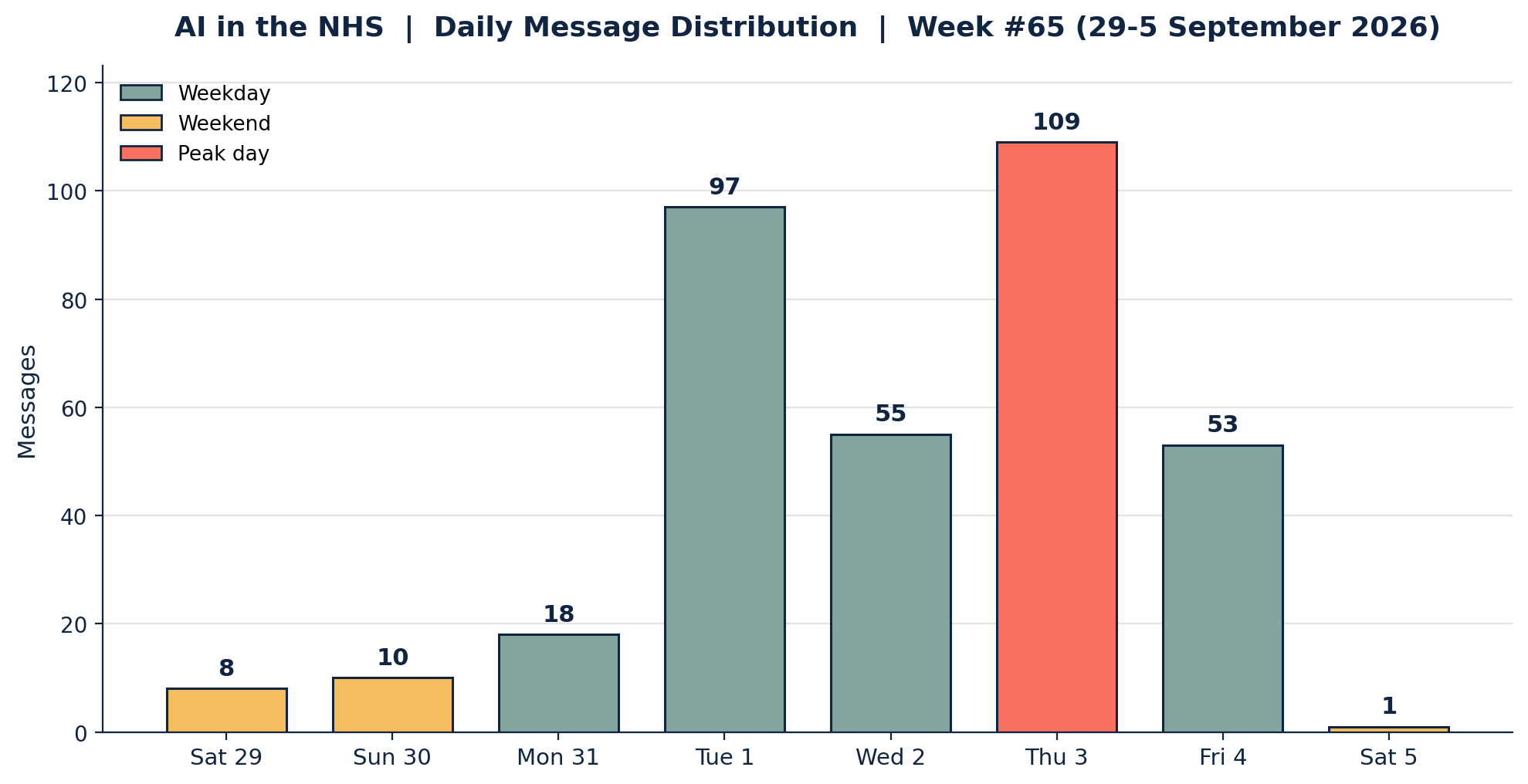
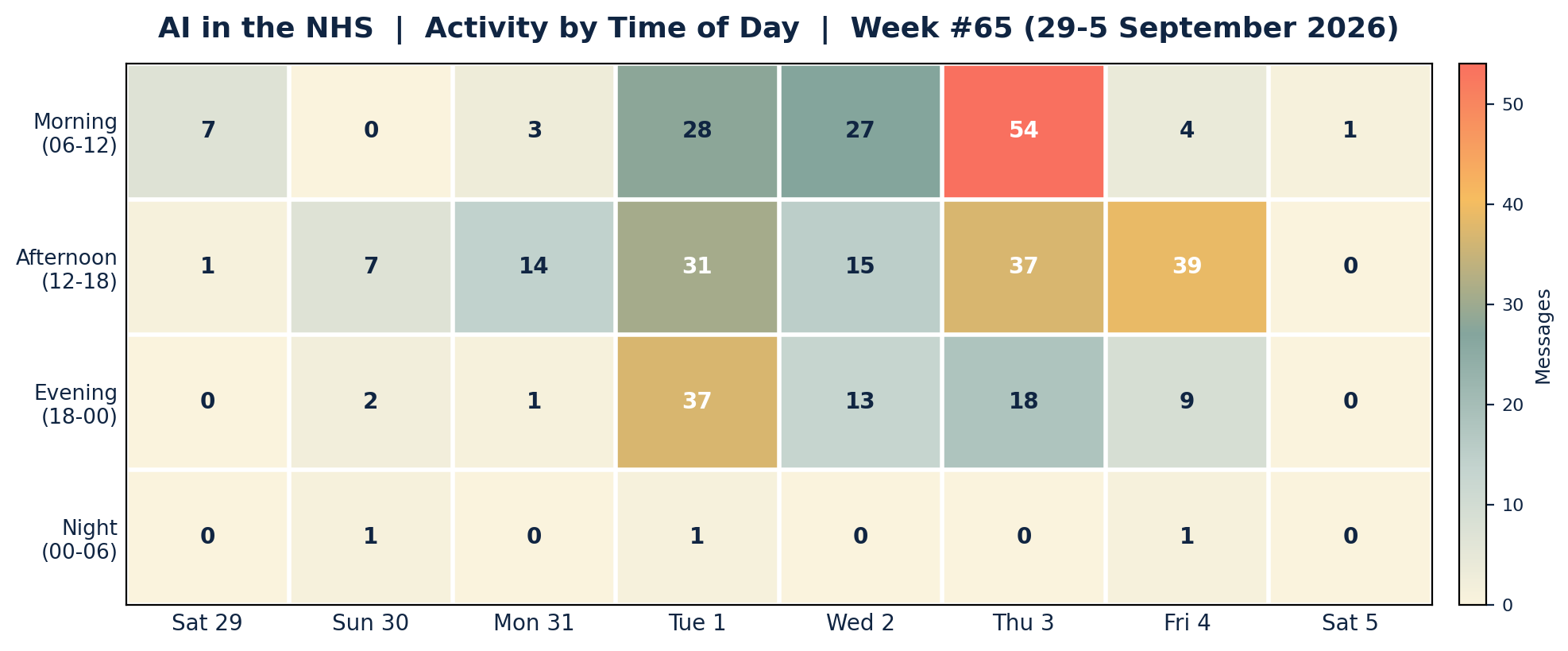
Patterns worth noting. This was the most working-week-concentrated issue in recent memory, with the weekend contributing under 6% of traffic. Thursday's peak was front-loaded, 54 messages before noon, driven by a single continuous clinical safety thread that ran from mid-morning through to the evening. Tuesday's shape was different: a steady build across morning and afternoon around cardiology AI and CSO training, then a substantial evening burst of 37 messages as a model release, a laptop question and a game-building diversion overlapped. Night activity was essentially nil, with three messages across the entire period.
APPENDIX B: Enhanced Statistics
52 group members posted at least one message this week. The 15 most active below account for 262 of the 351 messages (74.6%), a slightly more concentrated distribution than usual, with a long tail of occasional and one-off contributors making up the rest.
Top 15 Contributors (Role Descriptors Only):
1. The group moderator: 80 messages
2. A GP running an in-house AI service in his own practice: 26 messages
3. A primary care digital policy lead: 23 messages
4. A radiologist and clinical governance advocate: 20 messages
5. A GP interested in AI diagnostics: 17 messages
6. A GP partner: 14 messages
7. An integrated care operations lead: 13 messages
8. A medical device regulatory specialist with a radiology background: 11 messages
9. A recently qualified clinical safety officer: 11 messages
10. An NHS trainee with a hardware and hackathon interest: 10 messages
11. A cardiology-focused clinician with a regulatory interest: 9 messages
12. A clinical safety consultant: 8 messages
13. An ICB primary care digital lead: 7 messages
14. A wry health-tech watcher: 7 messages
15. A clinician with a patient-safety reporting interest: 6 messages
Hottest Debate Topics:
1. 🔥🔥🔥 Clinical safety capacity in general practice and whether assurance can be national (approximately 75 messages across Thursday)
2. 🔥🔥🔥 Cardiology AI, business cases and downstream pathway bottlenecks (approximately 35 messages across Tuesday)
3. 🔥🔥 Local model hardware, hybrid compute and pseudonymisation risk (approximately 32 messages across Tuesday to Wednesday)
4. 🔥🔥 AI scribes, the watchdog report and the missing incident-reporting route (approximately 20 messages across Monday and Friday)
5. 🔥🔥 Frontier versus specialist models, and which assistant is actually better this month (approximately 18 messages across Thursday and Friday)
6. 🔥 Unsearchable EPR documents and the in-house OCR fix (approximately 17 messages across Tuesday and Friday)
7. 🔥 Laptops, Surface versus Mac, and whether Parallels is any good (approximately 12 messages across Tuesday and Wednesday)
Discussion Quality Metrics:
• Evidence-Based vs Opinion Ratio: roughly 15% of messages carried a link to a paper, guideline, report or product source
• Average Thread Depth: approximately 6 messages per sustained discussion thread, with the Thursday assurance thread running to well over 40
• Constructive Challenge Rate: notably high this week, with at least three explicit partial disagreements that ended in a stated change of position
• External Resource Sharing: 52 unique links shared across the period
Cross-Expertise Engagement:
Contributions came from general practice, hospital medicine, radiology, cardiology, clinical safety, medical device regulation, information governance, ICB and commissioning roles, health policy, charity leadership, product and startup founders, and NHS trainees. The Thursday clinical safety thread was the most cross-disciplinary of the week by some distance, drawing GPs, an ICB digital lead, an ICB clinical safety officer, a device regulatory specialist, a radiologist and a policy lead into a single continuous argument. The clearest instance of knowledge transfer was the regulatory specialist's explanation of what an Approved Body actually reviews under ISO 13485 and ISO 14971, which visibly changed the position of a senior clinical safety practitioner within the same afternoon.
APPENDIX C: Daily Theme Summary
Saturday, 29 August 2026
Primary Theme: Incentives, workforce norms and job planning Key Discussion: A quiet start, carrying over the previous week's argument about the disconnect between decisions on delivering a service and decisions on funding it. One member recalled how quickly a supposedly safety-critical practice disappeared once consultants had to sign off the overtime it required, and wondered aloud what other norms would evaporate if incentives were properly aligned. Secondary Discussions: Agenda for Change as a gamed system, where job descriptions demand decision-making autonomy that the post-holder never actually gets; a correction to the previous week's newsletter link. Notable: 8 messages, the second-quietest day of the period.
Sunday, 30 August 2026
Primary Theme: Training, humanising the workforce, and an event sighting Key Discussion: An early-morning argument for becoming a trainer, including the practice of insisting trainees book their first week of leave at induction, which turns out to be better for service planning as well as for the trainee. Framed explicitly as more important, not less, in an automation age. Secondary Discussions: A first sighting of a healthtech hackathon poster at Oxford Circus; an OpenAI event link; whether a consumer AI assistant can retrieve documents from Outlook, answered in the negative outside of computer use. Notable: An AI doom and gloom blog shared late in the evening, which set up Monday's more sceptical reading.
Monday, 31 August 2026
Primary Theme: The NHS watchdog report on AI scribes Key Discussion: A Guardian report on scribes mistaking drug names and diagnoses was met with a detailed argument that none of this is new, that the defining control is the human check, and that where a patient has spotted an error the failure has run through every known control. Two group members were quoted in the coverage. Secondary Discussions: GlucoFM as a foundation model for continuous glucose monitoring; a Health Foundation webinar announcement; disagreement over the doom-laden framing of the weekend's blog post; whether the discussion is being overcomplicated when the real issue is people cutting corners. Notable: The two questions that went unanswered all week were asked here: what is the feedback loop, and what is the QA process.
Tuesday, 1 September 2026
Primary Theme: Cardiology AI, and how to become a clinical safety officer Key Discussion: A superhuman heart disease detection headline generated brief enthusiasm and then a sustained conversation about business cases, downstream capacity and whether new referrals would simply bounce. Separately, a GP asked for advice on choosing between CSO training routes and received the most useful answer of the week: the course is the easy part. Secondary Discussions: The absence of a Yellow Card category for AI coding incidents and a proposal for a blue card system; NHS silo behaviour and an emergency department that cannot see 111 referrals; why EPR documents cannot be text searched; a model release and an impromptu game-building eval; the recurring laptop question. Notable: 97 messages, with 37 of them after 18:00. The advice thread for the aspiring CSO produced a clear practical sequence: get trained, then get supervised experience, then inventory your organisation's digital tools and audit the documentation gap.
Wednesday, 2 September 2026
Primary Theme: Hardware, local models and hybrid compute Key Discussion: A £5,000 to £7,000 budget question opened into a comparison of home and small-office AI hardware, followed by Perplexity's hybrid compute announcement and a serious exchange about whether pseudonymisation before anything leaves the building is sufficient. It is not: pseudonymised data remains personal data. Secondary Discussions: A widely shared prediction that a thousand healthtech AI startups have lost their moat; the Northern Ireland Encompass referral failure and whether any clinical risk management was in place; a data breach affecting several English airports; the resurgence of blockchain at hackathons, greeted with appropriate scepticism; AI hardware costs forecast to rise 15 to 17% in six months. Notable: The Encompass story was proposed for the group's informal register of health IT harm examples, with the observation that DCB is not mandated in Northern Ireland.
Thursday, 3 September 2026
Primary Theme: The clinical safety crisis in general practice, and whether assurance can be national Key Discussion: The week's dominant thread, running from a college register proposal through trust in national bodies, ICB capacity, the GMS contract entitlement to CSO support, and into a detailed argument about what a Class IIa+ registration and a manufacturer's DCB0129 actually assure. It ended with a senior practitioner publicly revising his position after a regulatory specialist explained what an Approved Body reviews. Secondary Discussions: The DCB0129 and DCB0160 consultation deadline of 11 September, flagged twice; the ICO anonymisation consultation; ICB reorganisation and the shift of performance management to NHS England as it folds into DHSC; a well-known clinical safety practitioner welcomed into the group; a report on NHS AI deployment shared in the evening; a pitch deck review tool. Notable: 109 messages, the peak day, with 54 before noon. Also the day the group produced its best rule of thumb: if a hazard log review passes without one uncomfortable moment, the hazard log may be a fluff-piece.
Friday, 4 September 2026
Primary Theme: Which assistant is actually any good, and is OCR a device? Key Discussion: A candid round of model comparison, with several members reporting they had drifted back towards one assistant and away from another, one calling a recent release overly baroque in its language and another simply saying the new model is not that good. In parallel, a regulatory question about document scanning produced a careful answer on intended purpose, explicitly flagged as not a formal determination. Secondary Discussions: A Nature Medicine paper on frontier versus specialist clinical models, shared off the back of a question raised at an RSM event; an AI simulation workshop programme seeking host systems; sovereign AI funding opportunities; dictation tools and whether the subscription is justifiable; a light-hearted round of GPs being accused of having too much money for toys. Notable: 53 messages, with the afternoon busier than the morning, and the week's most affectionate insult delivered by a hospital doctor to the assembled general practitioners.
Saturday, 5 September 2026
Primary Theme: Weekend reading Key Discussion: A single message, a link to a Saturday ramblings post, closing the period. Notable: 1 message before the 09:00 cut-off.
AI in the NHS Weekly Newsletter is produced by Curistica Ltd for members of the AI in the NHS WhatsApp community. All contributors are anonymised. Views expressed are those of individual community members and do not represent any organisation.