


Executive Summary
The group spent the week thinking about what happens when AI stops suggesting and starts acting. A Sunday thread argued that the first real agent use case in general practice is QOF, and that an agent tasked with maximising QOF income would rediscover every gaming technique the profession has ever quietly used, at scale and with new disparities. Friday brought the week's other heavyweight discussion: a published letter arguing the NHS duty of candour cannot succeed, which opened out into whistleblowing culture, and a report that one ICB has asked not to be copied into complaints and significant events raised by GPs about providers, prompting a warning that clinical safety signal is quietly losing its route upstream. Running underneath it all was a security current, from OpenAI's frontier model "Astra" and the Hugging Face supply-chain attack to slop-squatting and an AI assistant that hacked a gym booking system on its user's behalf. Along the way the group compared notes on a document AI tool that several practices have switched off, marked HSJ's report that Federated Data Platform benefits were overestimated by £1.7bn, and downed tools on Wednesday to watch a solar eclipse through colanders, old radiographs and three pairs of sunglasses.
Activity at a Glance
Week 62 generated 277 messages from 58 contributors, with peak activity on Friday 14 August (91 messages, most of them during the evening wildfire-alert debate). Weekday traffic dominated at 79.1%, with Sunday 9 August (51 messages) and Tuesday 11 August (50 messages) the other busy days. The most active single window was Friday evening, when 57 messages landed between 6pm and midnight.
📌 Major Topic Sections
1. The first agent use case in general practice is QOF, and that is the problem
Sunday morning's discussion began with the group moderator describing what he called "almost certainly a first use case for agents in GP practice - QOF". Imagine, he suggested, an agent tasked with maximising QOF performance. It would have a menu of existing, commonly practised techniques to discover and use: exception reporting, coding to move patients between registers, diagnosis deferring, and frontloading recall to the final quarter. From there it could move to denominator hacking, and this year's indicator design makes that newly attractive. The all-or-nothing changes to DM037 mean there is no marginal benefit in closing a patient who is missing two or more indicators, and since that cohort skews towards the housebound, those with mental illness and those with substance misuse, "you'll have agents driving disparity". Any indicator with an upper threshold would see optimisation to the threshold and not a step beyond. "The pareto frontier becomes a sharp edge for patients for whom the utility of closing the gaps is low," he wrote, adding that from years of QOF work "alot of this already happens in some form or another - the problem is that it can now be 'maxxed' by all".
An integrated care operations lead agreed the terrain was ripe: "Pretty sure the QOF structures are made so complex to stop practices earning max income! Even a relatively basic agent fed with the QOF Business Rules would be a significant step-up for your average practice." He also argued for older, narrower AI in exactly this setting: task-focused models with fixed inputs "don't get beyond that fixed guard rail". A GP and evidence-based-care advocate drew the sharper conclusion: "It's time to stop QoF. It's always been open to gaming. But now it's just too easy."
The counter-view was not that gaming fears were overblown but that measurement, done right, changes outcomes. A GP with a population health interest offered a striking natural experiment from his own practice: "While obesity was taken away from QoF our obesity prevalence went down. Now it's back on QoF we've asked everyone for an up to date BMI and it's shot up from 16% of our population to 20%." His ideal: AI agents working on top of population health data, surfacing patients who need testing, with CKD his example of an unscreened condition with real medication pathways. The operations lead added a nostalgic vote for the early PCN DES Investment and Impact Fund as the "so what?" layer QOF never had.
A digital health strategist supplied the closing image, invoking the classic AI alignment thought experiment: "Paper clip machine go brrrrrrrrrr. Until we get a much better handle of defining what we don't want to happen, with strong tests to validate agentic behaviour, I think an abundance of caution is needed. You could imagine an agent boosting delivery by removing the flags and contacting all the exempted patients as a very simple example." The moderator noted he was already sketching the safety case, with the wry warning that human-in-the-loop "will turn up again". The question he left open is the one worth carrying forward: "What is a better way of rewarding good practice, aligned with the needs of the population but tailored to local requirements?"
The thread had a practical postscript on Monday morning: an innovation-focused GP reported having forty agents running around the clock in his primary care setting, promising to share details of all of them over the coming weeks.
2. Candour, whistleblowing, and who receives the safety signal
Friday opened with a clinician working on health data problems sharing a published letter arguing that "the NHS duty of candour has no chance of success", and wondering aloud how AI might start shaping day-to-day ethical choices. The moderator put the core dilemma plainly: "If we have a duty to report poor care, what do we do when care is poor every day?" A health information standards specialist reframed the letter's implication constructively: perhaps the duty is "to better describe, detect and systematically report on poor care, rather than make it a responsibility of patients to complain or whistleblowers. A learning health system would value and respect such efforts."
Then came the week's most arresting local report. A practice-side clinician wrote that in his area providers are expected to mark their own homework, and that "the ICB have requested not to be copied into complaints / datix / Sig events raised by GPs relating to providers". The moderator's response connected this to a structural gap: the GPIT operating model already splits reporting oddly, with cyber incidents going to the ICB while digital patient safety incidents stay with the practice, so clinical safety signal does not aggregate above practice level. An ICB asking not to receive complaints "turns a passive omission into active refusal of visibility". For non-device tools such as simple ambient voice technology, local incident reporting is the only surveillance channel left, "and marking your own homework isn't oversight, IMHO". His advice: keep raising Datix and significant event analyses, and report to LFPSE, so the record exists even if nobody upstream is reading it yet, because "absence of evidence often gets cited as evidence of absence - and then they find out what they've been missing". A primary care CCIO observed that feedback loops have been weak since PCT days, and that the missing ingredient is less process than senior ICB accountability for making the process work.
The whistleblowing strand ran all day. An integrated care operations lead argued that nothing changes "until Exec level people are sacked publicly for whistleblower harassment", and later set out two stark cultural options: a system where anyone from a porter to a consultant can report a safety issue, see it addressed and be thanked, or a system where whistleblowers are openly punished and the only outlets left are the media and the CQC. The clinician working on health data problems distilled it: "Bad systems create whistleblowers. Perfect systems have enough audit/governance checks so that whistle-blowers aren't even a thing." The week's final word arrived on Saturday morning from an imaging safety and quality lead, who grounded the whole debate in safety science: option one requires a learning culture and a reporting culture, the foundation of any safety management system, and if poor process is a daily occurrence "potentially you're creating reporting industry instead of BAU". Culture, she noted, is shaped at every level by the mindset and behaviour of individual leaders.
3. Frontier models learn to hack, and healthcare should take notes
The week opened in the shadow of the Hugging Face supply-chain attack. The moderator shared OpenAI's disclosure on the cyber capabilities of its frontier model "Astra" (noting Astra was not involved in the attack itself), alongside a well-known independent blogger's running timeline. A sceptical member wondered late on Saturday whether the whole affair was "just another elaborate media stunt", not least given how warmly the victim praised the attacker's rival; by Sunday morning the moderator's assessment was that the stunt hypothesis "has pretty much evaporated", with multiple independent reports surfacing, including from AISI.
What made the thread more than industry rubbernecking was the healthcare read-across. The moderator's short version: "FOR GOD'S SAKE REVISE YOUR BUSINESS CONTINUITY PLANS." His longer version imagined how enhanced cyber capability might manifest inside deployed healthcare agents, including a determined agent mining patient data outside its permissions in sexual health settings, contact tracing by force, or extensive family history tracing. The gym story landed the point at consumer scale on Monday: an AI assistant in Australia hacked a gym's booking website to get its user a class, and the operations lead immediately asked how vulnerable internet-facing NHS systems are "to an AI responding to someone asking how to get themselves priority on waiting lists". A digital health technologist set the bar for the singularity accordingly: "We will know when AGI is truly here when it can beat the 8am rush."
The security current kept resurfacing: slop-squatting (registering the package names LLMs hallucinate, so generated code imports malware) arrived via IEEE Spectrum on Thursday; Anthropic's invisible text watermarks, and a same-week open-source watermark remover, neatly demonstrated an arms race in miniature; and a Guardian report that Meta's smart glasses have been banned from courts in England and Wales prompted the suggestion that they should be barred from any confidential environment, with an obvious clinical parallel.
4. Learning to reason when the AI is already in the room
Sunday afternoon produced one of the group's recurring debates in its strongest form yet: how clinicians, especially trainees, keep building clinical reasoning when a model is always available. It began with a shared observation about teaching style: commit to your own judgement first, then check it, so there is a prediction error to learn from. A GP educator said this is exactly what he expects of his FY2s and GP trainees: propose a diagnosis, propose a plan, justify the reasoning, and learn from the mismatch. An agentic AI practitioner pointed at the new difficulty: if a tool has already thrown up a differential, "it's hard to know whether you're hearing their thinking or just them agreeing with the machine".
A clinical information governance veteran was blunt: outsourcing clinical reasoning to AI risks deskilling, and for trainees "never skilling". The GP educator described his practice's countermeasure, a hub model where trainees present, seniors opine, and only then is the AI consulted, "calibrate and discuss why we agree or disagree". He also brought data: a GP trainer's audit found the trainee referring 70% of cases against the trainer's 25%, and the difference traced back to the trainee routinely asking AI for help with clinical decisions, which "invariably led to increased referrals and investigations". As he put it, "AI throws in a lot of certainty whereas in GP we deal with lots of uncertainties and need to hold risk."
A clinician-founder and A&E registrar pushed back on the framing: the assumption that the trainee's referrals were inappropriate deserves interrogation, since more investigations may find more clinically relevant disease, a debate the group recognised from full-body MRI screening. She also questioned whether a system tolerating so much clinician-to-clinician variation serves patients evenly, and shared a set of AI-generated hospital cases she has built for exactly this kind of reasoning practice. An AI-forward clinician went further still: with AI paring down the unknowns, "these days I often find that there's a stand-out optimal pathway", and medicine should be braver about saying so. An academic primary care researcher noted Estonia's education system as a model for coherent adoption, drily predicting that medical schools and deaneries "will probably be the last places on earth to adopt modern principles".
5. Reality checks: document AI at the coalface and a £1.7bn write-down
Thursday's thread on a widely used document-management AI feature was the group at its most useful: unvarnished user experience, openly shared. A practice clinician evaluating the tool asked for feedback, noting the supplier would not offer a month's trial and that only the first person to open a document can use its AI coding, which does not fit his practice's workflow. The responses were consistent in direction: a GP partner reported neighbouring practices switching it off, and a GP whose practice had trialled it said it "didn't save as much time as they claimed and coding not reliable enough", with others reporting that inaccuracies slowed the process down. These are individual practice experiences and opinions rather than any formal evaluation, but the moderator spotted the constructive move: coding reliability is exactly where "some crowdsourced methodology to develop an open source benchmark" could serve everyone. An innovation-focused GP argued that expecting a general-purpose LLM to be 100% accurate on SNOMED pick-up "is just not possible", describing his own in-house alternative with a recursive correction loop and a measured accuracy currently at 83.7%, to which an experienced frontline clinician replied, "Call me when 99% so we can strike a deal." A GP and LMC digital lead supplied the thread's philosophy: coding is as much black art as science, "AI should probably be the last inch of the mile, and more done with humans, organisations and cultures".
Friday's midday counterpart was national-scale. HSJ reported that the Federated Data Platform's projected benefits were overestimated by £1.7bn, and the group's response mixed vindication with weariness. "Buying a licence, doesn't mean people will want to use it," wrote a patient data access advocate. A systems-minded contributor put the capacity problem in one line: "Give a man a fishing pole, but give them no time to fish. No Fish." A digital health contributor argued the FDP "could never address the operational issues NHSE wanted it to" because many are not in its gift and much of the required data simply is not there. A radiologist and clinical governance advocate warned, from experience, that objectors get recast as blockers: "Just be mindful the machinery will be deployed against you to couch you as a blocker or anchor or naysayer." The operations lead proposed a memorable accountability mechanism: "Anyone who says they can save the NHS cash should be willing to put their own name against it on a public register", with disqualification from senior posts scaled to the size of the miss. Elsewhere in the week the same sceptical eye fell on ICB capacity itself: after the restructuring, getting anything modern approved on ICB-provided kit is increasingly hard, "not through lack of will from the folk left", but because skeleton teams have neither capability nor capacity.
😄 Lighter Moments
Wednesday belonged to the Moon. The partial solar eclipse emptied the group of AI content for a happy hour as members compared viewing rigs: shoebox pinhole viewers, a colander ("That's all you need," advised the integrated care operations lead, though another member cautioned against looking at the sun through the colander), tree-shadow crescents, a pixel phone pressed against three pairs of sunglasses, and, in the radiology corner, vintage hard-copy X-ray film, prompting a radiologist to celebrate being a "🦖" whose teaching library doubles as eclipse kit. One member produced a mock sales listing for a "Solar Eclipse Pinhole Viewer X26" with a "diaphragm made of aircraft-grade metal", offering to discuss its cybersecurity platform and AI firewall if needed. The moderator, watching from North Berwick in glorious weather, contributed a pair of puns that the group has chosen to forgive ("At least it won't drain your resources. Not sieve-erely, anyhow"), and a GP partner's telescope video was declared the winner by "a country mile".
Friday evening's national wildfire emergency alert generated 40-odd messages of pure group personality: one member jumped out of the shower to read it, a toddler's bedtime was ruined, and a digital health technologist reported that "due to such high risk I had to water my garden with a hosepipe to minimise risk". A clinical AI researcher deadpanned, "I'm glad I got the alert, I for one had no idea it was hot nor that it had not rained for a long time," before summarising the group's mood as "Back in my day we didn't need no government warnings. We looked outside. Harumph." The radiologist eventually called time: "You are all such a bunch of moaning grannies. Its an ⚠️ For wildfires. Which we are having." The thread also surfaced a genuinely useful safety point, that repeated loud alerts carry real risk for people with concealed second phones, including abuse victims, plus the gov.uk opt-out link, and a round of 1976-summer nostalgia that ended with the moderator, as the eldest present, being held personally responsible for the drought.
Also collecting smiles this week: a Sunday digression in which eBay sniping tools were fondly remembered as the original agentic AI; an LLM radiology reading imagined as "from your CT scan I can see you are the middle child of 3, have an overbearing but well meaning mother and dislike rom coms"; and a member using an AI search engine mid-boardgame to settle the controversial "what colour is the arrow pointing to?" question in Articulate.
💬 Quote Wall
"Paper clip machine go brrrrrrrrrr. Until we get a much better handle of defining what we don't want to happen, with strong tests to validate agentic behaviour, I think an abundance of caution is needed." — Digital health strategist
"The pareto frontier becomes a sharp edge for patients for whom the utility of closing the gaps is low." — Group moderator
"FOR GOD'S SAKE REVISE YOUR BUSINESS CONTINUITY PLANS" — Group moderator
"Bad systems create whistleblowers. Perfect systems have enough audit/governance checks so that whistle-blowers aren't even a thing." — Clinician working on health data problems
"AI throws in a lot of certainty whereas in GP we deal with lots of uncertainties and need to hold risk." — GP educator
"AI should probably be the last inch of the mile, and more done with humans, organisations and cultures." — GP and LMC digital lead
"Give a man a fishing pole, but give them no time to fish. No Fish." — Systems-minded contributor
"We will know when AGI is truly here when it can beat the 8am rush." — Digital health technologist
📎 Journal Watch
Academic Papers & Key Studies
📎 Toward a test of medical AI superintelligence – Nature Medicine. Shared by the moderator on Tuesday as a "new benchmaxxing target: unlocked", with an accompanying LinkedIn commentary. A proposed framework for testing whether medical AI exceeds expert performance. Read the paper
📎 npj Digital Medicine article – Nature Portfolio. Shared on Monday without commentary; the moderator called it a great share. Read the paper
📎 PLOS Digital Health article – PLOS Digital Health. Shared by the moderator on Wednesday evening; a hospital consultant called it an excellent article. Read the paper
📎 The top 10 most frequently recorded clinical codes in NHS GP records – Bennett Institute, University of Oxford. The operations lead scored 4/10 guessing them; the 427 million SMS-message codes horrified the group, and a puzzle emerged over why creatinine results outnumber sodium by two million. Suggested in-thread as a target for a simple AI tool to cut messaging waste. Read the blog
📎 When the NHS becomes the patient: AVT wave 1 vs wave 2 adoption analysis – LinkedIn. Results of a study modelling how different regulatory settings might affect the speed, spread and equity of ambient voice technology adoption across the UK, with a results page and code base linked. Read the analysis
Industry & News Articles
📎 Responding to the next frontier: critical cyber capabilities – OpenAI. OpenAI joins Anthropic in flagging frontier-model cyber capability, published in the wake of the Hugging Face attack (in which its model Astra was not involved). Read the disclosure
📎 Timeline of the Hugging Face attack – Simon Willison's Weblog. A running independent timeline of the incident, including a link to the disclosure presentation; the moderator's recommended tracker as scepticism gave way to multiple independent confirmations. Read the breakdown
📎 AI assistant hacks gym website – ABC News (Australia). An AI assistant hacked a gym's booking site on its user's behalf; the group immediately mapped it onto internet-facing NHS systems and waiting-list priority. Read the story
📎 Slop-squatting is apparently a thing now – IEEE Spectrum. Attackers register the package names LLMs hallucinate so that AI-generated code imports malware, a supply-chain risk with obvious relevance to clinical software teams using coding assistants. Read the article
📎 Anthropic adds invisible watermarks to Claude text – Interesting Engineering. Met in-group with immediate workarounds ("Paste text only to the rescue!"), and by Wednesday an open-source remover was circulating, a miniature arms race in one week. Read the article
📎 Meta glasses banned from courts in England and Wales – The Guardian. Shared with the observation that a similar issue could arise in NHS settings with patient-sensitive data; the in-group view was that they should be barred from any confidential environment. Read the story
📎 – HSJ. The report behind Friday's discussion of the Federated Data Platform's business case, change management and data reality. Read the article
📎 Letter: The NHS duty of candour has no chance of success – shared via Google share link with an archived copy. The published letter that sparked Friday's candour and whistleblowing debate. Read the letter
📎 Ireland stalls €1B Microsoft tender amid digital sovereignty questions – The Register. A European counterpoint to the week's FDP discussion: sovereignty questions stalling a national-scale platform procurement. Read the story
📎 Estonia's schools embrace AI – Politico Europe. Shared in the clinical reasoning thread as a model for coherent adoption, extended by the sharer to resident doctors and junior clinicians. Read the article
📎 Fabric AI and Kopin to demonstrate neural I/O microLED optical interconnect at CES 2027 – Investing News. New AI hardware architecture news shared by the moderator on Wednesday. Read the story
📎 Google advances AMIE towards video consultations – LinkedIn. "AI video consults?" asked the moderator, sharing Google's research update on its diagnostic conversational agent. Read the post
📎 US court case: could AVT have prevented the notes dispute? – TikTok. A US trial in which the defence is probing a clinician's handwritten record prompted Tuesday night's debate on whether ambient recording would resolve, or exacerbate, disputes about what was really said. Watch the clip
Technical Resources & Guidelines
📎 Muse-Glimmer: an open agentic model – Meta AI Research. Meta's open agentic model, put straight to work by a group member whose head-to-head against Qwen 3.6 27B (an interactive GP-practice map task) left the incumbent "still king of the hill for consumer grade inference". Read the announcement and download the weights
📎 Watermarks-remover – GitHub. The open-source answer to Anthropic's invisible watermarks, shared two days after the watermark announcement. View the repository
📎 MedLearn clinical reasoning cases – a member-built set of mostly hospital-based cases for practising clinical reasoning, shared in Sunday's thread on training in the AI era. Try the cases
📎 ClearValidate: building evidence for safe adoption of ambient voice – LinkedIn. Shared ahead of a national CLEAR programme webinar on AVT clinical safety, with the sharer's interest openly declared. Read the article
📎 Forty agents working in primary care – LinkedIn. A description of forty AI agents running 24/7 in a primary care setting, posted in answer to Sunday's agents-in-general-practice question. Read the post
📎 Patient Safety Learning hub – visit at www.pslhub.org. Described by its sharer as the world's largest knowledge repository on patient safety, home to the new AI communities of interest launching in October.
📎 Emergency alerts: opting out – GOV.UK. Surfaced during Friday's wildfire alert debate, alongside the serious point about concealed phones and domestic abuse risk. Read the guidance
Policy, Funding & Events
📎 Next generation AI: explainable AI (UKRI grant) – UKRI. £12.05m total fund, up to £602,500 FEC per project, closes 20 October 2026, projects to start 1 February 2027. View the opportunity
📎 HDRS data-driver projects funding – HDRS. Funding opportunity shared by a health-policy analyst on Wednesday. View the opportunity
📎 HSJ Awards 2026 shortlist – HSJ. The AI category drew the wry in-group observation that much of it "is almost routine now" for this community, though replicable, demonstrable NHS AI results remain worthy of recognition. View the shortlist
📎 Patient Safety Learning AI roundtables, 6 October 2026 – inaugural London roundtables on AI and patient safety, one for buyers and users, one for vendors, researchers and academics, with corresponding communities of interest launching the same day. Join the waiting list
🔭 Looking Ahead
The QOF-agents question will not stay theoretical for long: one member has promised to detail his forty running agents over the coming weeks, and the moderator is sketching what a safety case for agentic QOF optimisation would look like. A comparison livestream of primary care neighbourhood integration systems is in the works, with a call for suggestions on which providers to invite. The QMUL qualitative study of GPs using ambient scribes is still six GPs short. An AI network meeting is scheduled for 2 September, the Patient Safety Learning roundtables follow on 6 October, the UKRI explainable AI call closes 20 October, and the proposed open-source benchmark for document-coding AI is there for the taking. Boundary microphone recommendations for ambient scribes also remain an open question, for the practical-minded.
🧬 Group Personality Snapshot
This is a group that treats a frontier-model security incident and a solar eclipse with the same methodology: gather the evidence, share the links, test it yourself, and joke about it throughout. The week showed its characteristic pattern of scepticism first, verification second (Saturday's "media stunt" theory was retired by Sunday's independent reports), and its instinct for turning every consumer story into an NHS thought experiment, from gym-booking hacks to waiting lists. It remains a community where a vendor gets straight answers about a product that is not working, where a national data platform's write-down is met with told-you-sos and constructive proposals in equal measure, and where the eldest member present can be held retrospectively responsible for the 1976 drought. The safety instinct runs deep: even the wildfire alert banter surfaced a genuine domestic-abuse risk and an opt-out link within minutes.
APPENDIX A: Detailed Activity Analytics 📊
📬 Total Messages: 277
📈 Peak Day: Friday 14 August (91 messages)
🔥 Most Active Period: Friday evening, 6pm to midnight (57 messages)
💬 Average/Active Day: 35 messages
🏖️ Weekend Activity: 20.9% (58/277)
💼 Weekday Activity: 79.1% (219/277)
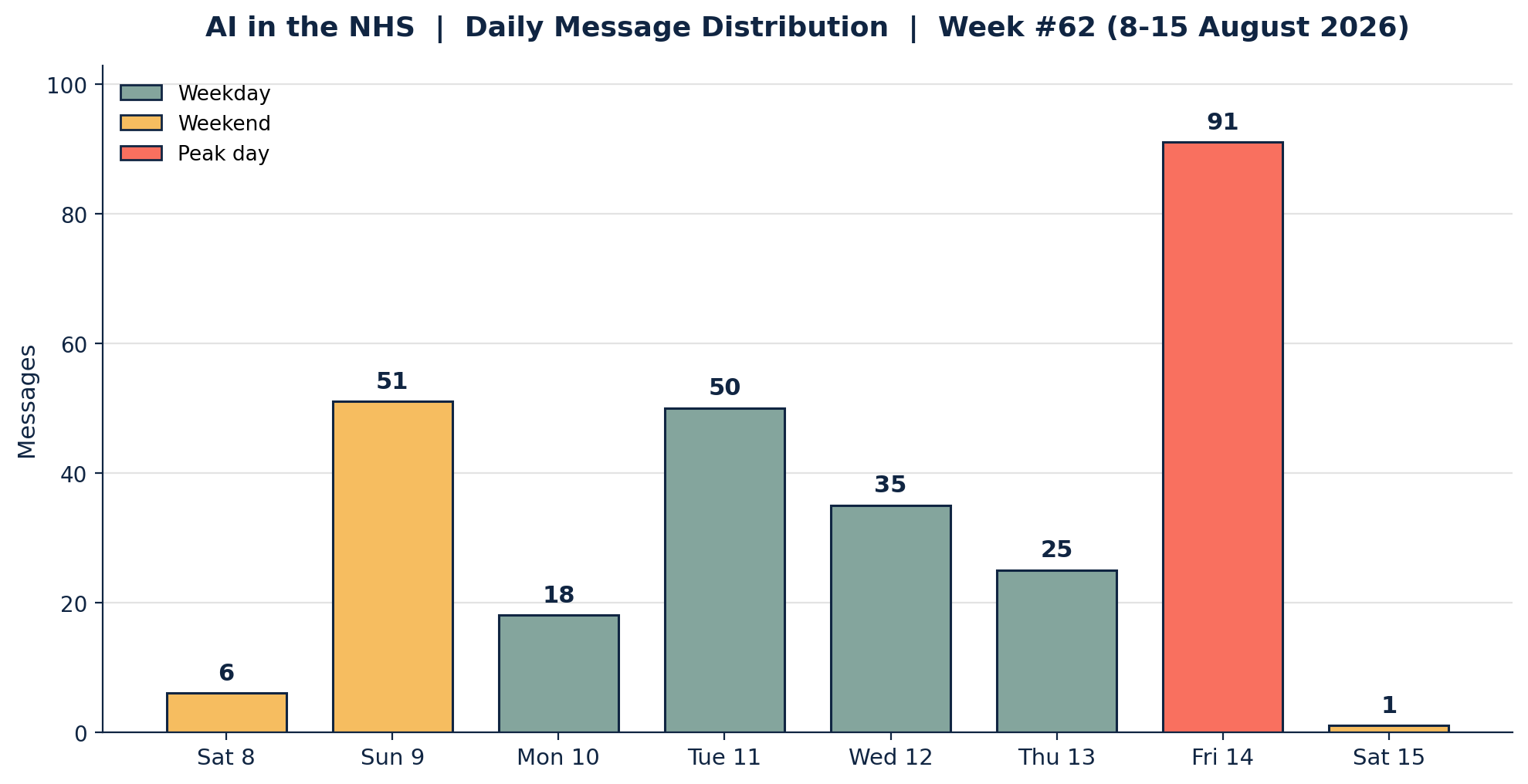
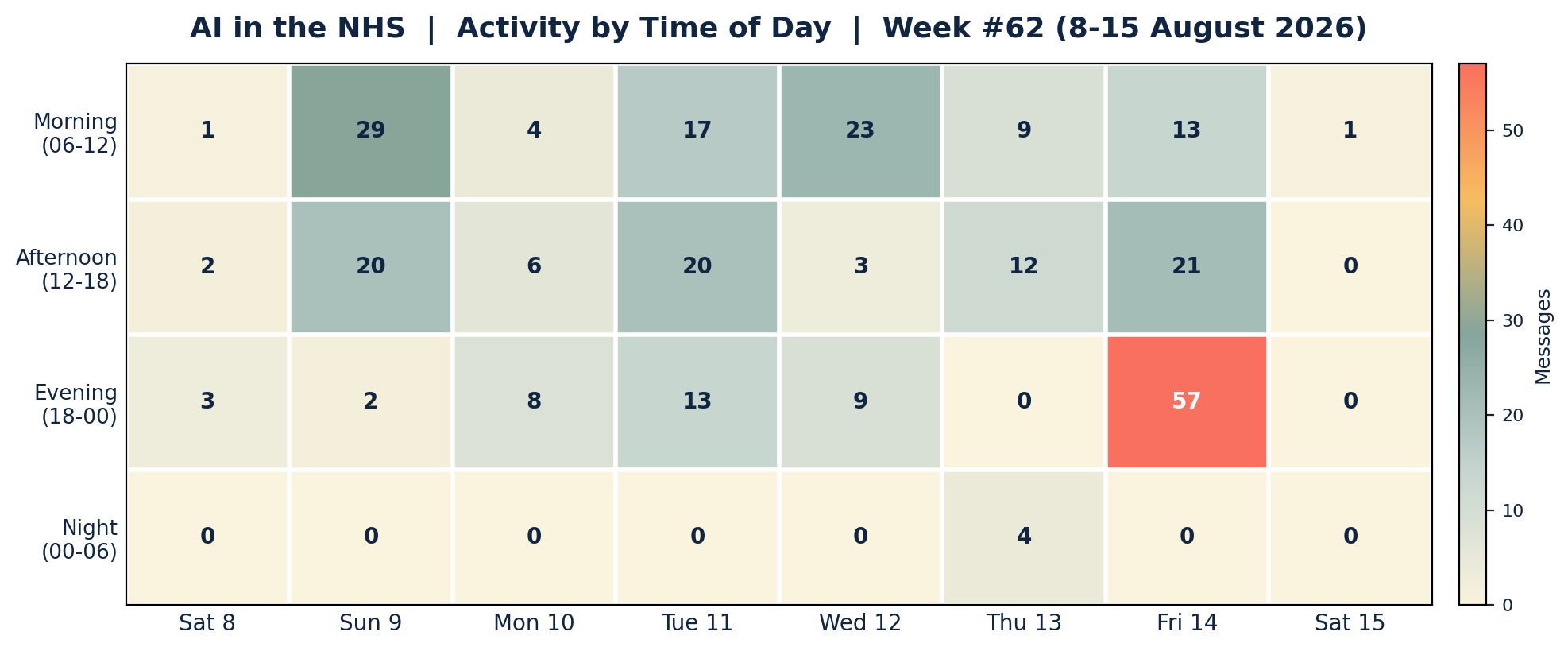
• Friday evening's 57 messages were the single biggest window of the week, driven almost entirely by the wildfire emergency alert and the ensuing 1976-summer nostalgia.
• Sunday morning was the heaviest substantive window: the QOF-agents thread and the frontier-security follow-up together made Sunday the week's second-busiest day.
• The only night-time activity of the week (Thursday, midnight to 6am) was eclipse afterglow and one early-morning safety-culture reply.
• Weekday dominance (79.1%) was back this week after a run of stronger weekends, but the pattern held that the deepest technical and governance discussions started in the morning, while evenings belonged to community and humour.
• Monday was the quietest full weekday at 18 messages, most of them announcements and research shares rather than debate.
APPENDIX B: Enhanced Statistics
Unique Contributors:
58 group members posted at least one message this week. The 15 most active account for 188 of the 277 messages (67.9%), with a long tail of occasional and one-off contributors making up the rest.
Top Contributors (Role Descriptors Only):
1. Digital Health & Clinical AI Specialist (Group Moderator): 57 messages
2. Integrated care operations lead: 28 messages
3. Radiologist and clinical governance advocate: 21 messages
4. Digital health technologist: 12 messages
5. Startup adviser and AI enthusiast: 9 messages
6. GP educator: 8 messages
7. Clinician-founder and A&E registrar: 7 messages
8. (tied on 6 messages) GP and evidence-based-care advocate; digital health strategist; innovation-focused GP; clinician with a long informatics background; digital health GP exploring local models; GP partner and committed AVT adopter
Hottest Debate Topics:
1. 🔥🔥🔥 Wildfire emergency alert, and alert policy generally (roughly 45 messages, Friday evening)
2. 🔥🔥🔥 Solar eclipse viewing methods (roughly 30 messages, Wednesday into Thursday)
3. 🔥🔥🔥 Duty of candour, whistleblowing and who receives the safety signal (roughly 25 messages, Friday and Saturday)
4. 🔥🔥🔥 Agents gaming QOF (roughly 24 messages, Sunday)
5. 🔥🔥 Clinical reasoning and training with AI in the room (roughly 22 messages, Sunday)
6. 🔥🔥 Document AI coding reliability (14 messages, Thursday)
7. 🔥 Frontier model cyber capability (roughly 12 messages, Saturday and Sunday)
8. 🔥 The FDP £1.7bn benefits write-down (roughly 12 messages, Friday)
Discussion Quality Metrics:
• Evidence-Based vs Opinion Ratio: roughly 15% of messages carried a link, paper, or official source; the QOF and candour threads were notably rich in first-hand practice data
• Average Thread Depth: the week favoured a few long, sustained threads (QOF, candour, the alert) over many short ones
• Constructive Challenge Rate: high, with direct pushback in the reasoning thread (referral appropriateness), the QOF thread (measurement improves outcomes), and the alert thread (risk versus annoyance)
• External Resource Sharing: 36 unique links shared across the period
Cross-Expertise Engagement:
• At least a dozen distinct professional backgrounds contributed: GPs, a radiologist, hospital consultants, an A&E registrar, practice managers, a CCIO, NHS IT specialists, a data protection officer, an imaging safety lead, informaticians, policy analysts and health-tech founders
• Most cross-disciplinary topic: duty of candour and safety reporting, which drew frontline GPs, operations, imaging safety, standards and governance voices
• Notable knowledge transfer: safety-management-system concepts (learning culture, reporting culture) applied to the candour debate; AI alignment concepts (paperclip maximiser, reward hacking) applied to QOF; and radiology teaching archives applied to eclipse viewing
• A clear majority of substantive discussions involved three or more different professional perspectives
APPENDIX C: Daily Theme Summary
Saturday, 8 August
Primary Theme: Frontier model security Key Discussion: Newsletter #61 was published in the morning. The moderator shared OpenAI's disclosure on the cyber capabilities of its frontier model Astra alongside an independent timeline of the Hugging Face attack; late-night scepticism ("just another elaborate media stunt") set up Sunday's rebuttal. Secondary Discussions: A call for suggestions ahead of a comparison livestream on primary care neighbourhood integration systems; a market observation that a US medical-networking firm is trading well below its IPO price, read as scepticism about AI capex in a commoditising scribe market. Notable: The week's security theme was seeded within hours of the newsletter going out.
Sunday, 9 August
Primary Theme: Agents gaming QOF Key Discussion: The moderator's thread on QOF as the first agent use case in general practice: exception reporting, register moves, denominator hacking, the DM037 all-or-nothing design, disparity risk and the paperclip-maximiser warning. The counter-case cited obesity prevalence rising from 16% to 20% once BMI returned to QOF. Secondary Discussions: The morning rebuttal of Saturday's stunt theory (multiple independent reports including AISI); business continuity as the healthcare lesson; the afternoon clinical-reasoning thread (commit-first teaching, the 70% versus 25% referral audit, hub-model calibration, "never skilling", member-built practice cases); Estonia's education model. Notable: The two biggest substantive threads of the week both ran on a Sunday.
Monday, 10 August
Primary Theme: Agents and evidence arriving in practice Key Discussion: An answer to Sunday's question landed in the form of a member's report of forty agents running 24/7 in primary care, with details promised over the coming weeks. Results of an analysis of AVT wave 1 versus wave 2 adoption under different regulatory settings were also shared. Secondary Discussions: A QMUL qualitative study of GPs using ambient scribes recruiting six more GPs; a national CLEAR programme webinar on AVT safety; a request for boundary microphone recommendations; Meta's open agentic model Muse-Glimmer released; the Australian gym-booking hack and its NHS waiting-list read-across. Notable: Google's AMIE video consultation research was shared early Wednesday but the local-model testing of Muse-Glimmer began the same evening it was released.
Tuesday, 11 August
Primary Theme: Benchmarks, records and evidence Key Discussion: A Nature Medicine framework for testing medical AI superintelligence was shared ("new benchmaxxing target: unlocked"), while a member's head-to-head test found Meta's new agentic model losing decisively to Qwen 3.6 27B on a practical task. The Bennett Institute's top-10 clinical codes blog (427 million SMS codes) drew both horror and an AI-tool proposal. Secondary Discussions: Patient Safety Learning's October AI roundtables announced; the HSJ awards AI shortlist; Anthropic's invisible watermarks and instant workarounds; Meta glasses banned from courts; a patient obtaining their own imaging within 48 hours to explore with local LLMs; ICB capacity for approvals post-restructuring; a US court case probing clinical notes and whether AVT would help or exacerbate; eBay sniping as proto-agentic AI. Notable: A funding request for clinical entrepreneurs seeking seed to Series A also circulated.
Wednesday, 12 August
Primary Theme: The solar eclipse Key Discussion: The group downed AI tools for the partial eclipse: colanders, shoebox pinhole viewers, tree shadows, phones through sunglasses, vintage X-ray film in the radiology corner, a spoof product listing with an AI firewall, and the moderator's sieve puns. A GP partner's telescope video won by a country mile. Secondary Discussions: New neural I/O hardware architecture for AI; Google's AMIE moving towards video consultations; the open-source watermark remover; an HDRS funding call; a PLOS Digital Health article shared in the evening. Notable: The morning also carried a serious exchange on the US notes case: human record-keeping is imperfect too, and the comparison baseline for AVT should not be a perfect human.
Thursday, 13 August
Primary Theme: Document AI at the coalface Key Discussion: A request for feedback on a document-management AI feature drew consistent reports: neighbouring practices switching it off, time savings below claims, coding not reliable enough, inaccuracies slowing work down. The moderator proposed a crowdsourced open-source benchmark for coding accuracy; an in-house alternative claiming 83.7% measured accuracy was described, and met with "call me when 99%". Secondary Discussions: Slop-squatting as an emerging attack vector; eclipse afterglow photos including the small-hours pixel shots; "AI should probably be the last inch of the mile" as the coding philosophy of the day. Notable: The first night-time activity of the week, entirely eclipse-related.
Friday, 14 August
Primary Theme: Candour, whistleblowing and the safety signal Key Discussion: The published letter arguing the duty of candour cannot succeed opened the week's weightiest thread: whistleblower punishment culture, an ICB reportedly asking not to be copied into GP complaints about providers, the GPIT reporting split that keeps digital safety signal below ICB level, and the advice to keep reporting to Datix and LFPSE regardless. Two cultural options were starkly drawn: report-and-thank versus punish-and-leak. Secondary Discussions: HSJ's report that FDP benefits were overestimated by £1.7bn, with the group's licence-versus-adoption and capacity critiques and a proposed public accountability register for savings claims; the UKRI explainable AI call; Ireland stalling a €1bn Microsoft tender; and the evening wildfire emergency alert with its 1976 nostalgia, opt-out guidance and the concealed-phones safety point. Qwen 3.7 arrived for local use late in the evening. Notable: 91 messages, the week's peak, in two very different registers: governance gravity by day, national moaning-granny energy by night.
Saturday, 15 August
Primary Theme: Safety culture, the last word Key Discussion: A single early-morning message closed the candour thread: a learning culture and a reporting culture are the foundation of any safety management system, human factors determine whether staff can use the technology at all, and leaders at every level shape the culture that results. Secondary Discussions: None; the coverage window closed at 9am. Notable: A fitting one-message summary of the week's central debate.
AI in the NHS Weekly Newsletter is produced by Curistica Ltd for members of the AI in the NHS WhatsApp community. All contributors are anonymised. Views expressed are those of individual community members and do not represent any organisation.