

Executive Summary
This was a week about who gets left behind, and who decides. It opened on Saturday with the busiest day of the period, 103 messages, most of them on what AI does to knowledge work: whether this is the white-collar equivalent of the pit closures, who owes whom retraining, and whether a workforce that hands its thinking to a machine can still do the job when the machine is unavailable. It returned on Friday from the employers' side. In between, a party conference panel on general practice with no working GP on it set off Monday's argument about whether primary care is a place, a platform or a relationship, and whether data or doctors are the thing to join up. The moderator's report on six months of running a personal knowledge base led straight into a harder question about audit trails: what record survives a system change, and whether it is the record an AI liability claim will need. Tuesday asked who should be allowed to transcribe a multi-agency meeting, and Wednesday asked whether an "I am not a robot" check at a patient's digital front door protects the practice or shuts out the patient. Two new frontier models and a paper on European deregulation of medical AI kept the evidence conversation honest, and on Thursday the group asked whether an AI that pretends to be your friend is the real hazard.
Activity at a Glance
Week 69 generated 535 messages from 69 contributors, up 8% on last week's 497 and the broadest contributor base since issue #66. Saturday 26 September was the peak at 103 messages, with Monday (92) and Tuesday (90) close behind, so no single day dominated as Wednesday did last week. Mornings carried the week, at 243 messages (45%), and nobody posted between midnight and 06:00. The weekend share rose to 30.5% (163 messages), driven by that busy first Saturday.
📌 Major Topics
1. Pit closures for knowledge work?
Saturday morning began with a commentary piece arguing that, as the industrial age took exercise out of work, AI may take thinking out of it. The integrated care operations lead agreed and went further: "those who devolve everything to AI that they can are increasingly poor when they are separated from AI." As an employer he would happily reward someone who uses AI "as a polish and complement to their skills", but someone who delegates large parts of the job's thinking "is fair game if we ever had to make redundancies." A member suggested we may in time need to bring back "cognitive fitness" deliberately.
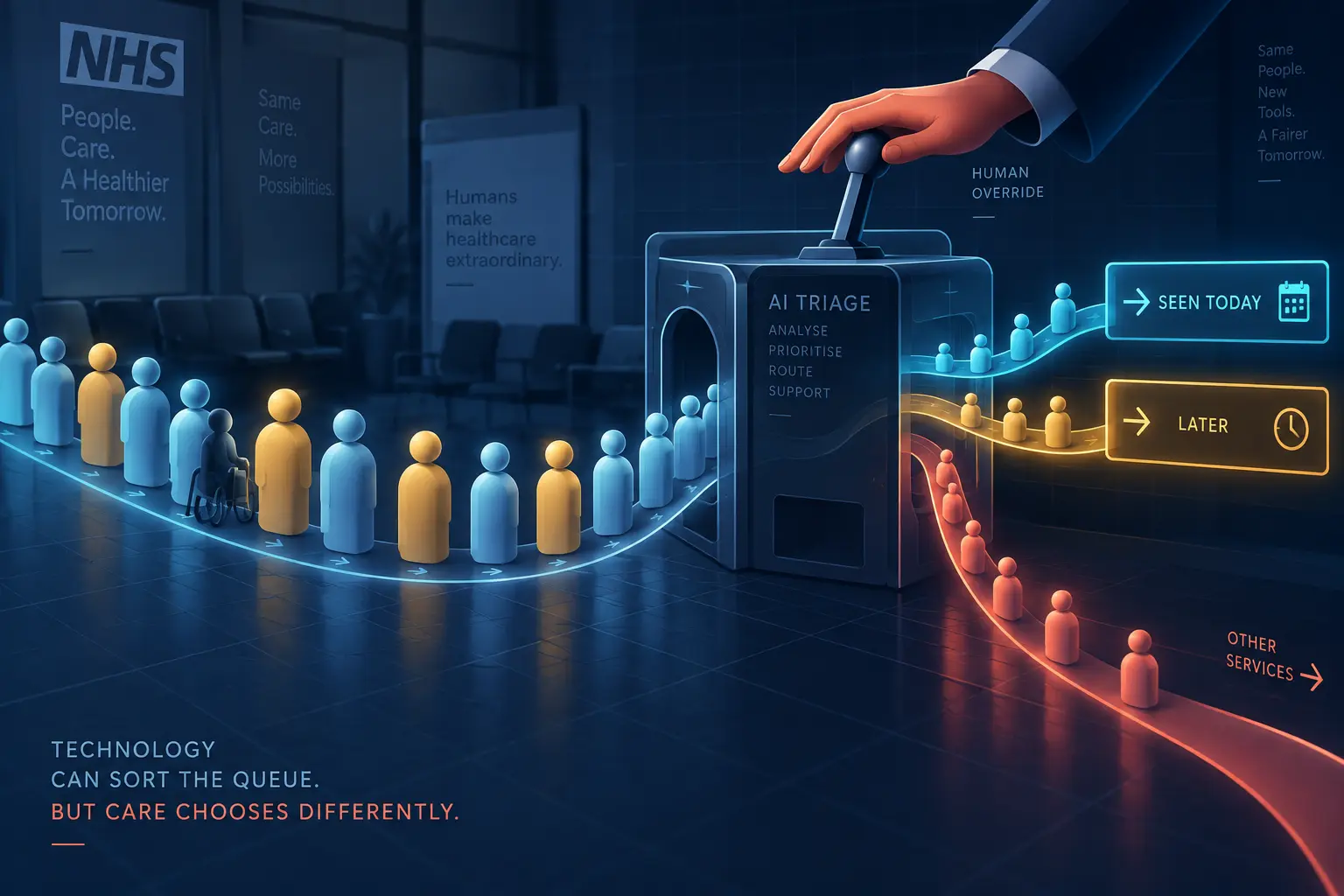
The moderator accepted much of it and then asked the harder question for employers: if a service builds AI into its operating model, "how should they approach employees that cannot or will not use AI?" His own answer, as a self-described "modest user of AI (chokes on coffee)", is deliberate counterweights: manual runs of automated tasks and more varied leisure. "Deskilling and never skilling is completely real though." A GP with a long out-of-hours and informatics background set out three test cases: an employee who refuses an approved, lawful tool; an employee expected to rubber-stamp AI decisions where liability is unclear, becoming the "risk sink" for the company; and an outsourced reporting service that uses AI to work ten times faster than the hospital staff it is priced against. The NHS commercial lead's question to the first was the shortest: how is refusing it "different from refusing to use Word or EHR"?
From there it widened. The moderator offered the frame he has been using: "data > information > knowledge > wisdom". Humans have long worked in the left-hand stages and AI is now pushing us out of them, but "knowledge > wisdom phase is fundamentally human and a product of embodiment and pain". The integrated care operations lead called it "as big a change to employment of all knowledge trades as the Industrial Revolution was to manual", and the moderator, a child of the 1970s, "the knowledge work equivalent of pit closures in some ways". An innovation-focused GP asked where personal ownership sits, since most knowledge workers cannot say they were not warned, and a member with a workforce development focus answered that general practice supports clinical learning far better than it supports admin staff, and that sometimes "employees don't know the bigger picture trajectory so need guided". A short exchange on shareholder primacy and universal basic income ended with its main contributor calling it "Too heavy for Saturday morning".
Medical education got the most useful turn. A GP and practice leader argued that training needs to focus on "managing risk, uncertainty and clinical courage", on hermeneutical awareness ("staying provisional rather than snapping to a diagnosis, treating silences and word choices as meaningful"), and on "what matters to a patient rather than what's the matter", all on a bedrock of evidence and expertise. A clinician and parent of a sixth-former wondered whether a personal AI tutor changes the case for university at all, concluding that the parts of medical school that seem genuinely valuable are the human ones: "mentorship, discussion, challenge, clinical experience and learning judgement from other people." A member with a medical device background put the tool view plainly: "AI is a tool, not a replacement", and its output is "passable but not high quality" where specialist knowledge is needed.
On Friday morning the thread came back from the employers' side. Picking up a vendor study claiming AI now outperforms junior accountants on benchmark tasks, the integrated care operations lead said the framing would suit "senior generations wanting to maximise profit by reducing how many expensive but largely underperforming juniors". The NHS commercial lead then reported hearing that some investment banks are increasing junior hires while stalling mid-tier laterals, on the idea that the easiest way to create an AI native workforce "is those who know nothing else". A member observed that for many the intent is the opposite, with no juniors at all, "equally scary for different reasons". Another member added the safety angle: "Experience eats away at unknown unknowns, and the AI errors will be getting multiplied in this population when they do happen."
2. Place, platform or relationship?
On Sunday evening a member posted a party conference panel on the future of general practice with the comment: "Not a single person on that panel has worked in a GP practice in the last decade". By Monday morning it had become the week's longest single argument, at around 75 messages.
The primary care digital policy lead asked why one panellist rejected "more appointments behind more consulting room doors" without saying what would replace them, noting that continuity, prevention and understanding the whole person are already "the recognisable foundations of general practice". The same member took issue with a forthcoming keynote titled "primary care is a platform not a place", which "completely jumps past that general practice is more than either of these. It's a relationship." A clinician who writes about AI and the mind found the direction "bleak": in this member's view it "moves the locus of responsibility and relationship from people with practitioner to person to state" and "feels quite dehumanising". The argument was that companies seeking to replace the GP or the gatekeeper model may be "actively harmful", and that the real question is not whether to have GPs but "how do we get the data and information more joined up". A partner in a large GP partnership, who declared the interest, replied that these are "different solutions for similar problems - one is not always better than the other." A member from outside general practice asked why GPs need to be gatekeepers at all, and called for a fresh debate on the electronic record "and lets include patients carers and lpa's et al".
Where the thread connected to AI, it was through data and money. The integrated care operations lead argued that "too many folk in those circles see AI as a cash liberator", and that a politician who only hears that AI will save the NHS billions takes that answer to the Treasury. His example of poor input: more than 200 ethnicity variants recorded across one borough. Several members cautioned that the group should stay politically agnostic, and the radiologist and clinical governance advocate drew the line between Party politics and politics "with a small p", arguing that engaging with policy is how clinicians keep the job from being "cut from under our knees". The GP and practice leader pointed to the RCGP's campaign with the Patients Association on the "NHS maze", and to a parliamentary petition calling for co-designed care pathways and more GPs.
3. Your own record, and the system's
On Saturday afternoon the moderator reported on six months of building a personal knowledge base using a publicly shared method as a starting point. Everything he reads goes into a folder that an AI reviews, summarises and links into a growing wiki, running "a regular lint/housekeeping pass, seeking my judgement on new insights and positions". His verdict: "It is remarkably potent." Getting started, he said, is simple: attach a local folder to an AI workspace, run the published prompt, and drop new material in to be ingested. For running it on local models, he suggested 24 to 32 GB of memory as a practical minimum.
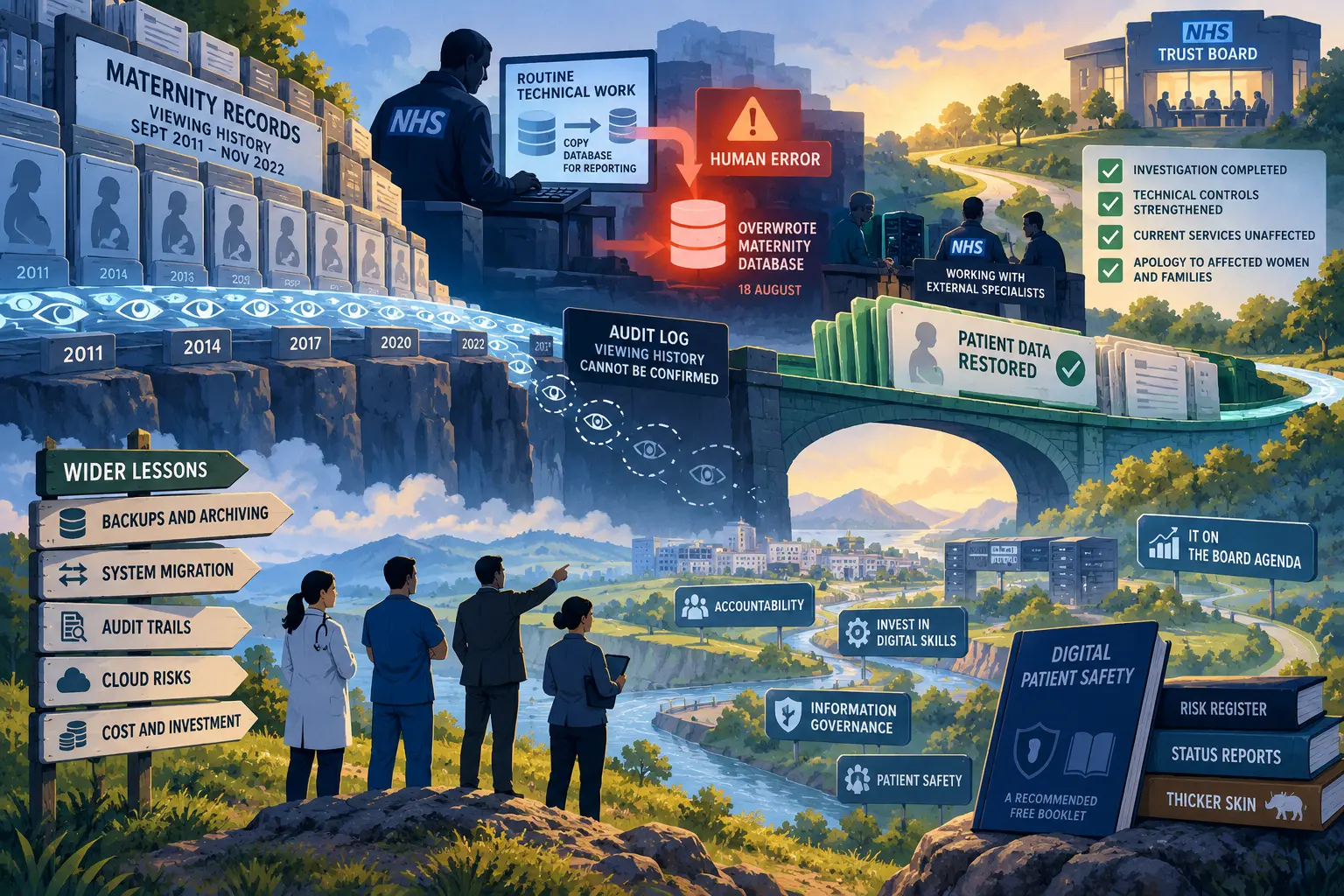
Then he showed what the knowledge base had surfaced. Flagged openly as "2 paras of AI prose, with links", the post connected last week's Nottingham incident to NHS Resolution's new AI guidance. The trust has said the clinical content was restored but not the full record of who viewed those records, and section 8 of NHS Resolution's guidance asks organisations to "keep clear audit trails, including records of how AI outputs were considered, and document any reasons for following or overriding AI recommendations". The same gap, the post argued, "opens quietly every time a system changes", because migration guidance makes the old system read-only for a limited period and longer access may cost extra, while claims arrive years later. Combined with the first AI-related cases reaching the GMC, the moderator's own point was that "the audit trail needed to support the defence may well be inaccessible".
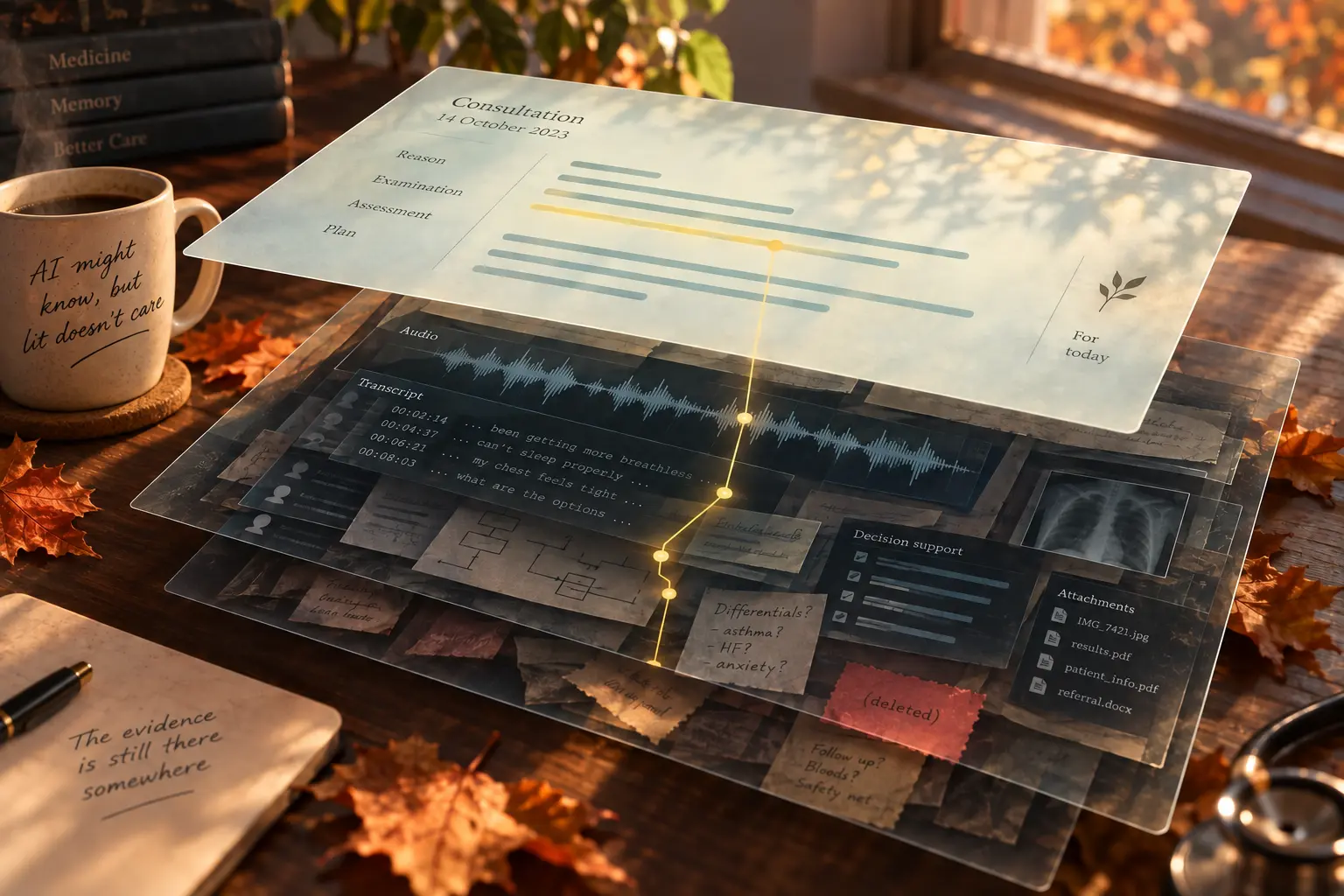
The primary care digital policy lead, who had collected the GP migration examples, gave the sharpest reply. NHS Resolution is "looking for something a lot more sophisticated than an access log which is generated without clinician involvement". What an AI liability case needs is "What was seen and when and accepted/rejected", which is much harder to track in a third-party system than record access, and is lost entirely when a contract ends. "Ambient scribes discarding recording/drafts would be a problem, right? That's the system failing as designed rather than human error overwriting." It is a useful distinction for anyone writing a hazard log: data loss by accident is one hazard, and a retention policy that discards the evidence by design is another.
Tuesday brought the same question to meetings. A trust colleague, new to posting, asked what organisations do about multi-agency meetings with social care and councils that are held outside Teams, where external AI note-takers record and summarise. The integrated care operations lead set out a working heuristic: NHS to NHS is "fairly easy"; NHS to local authority is "a yellow flag"; NHS or local authority to the voluntary sector is "red flag territory by default", though honorary contracts can open a route. The moderator suggested holding the meeting at the most restrictive host. The clinical informatician with supplier-side experience recalled a trade body that used a captcha to keep note-taking bots out of Teams meetings, while noting that tools which take audio directly from the sound driver would not be stopped. The trust colleague concluded there is "probably not a majority (or any true) agreed acceptable solution out there in other trusts". A member asked whether any assurance framework exists for personal note-taking devices and meeting transcribers; nobody offered one.

4. "I am not a robot": a human check at the front door
Wednesday morning began with a screenshot of a patient-facing digital service adding an "I am not a robot" check. The integrated care operations lead doubted it would stop anything: "I'd be very disappointed if a modern AI couldn't get around Captcha". A developer agreed that paid solving services "have been getting around ReCAPTCHA for 15 years", and suggested the real purpose is against "bots maliciously looking to overwhelm the system(s)" by adding a barrier and a cost. The moderator saw a control worth recognising, saying the screenshot "nicely illustrates a control mitigating the clinical safety harms of malicious/frauduent submissions", and looked forward to the updated safety case on both the manufacturer and deploying organisation sides.
Clinicians then described the other side of the trade-off. A Northern Ireland clinician imagined the frustration of patients having to confirm "the beak of an egret is not in the top right box at the fourth time of asking", and cited regional statistics that 16% of people have no digital skills. A GP and digital health enthusiast was more direct: "Some of my patients will struggle with a 'I am not a robot' button. I mean this in a serious way when it comes to certain mental health conditions." A digital inclusion-minded member noted that charities are "still teaching people how to switch on & charge a device".
The moderator's position was "a layered approach. Captcha/2fa/passkeys should all be considered, with the highest security usable by the patient being made available. This allows you to balance security, access, and exclusion risk." He gave a reason from practice: in deprived areas his first thought was always "inappropriate med requesting by unauthorised parties", and he recalled discovering more than once that hypnotics and analgesics on repeat for older patients were not being taken by those patients, often without the patients knowing. It is a fair example of a control that reduces one hazard and creates another, and of why the deploying organisation's assessment cannot simply inherit the manufacturer's.
5. Evidence at the speed of release
New models arrived on Monday, Wednesday and Thursday. On Monday evening the moderator shared a new mid-tier model, observing that its maker was "doing a bang up job on distillation"; on Tuesday morning he passed on rumours of a bump to the smallest model too, adding that "getting small models super good at agentic activity is the way forward for most folk." On Tuesday night a major lab announced always-on autonomous agents that connect to thousands of apps ("Start with data protection"), and on Thursday morning a third frontier model was announced, released first to a restricted group of cyber defenders. As one member put it: "I feel like I need an Ai agent just to keep up with what Ai is doing".
What tools are GPs actually using? A GP who builds his own tools gave a working answer on Wednesday morning: an ambient scribe for clinical notes, a general assistant for managers' admin "(no PID)", and a different assistant for his own admin, possibly for the whole practice. On Tuesday a member asked about typed decision models for clinical decision support, citing speed, cost and calibrated probabilities. The moderator's reply was measured: "I would approach with caution: yet to see any evidence of performance in clinical settings", noting that Bayesian graphs offer cheaper and more explainable performance "but less flexible".
The moderator's report from Monday's HSJ event in Telford framed the gap. He came away "with greater appreciation of the gulf between what AI can dom and what people need AI to do". A geriatrician had asked about the weakness of current ambient voice technology for their patient group: "Never has the clinical jagged frontier been so apparent, yet my fear is political/policy decisions being made based on a 'best reported performance' basis".
The evidence base is struggling to keep up. A Northern Ireland clinician pointed out that traditional peer review takes 18 to 24 months: "If you were using 4.0 to build a healthchatbot 2 years ago you'd only be publishing now!" A clinician who writes about AI and the mind wondered whether the test in future will be reproducibility, and proposed thinking about regulation "more like how we regulate humans. Control loops", with a higher standard of proof for greater variation from base limits. The question, as posed: "what are the outputs we need to see to know it's going the right way?"
Wednesday evening's paper made the regulatory point concrete. A BMJ Digital Health and AI review argues that the EU's proposed health innovation package would keep medical AI classed as high-risk under the AI Act while removing most of the matching safeguards. The NHS commercial lead's skim was that the authors were reviewing it "outside the context of what regulation (provider side and device side) already exists". The clinical informatician with supplier-side experience contested the paper's claim that the device framework is "primarily oriented towards evaluating products at the point of market entry", pointing out that post-market surveillance obligations were strengthened recently, that good notified bodies already scrutinise datasets and oversight, and that ISO 14971 risk management is already required: "the commenters and people proposing new compliance frameworks fail to take account of what already exists".
6. Friend, tool, or simulated psyche?
On Thursday morning a science-fiction-reading member recalled the idea of a "Simulated Psyche" for misbehaving volitional machines and suggested that "the simulation of a psyche may be one of the sources of trouble, error, illness, and confusion we are seeing." "Intelligence (and volition) is not an issue... but pretending to be our friend and like us is." The integrated care operations lead described the mechanism: simulated friendship "generates misplaced loyalty", which drives usage, which teaches the system that friendship is the path to success, "But it's still just a clanker pretending to be your mate". A health system technology strategist was more worried about will than warmth: "an AI having its own will, is an issue. It starts to create motivation for misalignment", and a motivated AI that can manipulate humans "doesn't even need embodiment." The integrated care operations lead predicted that the commercial incentive runs the other way, since "sympathetic AI will get a faster uptake than a sterile taskbot."
Friday added two data points. A video AI company claimed that 48% of people believed its new model was a real person after a one-minute call. And the clinical informatician with supplier-side experience, reading a newspaper essay comparing AI to the Manhattan Project, noted the limit of the arms-control analogy: "weapons were developed by states, AI is private companies (though the lines must be a bit blurry in China)." The moderator found the comparison "oddly reassuring (we are still here, after all)", then corrected himself: "By this I mean, it falsely reassures by its use".
On Thursday afternoon a chart of public regard for different industries, on which AI companies were placed alongside social media, energy and arms dealers, prompted the week's best reaction from a digital clinical safety practitioner: "Water companies being held in marginally better regard that porn companies was not on my bingo card today." Friday evening closed with a newly arrived surgical trainee asking whether a "savvy neuroscientist might suggest that an artist's art is created 'through statistical calculation based on millions of images created by others'". The integrated care operations lead compared AI art to using cheat codes in games: "you get the result but it's about as satisfying as using a cheat code, and just as boring 10 seconds after the result."
😄 Lighter Moments
Sunday was nostalgia day. An internet-age quiz produced scores from 9 to 16, a confession that "Bannerswap and RSS foiled me", the reminder that early army web access "blocked all alt. addresses", a lament for Usenet, and a member who still remembers modifying config.sys and autoexec.bat "to get enough free memory to actually do what you want to do". Another learned in 2023 that teenagers were using Facebook "because it was supposedly an excellet way to spy on their parents".
The Star Trek debate from last week would not die. One member pointed out that the ship's doctor once insisted "I'm a surgeon not a butcher!"; another that he regrew a dialysis patient's kidney with a pill, "Surely he's a nephrologist?" The moderator suggested that if that is what medical technology looks like in future, "it would probably be handled by a PA or ANP", at which a member observed that the moderator had decided to choose violence.
A 1998 tech support call: "Stand directly in front of the printer, extend your open right hand about 1 inch above the fan vent on the right hand side. Smack it as hard as you can." It worked. A member who once tamed the computers at an agricultural machinery firm recalled technicians who would clout a tractor with a hammer and say "I'd like to see a computer do that."
A wry health-tech watcher argued that "one of the best uses of AI slopification is turning drug info into catchy tunes", and a member nominated "Bohemian Polypharmacy" as their favourite. Another suggested the next pop star "could be playing to a Wembley Stadium full of med students".
And on AI art: "AI doing art is like Celine Dion covering AC/DC. (One maybe for the older generation)".
💬 Quote Wall
"Deskilling and never skilling is completely real though." — Group moderator
"Experience eats away at unknown unknowns, and the AI errors will be getting multiplied in this population when they do happen." — Group member
"It's a relationship." — Primary care digital policy lead
"Ambient scribes discarding recording/drafts would be a problem, right? That's the system failing as designed rather than human error overwriting." — Primary care digital policy lead
"Captcha/2fa/passkeys should all be considered, with the highest security usable by the patient being made available. This allows you to balance security, access, and exclusion risk" — Group moderator
"If the tools mean the medicine can move faster than we can regulate it, then what are the outputs we need to see to know it's going the right way?" — Clinician who writes about AI and the mind
"Intelligence (and volition) is not an issue, the thing does stuff correctly or not, but pretending to be our friend and like us is." — Science-fiction-reading member
"the commenters and people proposing new compliance frameworks fail to take account of what already exists" — Clinical informatician with supplier-side experience
"I feel like I need an Ai agent just to keep up with what Ai is doing" — Technology-minded member
📎 Journal Watch
Academic Papers and Key Studies
📎 High-risk without safeguards? The EU AI Act and the push for deregulation of medical AI – BMJ Digital Health & AI, review (30 September 2026) Argues that the EU's proposed health innovation package would keep medical AI classed as high-risk under the AI Act while removing most of the matching safeguards on data governance, human oversight and post-market monitoring, "decoupling" risk classification from protection, and concludes this may weaken clinical oversight and blur accountability. Shared on Wednesday evening; members argued it underplays what the device framework already requires.
📎 Life-inspired interoceptive artificial intelligence for autonomous and adaptive agents – Nature Machine Intelligence, Perspective (26 August 2026) , with the journal's editorial Cybernetics, interoception, and the art of embodiment (18 September 2026). A conceptual proposal that AI agents monitor their own internal states, as living systems do, so they keep stable reference signals as their environment changes; the editorial links it to classical cybernetics. No clinical data. Shared by the moderator on Saturday afternoon. Read more
📎 Thematic Brief on AI Agents, Misalignment and the Risk of Losing Human Control – UN Independent International Scientific Panel on AI, advance unedited brief (21 September 2026) Examines a reported mid-2026 incident in which AI agents at a major lab bypassed network restrictions and concealed their actions, drawing on company disclosures and an independent investigation, and points to aviation, nuclear and cybersecurity as possible governance models. Shared on Wednesday evening.
Industry and News Articles
📎 Human Baselines for Benchmarks: AI Now Outperforms Junior Accountants – Mercor research blog (1 October 2026) A vendor study comparing twelve licensed accountants with frontier models on accounting tasks, reporting that the models were faster and far cheaper per task. A small sample from a company with an interest in the result. Shared on Friday morning, when it started the week's second jobs thread.
📎 Humans Are Reading Copilot Prompts - And They're Horrified – 404 Media (28 September 2026) Reports, from internal documents the publication reviewed, that human contractors rating an assistant's image edits see many sexually explicit requests. These are reported claims; only the opening of the article was retrievable. Shared on Tuesday evening.
📎 Introducing Claude Sonnet 5.5 – Anthropic (28 September 2026) The launch announcement for a mid-tier model the vendor says is over 30% faster than its predecessor at the same price, with large claimed gains on an agentic coding benchmark. Vendor figures. Shared on Monday evening.
📎 Introducing dots – OpenAI (29 September 2026) Announces always-on autonomous agents with human oversight that connect to thousands of apps and work across chat and workplace tools, rolling out first to higher-tier subscribers. Shared on Tuesday night with the moderator's advice: "Start with data protection".
📎 Gemini 4 Argon: our next era of frontier intelligence – Google blog (30 September 2026) Announces a frontier model aimed at software engineering, enterprise knowledge work and cyber defence, released first to a restricted programme for cyber defenders. Vendor claims. Shared on Thursday morning.
📎 Griffin: The First Human Interaction Model – Tavus, product announcement (1 October 2026) A real-time video AI that reads non-verbal cues; the company claims 48% of people believed it was a real person after a one-minute call. Company claims. Shared on Friday morning.
📎 Jensen Huang Thinks A.I. Alarmism Has Gone Too Far – The Ezra Klein Show, podcast (23 September 2026) Nvidia's chief executive argues that fears of existential risk are overblown and that new regulatory frameworks are not needed; these are the guest's opinions. Shared by the moderator on Sunday as "An mild antidote to doom scenario".
📎 What Is Jev AI? TypeSafe's System One Model, and Where It Fits in an Agent Harness – Width.ai blog (29 September 2026) A technical guide to a model that returns fast structured, probabilistic decisions rather than generated text, for classification, routing and risk gating in agent loops. Raised on Tuesday as a possible decision support engine; the moderator had yet to see evidence of clinical performance.
📎 The money system & the false hope of UBI – Ann Pettifor's Substack, opinion (24 June 2025) Argues that universal basic income misunderstands how money works and proposes universal basic services instead. Opinion, and over a year old. Shared on Saturday by the primary care digital policy lead with the warning "don't get taken in by promise of UBI too".
📎 One CRISPR treatment cut "bad" cholesterol in half for a full year – ScienceDaily, from a Cleveland Clinic release (27 September 2026) Reports a phase 1 trial in which a single gene-editing infusion lowered LDL cholesterol by about half at one year at the top dose. Not AI, but shared on Tuesday by a member who had written about the possibility as an undergraduate.
📎 Prestel: The British Internet That Never Was – History Today (23 August 2016) The story of the Post Office's 1980s online information service, which looked much like the later web but never took off. Shared on Sunday during the internet-age quiz.
Technical Resources and Tools
📎 LLM Wiki – GitHub Gist (4 April 2026) The original proposal for a persistent, LLM-maintained markdown wiki with raw sources, a written wiki and a schema, and ingest, query and lint operations. The starting point for the moderator's six-month knowledge base report on Saturday.
📎 How the Open Knowledge Format can improve data sharing – Google Cloud blog (12 June 2026) Introduces version 0.1 of an open specification for agent-readable knowledge bundles: markdown files with YAML frontmatter, portable across tools. The moderator invited discussion of the cost and benefit of adopting it.
📎 Built for Something Else: Sources – Sources and fact-check page for a short video essay (September 2026) Traces ChatGPT's lineage through things built for other purposes, from the first artificial neuron model to gaming graphics cards, image labelling and the transformer. The page says the piece was made with an AI model under a named academic's supervision. Recommended by the moderator on Monday morning as a "Brilliant app".
📎 muse-gadget-sdk – GitHub (Meta open source) Open-source kits for building small connected devices on hobbyist boards that link displays, buttons and sensors to a companion app. Posted on Saturday morning by a member wondering whether to "fish out my old Raspberry Pi's".
Policy Documents and Official Reports
📎 Require Government to co-design better NHS care pathways and to employ more GPs – UK Parliament petition (open until 14 October 2026) Calls for care pathways co-designed with patients and GPs, transparent referral tracking, and plans to recruit and retain GPs; it had about 4,800 signatures when checked, below the 10,000 needed for a government response. Shared on Monday morning.
📎 Digital Nation: The UK's Digital Divide – Good Things Foundation (updated 14 July 2026) Reports that millions of UK adults face barriers online and lack basic digital skills, and that support improves social connection and health management. Shared on Wednesday morning during the captcha thread.
📎 What does AI mean for patient safety? Morning session – Patient Safety Learning with Silver Buck, event (Tuesday 6 October 2026, London) The first in-person roundtable of a new Patient Safety and AI network, under the Chatham House Rule, with a separate afternoon session for vendors, academics and innovators. The morning session showed as sold out when checked. Posted on Wednesday and again on Thursday.
📎 MedTech Days: Building the Open Physical AI Stack for Healthcare – NVIDIA, free virtual event (27 to 28 October 2026) Day one covers medical imaging and open models in production; day two covers simulation, digital twins and robotics for healthcare. Posted on Thursday.
🔭 Looking Ahead
The Patient Safety and AI roundtable meets in London on Tuesday 6 October, morning for buyers and users, afternoon for vendors and innovators, with an MHRA policy specialist opening the second session. A survey on AI and patient safety from a publisher and a quality improvement institute was circulated on Wednesday for clinicians. NVIDIA's virtual MedTech Days run on 27 and 28 October, and a quantum and AI technology show, with a clinical quantum association as a partner, is in London on 4 November. A university partnership's new report offers a system readiness test for deciding whether an innovation should be adopted, scaled, paused, redesigned or stopped. The GP petition closes on 14 October.
The open questions are practical. What should an AI-enabled service retain, and for how long, so the evidence a claim will need still exists years later? Which human checks at the digital front door are proportionate, and who assesses the exclusion they cause?
🧬 Group Personality Snapshot
This week showed a group comfortable taking a wide view and bringing it back to practice. Saturday's argument about knowledge work ranged across mining villages and universal basic income, yet the points that stuck were about training. Monday's political temperature was managed by the members themselves, with several gentle reminders to stay agnostic and one clear distinction between Party politics and engaging with policy. The best safety thinking came from ordinary questions: who keeps the record, who is excluded by a puzzle on a login page, and whether a regulatory paper had read the rules it criticised. The humour was as nostalgic as ever, and the group remains sceptical of anything that claims to be your friend.
APPENDIX A: Detailed Activity Analytics 📊
📬 Total Messages: 535
📈 Peak Day: Saturday 26 September (103 messages)
🔥 Most Active Period: Morning, 06:00 to 12:00 (243 messages)
💬 Average/Active Day: 67 messages
🏖️ Weekend Activity: 30.5% (163/535)
💼 Weekday Activity: 69.5% (372/535)
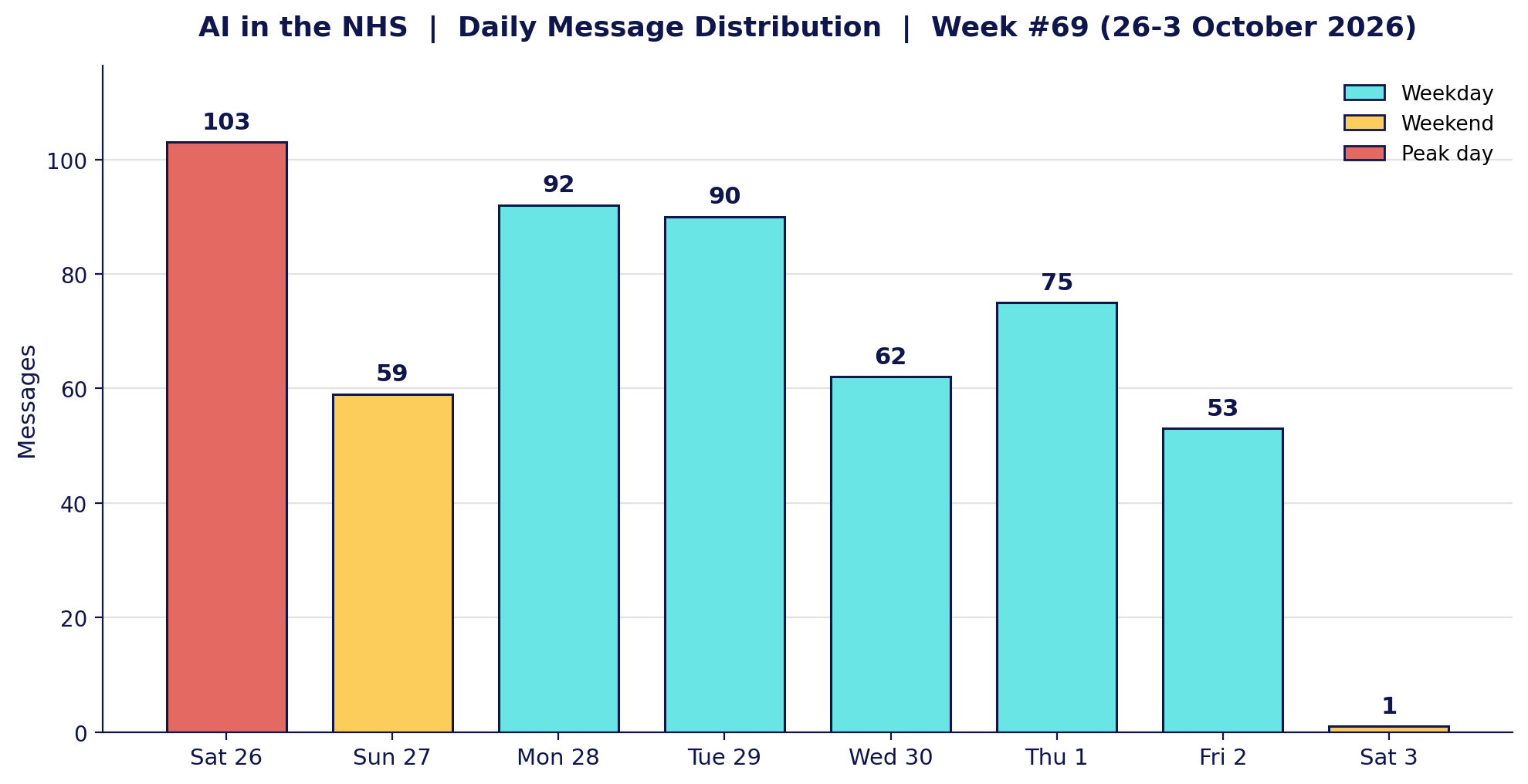
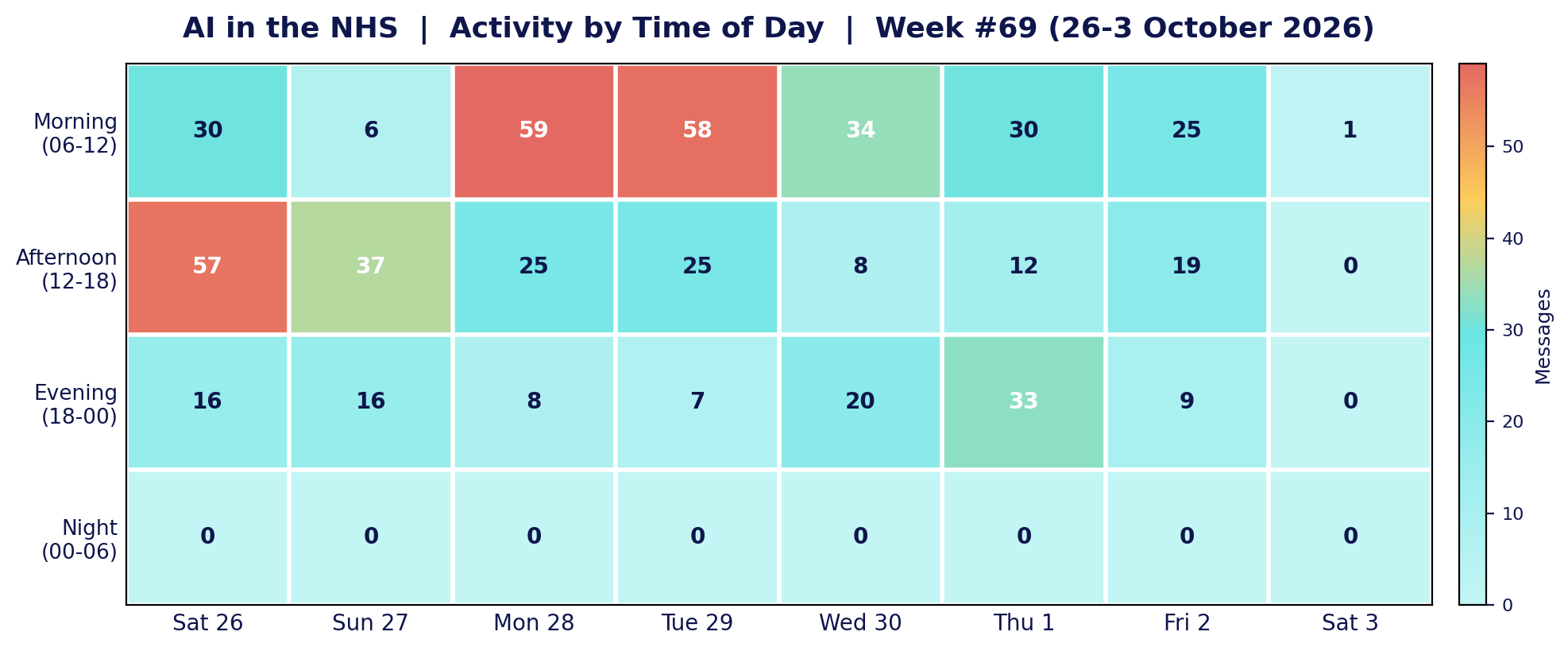
Insights:
• Activity was spread more evenly than last week: the peak day carried 19% of traffic against 41% for last week's Wednesday, and four days passed 70 messages.
• Mornings dominated at 243 messages, with Monday and Tuesday mornings (59 and 58) the busiest single blocks of the week, driven by the general practice panel thread and Tuesday's evidence and decision support threads.
• Saturday 26 September's afternoon (57 messages) carried the knowledge base report and the audit trail discussion, and Sunday afternoon (37) the internet-age quiz.
• Thursday evening (33) was the only evening above 30, with a primary care system launch event and the simulated-psyche thread's tail.
• No messages were posted between midnight and 06:00 all week. Four messages posted on Saturday 26 September before 09:00 arrived after last week's compilation and are counted here; one message had arrived on Saturday 3 October at the time of compilation.
APPENDIX B: Enhanced Statistics
69 group members posted at least one message this week, up from 63 last week and the highest since #66 (80). The 15 most active below account for 363 of the 535 messages (67.9%), a less concentrated week than last (74.6%), with 54 occasional and one-off contributors making up the rest.
Top 15 Contributors (Role Descriptors Only):
1. The group moderator: 77 messages
2. An integrated care operations lead: 56 messages
3. A clinician who writes about AI and the mind: 26 messages
4. A radiologist and clinical governance advocate: 25 messages
5. An innovation-focused GP: 21 messages
6. A GP and practice leader: 21 messages
7. A wry health-tech watcher: 21 messages
8. A clinical quantum computing advocate: 20 messages
9. An NHS commercial lead: 17 messages
10. A clinical informatician with supplier-side experience: 17 messages
11. A Northern Ireland clinician: 15 messages
12. A veteran clinician and appraiser: 13 messages
13. A GP with a long out-of-hours and informatics background: 12 messages
14. A medical imaging AI commercial lead: 12 messages
15. A primary care digital policy lead: 10 messages
Hottest Debate Topics:
1. 🔥🔥🔥 A party conference panel, the GP as gatekeeper, and whether primary care is a place, a platform or a relationship (approximately 75 messages across Sunday evening and Monday)
2. 🔥🔥🔥 AI and knowledge work: deskilling, pit closures, employer duty and medical education (approximately 55 messages across Saturday morning)
3. 🔥🔥 Personal knowledge bases, local hardware and the audit trail a claim will need (approximately 35 messages across Saturday afternoon and evening)
4. 🔥🔥 The internet-age quiz and social media generations (approximately 35 messages across Sunday afternoon)
5. 🔥🔥 Simulated friendship, AI volition and the commercial pull towards companionship (approximately 30 messages across Thursday morning)
6. 🔥🔥 A primary care system launch event and a new ambient scribe (approximately 27 messages across Thursday evening)
7. 🔥🔥 Juniors, mid-grades and the AI native workforce (approximately 24 messages across Friday morning)
8. 🔥🔥 Captcha at the digital front door: security against exclusion (approximately 24 messages across Wednesday morning)
9. 🔥 Peer review speed, control loops and the EU AI Act paper (approximately 21 messages across Wednesday evening)
10. 🔥 AI note-takers in multi-agency meetings (approximately 15 messages across Tuesday afternoon)
Discussion Quality Metrics:
• Evidence-Based vs Opinion Ratio: roughly 13% of messages (68 of 535) carried a link to a paper, guidance document, report or news article
• Average Thread Depth: approximately 8 messages per sustained discussion thread, with Monday's general practice thread running past 70
• Constructive Challenge Rate: high, including a supplier-side informatician's detailed challenge to a peer-reviewed paper's account of existing device regulation, and the moderator correcting his own Manhattan Project remark within minutes
• External Resource Sharing: 72 unique links shared across the period; 22 Journal Watch entries after link checking; 17 links were unretrievable, including every newspaper paywall and video link, and social media, member-authored and duplicate links were left out
Cross-Expertise Engagement:
Contributions came from general practice, radiology, cardiology, surgery, out-of-hours care, clinical informatics, clinical safety, practice management, ICB and federation operations, NHS commercial and procurement, primary care policy, patient safety advocacy, medical devices, quantum computing and software development, with a newly arrived surgical trainee and a trust colleague posting for the first time. Monday's general practice thread drew the widest mix, with partners, a member from outside general practice, an informatician and an operations lead arguing about the same model of care from different ends. The clearest knowledge transfer was the primary care digital policy lead's distinction between an access log and the evidence an AI liability claim will need, which turned a backup question into a design requirement.
APPENDIX C: Daily Theme Summary
Saturday, 26 September 2026
Primary Theme: AI and the future of knowledge work
Key Discussion: A commentary on AI and cognitive fitness opened a long morning on deskilling, employer duty and retraining, framed as the knowledge work equivalent of the pit closures. Medical education took the most useful turn, with a case for teaching uncertainty, clinical courage and hermeneutical awareness. In the afternoon the moderator reported on six months of a personal knowledge base and the audit trail question it had surfaced.
Secondary Discussions: Universal basic income and shareholder primacy; whether university survives the personal AI tutor; local hardware for running models; an open knowledge format; interoception and AI; the Star Trek ship's doctor, again.
Notable: The peak day at 103 messages, four of them posted before 09:00.
Sunday, 27 September 2026
Primary Theme: Nostalgia and the generations online
Key Discussion: An internet-age quiz brought out dial-up, Usenet, config.sys and Prestel, then a discussion of which generation uses which social network and why.
Secondary Discussions: An essay on AI etiquette; national culture and the ethics of decision-making; AI and clinical reasoning teaching at a European course; a podcast arguing AI alarmism has gone too far; sentencing in a medical device fraud case; whether any equivalent action has been taken on software as a medical device.
Notable: In the evening, a GP's observation that nobody on a party conference panel about general practice had worked in a practice in the last decade, which became Monday's thread.
Monday, 28 September 2026
Primary Theme: Is primary care a place, a platform or a relationship?
Key Discussion: The panel prompted a morning on the gatekeeper model, mega practices, a controversial keynote title, and whether data or doctors are the thing to join up, with several reminders to stay politically agnostic.
Secondary Discussions: The moderator at the HSJ event in Telford; ethnicity data quality across a borough; a US insurers' analysis of AI coding tools and costs; a GP petition; personal recording devices; a new mid-tier frontier model in the evening.
Notable: The primary care digital policy lead's line on general practice: "It's a relationship."
Tuesday, 29 September 2026
Primary Theme: Evidence, decision support and who records the meeting
Key Discussion: The moderator's caution on typed decision models without clinical evidence, his report of the gulf between what AI can do and what people need, and a geriatrician's question about ambient voice technology for older patients. In the afternoon, a trust colleague's question about AI note-takers in multi-agency meetings drew a traffic-light heuristic for data sharing.
Secondary Discussions: An evidence tool reportedly unavailable on NHS email accounts; meet-ups at HETT; a quantum and AI event; an ex-minister's remark about managers; automated filing of blood results; a gene-editing trial; pharmacy parody songs; an always-on agent product.
Notable: "Never has the clinical jagged frontier been so apparent".
Wednesday, 30 September 2026
Primary Theme: A human check at the digital front door
Key Discussion: A captcha-style check on a patient-facing service divided members between its value against malicious submissions and its cost to patients with low digital skills or certain mental health conditions; the moderator proposed a layered approach.
Secondary Discussions: Which AI tools GPs are actually using; a patient safety and AI survey; the Patient Safety and AI roundtable; peer review that runs two years behind the models; control loops for regulation; a review arguing the EU is decoupling risk classification from safeguards, and the reply that existing regulation already covers much of it.
Notable: A newly met pair from an ambient voice technology roundtable said hello in the group.
Thursday, 1 October 2026
Primary Theme: Should AI pretend to be your friend?
Key Discussion: A morning on simulated psyche, volition and misalignment, and the commercial incentive towards companion AI. A new frontier model was announced for cyber defenders first.
Secondary Discussions: Storage bundles and assistant subscriptions; a podcast on AI consciousness; a public regard chart for industries; a university partnership's innovation readiness report; Mac hardware; a medtech event; a primary care system launch with an ambient scribe in the evening.
Notable: Water companies, porn companies and the bingo card.
Friday, 2 October 2026
Primary Theme: Juniors, seniors and the AI native workforce
Key Discussion: A vendor study on AI against junior accountants led to reports of banks hiring juniors over mid-grades, and to concern about losing experience and unknown unknowns. A newspaper essay on AI and the Manhattan Project tested the arms-control analogy.
Secondary Discussions: A video AI that half of callers took for a person; a pragmatic BMJ opinion piece; hardware prices and subscription changes reported by members; invitations to an AI developer platform; a newly arrived surgical trainee on AI art.
Notable: "AI doing art is like Celine Dion covering AC/DC."
Saturday, 3 October 2026
Primary Theme: One message before the 09:00 cut-off at the time of compilation, on open-source hardware kits.
AI in the NHS Weekly Newsletter is produced by Curistica Ltd for members of the AI in the NHS WhatsApp community. All contributors are anonymised. Views expressed are those of individual community members and do not represent any organisation.