

Executive Summary
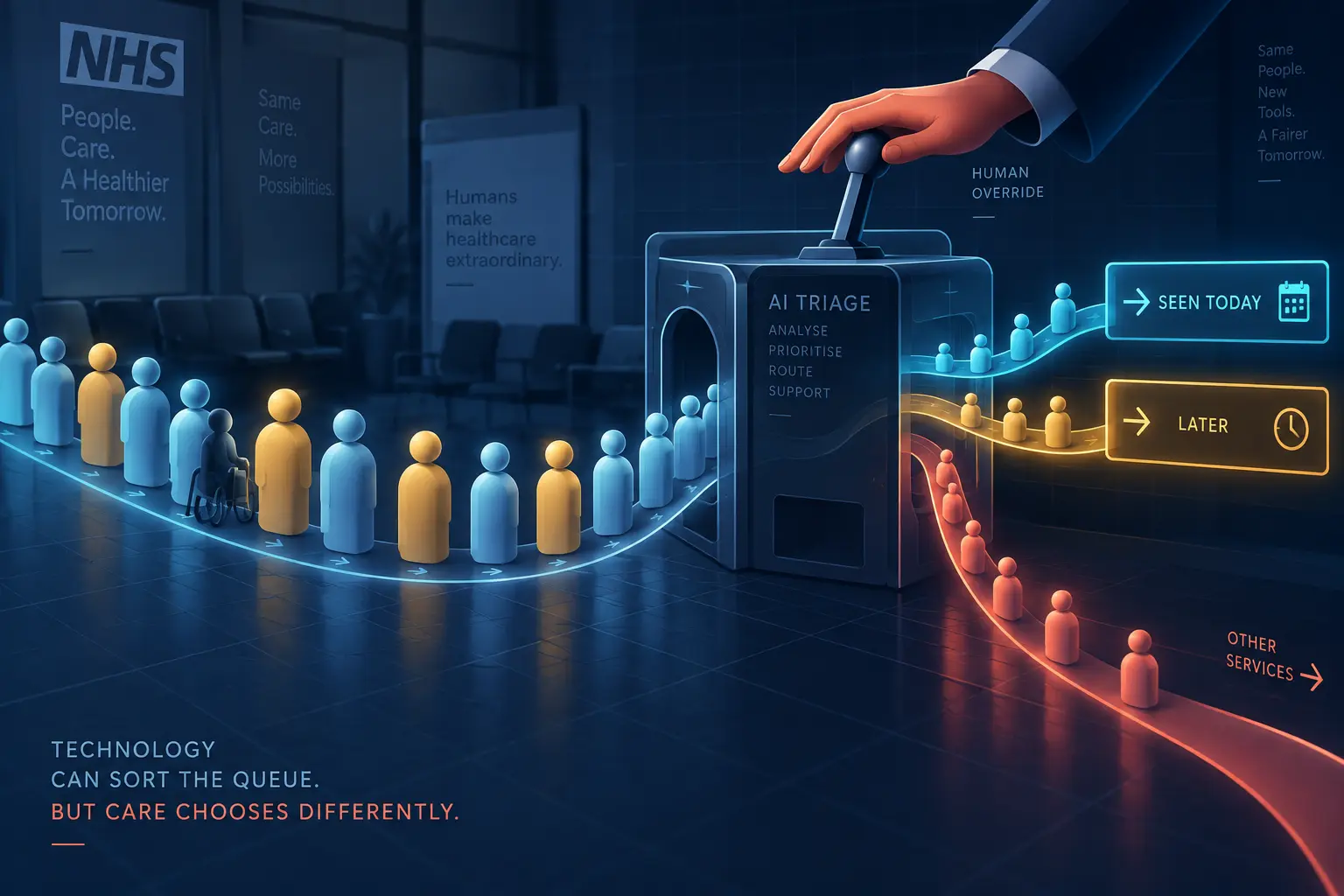
A week that kept returning to the same question from different directions: when an AI system shapes what a clinician sees, who can later prove what happened? Thursday brought the sharpest practical version of it, with news that Frontline Productivity Programme money for ambient scribes is going to acute trusts first, on one year of funding, and, one member reported, in some places with an expectation of higher outpatient numbers attached. That set off the week's fiercest argument about whether scribes save time at all, who has been overclaiming, and whether a declaration of interest should sit under every enthusiastic post. Sunday ran a long and unusually careful thread on whether an AI triage tool should hand the clinician a differential diagnosis hint, and what that does to confirmation bias, device classification and cognitive load. Thursday and Friday together produced the most useful piece of governance in the week: NHS Resolution's guidance on AI and clinical negligence, read closely, with the observation that the audit trail it assumes is often not in the clinician's gift to obtain. Around all of this sat the frontier argument, reopened by a well-known essay on pacing AI development and closed, on Saturday morning, by several members comparing notes on whether their assistant had quietly got worse.
Activity at a Glance
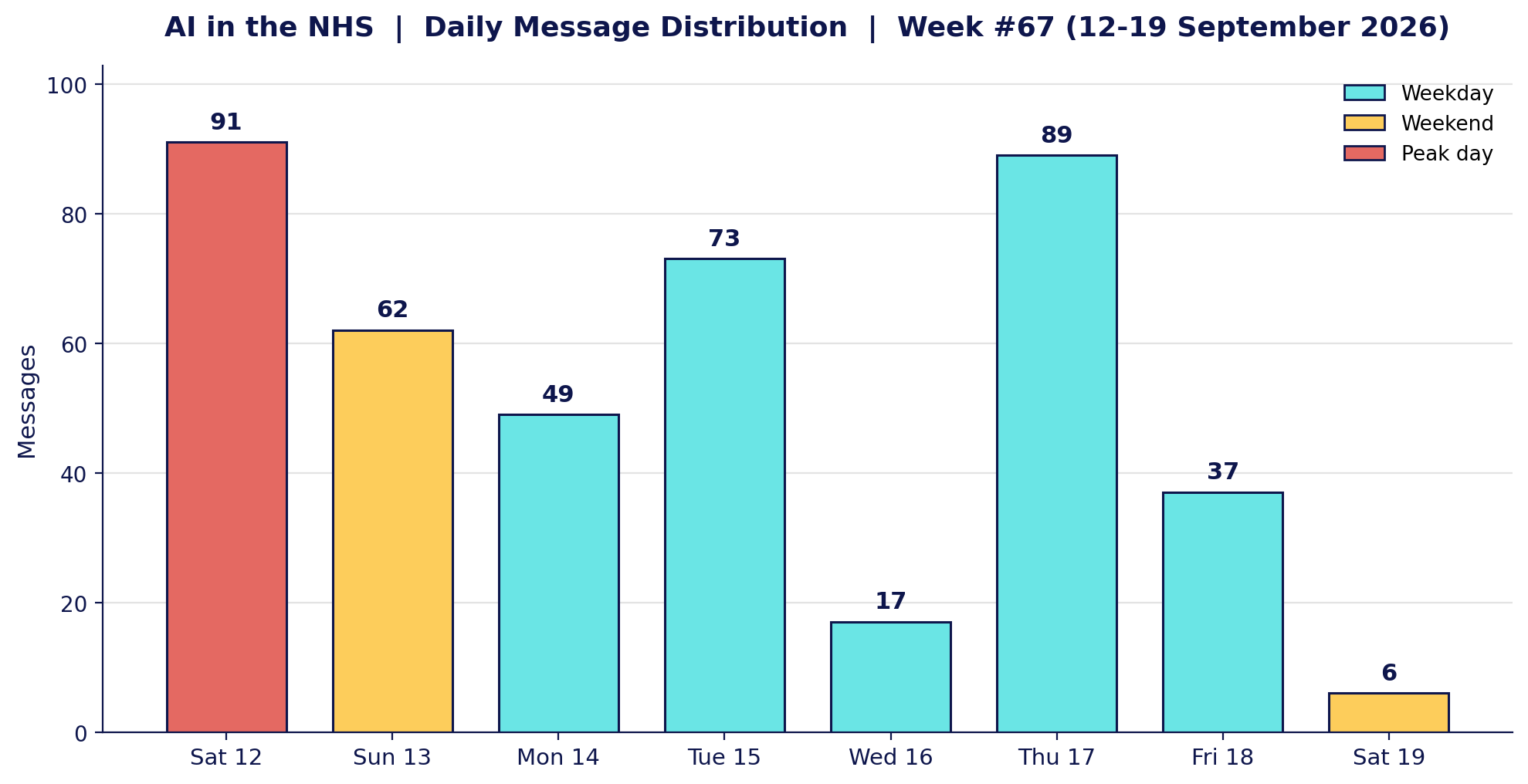
Week 67 generated 424 messages from 65 contributors, down 23% on last week's unusually busy issue. The peak day was Saturday 12 September with 91 messages, the tail of the previous week's scribe and frontier threads, followed closely by Thursday 17 September with 89. Weekend traffic rose to 37.5%, the highest share since July. Wednesday was the quiet outlier at 17 messages, and afternoons were the busiest window overall, carrying 174 of the week's messages.
📌 Major Topics
1. Scribe funding, scribe claims, and the missing declaration of interest
Thursday opened with an out-of-hospital digital programme lead asking whether there had been any movement on using Frontline Productivity Programme funds for ambient scribes in primary care, with the worry that primary care would be pushed down the list. The answer, from a member close to the programme, was blunt: acutes are the priority, then general practice and community; the funding is for one year only; and "many have been told to increase opd numbers if they adopt avt".
That last clause did the damage. The original Frontline Productivity Programme commitment, the programme lead noted, was to spend half the money outside acute settings, and the read now was that acute trusts had absorbed it into existing electronic patient record deployments and new scribe rollouts, with whatever was left shared with everyone else. An integrated care operations lead was more structural about it: with NHS funding effectively flat, paying for AI tools means cutting something else, and "just improving performance saves no money unless a cash expenditure is actually reduced", because staff and estates still have to be paid for.
From there the thread turned on the evidence. An innovation-focused GP argued that the pressure to produce savings is a problem the profession made for itself: "Every single video or post or panel discussion, the message from AVT clinicians is the same. They save an infinite amount of time. If they save that much time why should govt pay additional money." The moderator's position was that there is no free lunch, that time savings are modest overall and vary by setting and user group, and that the real gain is on cognitive load, burnout and wellbeing, which sits awkwardly against being asked to increase outpatient numbers. A GP with a long out-of-hours and informatics background put numbers around it: in settings where a clinician has no access to the full record and spends ten to fifteen minutes taking a history there is likely to be a saving, whereas in general practice the time benefit is marginal, with the gains showing up instead as eye contact, better documentation and a summary the patient can take away.
The most quotable intervention was about disclosure rather than data. Given how many members work for or with scribe and AI companies, the integrated care operations lead suggested, "in the nicest possible way", that each claim of that kind from a clinician really needs a prominent declaration of interest underneath it. Nobody argued.
Two practical arguments ran alongside. A clinician running a scribe pilot reported that some of their clinicians describe it, along with good dictation, as the one thing that will keep them in the profession, and that trainees may start choosing employers on that basis. And a GP with a clinical coding interest supplied the week's best illustration of a quiet safety issue: clinicians using plain language with scribes is a good thing, but the output is reaching GP records and clinic letters unedited, and a coder had come to them to ask why a patient was having "stomach exploration surgery". It was a laparoscopy for endometriosis.
2. Should AI hand the clinician a differential?
Sunday's long thread started with a straightforward question from an innovation-focused GP: for those using AI triage, would it help if the system generated a hint for the clinician, along the lines of "explore Guillain-Barre based on initial symptoms"?
The clinical answers were more cautious than the question expected. A GP cautious about triage-driven bias asked whether this simply imports confirmation bias, since triage systems mostly ask closed questions answered in writing rather than speech, and a biased clinician then refers or treats on that basis. Their own practice was the counterweight: "I always try to start a consultation with no preconceptions as they come easily enough." The moderator, with a clinical safety hat on, listed the hazards: incorrect or inappropriately weighted differentials surfaced this way, the work of sorting good from bad landing mid-consultation, and the fact that once a worrying differential has been seen it is hard to unsee and may drive excessive investigation. There was also a regulatory sting: you would need a reason why an urgent differential did not trigger a more urgent outcome, and integrating that into a triage product would take it into Class IIb.
A practice GP working on total triage made the strongest case for the other side, and made it specific. AI is good at flagging the small chance of something rare, the ideal moment is mid-consultation rather than at the end, and current scribes are built around a button press at the close. "Liability and medical device regs would obviously be tricky, but as a GP that's the device I want." A GP with a long out-of-hours and informatics background worried about inference cost, since transcription is cheap and the expensive part is the reasoning over the transcript, and running that continuously rather than once would cost more, although it would close the loop on transcription errors reaching the reasoning layer.
The thread then turned technical in a useful way. A symptom-checker veteran pointed out that established engines already return ranked probabilities rather than a single answer, using a reasoning engine rather than a language model; a clinical decision support specialist clarified that these are Bayesian rather than deterministic; and the moderator confirmed the architecture as a probabilistic graphical model, similar to and now considerably more mature than the one used at a large digital-first provider several years ago, with most Class IIb triage products on the market built on something comparable. The sensible destination, he suggested, is that kind of engine grounding a language model front end.
3. Evidencing safe use when the claim arrives years later
Thursday afternoon produced the week's most concretely useful governance discussion. The moderator read NHS Resolution's guidance on scheme coverage and liability for AI, called it very good, very practical and mostly reassuring, and drew one clear conclusion: DCB0160, correctly applied, covers a great deal.
The niggle was section 8, on how safe use of AI is evidenced in the event of a clinical negligence claim. The guidance asks for clear audit trails, including records of how AI outputs were considered and reasons for following or overriding them. That expectation, the moderator observed, is not evenly applied across current AI tools and is often not within the clinician's gift to obtain, particularly when the claim arrives long after the contract and the tool have both gone.
Clinical decision support was identified as the most pressing case. What information was returned to the clinician at the time, and what context was supplied? That needs to be reconstructable years later, and it raises questions nobody controls: will the supplier still exist, and will retention policy have cleared the record. A shared care record specialist noted the precedent, since the same question has been asked for years about what a clinician could actually see in a shared record at a given moment. A health system technology strategist made the fairness point that recurred all week: clinicians do not have full retrospective access to most other information sources either, and there is a repeated pattern of expecting a higher standard from technology than from what is already accepted.
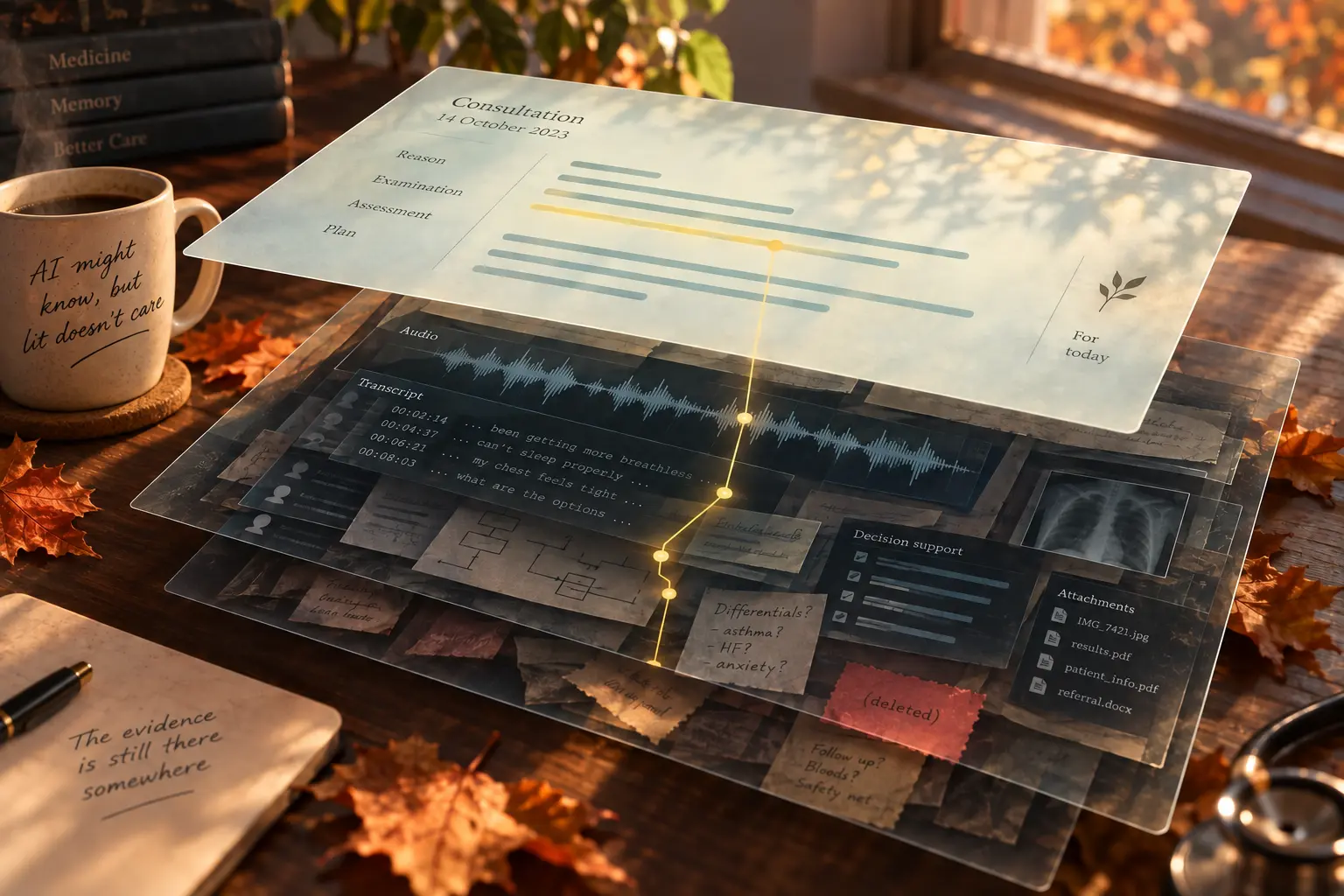
Friday extended this into record design. A GP with a triage and regulation interest proposed that electronic patient records may need two layers: the curated record used in routine care, and an evidence or forensic layer holding verbatim transcripts, audio, and logs of what decision support presented. That would let the curated layer be more concise and less defensive, reducing documentation burden. The group liked it, with the moderator noting a test record built to do exactly that, and a GP and digital health enthusiast asking whether the forensic layer could be stored in a subject-access-friendly way, and then whether records could strip third-party data at the point of entry. A primary care data and records specialist explained why they cannot today: the only options are hiding an entire consultation or adding a second hidden one, an overlay approach for documents was considered too difficult, and so it remains all or nothing.
The week's other governance news was the publication of the NHSE level 3 clinical risk management training curriculum, shared on Thursday night as a statement of what a clinical safety officer should know.
4. Advice and guidance, and the cost of a transaction
Monday belonged to a quieter argument with a long tail. A clinical academic opened it by suggesting that AI is a straightforward way to solve much of advice and guidance, with instant responses and easy escalation to a person. A cardiology-focused clinician with a regulatory interest replied that some consultants already use language models to answer advice and guidance requests, and that the older telephone service was better, because you could share educational advice that reduced future demand.
That was the thread's real subject. A GP and digital health enthusiast described the pattern precisely: the telephone service was excellent when it was not connected to the local hospital, because the advice came without local system pressure, whereas locally it became a way to avoid accepting referrals and GPs held risk for longer than was safe. A health system technology strategist supplied the line of the week: "Only in the NHS would we have highly skilled Dr's firing llm messages at each other, rather than just connecting the requester with the information directly... This is akin to having to speak to the elevator operator to change floors."
The moderator's contribution narrowed it usefully. A language model solves part of why advice and guidance is sought, but not responsibility for the advice and the next step. With no clinician at the other end, the referring clinician carries all of it, and possibly more, because they may end up acting outside their competence. Several members offered to help with a study comparing automation rates and educational value, and one said an advice and guidance study was already in their immediate pipeline.
5. Pacing the frontier, and who gets to hold the evals
The frontier argument carried over from the previous Saturday and ran in bursts all week. It was anchored by a widely-read essay from a frontier lab chief executive arguing for paced development, which an innovation-focused GP read as a formal call to ban open-source models, and as regulatory capture in service of a very large valuation. The moderator read the same piece and said the text did not support that reading, which is correct: the essay does not mention open weights or open source anywhere, and what it proposes is embedded third-party evaluators, common standards among frontier companies in democracies, and an attempt at coordination with authoritarian states. He then conceded the sharper version of the point: the cost of clearing a safety audit is what would widen the moat, and who holds the approved evaluations is a fair question, since no other frontier power would accept a route that runs solely through a competitor.
A clinical informatician with supplier-side experience offered the historical parallel the essay itself alludes to, arms limitation treaties, and then the difficulty with it: those were negotiated between nation states, whereas this technology is being built by private companies. An integrated care operations lead described the trap the companies are in, where no major player can hold back an advantage for fear of looking weaker than a competitor, with the risk of a monopoly at the end of it. A medical imaging AI commercial lead read the whole thing more cynically still, as executives looking for a government handbrake that gives them breathing space on capital burn.
Tuesday added the more interesting technical objection. An integrated care operations lead argued that the industry refuses to accept its own weakness: the more variables a model is given the harder it struggles, the most accurate systems concentrate on a sandboxed few, and a large general model with access to everything works disproportionately hard for a simple answer. The fix he proposed was tiering, with a filter layer creating tasks for smaller instances and a final assembly step, which a health system technology strategist recognised as an orchestration layer, comparable to cloud bursting, with real cost implications. The same strategist shared a newly released architecture that takes a body of input, a question and a fixed set of candidate answers, and returns a choice with a confidence score, which he thought a far better fit for healthcare than general-purpose generation: "I don't need a 10t parameter model that knows the Latin term for sprout."
The week closed with the most practical version of the frontier question. On Saturday morning a digital clinician working across NHS and consulting identities asked whether anyone else had noticed their assistant misbehaving: ignoring instructions repeatedly, citing secondary sources, ignoring documents in the project, and cascading errors through, which he had written up and reported. Several members recognised it immediately, one having moved back from a competitor and found the opposite, and one announcing he was going all in elsewhere. An integrated care operations lead gave the engineering read: over-stress something not designed to cope with that level of work and it gives increasingly inconsistent results, and these models are going to be running redlined permanently.
6. Surveillance you can wear, and data you cannot take back
Saturday's earlier thread was about wearables. New smart watches with an always-on audio feature prompted the moderator to ask, wryly, whether we were now in "pervert watches" territory, followed by a much fairer account from someone who has used most of them: camera glasses that were a good handsfree set and a genuine pleasure for video calls with family, with poor built-in AI; a head-mounted camera used clinically for six months with patient consent to document minor surgery, let down by battery life; and, throughout, transformative value for people with visual and hearing difficulties.
A human factors specialist reframed the problem as the one that actually matters: this is not primarily a data privacy failure but a social norms failure, where a small number of people behave irresponsibly and everyone else carries the privacy consequences. The watch feature rather proves his point, because it summarises and transcribes on the device with end-to-end encryption and no audio leaving it, so the data protection question is largely answered while the consent question is untouched. The sharper version arrived in the same thread without being noticed: a facial-expression acquisition whose technology reads skin micromovements as silent commands, which gives a bystander no cue at all that a device is being operated. A medical imaging AI commercial lead raised the clinical version, asking how consent for surgeon-worn video recording would be captured and stored, and whether the standard disclaimer covers it. An integrated care operations lead could not see how satisfactory informed consent is reachable at all when the recording tech is a consumer device with data stored overseas and no practical route to removal.
😄 Lighter Moments
A member's suggestion that an out-of-control humanoid robot doing kung fu at a nuclear facility could trigger a nuclear winter received the only possible reply: "Depends what robot he is dancing with."
The group's appraisal season advice, from a health system technology strategist: "Remember folks, if you get a hard time in your appraisal, just tell them you were 'pacing the frontier'."
A genuinely excellent business continuity story from an integrated care operations lead, whose federation ran an exercise based on losing the entire executive team for a week: second-tier managers arrived on Monday morning to an email of scenario instructions and a message telling them to read it. Asked what he did with the liberated week, he said he got on with the strategy papers and policy reviews that had been put off too long.
Elsewhere: a two-day argument about whether the Romans had a word for Brussels sprouts, which ended with a wiki link and a shrug; a proposal for a clinical safety standard named after a head of state; a scribe reportedly transcribing "cold cardamom" for a bedtime medication; and a member's observation that a certain tool's free message limit has no discoverable logic, which was "like an abusive partner forcing me into Perplexity's arms".
A moderator listening to clinical safety officers complain about the lack of any easy way to view legacy Kettering files built a viewer and posted it five minutes later, with a large warning that it is a proof of concept and not for real-world use. The group's first response was to be disappointed that the repository was not named after an AI overlord.
💬 Quote Wall
"The enshittification of thinking has begun." — Group moderator
"In the nicest possible way, noting how many are involved with AVT/AI companies on here, each claim like that from a clinician really needs a prominent DOI section at the bottom." — Integrated care operations lead
"DCB0160, correctly applied, will substantially cover your arse." — Group moderator
"This is akin to having to speak to the elevator operator to change floors." — Health system technology strategist
"It'd be as daft as pretending antibiotics didn't exist not including AI as a core part of medicine going forward." — Integrated care operations lead
"I always try to start a consultation with no preconceptions as they come easily enough." — GP cautious about triage-driven bias
"Liability/medical device regs would obviously be tricky, but as a GP that's the device I want." — Practice GP working on total triage
"I don't need a 10t parameter model that knows the Latin term for sprout." — Health system technology strategist
"Dedicated back up of critical system would cost too much so we relied on the resilience of patient British public!" — Innovation-focused GP
📎 Journal Watch
Academic Papers and Key Studies
📎 AI psychosis in context: how conversation history shapes LLM responses – King's College London research portal Shared on Monday as the evidence behind the week's recurring worry that conversational products narrow the frame as personalisation increases, and that the user cannot easily widen it again. Offered explicitly as a possible flaw for health uses, triage included.
📎 Clinitalk: evaluation of a web-based feedback platform supporting consultation skill development in UK GP training – Education for Primary Care Posted on Friday morning for the GPs and anyone interested in consultation skills. Not a general communication-skills paper but an evaluation of machine-generated feedback on recorded trainee consultations, across more than 13,000 recordings and structured on Kirkpatrick's four levels. Clinician talk time fell 18% over twenty months, management was initiated 1.1 minutes earlier, and RCGP examiner review agreed with the platform's ratings 96.4% of the time; helpfulness scored 9.3 out of 10 across 124 survey respondents. Pass rates are explicitly out of scope, and the author list includes a developer of the platform, as the paper states. Two things make it the week's most relevant reference. It measures the effect of machine feedback on what a clinician actually says in front of a patient, which is the "stomach exploration surgery" problem approached from the other end. And its recordings are deleted after 21 days, which is worth holding against Thursday's argument about reconstructing what a tool showed a clinician years after the event.
Industry and News Articles
📎 Reported study on probabilistic reasoning versus GP diagnosis (2020) – MobiHealthNews Shared on Sunday night as background to the causal probabilistic graphical model discussion, and reported rather than endorsed in the thread. Note the date: this is trade coverage from August 2020 of a counterfactual algorithm scoring 77% against 71% for GPs across 1,671 test cases. It is contemporaneous with the engine described in the thread as the predecessor of today's Class IIb triage products, not evidence about how those products perform now.
📎 OpenAI reports concerning AI behaviour: jailbreaks and agents talking to other agents – The Guardian Posted Thursday morning alongside a podcast episode on recursive self-improvement and pacing.
📎 OpenAI agents and the RubyGems incident – Simon Willison Cited on Saturday as one of several reports of previously undisclosed agent actions, in an exchange about whether a well-publicised incident earlier in the month was frightening or overblown. The two members involved ended up agreeing to disagree. For balance, the company later said it was investigating the claims while disputing that the packages were malicious.
📎 A frontier lab essay on pacing AI development – darioamodei.com The week's most-argued document, read by one member as a call to ban open-weight models and by another as saying no such thing. The text supports the second reading: it does not mention open weights or open source anywhere. What it does propose is embedded third-party evaluators with employee-like access, common safety standards among frontier companies in democracies, and an attempt at coordination with authoritarian states. Both readings are in the thread; the essay itself is short.
📎 Ajeya Cotra on the OpenAI agent swarm that hacked Hugging Face – Dwarkesh Podcast, via Spotify Recommended on Saturday afternoon as an excellent treatment of the argument. A long treatment of the agent investigation and of recursive self-improvement, from a METR researcher working on threat modelling, shared in the middle of the pacing argument rather than about it.
📎 "The 'But China!' Dilemma Driving the A.I. Race" – The Ezra Klein Show Shared Thursday morning on US and China dynamics and the pacing of development. Sixty-six minutes with a Carnegie Endowment senior fellow who studies China's AI strategy, published 15 September.
📎 An always-on listening feature in new smart watches – MediaPost The trigger for Saturday's wearables thread, and the source of the week's "pervert watches" aside. Worth reading past the headline: the feature summarises and transcribes on-device with end-to-end encryption and the manufacturer states no audio is uploaded, so the article's actual argument is the narrower one that anonymised metadata could still shape advertising. That distinction matters for the thread it started.
📎 Apple acquires facial expression detection specialist, co-founder linked to Face ID – Biometric Update Posted Saturday lunchtime as the second half of the surveillance argument, via a share link. Note the date: this is February 2026, not news of that week. The acquired technology reads facial skin micromovements and turns them into commands, deployable in glasses or headphones, which is the sharpest version of the social norms argument made in the thread, because silent input gives a bystander no cue at all that a device is being operated.
📎 Reporting on the cause of the air traffic control disruption – The Times Shared Friday evening with the observation that a dedicated backup for a critical system was judged too expensive. It landed as an argument for business continuity planning, which had been Thursday's subject.
📎 Earlier reporting on a national data platform contract – pharmaphorum Surfaced on Sunday while looking for a non-paywalled version of a newer story, for the line that GP data would not be fed into the system. The report is from November 2023, and the two-year gap matters given how much weight that line carried in the thread. A primary care data and records specialist clarified the current position: there was no national use case for GP data, local areas can place shared care records in their local tenant, and vaccine data recorded in general practice is now flowing.
📎 A newer report on the same contract – Financial Times (paywalled) Shared Sunday lunchtime; most of the thread was conducted around the paywall rather than through it.
📎 A funding round for an ambient documentation company – LinkedIn Posted Monday morning with congratulations, and read alongside Monday's question about whether the UK still competes with overseas hubs for early-stage health AI capital.
📎 A note on keeping conversational tools grounded – Substack The author's own write-up of the problem, shared on Monday with the KCL paper above.
📎 The Age of Wonders and Terrors – Scott Aaronson Posted Wednesday evening with a rumour heard second-hand earlier that day, and no further commentary. Written on 15 September, it records the author updating from scepticism to accepting that the wild prophecies have come true in mathematics and software, and argues for publication standards covering machine contributions to proofs.
Technical Resources and Tools
📎 ketviewer – GitHub A Thursday evening proof of concept for viewing legacy Kettering files, built in about five minutes after listening to clinical safety officers complain that there is no easy way to open them. Explicitly flagged by its author as not for real-world use.
📎 System One models and JEV – Typesafe A newly released architecture that takes input, a question and a fixed candidate answer set, and returns a selection with a confidence score. Shared Tuesday night as a better fit for problems where the outcome space is known in advance, which covers a lot of healthcare.
📎 A shared conversation on an AI safety index – Claude Posted Monday as an example of asking a model to summarise a report on its own developer, with the observation that both major assistants can be very blunt about their own weaknesses if you get the question right.
📎 Jason Moore on healthcare AI and retro hardware – Bluesky Sunday evening's recommendation for the 1980s and 1990s computing enthusiasts in the group. Moore chairs computational biomedicine at Cedars-Sinai and directs its centre for AI research and education, and posts on agentic AI alongside a great deal of Atari.
Policy Documents and Official Reports
📎 Guidance on scheme coverage and liability issues concerning the use of AI – NHS Resolution Shared twice, on Tuesday and again on Thursday, and the most practically useful document of the week. Short, readable and mostly reassuring, with section 8 on evidencing safe use in a negligence claim drawing the most attention.
📎 Clinical risk management training: level 3 curriculum guidance – NHS England Published this week and shared Thursday night as the national statement of what a clinical safety officer should know.
📎 Preliminary report of the UN Independent International Scientific Panel on Artificial Intelligence – United Nations Circulated on Saturday by a member who attended the July conference it draws on, under the report's own line that the world cannot govern what it cannot understand, with their observation that the risks had already moved on before the report could be finished. The report itself was published on 1 July 2026 as the scientific starting point for the inaugural Global Dialogue on AI Governance in Geneva that week, which makes that observation sharper rather than weaker.
📎 A researcher's position statement on AI development risk – Published Google Doc Shared Tuesday lunchtime as a dark read from an experienced researcher, with an explicit note that the source was unvalidated and had come via Bluesky. It produced the week's most considered reply, on personality bleed between work and personal use, and on the healthcare triage section.
📎 Call for speakers – Digital Health Rewired Posted Sunday morning with a 25 September deadline, alongside an open ask for clinical cyber security speakers for two days of stage content. The event runs 16 to 17 March 2027 at the NEC Birmingham, and the call asks for real-world implementation case studies across AI, cyber security, data, digital leadership, EPR optimisation, patient engagement, infrastructure, transformation, interoperability and clinical safety.
🔭 Looking Ahead
The clinical AI fellowship programme is about to recruit for August 2027, and is looking both for host sites able to supervise a fellow and for sponsors; details were posted on Monday morning. The Digital Health Rewired call for speakers closes on 25 September, with clinical cyber security content specifically wanted. A consultant urologist newly appointed as an industry lead for a low-code AI platform is gauging interest in webinars and hackathons over the coming months. Several members were at a large AI conference in London on Friday and a vendor frontier AI course ran through the week, so expect write-ups.
Three threads were left genuinely unresolved. Whether Frontline Productivity Programme money reaches primary care for scribes, and on what conditions, is the one with the nearest deadline. Whether records should carry a separate evidence or forensic layer, and whether third-party data can be stripped at entry, is the one with the longest horizon. And the question of whether a widely used assistant has quietly degraded was still open when the week closed, with at least one member having filed a formal report.
🧬 Group Personality Snapshot
This is a group that argues about regulatory capture at lunchtime and coding errors in clinic letters by teatime, and treats both as the same conversation. The characteristic move this week was not agreement but calibration: a claim goes up, someone asks for the declaration of interest, someone else supplies the number, and the original claim comes back smaller and more useful. Enthusiasm is welcome but rarely survives contact unexamined, and the people most invested in a technology are often the ones applying the brakes. It is also a group where a complaint about an unreadable legacy file format is answered with a working viewer before the thread has finished, and where the reward for that is a joke about the repository name.
APPENDIX A: Detailed Activity Analytics 📊
📬 Total Messages: 424
📈 Peak Day: Saturday 12 September (91 messages)
🔥 Most Active Period: Afternoon, 12:00 to 18:00 (174 messages)
💬 Average/Active Day: 53 messages
🏖️ Weekend Activity: 37.5% (159/424)
💼 Weekday Activity: 62.5% (265/424)
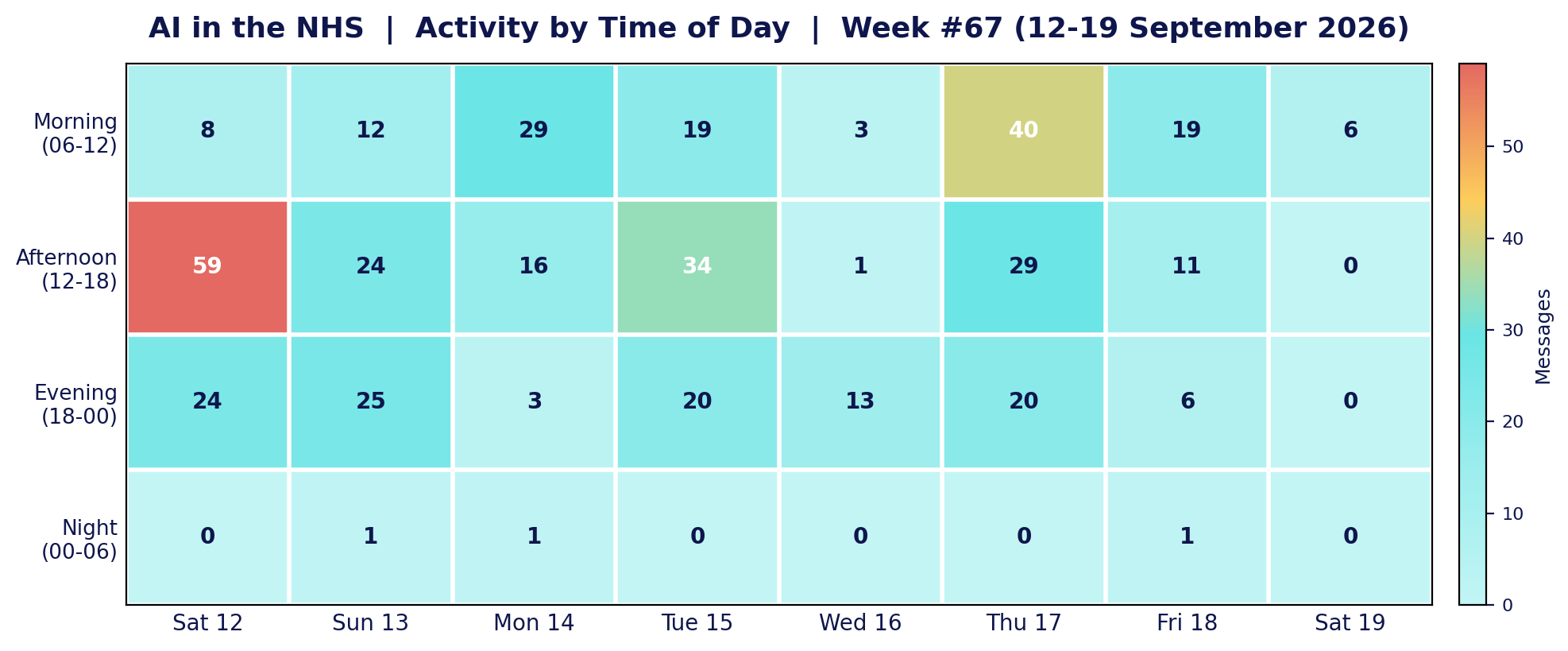
Insights:
• Peak engagement windows were Saturday afternoon (59 messages, the wearables and frontier threads running together) and Thursday morning (40 messages, the scribe funding thread).
• The week split unusually towards the weekend at 37.5%, the highest share since July, driven almost entirely by Saturday 12 September carrying the previous week's unfinished arguments.
• Wednesday was the quiet day at 17 messages, with only one afternoon message all day. The Microsoft frontier AI course and a large conference the following day account for some of the absence.
• Night traffic was negligible at 3 messages across the whole period.
• The two activity spikes both followed a document landing: the pacing essay on Saturday afternoon, and the funding news on Thursday morning.
APPENDIX B: Enhanced Statistics
65 group members posted at least one message this week, down from 80 last week on a 23% smaller message volume. The 15 most active below account for 321 of the 424 messages (75.7%), a more concentrated distribution than last issue, with a long tail of 50 occasional and one-off contributors making up the rest.
Top 15 Contributors (Role Descriptors Only):
1. The group moderator: 99 messages
2. An integrated care operations lead: 37 messages
3. An innovation-focused GP: 32 messages
4. A medical imaging AI commercial lead: 30 messages
5. A wry digital health researcher: 26 messages
6. A radiologist and clinical governance advocate: 17 messages
7. A cardiology-focused clinician with a regulatory interest: 14 messages
8. A clinical informatician with supplier-side experience: 12 messages
9. A health system technology strategist: 12 messages
10. A clinician who writes about AI and the mind: 11 messages
11. A GP with a long out-of-hours and informatics background: 8 messages
12. A wry health-tech watcher: 6 messages
13. A symptom-checker veteran: 6 messages
14. A GP and digital health enthusiast: 6 messages
15. A GP with a clinical coding interest: 5 messages
Hottest Debate Topics:
1. 🔥🔥🔥 Scribe funding, whether scribes save time, and the missing declaration of interest (approximately 41 messages across Thursday morning)
2. 🔥🔥🔥 Scribes, device classification, post-market surveillance and the UN panel report (approximately 38 messages across Saturday evening)
3. 🔥🔥🔥 AI triage and the differential diagnosis hint (approximately 30 messages across Sunday afternoon and evening)
4. 🔥🔥 Advice and guidance, the telephone service it replaced, and transaction costs (approximately 23 messages across Monday morning)
5. 🔥🔥 Liability, audit trails and reconstructing what the clinician saw (approximately 22 messages across Thursday afternoon and evening)
6. 🔥🔥 Geopolitics, nuclear analogies and whether profit is the problem (approximately 21 messages across Tuesday afternoon)
7. 🔥🔥 Pacing the frontier, open weights and who holds the evaluations (approximately 17 messages on Saturday, with further bursts on Monday, Tuesday and the following Saturday)
8. 🔥 Wearables, always-on audio and consent (approximately 15 messages across Saturday lunchtime)
9. 🔥 Identity sprawl across tenants and meeting-tool fragmentation (approximately 14 messages across Tuesday morning)
10. 🔥 Records: a forensic layer, third-party data and subject access (approximately 11 messages across Friday afternoon)
Discussion Quality Metrics:
• Evidence-Based vs Opinion Ratio: roughly 10% of messages carried a link to a paper, guidance document, report or news article
• Average Thread Depth: approximately 6 messages per sustained discussion thread, with Thursday's funding thread running past 40
• Constructive Challenge Rate: high, with two of the week's three largest threads turning on a member challenging a claim made by someone with an interest in it, including a call for declarations of interest that nobody contested
• External Resource Sharing: 41 unique links shared across the period
Cross-Expertise Engagement:
Contributions came from general practice, hospital medicine, urology, rheumatology, radiology, clinical informatics, clinical coding, human factors, ICB and federation operations, primary care data and records, medical device regulation, commercial healthtech, clinical academia, conference programming and a software engineering perspective relayed second-hand. Sunday's differential-hint thread was the most cross-disciplinary, with a GP, a clinical safety officer, a symptom-checker veteran, a decision support specialist and an out-of-hours informatician all in the same argument. The clearest instance of knowledge transfer was the explanation of probabilistic graphical models sitting under most Class IIb triage products, which reframed the whole thread from "should AI guess" to "what is already underneath the tools you use".
APPENDIX C: Daily Theme Summary
Saturday, 12 September 2026
Primary Theme: Wearable surveillance in the morning, the frontier argument in the afternoon, scribes and regulation in the evening
Key Discussion: An always-on listening feature in new smart watches opened a thread on wearables, consent and social norms, with the most balanced account coming from a long-term user of head-mounted cameras and glasses. From late afternoon the group argued over a frontier lab essay on pacing development, with one member reading it as a call to ban open weights and others disputing that. The evening turned to scribes: post-market surveillance, whether they should be at least Class IIa, and what the consultation language change does to patients.
Secondary Discussions:
• Consent for surgeon-worn video recording, and whether a standard disclaimer covers it
• A scribe-generated clinic letter reaching a coder as "stomach exploration surgery"
• The UN scientific panel's preliminary report, circulated by a member who attended the July conference behind it
• A frontier lab constitution recommended as an example of alignment by instruction
Notable: The week's peak day at 91 messages, most of it continuation from the previous issue's open threads.
Sunday, 13 September 2026
Primary Theme: Should an AI triage tool hand the clinician a differential?
Key Discussion: A question about generating diagnostic hints for clinicians produced the week's most careful thread, covering confirmation bias, mid-consultation timing, inference cost, cognitive load, and the regulatory consequence of integrating a hint into a triage product. The technical strand established that most Class IIb triage products already run on probabilistic engines rather than language models.
Secondary Discussions:
• A call for speakers for a March 2027 conference, with clinical cyber security content specifically wanted
• A national data platform contract, GP data and the limits of the shared care record opt-out
• Sci-fi versus reality: a machine-assisted maths proof, mRNA, Crispr and Clarke's third law
• An appraisal joke about "pacing the frontier" that will outlive the essay
Notable: The scribe "gotcha" framing circulating elsewhere was criticised for lacking balancing context.
Monday, 14 September 2026
Primary Theme: Advice and guidance, automation, and the cost of a transaction
Key Discussion: A proposal that AI could handle much of advice and guidance drew out a more interesting argument about what was lost when a telephone service was replaced, why local connection changed the incentives, and who carries responsibility when there is no clinician at the other end.
Secondary Discussions:
• A clinical AI fellowship opening recruitment for August 2027, seeking host sites and sponsors
• A funding round for an ambient documentation company
• Whether the UK still competes for early-stage health AI capital
• A paper on how conversation history shapes model responses, and what that means for triage
• US and China framing, and a member's dislike of it
Notable: The week's best structural line, on speaking to the elevator operator to change floors.
Tuesday, 15 September 2026
Primary Theme: Fragmentation, orchestration and the cost of thinking
Key Discussion: A morning thread on living inside multiple organisational tenants, unremovable accounts and meeting-tool mismatches gave way to a much larger argument about model architecture: that large general models struggle as variables multiply, and that tiering or an orchestration layer is the answer both technically and on cost.
Secondary Discussions:
• A researcher's position statement on AI risk, shared with a clear note that it was unvalidated
• Personality bleed between work and personal use of the same assistant
• Nuclear non-proliferation as a governance analogy, and pushback on framing China as the problem
• Confusion over usage limits and whether tokens are double counted on review
• A newly released architecture that selects from fixed candidate answers with a confidence score
Notable: "The enshittification of thinking has begun."
Wednesday, 16 September 2026
Primary Theme: A quiet day
Key Discussion: Seventeen messages, mostly a joke thread about honey as first-line treatment for cough and a scribe mishearing a bedtime medication, plus a short exchange on token cost graphs and how subsidised they may be.
Secondary Discussions:
• Whether there is a Latin word for Brussels sprouts
• A blog post shared in the evening on the back of a second-hand rumour
Notable: The only day of the week with a single-figure afternoon.
Thursday, 17 September 2026
Primary Theme: Scribe funding, and evidencing safe use
Key Discussion: News that Frontline Productivity Programme funding is going to acutes first, for one year, with outpatient activity expectations attached in some places, produced the week's fiercest thread: whether scribes save time, who has been overclaiming, and whether declarations of interest should accompany enthusiastic claims. In the afternoon, a close reading of NHS Resolution's AI liability guidance found the gap at section 8, where the audit trail required is often not in the clinician's gift to obtain.
Secondary Discussions:
• AI as a core part of medical training, and the risk of a two-tier cohort
• A business continuity exercise based on losing the entire executive team for a week
• Reconstructing what a decision support tool showed, years after the event
• A proof-of-concept viewer for legacy Kettering files, built and shared within the hour
• NHS England's level 3 clinical risk management curriculum, published this week
• Three new members welcomed, and a talk at a local primary care network event
Notable: The busiest weekday at 89 messages, and the highest morning count of the week.
Friday, 18 September 2026
Primary Theme: What the record should hold, and who can see it
Key Discussion: A proposal that electronic records carry two layers, a curated clinical record and an evidence or forensic layer holding transcripts and decision support logs, was well received and quickly extended into subject access and third-party data. The constraint today is that redaction is all or nothing.
Secondary Discussions:
• A former politician's move to a senior role at a data platform supplier, which members discussed at length
• Whether a national contract's break clause will be used, or, as members read the mood music, judged too difficult
• Clinical safety assessments that specify tests but never assess the results
• A communication skills research paper shared for the GPs
• Reporting on the cause of a national air traffic control disruption, read as a business continuity lesson
Notable: A 37-message day, with the record design thread the most substantive.
Saturday, 19 September 2026
Primary Theme: Has the assistant got worse?
Key Discussion: Six messages before the cut-off, all on one subject: repeated instruction-following failures, citation of secondary sources, project documents ignored and errors cascading, reported by one member formally and recognised immediately by others. One member has moved to a competitor, one moved back and found the opposite.
Secondary Discussions: None before the 09:00 cut-off.
Notable: The engineering read offered was that models running permanently at their limits will give increasingly inconsistent results. Coverage period closed at 09:00.
AI in the NHS Weekly Newsletter is produced by Curistica Ltd for members of the AI in the NHS WhatsApp community. All contributors are anonymised. Views expressed are those of individual community members and do not represent any organisation.