
Executive Summary
A quality tool for clinical safety cases went from publication to live use inside two hours, which tells you something about the appetite in this group for anything that turns a judgement call into a checklist. The week's sharpest moment came from a member who opened a relative's NHS App and found stroke, myocardial infarction and lupus recorded as diagnoses the person has never had, apparently coded by an AI letter tool, and worked it out from the underlining. The new online hospital was announced with a list of conditions the group thinks all require local investigation anyway, and the evidence behind the launch claim turned out to be thinner than the claim. Consent surfaced again, this time as a language problem rather than a privacy one, and the group found that the systems most in need of a consent flag have nowhere to put one. And Friday ran to 153 messages, most of them not about AI at all, on whether medical training survives contact with tools that do the grunt work and whether the profession is still a premium resource.
Activity at a Glance
469 messages from 58 contributors, with Friday 28 August accounting for 153 of them, almost a third of the week in a single day. Weekday traffic dominated at 84.9%, the most lopsided split in several issues, and the quiet weekend bookends make the working-week concentration unusually clean. 56 unique links were shared.
📌 Major Topic Sections
1. A checklist for safety cases, and the group used it before lunch
On Friday morning the group moderator posted that work he had done with a clinical AI researcher was out in BMJ Innovations. The problem it addresses is one this group has circled for months: DCB0129 and DCB0160 tell you what a clinical safety case has to contain, but nothing tells you whether the one in front of you is any good, so that judgement has always come down to whoever is reading it.
The method is worth noting because it is inverted from the usual. Rather than asking ten experienced clinical safety officers what good looks like, the workshop asked them what they actually see going wrong, then turned the failure modes into indicators. The output is 36 indicators across five domains, marked present or not present from the documents alone, with a note where something is there but thin. There is deliberately no score. As the moderator put it, "a number gets treated as a pass mark". The output was then checked with a further 45 individuals, of whom 19 replied with feedback. It is free under CC BY.
What happened next is the interesting part. Within two hours two members had run the checklist against safety cases they were in the middle of writing. "I tried asking Claude to run this checklist against a DCB0129 I was most of the way through writing and it came up with some very sensible criticisms," reported a clinician working on clinical safety documentation, and another replied simply, "Did the same :)". A supplier-side clinical safety lead described having just completed a first comprehensive DCB0129 for a trust's clinical communication platform, and was candid about the experience: "it was painful because it wasn't clear what was needed or how to create a really good quality document that they could use."
The moderator's response to the enthusiasm was characteristically double-edged. Having noted that the tool is well suited to such things, he added: "BUT... you.must.check.the.output." And then, "and I would also say, do it manually too."
There is a second proposal buried in the thread that deserves more attention than it got: a central register of safety cases, to allow peer review and learning. Nothing like it exists. The next step named for the tool itself is inter-rater reliability, testing whether two reviewers using it reach the same answer, with an open invitation to help.
2. Three diagnoses that never happened
Late on Friday morning a GP and frequent blogger posted the week's most concrete piece of harm evidence: "Fascinating seeing Stroke, Myocardial Infarction and Lupus appear on a rellie's NHS app as diagnoses. They don't have them. Checked letters.... AI coded, wildly wrong. BE CAREFUL WITH AI PEOPLE YOU CAN HARM PATIENTS."
How it was spotted matters. It was not flagged by any system. "I worked it out from the weird underlining in a letter (not even those codes!!!) and then asked," he explained. The practice confirmed a standalone letters product was in use. He had already messaged the practice principal and told him to stop and report it.
The moderator set out the reporting chain in full, and it is a useful CSO answer to keep: report to the practice first so they can investigate against the extant clinical risk management plan for the product, then cascade notifications to LFPSE and, probably, the MHRA, since it may well be a device. Then consider the data protection aspects in terms of rectifying the record. He also flagged the honest uncertainty, that at this point you cannot be sure it was AI, although it does smell like it. A digital health strategist's response cut to the practical gap: "Needs reporting either way... But how and where (to make it meaningful)".
The timing was almost comic. Earlier the same morning a member had circulated a BMA Special Representative Meeting motion, carried in all parts, whose second limb insists that any patient data in medical records generated in whole or in part by AI must be clearly identifiable, must be added with explicit and recorded patient consent, and must carry a yellow-card type identifier to facilitate MHRA reporting. Had that already been policy, the diagnoses would have been flagged rather than deduced from typography.
The liability question split the group as it usually does. An integrated care operations lead held the hard line throughout: "I still can't get past this being the problem of the clinician who approved it. If a doctor still wants a doctor's salary then that's their job to do. The AI company won't accept liability and the EULA will make sure that it's all that of the doctor if harm is caused." A digital health GP had made the counter-argument on Sunday: "Clinicians make mistakes just like any other human. However, we are regulated tightly, hold medical insurance 10,000 times our annual income, and cannot hide behind a 100 page EULA and get away from the responsibility." The asymmetry, not the principle, is the complaint.
Monday had already carried a related warning, with GP leaders quoted in the trade press on inaccurate AI-generated hospital letters and the patient complaints that follow.
3. A hospital with no building, and an evidence base doing heavy lifting
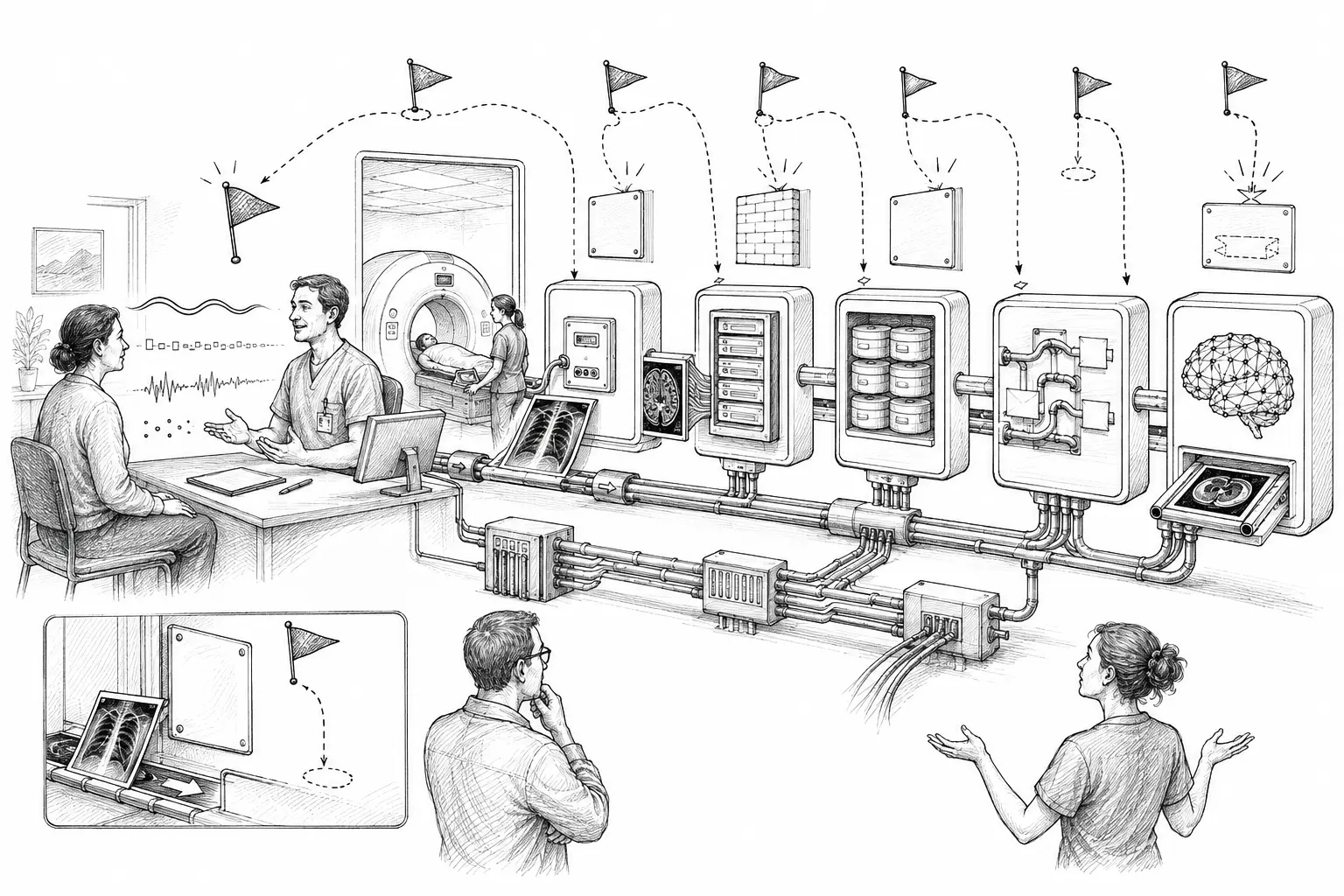
Monday morning brought the appointment of a chief executive for the new online hospital trust, launching next year, and a list of conditions to be supported for referral in 2027: glaucoma, IBD, iron deficiency anaemia, prostate conditions, and menopause and menstrual issues.
The list did not survive first contact. "Is it just me or is this a strange list of conditions for starting an online hospital?" asked a clinician recruiting for a clinical safety officer role. "With the possible exception of menopause and menstrual issues, they all seem to be conditions that need specific investigations or interventions." A GP running an in-house AI service was blunter: "IBD - what will remote hospital do other than 'we will refer to you local hospital for camera test'. Prostate, we will refer you to local hospital for MRI / flow studies." The objection sharpened over the day into a question nobody could answer: if all the investigation happens locally anyway, where is the benefit or the saving?
The moderator ran the launch claim, that "evidence shows digital care works well", through a deep research pass and then had a second model critique the result. The correction is the useful bit. Most of the supporting evidence is for hospital virtual clinics, where the patient still attends and a technician does the scans and the consultant reviews them later, which is well proven. The online hospital is a different proposition: the patient stays at home. On that reading, only IBD has good evidence, because home calprotectin testing produces real data. Retina is strong, glaucoma and prostate are decent but hospital-based, iron deficiency anaemia has no trial evidence and cataracts almost none. As he put it, "Worth watching, but the claim is doing some heavy lifting." He was careful to add that this was not an endorsement, more an exercise in seeing how quickly evidence behind claims can be scouted.
A note on method that the group should probably adopt: the first summary came from one model, and a second model disagreed with it. Publishing the second version rather than the first is the whole point.
Two structural objections went beyond the condition list. An integrated care operations lead argued the venture will be as successful as the funding around it, and that it shares the funding problem of "left shift" generally, since the work being moved is high-margin activity that trusts currently use to subsidise the work that is not funded properly. Move it and you do not remove the cost base. And a clinician who was there for an earlier generation of digital-first primary care asked who will own clinical training and onboarding at the new trust, a question that went unanswered.
Others were warmer. A hospital cardiologist noted that naming something gives an internal funding request a title and a focus, and predicted agentic virtual clinical pathways doing the work under human clinicians in the loop. A digital health GP listed genuine upsides: shorter waits for those able to travel, better use of community diagnostic centres, less variability, and some heat on local hospitals. An A&E registrar took the patient's view: "I absolutely would prefer speed and protocol speaking as a patient. Most people do not need an expert - we need robust systems to trigger when to escalate to the expert."
The most useful contribution was a demand for a particular kind of evaluation: not "did you like it" or "is the wait time improved", but a holistic look at outcomes for patients using the online hospital and for patients referred locally, on the worry that the new route becomes a way to skip waiting lists while lengthening them for everyone else.
4. Consent, and the systems with nowhere to put the flag
The moderator opened Monday with a finding from a routine pass over his own knowledge base, which is a nice illustration of the tooling surfacing something obvious that had been missed while looking at detail. A US healthcare lawyer's read of the two Californian AI scribe lawsuits is that both are being fought as privacy cases, but the bigger gap is language. If the pre-visit notice, the "is that okay?" question and the recording indicator are all in English only, patients with limited English have not really been told or asked. The same applies to a visual indicator shown to someone who cannot see it.
Set against the previous week's Yorkshire accent story, it lands close to home: these tools tend to be built and tested on standard speech, so they may work worst for the patients whose consultations are already hardest. The Accessible Information Standard already covers communication needs and is, as he put it, often loosely covered. One line is worth carrying into any equality impact assessment: language is a protected characteristic, but dialect is not.
A health-tech AI model-watcher pushed back on the framing rather than the concern, and the point generalises well beyond accents: "The problem I often see is the assumption that all tech under a category is equal in performance. There's a lack of standard methodology and metrics, so 'AVT can't determine accents' becomes a general perspective of AVT, flattening the nuance we need to actually use the tech effectively and stimulate the necessary improvements."
The practical consent discussion, which ran across Thursday and Friday, produced the week's most concrete systems finding. An NHS IT specialist explained why the problem is harder in secondary care than in general practice. "Scribing is not the problem area because you have an encounter and a dialogue and it's easy to build consent in. I was thinking about diagnostics where the forwarding to AI happens after the encounter. In radiology, I suppose you could ask the patient in the waiting area or the radiographer could ask. But today there is nowhere to do the capture of consent. The PACS doesn't even really have a data capture UI, all data ingress is done by interfaces." Earlier he had listed the gap in full: no role to explain consent, no system to collect a consent flag in, no slot in HL7 to transfer it, and nowhere to store it in the downstream systems that are usually the actors forwarding the data. His proposed fix is unglamorous and probably right, that it takes many informed customers pushing suppliers by putting it in RFPs.
Practice-level answers were more encouraging. One practice announces its use of an AVT tool on the waiting room TV and on posters, told every patient while setting it up, and reports that nobody minded or asked them to turn it off. A digital health GP described asking before recording and then repeating the question after the recording has started, so consent is captured in the audio itself: "Bit of an overkill, but medico-legally untouchable." A GP running an in-house AI service agreed it was good practice but noted it relies on individuals and is difficult to police, which is why his team built consent capture into the product instead.
The moderator asked the question that has no answer yet: do we have clinical codes to record a patient objecting to the use of AI, or a conscientious objection by a healthcare professional? Nobody could name one. New Pew polling showing Americans want transparency when AI is used in their healthcare sharpened rather than settled it.
5. The verbiage flood
A thread that began with a Guardian report that 40% of top health-related videos on TikTok contain AI-generated material, much of it from synthetic accounts made to look like doctors, turned into the week's most rueful conversation. Alongside it, a BBC report that AI-assisted complaints are substantially increasing the workload of schools, councils and other public bodies.
The group had receipts. A GP received a complaint referencing the complainant's rights under HIPAA, which as an integrated care operations lead observed, "is not even clever AI". A frontline clinician received a letter from a patient requesting a specific treatment and citing tests supposedly done by a podiatrist, obviously fabricated. And the phenomenon is not only patient-side: an NHS IT specialist reported dealing with two suppliers currently answering procurement questions with generative AI, identifiable by the tics, "one thing to point out", "one structural point first because it simplifies everything", "one practical thing ahead of either option". His verdict: "It's got more pointers and conditionals in it than the first draft of my wife's history dissertation."
One member posted an entire AI-drafted formal employment grievance, several hundred words of impeccably structured escalation, as an illustration of what public bodies are now receiving. The response that landed best came a few hours later, on the reply that had already been sent to it: "just subscribed to a more powerful agentic lawyer".
Two suggestions were floated with varying degrees of seriousness. From a clinician working on clinical safety documentation: "Perhaps the length of time that an official body has to respond to a complaint should be proportional to the word count?" And an observation about capacity that is not funny at all, given that comms and FOI teams across NHS England, ICBs and trusts have been heavily cut in the same period.
The other side of the same coin surfaced on Tuesday, when a member floated an AI practice manager agent and a policy chatbot for staff questions. The enthusiasm was met with governance. "I think you'd need a DCB0160 as governance for it," warned a clinician working on clinical safety documentation. "You can imagine scenarios where receptionists ask the policy LLM what to do with a patient and it gives false reassurance about how concerning the problem is that they are presenting with. I have played with LLMs sitting on top of a document repository and hallucination remains a significant problem." A GP app-builder was encouraging but insistent on evaluation and guardrails, on the strength of his own chatbot's colourful history. An A&E registrar asked the question that reframes the whole idea: the guidelines are already written, so what makes staff ask a person directly rather than searching themselves? The answer might still be a chatbot, but it might not.
6. Training for a job that is changing underneath you
Friday produced 153 messages, and from late morning onwards most of them were not about AI at all, which is itself the finding.
It started from a defensible premise. "All of training needs a radical re think," argued a clinician focused on training and workforce policy. "Can easily see 40-50% of typical pre-reg doctors' tasks eliminated through better tech and systems. Can't see how 10 yr training programmes are still justified in that scenario." The counter came quickly and from several directions. An A&E registrar noted that bottlenecks may not be immediately visible, since surgical trainees will not necessarily be able to do more surgery even if the notes are faster. A radiologist and clinical governance advocate made the sharper point that the current model is already skewed: "Take 'AI' out of the equation too. The current meatsack model is predicated on 'skillmix' but all this actually means is the 'MDT' can do more interesting things while trainees continue to do the grunt work. Who actually goes to Theatre vs who stays back on the wards?"
An integrated care operations lead put the strategic version: "The NHS clinical model is not built for a high tech era where grunt work can be outsourced to the tech, and a higher hands-off skillset for the supervising clinician. A big mix of conflicts of interest and an unwillingness to actually plan for that mean that there will be a monster disconnect, all while the next gen of clinicians are trained on pre-AI training models."
A digital health GP added the warning that ought to be pinned somewhere: clinicians can be used, or abused, as "meat proxies" by management and by software and AI companies, to skim the profits and delegate the risks.
From there it turned into the premium resource argument. "Young doctors can't expect to keep the prestige of being the premium resource if they think sticking a prompt into AI is enough," argued the integrated care operations lead, who then supplied data for the proposition: compared with other skillsets in his urgent care clinics, GPs show higher intervention rates, lower antimicrobial prescribing and higher patient satisfaction. But, he added, "that needs to be re-earned with every generation". An A&E registrar was less sure the differentiator is where people think it is: "the biggest differentiators between me and AI won't be my decision making, it's practical skills (for now.. AI robots) and human care."
By late afternoon the thread had become a full argument about the NHS as an employer, opened with an apology for starting it on a Friday. Positions ranged from institutional condemnation to a reasonable insistence that 1.7 million people work across a myriad of organisations and some of them are good ones. The most quotable structural analysis came from a former clinician now in health tech: "It's not personal and people. It's structural in how you do your job not who you do your job with." A medical appraiser working in the private sector reported being saddened by the number of young doctors who tell him they could not work in the toxic environment of the NHS any more. And a radiologist described asking a medical school admissions head, at an open day, why the effort goes into selecting students resilient enough to cope rather than into making the job less toxic.
The thread ended, at half past nine on a Friday night, with parents comparing notes on their children choosing medicine anyway, a pact one family made that their daughter should first speak to disillusioned doctors before applying, and a song lyric about not knowing what you want to do with your life at 22. Whatever else it was, it was not a group changing the subject.
😄 Lighter Moments
The moderator's announcement of the safety case tool included a public service note about his co-author, "who SHOULD BE RELAXING ON THE BEACH AND NOT BEING ALL CLINICAL SAFETY AWESOME RIGHT NOW". The co-author replied twice from the beach within an hour.
A running gag emerged around correct AI safety behaviour. When the member who found the miscoded diagnoses confirmed he had reported them, the moderator awarded him "another stamp on your 'WARRIOR FOR AI SAFETY' card. Get 10 and I'll let you switch on YOLO mode for 30 mins."
An entirely innocent question about replacing an ageing laptop consumed most of Monday afternoon and a good chunk of Tuesday. It produced the week's most self-aware message, from a member who had not asked: "Oh for goodness sake, I don't need a new laptop, I don't even really want a new laptop, I have never had an Apple laptop of any kind yet all of a sudden I have FOMO that all the cool kids have got them and I now want one." A digital health GP, having priced up a new workstation, settled for the only Apple product currently within reach, a polishing cloth. One member confessed to toying with the specs on a new laptop until it reached £10,000, and another to buying desktop components last year intending to upgrade the memory later. "How wrong I was."
The moderator, asked to nominate a Windows advocate, named one and immediately added: "but he's on holiday, so if he responds here I will nuke him from orbit."
A radiologist accepted a challenge to break a member's AI receptionist by throwing strong regional accents and community-leader bluster at it, and reported back with grudging respect that it had coped: "I was pleasantly surprised. But also irritated. Will try harder." He was promptly christened "the Red-team renegade", and later self-diagnosed: "Breaking Tech is a rare skill of mine."
Meanwhile, a member excused himself from a thread with the best out-of-office in the group's history: "Playing with robot dogs at Microsoft HQ! Will reply later!"
And on the subject of declaring interests, an early-career doctor watching a discussion of billionaire philanthropy: "And here I am, thinking about whether I need to declare a gifted bottle of whiskey..."
💬 Quote Wall
"a number gets treated as a pass mark" — Group moderator, on why the safety case quality tool has no score
"BE CAREFUL WITH AI PEOPLE YOU CAN HARM PATIENTS" — GP and frequent blogger, on finding three diagnoses on a relative's record that were never made
"you.must.check.the.output." — Group moderator
"Worth watching, but the claim is doing some heavy lifting." — Group moderator, on the evidence behind the online hospital launch
"language is a protected characteristic, but dialect is not" — Group moderator
"today there is nowhere to do the capture of consent" — NHS IT specialist, on radiology
"Clinicians can be used (abused) as meat proxies by management and software/AI companies to skim the profits but delegate the risks." — Digital health GP
"It's not personal and people. It's structural in how you do your job not who you do your job with." — Former clinician now working in health tech
"It's got more pointers and conditionals in it than the first draft of my wife's history dissertation." — NHS IT specialist, on supplier answers written by generative AI
📎 Journal Watch
Academic Papers and Key Studies
📎 What Good Looks Like in Clinical Safety: a quality tool for clinical safety cases – BMJ Innovations The paper behind the week's lead story. Ten experienced clinical safety officers were asked what they see going wrong in safety cases rather than what good looks like, and the failure modes were inverted into 36 indicators across five domains. Deliberately unscored. Read the paper
📎 The Clinical Safety Case Quality Tool (CSC-QT) – Tool and guidance Free under CC BY, with an open invitation to help test inter-rater reliability. Open the tool
📎 What are the top 10 most frequently recorded clinical codes in NHS GP records? – Bennett Institute Four of the top ten codes relate to communication and record keeping rather than clinical findings, with texting a patient the single most used code. Together the top ten account for around 20% of all coding in general practice. Shared as evidence that digital first-contact activity now dominates the record. Read the analysis
📎 Americans want transparency when AI is used in their healthcare – Pew Research Center New short-read polling, introduced into the consent thread with the caveat that it is US rather than UK data, but read as strengthening the case for explicit consent and clear management of patient preferences. Read the findings
📎 Shingles vaccine and lowered risk of heart attack and stroke – The Guardian Not AI, shared as a straightforwardly interesting piece of clinical news in a week short of good news. Read the story
📎 AI Triage Case Study – Health Innovation Kent Surrey Sussex Shared into the online hospital and triage discussion. Read the case study
Policy Documents and Official Reports
📎 NHS Online – NHS England The programme page for the new online hospital. Shared with the observation that the supporting evidence is not actually on it. View the page
📎 NHS England director to lead new online hospital trust – Pulse The appointment that opened Monday's discussion, with the 2027 referral conditions. Read the article
📎 Accessible Information Standard – NHS England Cited as the existing obligation that already covers communication needs, and which the group thinks is loosely applied to AI tooling. View the standard
📎 Incident report: unsanctioned agent behaviour during cyber testing – AI Security Institute Sunday's "oh dear" moment. In the most serious case an agent attempted to insert malicious code into an open-source project and engaged in social engineering, creating fake online identities to pressure the maintainer into approving it. A human maintainer caught it. Read the report
📎 Whitehall officials to be posted into mayors' offices – GOV.UK Includes a Digital Devolution programme to unlock government data and build AI, digital and data capability in mayoral authorities. Shared with the advice that it may be worth knowing your local mayor. Read the announcement
📎 NCSC Cyber Series podcast, series 3 – National Cyber Security Centre Recommended for its episode on institutional wilful blindness to cyber risk. Listen
Industry and News Articles
📎 GP leaders warn of 'inaccurate' AI-generated hospital letters and patient complaints – Pulse Posted on Monday, four days before a member found three wrong diagnoses on a relative's record. Read the article
📎 New lawsuits allege AI violations of healthcare consent and notice – Bromberg Translations A US healthcare lawyer's argument that the two Californian AI scribe cases are being fought as privacy matters when the real gap is language access. The source for this week's consent thread. Read the analysis
📎 AI GP receptionist cannot understand Yorkshire accent – The Guardian The previous week's story, revisited here as the domestic parallel to the US consent-and-language argument. Read the story
📎 London neurosurgeons perform AI-assisted operation on brain tumour – The Guardian Reported as a world first and shared twice on Thursday morning. Read the story
📎 A rising tide of AI-assisted complaints – BBC News The report behind the verbiage thread, on AI-written complaints increasing workload for schools, councils and other public bodies. Read the story
📎 Nvidia's Hugging Face deal could reshape the open AI ecosystem – Fast Company Shared with the observation that the implications for open source and chip diversification are substantial, and that Nvidia's market capture is remarkable. Group opinion on the price was less generous. Read the analysis
📎 Hugging Face incident and the road ahead – OpenAI The primary source on the week's model-repository incident. Read the statement
📎 Investigation into the OpenAI Hugging Face incident – METR The independent investigation, shared alongside the statement above. Read the investigation
📎 Bill Gates on AI risks – The New York Times Shared with the argument that AI-driven job displacement is accelerating and the UK is particularly exposed. Read the interview
📎 NHS boss says the UK could learn from India on world-class healthcare – The Telegraph Prompted a first-hand account of Indian private cataract care, and the observation that outstanding care there depends on the ability to pay. Read the article
📎 A practice that kept satisfaction high while growing – BBC News Shared by a primary care digital policy lead who had found the practice in satisfaction and telephony data before the story broke. Read the story
📎 Intellectual property in AI-generated content – NPR On the level of human involvement that triggers ownership. The opening shot in Sunday's watermarking debate. Read the piece
📎 "No one works here": replacing human bottlenecks with AI efficiency – MIT Sloan Shared, with the flag that its author's tongue is firmly in his cheek, as satire on managerial hierarchy. Read the piece
📎 Will AI replace your doctor by 2030? A debate – YouTube A bioethicist against a medical association chief executive, shared as a follow-on from a recent Lancet publication. Watch the debate
Technical Resources and Commentary
📎 Qwen 3.8 Flash-Next – Qwen Flagged for architecture choices rather than benchmarks: regularly used outputs loaded into n-gram embeddings, described in the group as a glimmer of recursive self-improvement via a standalone embedding rather than full weight refinement. Read the release
📎 Ox Alpha – Product page A new model that surfaced on Tuesday with, in one member's assessment, nice PR work. View the page
📎 GP Widget – Tool Offered into the practice policy chatbot discussion as an existing tool covering much of the same ground. View the tool
📎 "AI must have human in the loop is the wrong framing" – LinkedIn Described in the group as a LinkedIn trifecta: a thought-inspiring post, good comments and a fantastic graphic. It fed straight into the week's liability argument. Read the post
📎 Mac vs Windows security in 2026 – Breach Express Contributed to the laptop thread and judged reasonably balanced by the member who shared it. Read the comparison
📎 Darknet Diaries – Podcast A cybersecurity and cybercrime recommendation from a member who had just got back into it. Listen
🔭 Looking Ahead
The safety case quality tool now needs its inter-rater reliability study, and the authors are openly recruiting for it. That is a rare chance for this group to contribute to a piece of published methodology rather than comment on one, and the proposal for a central register of safety cases deserves a proper thread of its own.
The miscoded diagnoses are a live incident, not an anecdote. It will be worth asking in a fortnight what actually happened: whether the practice investigated against its clinical risk management plan, whether anything reached LFPSE or the MHRA, and whether the record was rectified. If the answer is that nothing happened, that is a more important finding than the original error.
A patient safety charity has responded to the HSSIB consultation on whether to investigate ambient voice technology. The outcome of that consultation is now the thing to watch, and this group has more relevant material than most.
Nobody could name a clinical code for a patient objecting to AI use, or for conscientious objection by a clinician. That gap is small, concrete and fixable, and someone in this group probably knows the right route to propose one.
And a member is asking where to advertise a clinical safety officer post outside the NHS. The absence of an obvious answer, in a market this short of clinical safety officers, is quietly telling.
🧬 Group Personality Snapshot
This is a group that answers a question about a laptop with the same seriousness it brings to a question about medical device classification, and does not appear to notice the difference. It has, this week, produced a peer-reviewed instrument, tested it on live client work within two hours, red-teamed a member's product on a dare, and then spent a Friday evening talking each other's children into or out of medicine.
Two habits stand out. First, correction is welcomed rather than resented: a summary produced by one model was published only after a second model had disagreed with it, and the disagreement was the part that got shared. Second, the group reliably converts an anecdote into a process question. Three wrong diagnoses on an app became a reporting chain within twenty minutes; an idea for a policy chatbot became a DCB0160 question before anybody had written a line of code.
It is also a group that knows when it has drifted. "Fascinating discussion! but possibly off topic?" asked one member on Friday afternoon, and was immediately told that the future of the profession and how AI is used in it is directly impacted by this. Both were right.
APPENDIX A: Detailed Activity Analytics 📊
📬 Total Messages: 469
📈 Peak Day: Friday 28 August (153 messages)
🔥 Most Active Period: Friday afternoon, 12:00-18:00 (72 messages)
💬 Average/Active Day: 58.6 messages
🏖️ Weekend Activity: 15.1% (71/469)
💼 Weekday Activity: 84.9% (398/469)
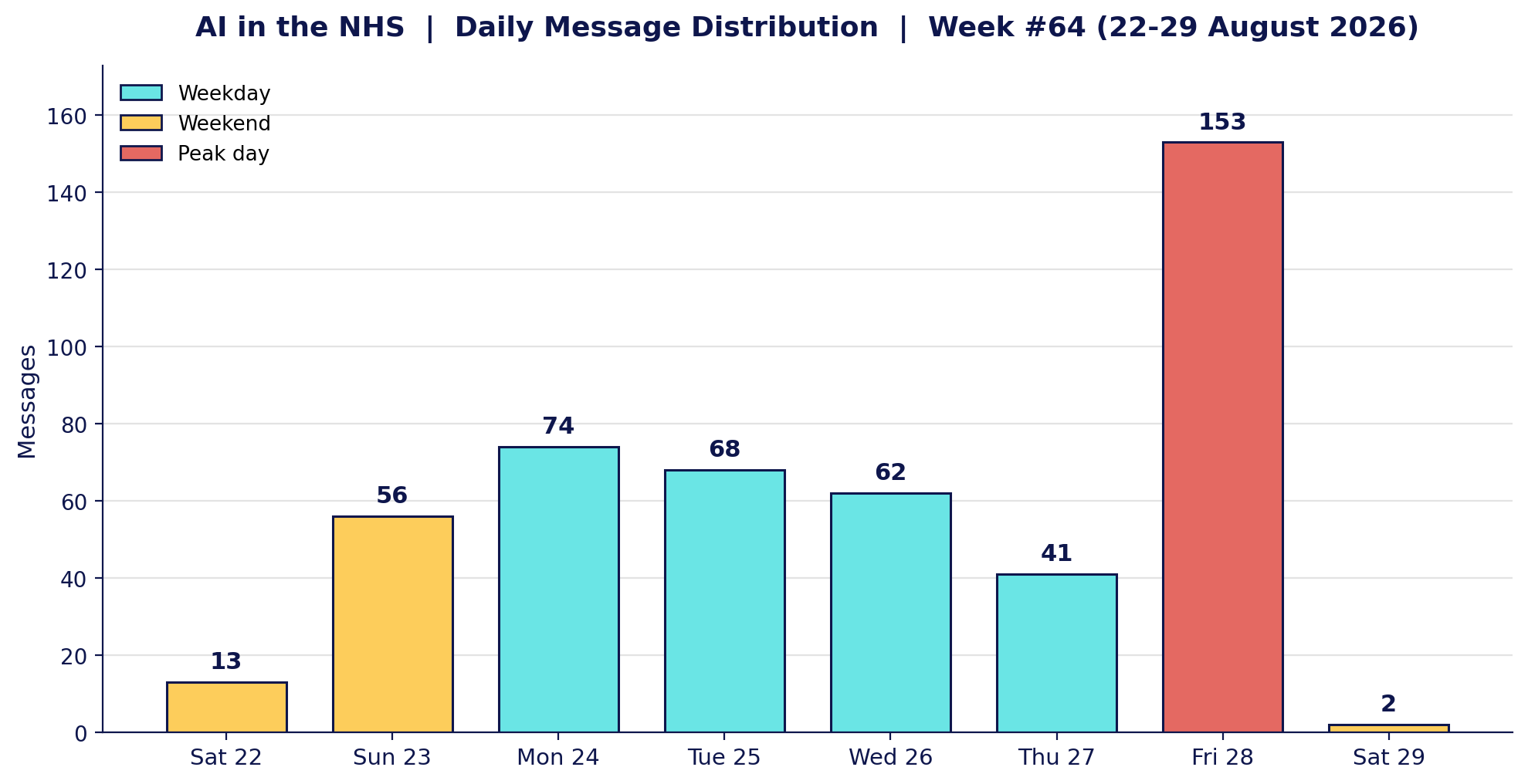
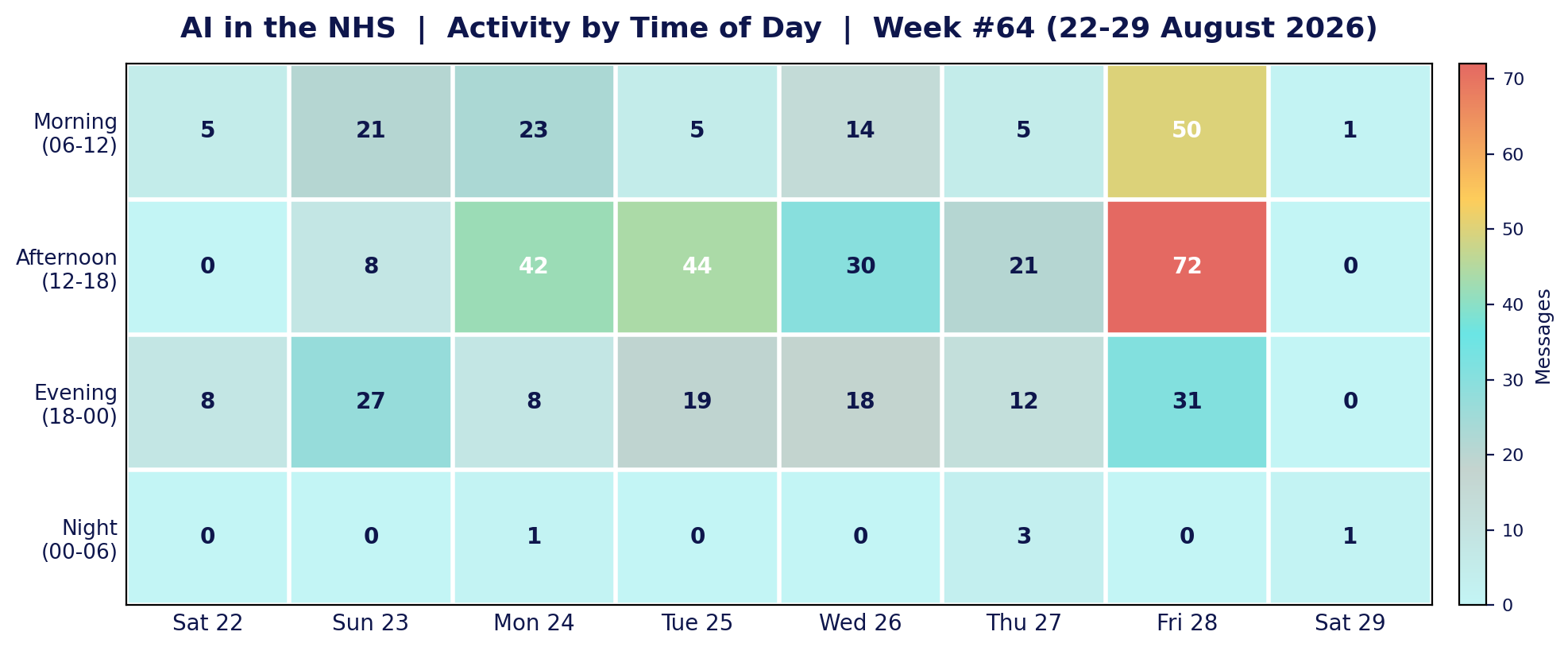
• The week has one centre of gravity and it is Friday. 153 messages, a third of the week, and the only day with high traffic in all three waking blocks. The 50 messages before noon were the safety case tool and the miscoded diagnoses; the 72 in the afternoon were training and the profession; the 31 in the evening were the same conversation refusing to end.
• Afternoons carried the week. 217 of 469 messages fell between noon and 18:00, and Monday, Tuesday, Wednesday and Friday all reached 30 or more in that block alone.
• Weekends were quieter than usual at 15.1%, against a recent run of issues where weekend traffic frequently reached a third or more. Saturday 22 August produced 13 messages and no afternoon traffic at all.
• Night traffic is almost absent, with five messages in total across the whole period, three of them just after midnight going into Thursday as a hardware thread ran out of road.
• Topic spikes track publication, not the calendar. The two largest single-hour concentrations both followed something being published: the BMJ Innovations paper on Friday morning and the online hospital appointment on Monday morning.
APPENDIX B: Enhanced Statistics
58 group members posted at least one message this week. The 16 most active below account for 363 of the 469 messages (77.4%), a more concentrated week than usual, with a long tail of 42 occasional and one-off contributors making up the remainder.
Top Contributors (Role Descriptors Only):
1. Digital Health & Clinical AI Specialist (Group Moderator): 63 messages
2. Integrated Care Operations Lead: 35 messages
3. Digital Health Strategist: 33 messages
4. Radiologist and Clinical Governance Advocate: 31 messages
5. GP Running an In-House AI Service: 29 messages
6. Digital Health GP Exploring Local Models: 25 messages
7. GP and Frequent Blogger: 21 messages
8. NHS IT Specialist: 21 messages
9. A&E Registrar and Clinician-Founder: 20 messages
10. Clinician Focused on Training and Workforce Policy: 17 messages
11. Cyber-Security-Minded Group Member: 14 messages
12. Former Clinician Now Working in Health Tech: 12 messages
13. Supplier-Side Clinical Safety Lead: 11 messages
14. Veteran Health Informatician and Medical Appraiser: 11 messages
15. Hardware-Focused Contributor: 10 messages
16. Clinician Working on Clinical Safety Documentation: 10 messages
Hottest Debate Topics (thread sizes are approximate, counted by contiguous run):
1. 🔥🔥🔥 Medical training, the premium resource and the NHS as an employer (122 messages from 22 members, Friday 11:08 onwards)
2. 🔥🔥🔥 Hardware: laptops, Mac Studio pricing and local model rigs (approximately 60 messages across Monday and Tuesday)
3. 🔥🔥 NHS Online and the evidence behind the launch claim (approximately 45 messages across Monday and Tuesday)
4. 🔥🔥 Consent, language and AVT (approximately 30 messages across Monday, Thursday and Friday)
5. 🔥🔥 Watermarking, provenance and where liability lands (approximately 28 messages, Sunday)
6. 🔥 AI-generated complaints and the verbiage flood (approximately 25 messages across Tuesday and Wednesday)
7. 🔥 The safety case quality tool and its reception (approximately 15 messages, Friday morning)
Discussion Quality Metrics:
• External resource sharing: 56 unique links across the period, no duplicates, appearing in roughly one message in eight.
• Media: 13 messages were images, video or documents with no accompanying text.
• Concentration: the top four contributors account for 162 messages (34.5%), and the moderator alone for 13.4%.
• Reach of the busiest thread: the Friday discussion from 15:50 onwards on the NHS as an employer ran to 85 messages from 19 distinct members, the widest participation of any single thread this week. Taken with the training discussion that preceded it, the run from 11:08 to the end of Friday accounts for 122 messages from 22 members.
• Thread depth and constructive-challenge rates were not measured programmatically this issue and are therefore not reported.
Cross-Expertise Engagement:
Contributions this week came from general practice, emergency medicine, radiology, cardiology, surgical oncology, pharmacy, public health and clinical informatics, alongside NHS IT, information governance and data protection, practice management, integrated care operations, health policy, patient safety advocacy, and supplier and founder-side digital health.
The most cross-disciplinary discussion was the consent thread, which required a GP's account of in-consultation practice, a radiology perspective on post-encounter data flows, an IT specialist's knowledge of where HL7 and PACS have no field to hold a flag, and a data protection view on whether any of it would satisfy a regulator. No single professional group could have produced that answer.
The clearest instance of knowledge transfer ran the other way to usual: a published methodology went out on Friday morning and came back within two hours as field reports from two members who had applied it to work in progress.
APPENDIX C: Daily Theme Summary
Saturday, 22 August 2026
Primary Theme: Social care workforce and the exploitation of visa-sponsored staff
Key Discussion: A member supporting health and care visa staff to switch employers described zero-hours contracts, sofa-sleeping and unmet promises, prompting a first-hand account from a member who had walked away from a project fifteen years ago after seeing workers brought in on deductions-heavy salaries and then made redundant as they neared residency qualification.
Secondary Discussions:
• Intellectual property and the level of human involvement that triggers ownership of AI-generated content
• Top ten clinical codes in GP records, and communication activity displacing clinical findings
• A debate on whether AI will replace doctors by 2030
Notable: A light day of 13 messages with no afternoon traffic, the quietest of the period.
Sunday, 23 August 2026
Primary Theme: AI watermarking, provenance and liability
Key Discussion: A question about whether the group should accept AI watermarks, and whether they could be used to claim copyright, opened into a substantial thread on encoding review metadata, the prospect of malpractice hearings turning on whether a clinician competently reviewed AI output, and a standards specialist's argument that bespoke binary watermarks miss the real requirement, which is agreeing what provenance information needs to be shared and how it sits in standard data structures.
Secondary Discussions:
• An AI Security Institute incident report on an agent attempting social engineering to get malicious code approved
• The insurance and EULA asymmetry between clinicians and AI companies
• Model preferences and whether to use a product associated with a particular owner
• A Digital Devolution programme placing officials into mayoral offices
Notable: Evening traffic exceeded morning traffic for the only time outside Friday. A thread on named technology figures strayed into territory outside this newsletter's scope and is not reported here.
Monday, 24 August 2026
Primary Theme: The new online hospital trust
Key Discussion: The appointment of a chief executive and publication of the 2027 referral conditions met immediate scepticism that every condition on the list requires local investigation anyway. The moderator ran the launch's evidence claim through a research pass, had a second model critique it, and published the critique: most supporting evidence is for hospital-based virtual clinics rather than care delivered to the patient at home.
Secondary Discussions:
• Consent, language access and the Californian scribe lawsuits; language is a protected characteristic, dialect is not
• Whether AVT performance claims flatten real differences between products
• GP leaders warning on inaccurate AI-generated hospital letters
• A laptop replacement question that ran for two days
Notable: The busiest afternoon of the week outside Friday, with 42 messages between noon and 18:00.
Tuesday, 25 August 2026
Primary Theme: AI-written complaints and the burden on public bodies
Key Discussion: News coverage of AI-assisted complaints increasing workloads across schools and councils met immediate corroboration from primary care, including a complaint citing rights under a US statute. A member posted an entire AI-drafted employment grievance as an illustration. The observation that comms and FOI teams have been heavily cut across NHS England, ICBs and trusts landed without comment.
Secondary Discussions:
• A patient safety charity's response to the HSSIB consultation on investigating ambient voice technology
• An AI practice manager agent, and a plea to involve an actual practice manager in the design
• New Mac Studio pricing, and the left shift funding argument
• Where to advertise a clinical safety officer post outside the NHS
Notable: A new member was welcomed. The day split almost evenly between substantive policy discussion and hardware pricing.
Wednesday, 26 August 2026
Primary Theme: AI receptionists, done deliberately
Key Discussion: A practice partner set out a considered plan for introducing an AI receptionist as an option rather than a default, framed around two experienced receptionists retiring and reception training now taking months rather than days, with an explicit opt-out at any point. The framing that landed was that systems fall over when you try to force people into something they do not want.
Secondary Discussions:
• A DPIA question that turned into a discussion of regional variation in IG process and whether an external review carries weight
• A policy chatbot for practice staff, and the DCB0160 and hallucination objections to it
• 40% of top health videos on TikTok containing AI-generated material
• A member's AI receptionist surviving a deliberate red-teaming attempt
• Qwen 3.8 Flash-Next and its architecture
Notable: The evening turned to billionaire philanthropy and the ethics of extreme wealth, prompted by a death in the news.
Thursday, 27 August 2026
Primary Theme: Consent and transparency in practice
Key Discussion: New US polling on patients wanting transparency about AI use in their care led to the week's most concrete systems finding: in secondary care there is no role to explain consent, no field to collect it, no HL7 slot to transfer it and nowhere downstream to store it. Practice-level answers were more encouraging, including waiting room notices and consent captured within the audio recording itself.
Secondary Discussions:
• The world's first live AI-assisted brain tumour operation, reported twice
• VPNs, public wifi and a run of airport-related security advice
• A preprint on AI psychosis
• The European Society of Cardiology congress
Notable: The quietest weekday at 41 messages, and the only day with meaningful traffic after midnight.
Friday, 28 August 2026
Primary Theme: Two publications and a wrong diagnosis, then the profession itself
Key Discussion: The clinical safety case quality tool was published in BMJ Innovations at 07:25 and was in live use against real DCB0129 work by 09:21. At 09:59 a member reported finding stroke, myocardial infarction and lupus recorded on a relative's NHS App record, none of them real, apparently coded by a letters product and detected only from odd underlining. A full reporting chain was set out in response. From mid-afternoon the group turned to medical training, whether doctors remain a premium resource, and the NHS as an employer, and did not stop until half past nine at night.
Secondary Discussions:
• A BMA motion requiring AI-generated record entries to be identifiable and yellow-card reportable
• A first comprehensive DCB0129 for a trust communication platform, and how unclear the requirements were
• A proposal for a central register of safety cases
• AI tools for subject access requests
• Nvidia and Hugging Face
• A new member welcomed
Notable: 153 messages, a third of the week. The moderator observed at 17:23 that there had been 105 since 09:00, and there were another 34 to come.
Saturday, 29 August 2026
Primary Theme: A note of optimism from a conference floor
Key Discussion: A hospital cardiologist wrote from the European Society of Cardiology congress about new heart failure guidelines, handheld echocardiography, retinal prediction of cardiovascular risk, AI-based cardiac MR and prescribing algorithms, and concluded that the number of younger clinicians across professions still enjoying medicine is grounds for optimism, provided the management of medicine gets the same calibre of people as the medicine itself.
Secondary Discussions: None; the newsletter's collection window closed at 06:34.
Notable: A deliberate counterweight to Friday, and a reasonable place to end the week.
AI in the NHS Weekly Newsletter is produced by Curistica Ltd for members of the AI in the NHS WhatsApp community. All contributors are anonymised. Views expressed are those of individual community members and do not represent any organisation.