


Executive Summary
A quieter week by volume, at 304 messages, but one that kept returning to a single question: what is the thing actually for? It opened on Saturday with a GP's count from his practice's own ambient scribe, 2,522 words deleted by clinicians against 258 added, which became a morning-long argument about whether a clinical note is a legal record, a memory aid, a letter to the patient or a scratch pad for thinking. On Monday the same question was asked of templates: if structured reviews exist to capture coded data, what does a scribe add? Monday also asked who should know which AI providers process patient data, and why the assurance bar seems higher for small companies than for large ones. The week's busiest day, Tuesday, asked how patients really feel about AI receptionists, and practices reported answers that ran in opposite directions. Between those, the government accepted every recommendation of the National Commission on the regulation of AI in healthcare, a US start-up began prescribing acne treatment by AI in Utah, and on Thursday a release of AI-generated mathematical proofs prompted the moderator to ask what medicine will look like when its best answers arrive before anyone can explain them.
Activity at a Glance
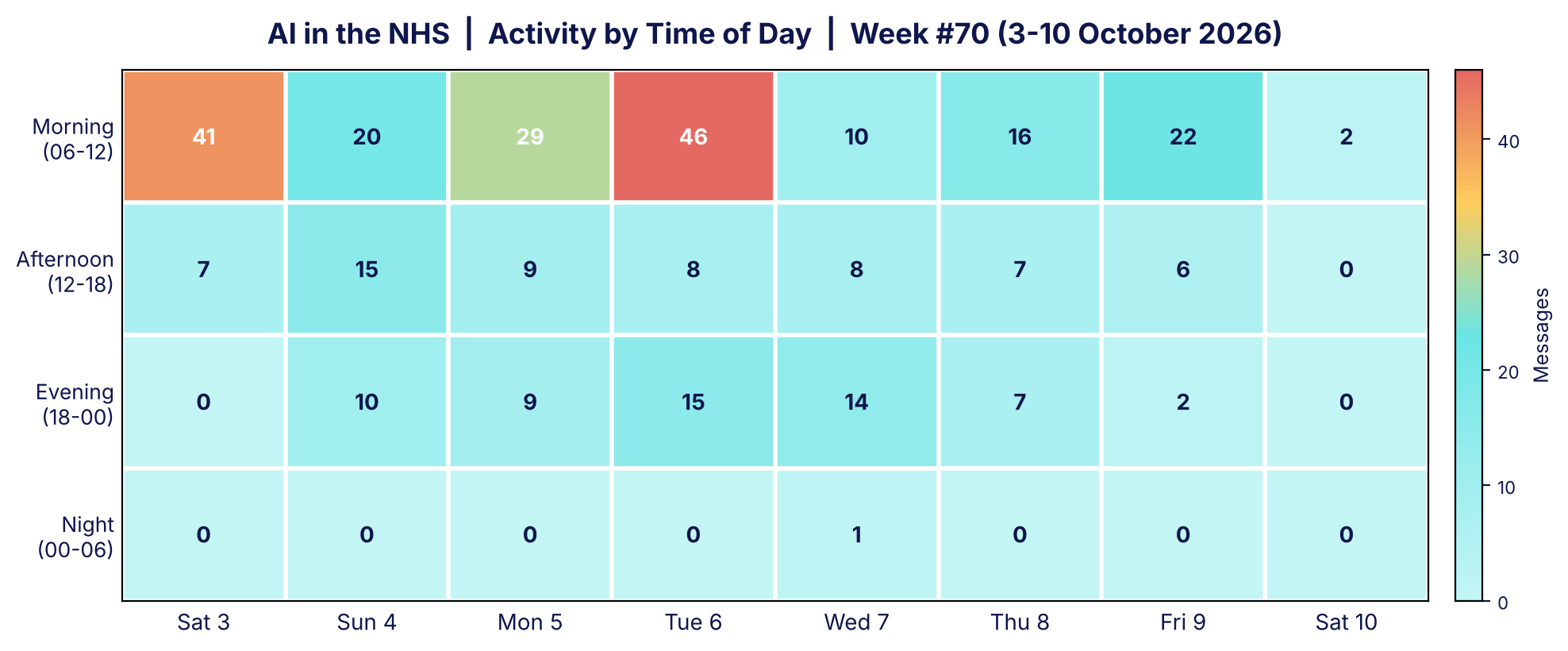
Week 70 generated 304 messages from 62 contributors, down from 535 and 69 last week. Tuesday 6 October was the peak at 69 messages, carried by the AI receptionist thread, with Saturday 3 October (48) and Monday 5 October (47) next. Mornings carried 61% of the traffic (186 messages), and only one message, an image, was posted between midnight and 06:00. The weekend share was 31.2% (95 messages), almost identical to last week.
📌 Major Topics
1. 2,522 words deleted: what is a clinical note for?
Saturday began before 08:00 with an innovation-focused GP reporting what his practice's in-house scribe had learned. Its learning loop measures how clinicians edit the draft, and the totals were stark: "Words deleted: 2522 words added: 258". The GP's reading was that "We definity do not like verbose scribe output in my practice", and that the errors were the small part of it: "Hallucinations are just 9 deleted words. The rest are clinicians shortening the narrative." Most of the deletion, he said, was in the history section, where a long-established team's social chat with patients ends up in the draft, and in phone calls the tool would add that no examination was performed. The GP was clear that the loop does not alter the record: "scribe generates output - clinician edits them - learning loop is measuring that change so that the next time when the output is generated is much more to clinicians own style."
Members read the numbers differently. A GP using an AI receptionist suggested that heavy deletion could mean the opposite, "Or the hallucination is high and things need deleting", and that acceptance takes time: "In our practice it took over 3 months". The wry health-tech watcher reported that one product adds "no allergies discussed" or similar to every consultation whether or not it is relevant. A member with a workforce development focus asked whether a stable team simply needs less context because "you know them all", and then put the question the morning turned on: "Purpose of notes: Summary of consultation Or verbatim record And who for?" A cardiology-focused clinician with a regulatory interest wanted the denominators before anyone drew conclusions (total words processed, abbreviations added, medicines amended, a comparison with similar consultations last year) and ended with one word: "Publish?"
The clinician who writes about AI and the mind gave the firmest answer: "It is the legal record of the encounter. The other use cases are adjuncts. Not purpose." A veteran clinician and appraiser disagreed, "still not sure that the primary purpose of notes has been 'a legal record'", arguing that "thinking process" matters and that "even a 100% accurate full transcript won't capture that", and asking: "Surely if the record does a good job clinically it will be an adequate legal record?" The reply conceded ground and sharpened the point. The NHS Records Management Code defines a record as "Information created, received, and maintained as evidence and as an asset", and the primary purpose is continuity of care; but "the tools are trying to do everything in one. And it's making a mess." The suggested model was the operation note: "Coded encounter at top. Details of procedure sit below. Important findings coded."
Two observations stayed with the thread. The veteran clinician wondered whether stored recordings and video are close, and feared "this may change the nature of interaction". And a hospital clinician who builds his own agent systems described the pendulum from both ends: "Notes are basically running commentary now. Probably better than single line scrawl from a surgical reg after you'd waited 3 days for a review." Asked why hospital letters had grown, his one-word answer was "Defensiveness." For anyone assessing a scribe, the useful lesson is that edit volume is not an error rate. A tool can be accurate and still create work, and a hazard log that counts only hallucinations will miss the cost that clinicians are actually paying.
2. Scribes and templates: what does AVT add to a coded review?
On Monday morning a Northern Ireland clinician asked those using ambient voice technology in general practice whether they use it in templated consultations, such as joint injections, minor surgery and chronic disease reviews, "those where coding is especially relevant for data retrieval", and if so how its output fits with the template.
The answers were mostly no. A GP was "not aware of any that will reliably generate the right codes every time for this kind of consultation", and running a scribe alongside a template would mean "repeating a lot". A GP who builds his own tools found them "jolly hard to make them map appropriately". The innovation-focused GP gave the most direct answer: "A definite NO from me", because humans fill templates faster, "Templates are more accurate than AVT output could ever be" and "It doesnt burn the planet". The veteran clinician liked that last point ("Why use a sledgehammer to crack a nut?") and asked whether we are "expecting docs to lose all of their documentation skills?" The Northern Ireland clinician saw no value in a "'shadow consult' through a scribe when the ask of these structured reviews is high quality granular data collection".
The integrated care operations lead argued the other way. A suggestion does not need to be perfect: "Only truly autonomous systems need to be at least as good as humans, assistive tools are ok to have precision issues as long as the clinician does a competent review". A GP replied: "But why would you use AI for that problem when a template is better at it?"
The best case for the scribe came from clinicians who use one for exactly this work. A GP who uses AVT in long-term condition reviews said it captures what the template cannot, such as the conversation behind "8 salbutamol inhalers this year and only 1 clenil", while the clinician ticks the boxes. It helps most in "those long complex consults that overrun", which are "often the ones that you need to go back to notes for complaints / reports / memory lapses later on." Another member said colleagues use it for care plans, where the conversation "can be rich", though "None are that helpful for coding. Yet." A primary care clinician summed up the risk on Monday night: an AI "getting lost in the SNOMED terminologies" and disrupting payments for local enhanced services and QOF "would be above most people's risk thresholds", and there is "little overall benefit when the choice between 'I know what I am ticking ' and 'I still have to check what an AI has ticked for me'". The emerging position is a division of labour: the template captures the codes, and the scribe records the conversation behind them.
3. Who signs it off? Sub-processors, DTAC and the national picture
Monday opened with an ICB digital assurance reviewer sharing the conclusion of a local information governance review of an ambient scribe. According to the reviewer, the review could not be completed because the supplier would not name the AI, speech-to-text and text-to-speech providers processing patient information, citing commercial sensitivity. Other matters were unresolved, so they were recorded as residual risks and no IG approval was given on behalf of the practices. Another member asked the general question: "Should there be one body (at national level) that can make a definite decision?" The reviewer's answer was "should..wont be though", adding that the option seemed to go when NHS Digital moved into NHS England.
The hospital clinician who builds his own agent systems made the legal point: it is "Hard to square with UK GDPR Art 28... controllers must authorise every sub-processor, so 'commercially sensitive' isn't an answer." He went on: "SMEs don't get through DTAC without naming and defending theirs. Why is the bar lower at scale/ higher for SMEs?" A member from outside general practice asked whether DTAC has been "weaponised", and a member with national assurance experience recalled that "We did used to have a central DTAC assessment function for nationally supported products - it got shut down as part of budget cuts", adding that "it always came with caveats on clinical safety and local hazard log still required". This is an account from one ICB's review, not a finding about the supplier. The general point holds for any product, though: sub-processor disclosure is a controller's legal question before it is a commercial one, and one organisation's approval is not assurance for another.
The national picture moved on Tuesday. The government announced that it accepts in full all 44 recommendations of the National Commission into the Regulation of AI in Healthcare, which the Northern Ireland clinician shared on Tuesday morning. The central conclusion is that AI-enabled devices should be assessed and monitored across their working life rather than at a single point of approval. Draft guidance on changes to adaptive devices is due by December, the MHRA will consult in 2027 on how AI-enabled devices are qualified and classified, and staged authorisation pathways will be explored. The thread itself was short, but the lifecycle principle answers Monday's complaint about one-off sign-off.
Monday evening had shown the other model. A developer shared the news that a US start-up's AI can now prescribe acne treatment in Utah, calling it, with heavy quotation marks, "the first end to end AI clinician in the world" and noting "Quite a few limitations". The innovation-focused GP had a different comparison in mind: "Their dermatology wait is 61 days", while his patients wait 12 months, so "Could I send all my pts to Utah". By Tuesday the primary care digital policy lead was wondering "when Utah's approach will become mainstream".
4. "When I hear AI or Digital assistant, I just put the phone down"
On Tuesday morning the moderator shared a newspaper report on rising anti-AI activism, including disruption of AI events in London, and drew out "a practical angle": patient and staff awareness, consent, and "the potential backlash when things go wrong." His question: "how is sentiment in your PPGs and at the consultation desk appearing?" It became the week's longest thread, at about 47 messages.
The first answer was a patient's: "Older gentleman yesterday 'when I hear AI or Digital assistant, I just put the phone down'". The evidence that followed pointed the other way. An AI receptionist supplier said that "we have found older patients to be the group that rates our AI receptionist the highest". A GP using an AI receptionist reported that over the last three months more than 70% of calls to book appointments and same-day triage requests through it came from people aged 65 and over, and over 35% from people over 80. The primary care digital policy lead asked the right question about that number: is it the share of callers who are older, or the share of older patients choosing the AI route? It was not settled.
A practice manager told the week's best story. The practice's patient participation group was "totally anti the idea of anything involving Ai" until it needed someone to take minutes; the recording device the manager offered is now "an honorary member of the PPG". The group was equally opposed to an AI voice assistant on the phones until it was explained as optional, which "would, ironically, remove digital exclusion from patients wanting to put in a request out of hours". "They trialled it, loved it and are now champions of it." The GP with a long out-of-hours and informatics background gave a more mixed report after trying two products: "a bit of a marmite". Some patients loved it, the 45 to 65 age group less so, and an unclear problem "can go around in a loop". "Our phone waiting time dropped by 20% but abandoned calls increased", and reception staff "became suspicious we are trying to replace them".
The counterweight came from a member writing as a patient: "it's impossible to call my GP Practice now. You pretty much have to go through the online front door", and later, "there is a choice but people are at a disadvantage for going the non digital route". The member with a workforce development focus wanted choice by request type ("Some things are simple transactional requests, others more complex and need synchronous dialogue"), and the integrated care operations lead warned that without it "it's simply demand gatekeeping by exclusion." Several members widened the frame. The NHS commercial lead saw "a general degradation in operational quality", and the health system technology strategist put it more bluntly: "layering on a bit of tech, on top of a rats nest of inefficient and self optimising work arounds doesn't make for a fully streamlined system". The innovation-focused GP asked why the conversation is only ever about GP access and not about rearranging hospital appointments, waiting in A&E or corridor care.
On evidence, the workforce development member was firm: "Needs proper research. Anecdotal response no good", because a patient may tell their GP "'it's lovely'" and the receptionist "'it's awful'" depending on why they think the tool is there. The thread ended on the Friends and Family Test, which the same member described as a "fairly useless measure of access or outcomes", and which the integrated care operations lead's organisation uses as weekly management information, reviewing "the actual returns" with extra narrative questions such as "what would you have done but for this appt?" For a deploying organisation, the safety point is that an AI front door is a change to the access route, and exclusion and abandoned calls are hazards to monitor, not anecdotes to trade.
5. Agency at the end of the world, and locking your own door
Sunday morning began with a newspaper report of a senior safety leader leaving a frontier lab with a warning about its culture. A member asked for the reassurance he had been promised "that the world isn't going to end", and later reported, "I'm not feeling any better btw." The digital inclusion-minded member thought "the extinction threat is overblown and distracting from the very real concerns on crucial infrastructure threats due to elevated cyber attack capabilities." The integrated care operations lead named a different risk: "the vast bulk of humanity will go backwards in means and opportunity", which makes extinction "a small risk compared to that near certainty." He also recalled the 1983 nuclear false alarm as a reminder of the "meatsack 'this just isn't right' thing" that technology cannot yet do.
The moderator's answer was "The world won't end. It will change, and this is where we have agency". The health system technology strategist passed on advice he had heard: "No one person can Control for the positive outcome of AI. All one person can do is work to shape AI to be as beneficial as possible for what you care about." The moderator called this "the way of the stoic" and explained why he works on the safety of AI: "there are things within my control that my life thus far has given me some capabilities in. That is where I exercise control, and try to remain humble in the face of those things I cannot."
Security ran through the week as well. On Sunday evening the moderator summarised a newspaper report on hacks uncovered at a frontier lab as "loose testing, safety and security practices coming home to roost". On Wednesday morning the integrated care operations lead told a cautionary tale for "knowledgeable tech folk who think your security competence will keep you safe". A friend, a respected technology leader, lent his laptop to his adult son, who most likely "clicked a dodgy link" and allowed a remote session takeover. The browser password manager was unlocked, and the recovery codes for two-factor authentication were stored in email. Email accounts were compromised, and so was a shopping account "that purchased quite a few gift cards overnight." On Saturday 10 October the innovation-focused GP shared an AI inference provider's security bulletin, in which the company reports that a third party used internal credentials to reach stored customer keys.
6. Proofs nobody can follow, and medicines nobody can explain
On Wednesday evening the moderator shared a release of several hundred AI-generated mathematical proofs and counterexamples, "the mother of all mathematical mic-drops". On Thursday morning he linked a leading computer scientist's account of mathematicians trying to read them. What he could follow was one mathematician's struggle to understand them, which "feels very alien", and the post ended on an analogy: mathematicians spend their lives climbing towards a peak, "only to find they've been teleported there and the route up is shrouded in mist. The new journey is what you learn as you make your way down". He asked the group for the medical equivalent: perhaps an explanation of how paracetamol actually works, or "truly precise gut microbiome therapeutic approaches that make no sense but work as intended. Maybe we'll enter a world where our formularies are populated with drugs we can't explain?"
A member replied that "We already live in this world! 😅 SSRIs, GLP's random benefits..." and that clinical reasoning is analogous. The GP with a long out-of-hours and informatics background said that an outcome reliably correct but beyond explanation "is akin to a miracle. We are in a very strange time in human history." The integrated care operations lead set the condition. It is fine to hand over work once done by people to "a completely automated and PROVEN SAFE environment", but "Until AI is overwhelmingly safe to the point that your average professional is happy to trust their registration to use it then it's not safe to park to that 'trusted basic tech' status." The moderator added an example from software: an open-source, Rust-built suite of creative apps that drew "awed responses from devs", "a real shot across the bows of legacy manufacturers". The digital inclusion-minded member answered: "Do not underestimate the ability of public services to maintain the status quo."

Friday morning brought the clinical version. The innovation-focused GP shared a newspaper report on concern about overdiagnosis of ADHD and autism in children, noting that "there are no biochemical markers to confirm the diagnosis", and asked "Could AI help? Should digital biomarkers be developed?" The Northern Ireland clinician pointed out that mental health conditions are also "clinical diagnoses with no biomarkers available (yet)", with treatments whose side effects "mimic the condition for which it's been commenced". The innovation-focused GP offered the week's sharpest one-liner: "The current LLMs have diagnostic sensitivity of 103%". Later that morning the moderator asked whether anyone had "spent much time with Jev style AI", sharing an open 27-billion-parameter medical model that returns calibrated probabilities rather than text. The health system technology strategist was interested but cautious: it "needs a lot of validation, and care needed not to throw AI at a deterministic problem."
😄 Lighter Moments
Saturday's notes thread had its own comic register. The wry health-tech watcher predicted that scribe output will be pruned until we are back to "Impression: Infection Plan: Antibiotics", a GP shared a retired partner's entire note ("Has come for review Fit as a butchers dog."), and a member pointed out that hospital letters always ask the GP to "kindly" do something. The integrated care operations lead set the bar for real intelligence: AI will only truly be advanced "once it starts to give rolled eye emojis at the bad GP jokes."
Wednesday's live debate session at a primary care conference in Birmingham, billed in the group as "Rumble in Brum", was streamed by a GP partner, with a member who makes AI videos supplying the trailer. Requests to watch it online met the radiologist and clinical governance advocate's ruling: "Premium Box Office only". A member who watched later called it "the highlight of my day", and the GP leader behind the session said its inspiration came from this group, which he thinks is really "'All in the NHS' rather than just 'AI in the NHS'".
Sunday's doom had its lighter side. Asked to book ten years of holidays "before we all DIE", one member replied "All booked + accommodation sorted ✔️", and the radiologist issued the decision: "Request denied You used the wrong form and too many will already be away (extinct) so we will be short staffed".
A hardware-hunting developer priced new AI laptops at up to £5.8k, prompting a practice manager to admit that nearly six grand for a laptop "would give me huge collywobbles about ever going anywhere with it". The moderator's view: "With that laptop you wouldn't need to leave the house ever again". On Friday a trust-based member reported that "Our NHS IT team were blocking LinkedIn this morning - which was fine as twitter was still working."
💬 Quote Wall
"Hallucinations are just 9 deleted words. The rest are clinicians shortening the narrative." — Innovation-focused GP
"Surely if the record does a good job clinically it will be an adequate legal record?" — Veteran clinician and appraiser
"the tools are trying to do everything in one. And it's making a mess." — Clinician who writes about AI and the mind
"Only truly autonomous systems need to be at least as good as humans, assistive tools are ok to have precision issues as long as the clinician does a competent review" — Integrated care operations lead
"SMEs don't get through DTAC without naming and defending theirs. Why is the bar lower at scale/ higher for SMEs?" — Hospital clinician who builds his own agent systems
"Needs proper research. Anecdotal response no good." — Member with a workforce development focus
"The world won't end. It will change, and this is where we have agency" — Group moderator
"Maybe we'll enter a world where our formularies are populated with drugs we can't explain?" — Group moderator
"care needed not to throw AI at a deterministic problem." — Health system technology strategist
📎 Journal Watch
Academic Papers and Key Studies
📎 Shapley value explanations for clinical prediction models: a scoping review and guide – npj Digital Medicine (3 October 2026) A review of 100 randomly selected studies that use Shapley values to explain clinical prediction models, finding that methods were often underreported: about 91% did not name the algorithm and 97% did not state the source or size of the reference population. It closes with practical recommendations. Shared by the moderator on Monday night: "Fans of shap values rejoice".
📎 Is AI the End of Math As We Know It? – Quanta Magazine (5 October 2026) An essay on mathematicians' grief, anger and uncertainty as AI systems produce proofs of long-standing problems, arguing that these proofs often lack the explanation and insight mathematicians value and that they strain journals and publication incentives. Shared by the moderator on Friday: "Try to think of the work you do, and why you do it".
📎 The Mathocalypse – Shtetl-Optimized, blog (7 October 2026) A computer scientist's account of a frontier lab's release of hundreds of purported new mathematical results from an internal model, including a claimed proof of a major open conjecture, many of them hard for humans to read. The source of Thursday's teleported-to-the-peak analogy.
Industry and News Articles
📎 Our AI Midwife – Astral Codex Ten, guest post (2 October 2026) A husband's account of six years of unexplained infertility, in which a chatbot prompted them to seek an MRI that found a large fibroid missed by their fertility doctors; after surgery his wife conceived naturally. A single personal account. Shared on Wednesday evening; the innovation-focused GP was surprised the fibroid had not been seen on ultrasound.
📎 Nolla Health – Company website (accessed 10 October 2026) The company describes a private AI health assistant "backed by licensed U.S. physicians", with an AI skin care service offering custom prescriptions and AI prescriptions "now live in Utah". Company claims; the news coverage shared alongside it could not be retrieved. Shared on Monday evening.
📎 Introducing Mistral Large 4 – Mistral AI (6 October 2026) Announces a multimodal mixture-of-experts model with 1 trillion total parameters (52 billion active), in public preview, with open weights promised by the end of October. Vendor figures. Shared on Tuesday evening by the developer who follows open models, who asked whether anyone has the hardware to run it.
📎 Anthropic usage policy update – Bluesky post by a technology journalist (8 October 2026) Reports, as an exclusive, that the company is updating its usage policy for the first time in over a year, including new rules against sustained abusive or cruel behaviour towards its assistant. Shared on Thursday evening with the comment "don't be mean to Claude".
📎 Fireworks October 2026 security incident – Fireworks AI security bulletin (updated 9 October 2026) The company reports that an unauthorised third party used internal credentials to access stored API keys and tokens in a limited number of customer accounts, that it found no access to models, datasets or personal data, and that review is ongoing. Company statement. Shared on Saturday 10 October.
Technical Resources and Tools
📎 MedDecider-27B – Hugging Face model card (October 2026) An open 27.8-billion-parameter model that returns calibrated probabilities for answer options on clinical decision questions instead of generating text, with reported benchmark results. The card states it is "a research model, not a medical device" and must not guide patient care without local validation and clinical oversight. Licensed for non-commercial use. Shared by the moderator on Friday.
📎 EmbeddingGemma 2 – Google blog (6 October 2026) An open 740-million-parameter embedding model that puts text, images, audio and video into one vector space, released under Apache 2.0. Shared on Tuesday night as "Interesting for those with RAG pipelines".
📎 Crafting Apps – ArtCraft (2026) Seven free, open-source desktop creative tools written in Rust, covering image editing, illustration, video, photography, PDFs, motion graphics and layout, that run locally and can be scripted by AI agents. The moderator's example of what the first wave of AI-native builders is producing.
Policy Documents and Official Reports
📎 Government backs recommendations of NHS doctors-led AI Commission – GOV.UK press release, MHRA (6 October 2026) The government accepts in full all 44 recommendations of the National Commission into the Regulation of AI in Healthcare, built on lifecycle assessment and monitoring of AI-enabled devices. Commitments include draft guidance on changes to adaptive devices by December 2026, a 2027 consultation on qualification and classification, exploring staged authorisation pathways, and a third phase of the MHRA's AI Airlock sandbox, with an implementation roadmap due by spring 2027. Shared on Tuesday morning.
🔭 Looking Ahead
The Commission's implementation is now the thing to watch: draft guidance on adaptive devices by December, a classification consultation in 2027 and a roadmap by spring. The MHRA's AI Airlock Phase 3 is open for applications, focused on post-market surveillance and lifecycle regulation, with an applicant webinar on 22 October and the first cohort chosen in November. Open weights for the new trillion-parameter European model are promised by the end of October.
The open questions are local ones. What should a scribe be measured on, given that clinicians cut nearly ten words for every one they add? What can a deploying organisation do when a supplier will not name its sub-processors? And how should a practice measure who an AI front door serves and who it turns away, before the anecdotes settle the matter?
🧬 Group Personality Snapshot
A smaller week showed the group at its most practical. The longest threads began with real numbers from real practices (words deleted, callers over 65, phone waits down and abandoned calls up), and the replies tested the numbers rather than cheering them. Disagreement stayed generous: the legal record argument ended with a concession and a better model, and the AI receptionist thread held a supplier's data, a sceptical patient and a practice manager's converted PPG without anyone needing to win. On Sunday, when the news turned apocalyptic, the group answered with stoicism and holiday bookings in about equal measure.
APPENDIX A: Detailed Activity Analytics 📊
📬 Total Messages: 304
📈 Peak Day: Tuesday 6 October (69 messages)
🔥 Most Active Period: Morning, 06:00 to 12:00 (186 messages)
💬 Average/Active Day: 38 messages
🏖️ Weekend Activity: 31.2% (95/304)
💼 Weekday Activity: 68.8% (209/304)

Insights:
• Volume fell 43% on last week (304 against 535), and the first three days carried almost half of it (140 messages), so the week front-loaded rather than building to a peak.
• Mornings dominated more than usual, at 186 messages (61%, against 45% last week). Tuesday morning (46) and Saturday morning (41) were the busiest single blocks, carrying the AI receptionist and clinical notes threads.
• Evenings were quiet: Saturday 3 October had no evening messages at all, and only Tuesday reached 15, with the new open-weights model and conference chatter.
• The single night message was an image posted at 05:23 on Wednesday.
• Messages from Saturday 3 October between 07:43 and 09:00 arrived after last week's compilation and are counted here, as is the established practice; two messages had arrived on Saturday 10 October at the time of compilation.
APPENDIX B: Enhanced Statistics
62 group members posted at least one message this week, down from 69 last week. The 15 most active below account for 204 of the 304 messages (67.1%), almost exactly last week's concentration (67.9%), with 47 occasional and one-off contributors making up the rest.
Top 15 Contributors (Role Descriptors Only):
1. The group moderator: 45 messages
2. An integrated care operations lead: 28 messages
3. An innovation-focused GP: 26 messages
4. A clinician who writes about AI and the mind: 15 messages
5. A member who signs off the weekends: 12 messages
6. A wry health-tech watcher: 11 messages
7. A member with a workforce development focus: 10 messages
8. A hospital clinician who builds his own agent systems: 9 messages
9. A GP using an AI receptionist: 8 messages
10. A Northern Ireland clinician: 8 messages
11. A veteran clinician and appraiser: 7 messages
12. A member writing as a patient: 7 messages
13. A health system technology strategist: 6 messages
14. A GP with a long out-of-hours and informatics background: 6 messages
15. A hardware-hunting developer: 6 messages
Hottest Debate Topics:
1. 🔥🔥🔥 AI receptionists, PPG sentiment and digital exclusion (approximately 47 messages across Tuesday morning)
2. 🔥🔥🔥 What a clinical note is for: scribe edits, the legal record and continuity (approximately 45 messages across Saturday morning)
3. 🔥🔥 Extinction, agency and stoicism (approximately 33 messages across Sunday morning)
4. 🔥🔥 Scribes in templated and coded consultations (approximately 21 messages across Monday)
5. 🔥🔥 AI-generated proofs and the medical equivalent (approximately 20 messages across Wednesday evening and Thursday)
6. 🔥 Sub-processor disclosure, DTAC and national assurance (approximately 14 messages across Monday morning)
7. 🔥 A new open-weights frontier model and who funds it (approximately 14 messages across Tuesday evening)
8. 🔥 The live conference debate session and its stream (approximately 12 messages across Wednesday)
9. 🔥 Agent memory, lab hacks and newspaper AI coverage (approximately 12 messages across Sunday evening)
10. 🔥 Home security after a family laptop hack (approximately 6 messages across Wednesday morning)
Discussion Quality Metrics:
• Evidence-Based vs Opinion Ratio: roughly 12% of messages (37 of 304) carried a link to a paper, guidance document, report or news article
• Average Thread Depth: approximately 7 messages per sustained discussion thread, with Tuesday's AI receptionist thread running to about 47
• Constructive Challenge Rate: high, including the challenge to the scribe deletion figures as possible evidence of error rather than style, the primary care digital policy lead's question about the denominator behind the over-65 receptionist figure, and the legal-record exchange ending in an explicit concession
• External Resource Sharing: 38 unique links shared across the period; 12 Journal Watch entries after link checking. Every newspaper and paywalled link, the specialist journal article, the video and social media links and the shortened links that would not resolve were unretrievable and left out, as were member-authored posts
Cross-Expertise Engagement:
Contributions came from general practice, hospital medicine, paediatrics, radiology, cardiology, clinical informatics, clinical safety, practice management, ICB assurance and operations, NHS commercial work, national assurance, software development and an AI receptionist supplier, with a member writing as a patient. Tuesday's receptionist thread drew the widest mix, with a supplier, a practice manager, GPs, an operations lead and a patient describing the same tool from different ends. The clearest knowledge transfer was the hospital clinician's reframing of a supplier's commercial-sensitivity answer as a UK GDPR Article 28 question.
APPENDIX C: Daily Theme Summary
Saturday, 3 October 2026
Primary Theme: What is a clinical note for?
Key Discussion: A GP's in-house scribe data (2,522 words deleted against 258 added, nine of them hallucinations) opened a long morning on verbosity, continuity and whether the record is primarily a legal document or a clinical one. The operation note was offered as a model: coded encounter at the top, detail below.
Secondary Discussions: Defensive hospital letters; scribes and social chat; trailers for a live conference debate session.
Notable: 41 messages before midday, the second-busiest block of the week.
Sunday, 4 October 2026
Primary Theme: Doom, agency and stoicism
Key Discussion: A safety leader's departure from a frontier lab prompted extinction jokes, a case that infrastructure and inequality are the nearer risks, and the moderator's account of why he works on the safety of AI.
Secondary Discussions: An AI "bank run" warning; the 1983 nuclear false alarm; interoperability through a translation layer; hacks uncovered at a frontier lab; memory shared between multiple agents.
Notable: "The world won't end. It will change, and this is where we have agency".
Monday, 5 October 2026
Primary Theme: Assurance and the scribe in coded consultations
Key Discussion: An ICB reviewer's account of a scribe supplier that would not name its AI sub-processors led to UK GDPR Article 28, DTAC and the lost central assessment function. Later, members largely agreed that templates beat scribes for coding, with a case for the scribe in capturing the conversation behind long-term condition reviews.
Secondary Discussions: Regional events; AI prescribing of acne treatment in Utah; a Shapley value scoping review; a new open-weight US model.
Notable: "Why is the bar lower at scale/ higher for SMEs?"
Tuesday, 6 October 2026
Primary Theme: AI receptionists and patient sentiment
Key Discussion: A report on anti-AI activism led to the moderator's question about PPG sentiment, and the busiest thread of the week: older patients hanging up and older patients using it most, a converted PPG, shorter phone waits with more abandoned calls, and the case for choice by request type.
Secondary Discussions: The Friends and Family Test; access to hospital care; a Lancet piece on the clinical AI scientist role; the government accepting all 44 Commission recommendations; a mention for the moderator's FoI work at a patient safety session; a new trillion-parameter open-weights model; a multimodal embedding model.
Notable: The peak day at 69 messages.
Wednesday, 7 October 2026
Primary Theme: Security, conferences and AI-generated proofs
Key Discussion: A cautionary tale of a family laptop hack and recovery codes kept in email, then a day of conference chatter around a live debate session in Birmingham. In the evening, a release of several hundred AI-generated proofs and an open-source creative suite.
Secondary Discussions: An AI-assisted infertility story; new AI laptops and their prices.
Notable: "the mother of all mathematical mic-drops".
Thursday, 8 October 2026
Primary Theme: What is the medical equivalent of proofs nobody can follow?
Key Discussion: The moderator's question about drugs we cannot explain drew SSRIs and GLP-1s as existing examples, a "miracle" reading, and the condition that handing over work needs a proven safe environment.
Secondary Discussions: The AI-native first wave; a claimed planet discovery; assistant usage limits; a usage policy update against abusing an assistant; reflections on the debate session's origins in this group.
Notable: "PROVEN SAFE environment".
Friday, 9 October 2026
Primary Theme: Diagnoses without biomarkers
Key Discussion: A newspaper report on overdiagnosis of neurodevelopmental conditions in children prompted a question about digital biomarkers, with mental health conditions raised as the parallel case. Later, decision models that return calibrated probabilities and an open medical model built that way.
Secondary Discussions: Office software and subscription licensing; a blocked social network on an NHS network; a scribe company's next step.
Notable: "The current LLMs have diagnostic sensitivity of 103%".
Saturday, 10 October 2026
Primary Theme: Two messages before the 09:00 cut-off at the time of compilation, including an AI inference provider's security bulletin.
AI in the NHS Weekly Newsletter is produced by Curistica Ltd for members of the AI in the NHS WhatsApp community. All contributors are anonymised. Views expressed are those of individual community members and do not represent any organisation.