


Executive Summary
This was the week the group's long-running clinical safety argument acquired hard evidence. On Wednesday morning the group moderator announced that he and three co-authors, two of them group members, had published their second national study of digital clinical safety in the NHS, finding a mean Clinical Safety Officer capacity of just 1.1 whole-time equivalents per organisation and four mutually reinforcing drivers of non-compliance. It landed a day after HSSIB's interim report into electronic referral systems, which members read with alarm: not one deploying organisation investigated could evidence a completed DCB0160. The collision of the two produced the week's biggest debate, a long and unusually rigorous exchange about who actually owns clinical safety for e-RS and Advice and Guidance, and where technology risk ends and people risk begins. Around it, the week ran from a sovereignty thread on owning rather than renting intelligence, through a provocative JAMA viewpoint arguing that keeping humans in the loop can degrade AI performance, to Thursday's collective delight at a Guardian report of an AI receptionist defeated by Yorkshire accents, which triggered the mandatory sharing of the Burnistoun voice recognition sketch.
Activity at a Glance
Week 63 generated 302 messages from 55 contributors, with peak activity on Wednesday 19 August (71 messages), the morning of the paper announcement, when 46 messages landed before midday. Weekday traffic dominated at 81.8%, with Friday 21 August (51 messages) and Thursday 20 August (45 messages) the other busy days. Friday evening was the week's liveliest social window, with 31 messages between 6pm and midnight.
📌 Major Topic Sections
1. "Unfit for the future?": the safety evidence arrives, and HSSIB agrees
Wednesday morning opened with the announcement the group's clinical safety contingent had been waiting for: the second Freedom of Information study of digital clinical safety in England's NHS, published in BMJ Innovations under the title "Unfit for the future?". From 211 responding organisations (an 88.3% response rate), mean CSO capacity was 1.1 whole-time equivalents, with integrated care boards averaging just 0.4, and the qualitative data suggested even those figures overstate reality, with CSO duties typically bolted onto clinical roles. The paper identifies four mutually reinforcing drivers of non-compliance: lack of understanding of the standards, immature governance, ineffective assurance and workforce fragmentation, and proposes CQC regulatory enforcement, National Quality Board quality standards and workforce professionalisation in response.
The timing was uncomfortably apt. The previous day, HSSIB published the interim report of its investigation into electronic referral systems, and a clinical AI researcher in the group put its starkest finding in capitals: "Note that ZERO deploying organisations had evidence of DCB0160 done. ZERO." An HSJ exclusive headlined that the watchdog had linked patient deaths to a controversial NHS England policy. A primary care digital policy lead quoted the report's own account of the confusion at the heart of it: some national stakeholders say each general practice should have a CSO and a clinical risk management file for e-RS, others consider it a PCN or ICB responsibility, and ICBs, at 0.4 WTE, "did not always have the capacity or capability" to help. As she put it: "with only 0.4 CSO per ICB it is pretty clear why this happens".
What followed was the week's best argument. A digital health contributor pushed back on the reflex to blame technology: delays caused by specialty workload are a people problem, not an e-RS problem, and "there's a propensity for both 0160 & 0129 to be weaponised... with the default being everything does [come under the standards], which is patently absurd". The moderator's counter was a taxonomy of genuinely technical hazards: referrals not delivered, wrong destinations, lost attachments, absent progress tracking, poor UX and stale training material, all of which "would be caught if the 0160 was undertaken, allowing controls to be put in place". The two positions eventually converged on agreement that the standards are needed in the clinical context while acknowledging they can be misapplied as a stalling mechanism. A radiologist supplied the ground truth from the reporting room: two successive reports recommending three-month follow-up, "and yet here we are 2 years later", a pattern he has christened the digital butler problem. A patient safety organisation and members of this group both responded to the draft report, with some comments incorporated, and a fuller written response from the paper's authors is promised.
The thread rolled into Thursday with a sharp postscript on FOI itself: trusts increasingly refuse to disclose what systems they run on cybersecurity grounds, a refusal the paper's authors faced and successfully challenged. Which made Wednesday evening's other share neatly ironic: a widely praised, publicly compiled register of the common health tech deployed in every English trust, which several members immediately checked for their local hospital and mostly regretted: "LIMS/MIS/RIS/PACS all unlisted", reported the radiologist.
2. Own the intelligence or rent it
The week opened with token economics. A Saturday morning benchmark share (18.71 tokens per second on clinical code extraction from a discharge letter) sparked a running argument about whether the future of NHS AI is subscription or ownership. A GP running an in-house AI stack made the case for sovereignty in a phrase that became the week's refrain: "Own the Intelligence - the value only compounds. Rent Intelligence - drain own pocket with no appreciable value in return." A digital health GP exploring local models agreed with caveats: it works if you have the expertise in-house and open-source models keep pace, and "not giving out one's data is priceless". The moderator argued the rented frontier still buys you more intelligence at higher speed, while a local-AI infrastructure enthusiast noted how fast the gap is closing: a newly released 27-billion-parameter open model performs comparably to a frontier model from eight months ago and runs on under 24GB of memory. "This is the worst local AI will ever be."
By Monday the thread had turned practical. A newcomer asked which open-source models to try and got a generous, concrete answer within minutes, with the important caveat that none of them can be deployed for actual clinical decisions. A GP partner new to the group asked the question every practice will eventually ask: if a super-partnership can stand up local AI for a £5-10k hardware investment, what stands in the way? The answer, delivered kindly but firmly by a governance-minded contributor, is that running a model locally changes the data flow, not the obligations: "you are still 'processing data'", and clinical safety, data protection and possibly consent work all still apply. The in-house GP's rejoinder was that governance "is not a Scary Monster... if followed correctly, it is fairly straightforward". The moderator plugged the group's stalled sovereign AI project, which aims to crowdfund shared secure compute, back into the conversation, and a clinician reported the countervailing reality: standard-issue NHS hardware runs small models that are "either too stupid or they run too slowly to be useful".
3. The obsolete physician, and who gets to stay in the loop
Tuesday's set-piece was a JAMA viewpoint arguing that for cognitive tasks, AI working alone is already equivalent or superior to physicians, and that keeping a human in the loop actively degrades performance once AI has passed human capability. The moderator's posted summary was scrupulous about the caveats: nearly all the evidence is simulated vignettes, tail risks fail differently from human error, and the declared conflicts include a telehealth company CEO and an investor among the four authors. The group's responses mapped the whole spectrum. A health-tech industry contributor read it as "more an opinion piece" while conceding that autonomous AI for narrow, specific workloads by 2030 "feels reasonable". The moderator declared himself sympathetic on the evidence about human-in-the-loop degradation but pointed at deskilling as the real risk. A GP reminded the room that general practice is multimorbidity, thin evidence and patient choice, not single-condition decision-making. And the in-house GP refused the premise outright: "If they believe physicians have no role then have a model of care with NO physicians. Have the conviction & prove the model."
The deskilling theme resurfaced on Thursday when a clinical AI researcher shared a chart of exam performance with and without AI, observing that the AI-assisted curve's skew "probably represents user competency with AI". The ensuing exchange, one of the week's most thoughtful, split the room between those arguing exams matter more than ever precisely to test unassisted knowledge ("You can far more safely and competently use AI if you understand the core subject than if all you know is how to use AI to do it for you") and those asking whether preparing children for an AI-saturated working life is the better goal, with a further worry about developmental effects on young brains. The moderator's Thursday aphorism tied the two days together: "AI is fantastic when paired with someone who knows their shit", to which the response came within minutes: "Mission Statement for this group right there."
4. What evidence should the NHS demand?
A clinician researching AI evaluation asked the group a deceptively simple question on Tuesday: what evaluation metrics should procurement and regulation demand for AI deployed in the NHS? The answers amounted to a masterclass in the current state of the assurance landscape. Start with the problem, not the product, said the radiologist: "Solicit engagement from clinical teams and work up a use case. Not 'here is a shiny toy, we demand you use it'". A health-tech industry contributor separated the strands: procurement is about value and vendor quality systems, regulation is the black-and-white minimum standard, and the biggest gap is afterwards, "when a vendor fails, who holds them to account". An interoperability standards specialist pointed to the overlap between regulatory and procurement evidence and the case for making evidence reusable across DTAC, Label2Enable and ISO 82304-2. An NHS IT specialist supplied the institutional memory: the Evidence Standards Framework is useful but its advocates have moved on; the 2020 NHS Buyers' Guide remains "the closest the NHS has to a cookbook" but predates ambient voice and generative AI; and an AI readiness checklist from the CERSI-AI group is coming. A 54-page county AI playbook landed in the chat as supporting material, and the FDA's first considerations for regulating generative AI followed on Wednesday, so the reading list is not short.
5. Voice AI meets the real world (and the real world has accents)

Thursday belonged to voice. A Guardian report that frustrated patients in Rotherham were hanging up on a GP AI receptionist that could not parse Yorkshire accents drew rueful recognition rather than surprise, the radiologist noting that human-era dictation systems glitch "not infrequently" too. It escalated into a celebration of regional-accent defeat of technology: the Burnistoun lift sketch ("Hoo can ye be racist tae a lift?"), a Scottish member's report that "voice recognition disnae work fer us frae North o' the Border", and a heartfelt curse on a tax authority's voice-authentication system. Beneath the comedy sat the serious version of the same question, posted the same afternoon: the largest European real-world ambient scribe evaluation to date, 2.33 million consultations over 16 months across a Spanish hospital network. Voluntary adoption reached 31% of outpatient visits and clinician experience improved, but consultations did not get shorter, and the headline "89% accuracy" measures how little clinicians edited the draft, not whether the note was right. As a companion piece to the accents story it made the week's point about voice AI rather well: adoption is real, benefit is real, and the measurement still needs care.
😄 Lighter Moments
- A share of a retro streaming site for anyone with 90s Blockbuster nostalgia prompted the practice manager's finest deadpan of the week: "Bah this modern technology is all a fad they will be coming for my pager and fax machine next."
- A photograph of an ambient scribe vendor's branded bottle lid being used to balance drinks cans drew a one-word caption from a digital health strategist ("#innovation") and the follow-up "and shareholder value".
- The moderator returned from Yorkshire having discovered the parmo; a clinical safety officer raised him "Chinook. Double helicopter & chips", and a clinical AI researcher, on brand, replied "can you repeat, I missed the end bit."
- Friday evening's care-sector questions from a brand-new member drew increasingly Father Ted-flavoured responses from a GP partner ("Fuse lit, now going out for dinner with family..." "Drink!") before more constructive answers arrived on Saturday morning.
- When members joked about recognising each other in external meetings, the group settled on its own first rule: nod along like it's a secret society handshake.
- Last week's issue shipped with a bonus: a playable game of Breakout, built by an open-source model, as the moderator pointed out to a member who thought the newsletter hadn't arrived.
💬 Quote Wall
"Own the Intelligence - the value only compounds. Rent Intelligence - drain own pocket with no appreciable value in return." — GP running an in-house AI stack
"This is the worst local AI will ever be." — Local-AI infrastructure enthusiast
"Note that ZERO deploying organisations had evidence of DCB0160 done. ZERO." — Clinical AI researcher
"What drives me nuts is that we have to inch step by painful step towards the truth of the matter, which is that poorly governed tech can cause harm." — Group moderator
"Modern AI is more Loki than Thor. Give it a chance to misbehave and it often will." — Integrated care operations lead
"The person who creates an AI standalone system that minimises token usage will instantly achieve cult status." — Integrated care operations lead
"A significant issue which you won't see on risk registers in healthcare is that in the majority of cases, the goodwill is gone." — Local-AI infrastructure enthusiast
"The difference between knowing your 💩 and knowing you're 💩." — Radiologist and clinical governance advocate
📎 Journal Watch
Academic Papers & Key Studies
📎 Unfit for the future? Revisiting the national cross-sectional study of digital clinical safety in England's NHS – BMJ Innovations. The week's centrepiece, co-authored by two group members: 239 organisations surveyed by FOI, 211 responses, mean CSO capacity 1.1 WTE (ICBs 0.4), and four mutually reinforcing drivers of non-compliance. Announced Wednesday with an accompanying LinkedIn post and a second from a co-author. Read the paper
📎 The unavoidable transition to autonomous AI systems in medicine – JAMA. The Tuesday provocation: for cognitive tasks, human-in-the-loop may degrade performance once AI exceeds human capability. Discussed at length, caveats and declared conflicts included. Read the viewpoint
📎 Deployment of an ambient AI scribe in emergency care: a 12-month evaluation in a large Spanish hospital network – Frontiers in Digital Health. 2.33 million consultations over 16 months: 31% voluntary adoption, improved clinician experience, no shorter consultations, and an "89% accuracy" figure that measures edit distance rather than correctness. Shared Thursday via ResearchGate. Read the paper
📎 How malicious AI swarms can threaten democracy – Science. Cited within Sunday's BMJ share on commercial determinants: the fusion of agentic AI and LLMs as a new frontier in information warfare. Read the paper
📎 Artificial intelligence as a new commercial determinant of health – The BMJ. One of two BMJ pieces shared on Sunday morning, framing AI itself as a commercial force shaping population health. Read the analysis
📎 LLM watermarks in medical texts – arXiv. Wednesday morning share on what watermarking does to medical text, with a policy analyst noting the findings, if reproducible, have significant implications for several AI uses. Read the preprint
📎 Mind viruses: idea contagion between LLM agents – arXiv preprint, shared in-group as PDF. A study of whether ideas can spread between AI agents: contagion is demonstrable but brittle, the biggest risk factor is self-modifiable instruction files, and a one-paragraph warning currently confers near-total immunity. Prompted a Friday debate about whether "mind virus" is just a loaded word for meme.
📎 npj Digital Medicine article – Nature Portfolio. Shared Saturday evening without commentary. Read the paper
📎 The curious case of the disappearing polymorphs – Chemistry World. Friday's glorious tangent from a wearables discussion: the ritonavir crisis, crystal forms that "evolve", and why a drug can become impossible to manufacture. "The stuff of legend," concluded an NHS IT specialist. Read the feature
Policy Documents & Official Reports
📎HSSIB interim report: electronic patient record systems and electronic referrals for ongoing care – HSSIB. The report behind the week's biggest debate: no deploying organisation investigated could evidence a completed DCB0160, and responsibility for e-RS clinical safety is contested between practices, PCNs and ICBs. Read the interim findings
📎 Watchdog links patient deaths to controversial NHSE policy – HSJ. The HSJ exclusive on the HSSIB investigation, shared Tuesday. Read the article
📎 Four fifths of NHS trusts are still using pen and paper for record keeping – The BMJ. Twenty-five years after the first digitisation push, with comments from one of the group's own policy analysts, who argued the real challenge is letting go of old technology while keeping viable backup systems. Read the article
📎 FDA: considerations for regulation of generative AI – US FDA. The FDA's first formal considerations for generative AI regulation, shared Wednesday for the regulatory watchers. Read the document
📎 Surrey AI playbook 2026 – shared in-group as a 54-page PDF during the evaluation-standards thread, as an example of what local NHS AI guidance currently looks like.
Industry & News Articles
📎 Frustrated GP patients hang up as Yorkshire accent baffles AI receptionist – The Guardian. Thursday's most-discussed story and the trigger for the accents thread. Read the article
📎 NHS records-access case – BBC News. Shared mid-debate on Wednesday with the reaction "the scale of this and the intent is quite frightening"; it prompted reflections on how disciplinary processes fail to follow staff between NHS organisations. Read the article
📎 Measuring the contribution of LLMs to scientific discoveries – METR. Early evidence of AI accelerating discovery: clear in cybersecurity, probable in maths, unproven elsewhere. Read the analysis
📎 Pacing model development on cyber capabilities – OpenAI. A frontier lab slowing its release cadence on cyber-capability grounds, noted without much surprise. Read the post
📎 A register of common health tech in every English trust – LinkedIn. "Do check out what your local hospital is rocking." Members did, found their own departments' systems missing, and were invited to submit corrections. See the resource
📎 Clinical specialist role at a frontier AI lab – Microsoft AI. Shared Thursday; the line that caught the group's eye was "pragmatism about when something is good enough to ship, and when it isn't". See the posting
📎 How Claude text watermarking works – Anthropic. Sunday share for anyone wondering how AI text will be marked. Read the summary
Technical Resources & Commentary
📎 Sovereignty or servitude? – Substack. The long-form case for practices owning their AI stack, shared during Monday's local-models thread, with the important caveats that compliance is assured, no staff are made redundant and the PPG is a partner. Read the essay
📎 How to get ChatGPT to help you build a meth lab – IEEE Spectrum. Monday's jailbreaking explainer, for anyone who still thinks guardrails are a solved problem. Read the article
📎 AI fluency for small businesses – Claude Academy. Recommended Friday as a fit for GP practices on the business-operations side, in a thread about training resources for infrequent users. Take the course
📎 Personal health operating systems – podcast. A member-shared conversation about self-managed health data, with feedback invited. Listen
🔭 Looking Ahead
Registrations opened this week for a BMJ event where several group members expect to meet in person (register here). The HSSIB investigation continues beyond its interim report, and both a patient safety organisation and the FOI paper's authors have longer written responses in the works, so the clinical safety thread has plenty of fuel. The sovereign AI project is due a post-holiday revival, a member is building a training website for exactly the kind of infrequent-user upskilling Friday's thread asked for, and an on-demand webinar on AI in quality and performance management was flagged for sign-up (details). Two community requests to act on: if your WhatsApp account shows only a phone number, set a display name, and add a member tag so the group knows who it is talking to.
🧬 Group Personality Snapshot
This is a group whose members now routinely spot each other in external meetings and greet the fact with the discretion of a secret society. It welcomes a newcomer asking "which model should I try?" with concrete answers in under fifteen minutes, and greets a newcomer asking vague market-research questions with polite, forensic suspicion until the answers get specific. It contains at least one member reading the entire newsletter back catalogue like a box set, several who treat governance as a craft rather than a chore, and a standing capacity to pivot from statutory clinical safety standards to deep-fried cheese-topped kebab meat within four messages. Its self-declared mission statement, ratified by acclamation on Thursday morning: AI is fantastic when paired with someone who knows their shit.
APPENDIX A: Detailed Activity Analytics 📊
📬 Total Messages: 302
📈 Peak Day: Wednesday 19 August (71 messages)
🔥 Most Active Period: Wednesday morning, 6am to midday (46 messages)
💬 Average/Active Day: 38 messages
🏖️ Weekend Activity: 18.2% (55/302)
💼 Weekday Activity: 81.8% (247/302)
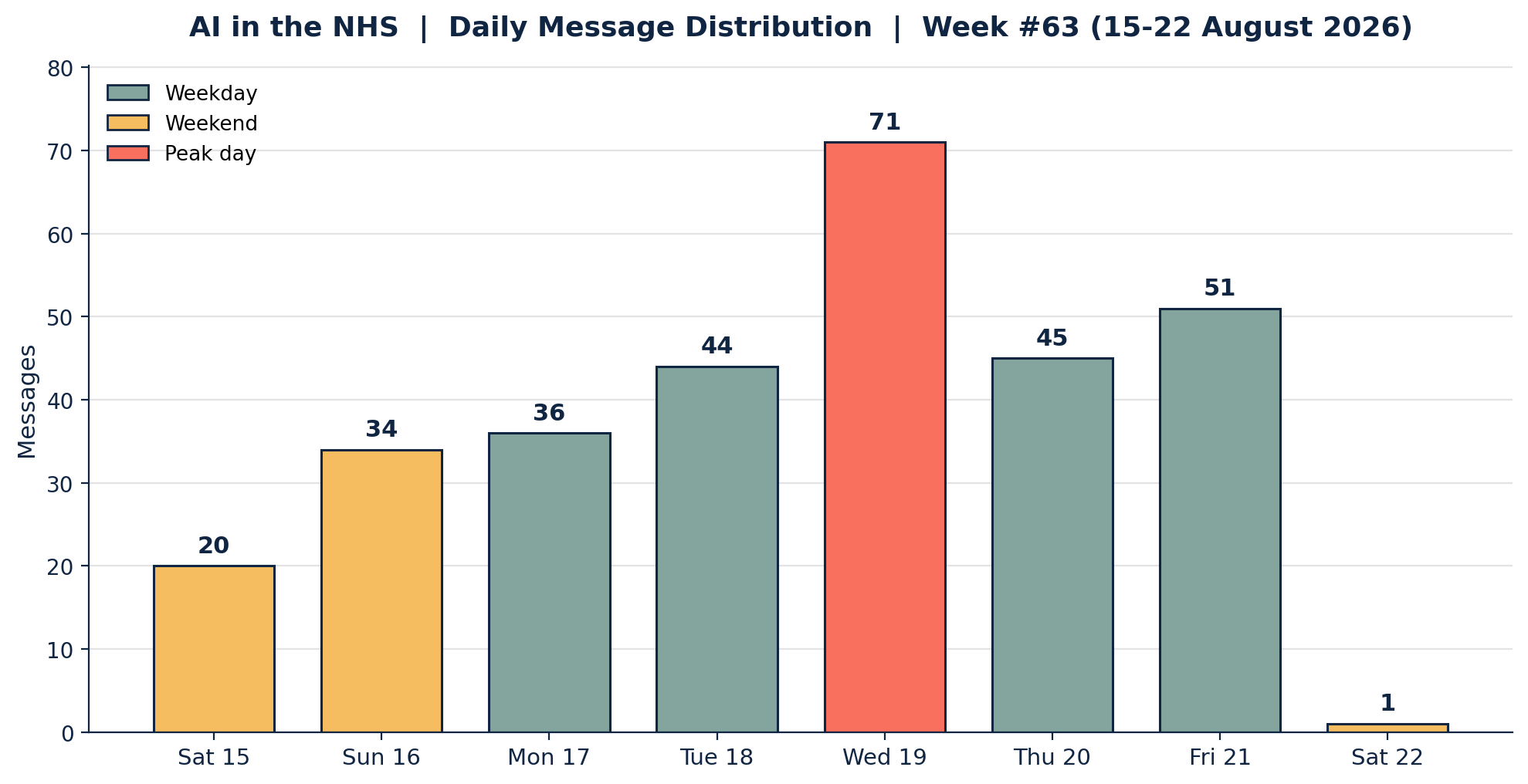
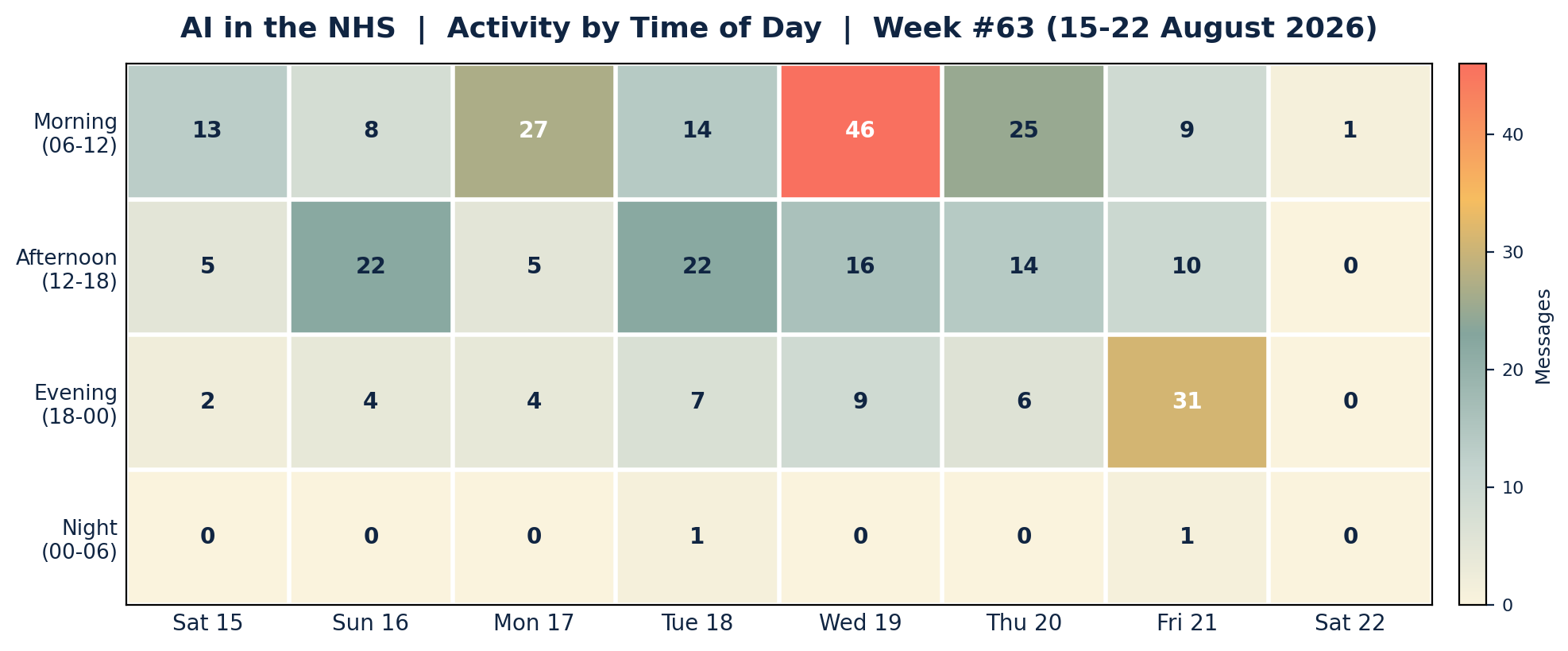
• Wednesday morning's 46 messages made it the heaviest substantive window of the week, driven by the paper announcement and the DCB0160 ownership debate that followed straight after.
• Friday evening (31 messages) was the only evening spike, and almost entirely social: the care-sector newcomer exchange, the polymorphs tangent and community housekeeping.
• The week built steadily from Saturday to its Wednesday peak rather than spiking around a single event, unusual for this group, whose peaks are normally news-driven.
• Weekday dominance (81.8%) was the strongest in several issues, with both weekend days quiet and no night-time activity beyond two stray messages.
• The pattern held that governance and evidence debates run in the mornings while evenings belong to community and humour.
APPENDIX B: Enhanced Statistics
Unique Contributors:
55 group members posted at least one message this week. The 15 most active account for 233 of the 302 messages (77.2%), with a long tail of occasional and one-off contributors making up the rest.
Top Contributors (Role Descriptors Only):
1. Digital Health & Clinical AI Specialist (Group Moderator): 75 messages
2. Radiologist and clinical governance advocate: 24 messages
3. Integrated care operations lead: 20 messages
4. Innovation-focused GP: 15 messages
5. Digital health contributor: 15 messages
6. Digital health GP exploring local models: 13 messages
7. GP partner and committed AVT adopter: 12 messages
8. NHS IT specialist: 10 messages
9. Health-tech industry contributor: 10 messages
10. Clinical AI researcher: 9 messages
11. Newcomer researching the care sector: 9 messages
12. Primary care digital policy lead: 6 messages
13. Practice-side contributor: 6 messages
14. GP partner exploring practice-level AI: 5 messages
15. Health-tech AI model-watcher: 4 messages
Hottest Debate Topics:
1. 🔥🔥🔥 Who owns DCB0160 for e-RS and Advice & Guidance (~45 messages across 3 days)
2. 🔥🔥🔥 Own vs rent intelligence: local models in practice (~45 messages across 3 days)
3. 🔥🔥 The "obsolete physician": autonomous AI and the human in the loop (~15 messages, 1 day)
4. 🔥🔥 Evaluation standards for NHS AI procurement (~15 messages, 1 day)
5. 🔥🔥 Voice AI vs regional accents (~15 messages, 1 day)
6. 🔥 AI, homework and whether exams still matter (~12 messages, 1 day)
Discussion Quality Metrics:
• Evidence-Based vs Opinion Ratio: an unusually evidence-heavy week; roughly a third of substantive messages referenced papers, official reports or published data, anchored by two peer-reviewed publications and an official investigation report
• Average Thread Depth: the two flagship debates each sustained 40+ message exchanges across multiple days
• Constructive Challenge Rate: high; the DCB0160 thread was a model of sustained respectful disagreement that ended in partial convergence
• External Resource Sharing: 41 unique links shared across the period
Cross-Expertise Engagement:
• Contributors this week spanned general practice, radiology, hospital medicine, pharmacy-adjacent chemistry, ICB operations, NHS IT, practice management, health-tech industry, interoperability standards, patient safety and commissioning
• Most cross-disciplinary discussion: the DCB0160/e-RS thread, which drew clinicians, operations, IT, safety specialists and policy voices into a single argument
• Notable knowledge transfer: a former chemist explaining crystal polymorphism to clinicians via a wearables thread; an NHS IT specialist giving the room a history of the Evidence Standards Framework
• Well over half the substantive discussions involved three or more distinct professional perspectives
APPENDIX C: Daily Theme Summary
Saturday, 15 August
Primary Theme: Token economics and the own-vs-rent argument. Key Discussion: A clinical code extraction benchmark sparked debate on whether owning hardware and models beats renting frontier intelligence, with positions staked out that would run all week. Secondary Discussions: OpenAI/Hugging Face commentary follow-up from last week; a Nature paper shared without comment. Notable: The "Own the Intelligence" framing entered the group vocabulary.
Sunday, 16 August
Primary Theme: BMJ double-bill and personal AI tooling. Key Discussion: Two BMJ pieces (AI as a commercial determinant of health; four fifths of trusts still on pen and paper) framed the morning; the moderator described building a local journal-paper assistant on a 27B open model and asked what others use. Secondary Discussions: Malicious AI swarms citation; Claude watermarking explainer; retro streaming nostalgia. Notable: A major AI service outage late evening prompted jokes about LinkedIn post volumes plummeting.
Monday, 17 August
Primary Theme: Local models in practice. Key Discussion: A newcomer's "which open-source model?" question and a GP partner's super-partnership hardware costings turned the sovereignty argument practical, with governance obligations firmly restated: local processing is still processing. Secondary Discussions: Derm triage proof-of-concept post-training; the sovereign AI group's crowdfunded compute idea; jailbreaking explainer; a model-finder tool launch. Notable: A new member praised the newsletter back catalogue and joined the mailing list.
Tuesday, 18 August
Primary Theme: Autonomous AI and the arrival of the HSSIB interim report. Key Discussion: The JAMA viewpoint on removing humans from the loop dominated the morning; the HSSIB interim report and HSJ's patient-deaths exclusive landed at lunchtime, with the zero-DCB0160 finding put in capitals. Secondary Discussions: The evaluation-metrics question and the ESF/DTAC/Buyers' Guide answers; METR on AI-accelerated discovery; OpenAI slowing releases. Notable: The question "do you have an up-to-date 0160?" was put directly to every reader working near e-RS.
Wednesday, 19 August
Primary Theme: "Unfit for the future?" publication and the DCB0160 ownership debate. Key Discussion: The group's second FOI paper published in BMJ Innovations (1.1 WTE mean CSO capacity; four drivers of non-compliance), followed immediately by the week's longest argument over whether e-RS failures are technology hazards or people problems, converging on the need for the standards while acknowledging their misuse. Secondary Discussions: LLM watermarks in medical texts; the health-tech register; a BBC records-access story and staff-movement accountability; FDA generative AI considerations. Notable: Peak day of the week at 71 messages; 46 of them before midday.
Thursday, 20 August
Primary Theme: Voice AI, accents, and knowing your subject. Key Discussion: The Yorkshire-accent AI receptionist story ran all afternoon alongside the serious counterweight, the 2.33-million-consultation Spanish ambient scribe evaluation; the morning carried FOI-refusal frustrations and the exams-and-AI debate. Secondary Discussions: A frontier lab's clinical specialist job posting; the group mission statement, coined and ratified. Notable: The Burnistoun sketch was declared mandatory sharing.
Friday, 21 August
Primary Theme: Community evening: training, tangents and housekeeping. Key Discussion: A thread on training resources for infrequent AI users (with a small-business course recommended for practices), the mind-virus paper and the meme debate, and the polymorph chemistry tangent that delighted everyone. Secondary Discussions: Wearables disagreeing about sleep; the care-sector newcomer exchange; personal website building. Notable: Two community requests: set a WhatsApp display name and add a member tag.
Saturday, 22 August
Primary Theme: Early morning care-sector coda. Key Discussion: A former commissioner answered Friday's care-sector questions properly: digital literacy, infrastructure and the funding boundary between free-at-point-of-need health and means-tested social care. Secondary Discussions: None; one message before the 9am cutoff. Notable: The week closed as it opened, with someone taking a question seriously.
AI in the NHS Weekly Newsletter is produced by Curistica Ltd for members of the AI in the NHS WhatsApp community. All contributors are anonymised. Views expressed are those of individual community members and do not represent any organisation.