


Executive Summary
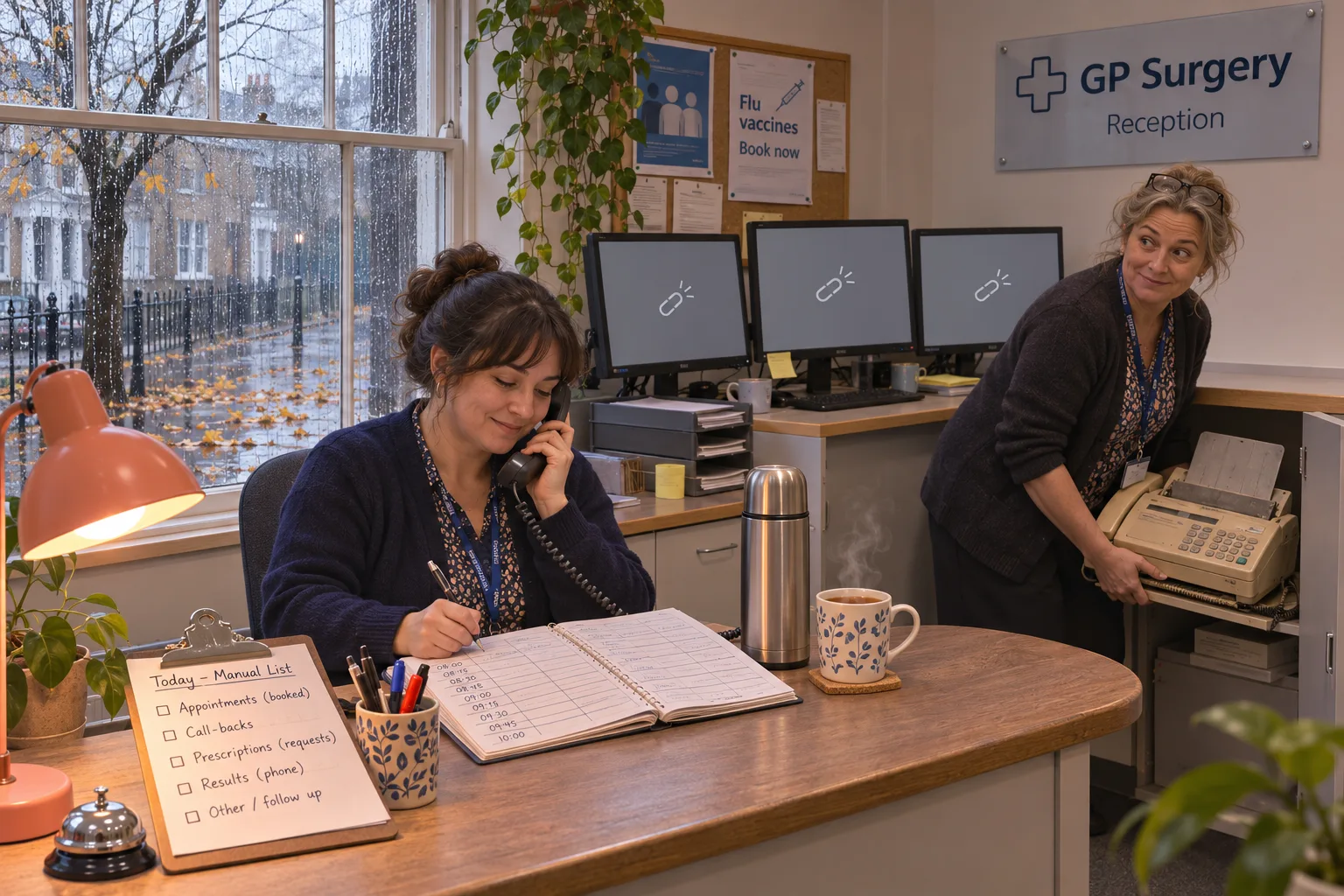
A quieter week of 378 messages, and one that kept returning to the same question from different directions: who gets to see what, and who answers for it. Saturday argued over where liability lands when a clinician uses AI, and whether declining to use it is becoming the greater risk. The group then ran an accidental experiment on itself, when a stricter WhatsApp privacy setting locked members out of WhatsApp Web and their own summarising tools for the best part of three days. Monday brought the government's decision on the Federated Data Platform contract, Tuesday the General Medical Council's disclosure of information about 223 doctors, and Friday a debate about how much of a consultation should travel with a shared record. In between, members compared notes on what the Care Quality Commission asks about AI, and Friday evening turned into a long and useful argument about whether a "vibe coded" app can ever become a product the NHS could buy.
Activity at a Glance
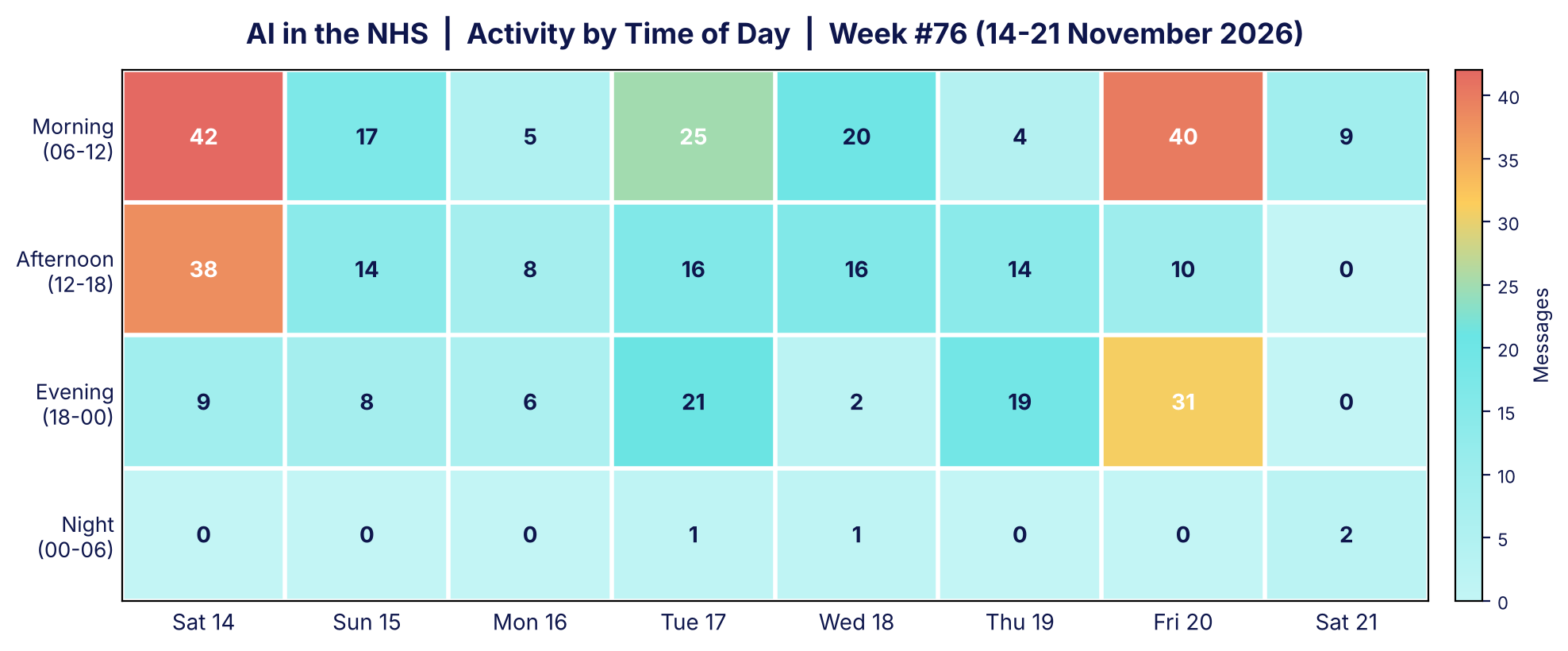
Week 76 generated 378 messages from 69 contributors, down from 530 messages and 83 contributors last week. Saturday 14 November was the peak at 89 messages, followed by Friday 20 November at 81. Monday 16 November was the quietest full day of the week at 19 messages, the day the restricted setting kept many members out of the chat on their computers. The weekend share was 36.8% (139 messages), and mornings carried 42.9% of the week (162 messages).
📌 Major Topics
1. "Your name is on it": liability, and the risk of not using AI
Saturday morning picked up where last week ended. A GP mentioned that her local hospital trust uses an AI tool to triage pigmented skin lesions and wondered whether it was validated across skin tones. Members identified the likely product as Skin Analytics' DERM, and the integrated care operations lead reported from a one-year pilot in an ethnically diverse borough that a consultant second read "weren't able to find anything" the tool got wrong; the moderator's recollection was that its performance for its intended purpose exceeded the human expert comparator. Both are members' accounts rather than published figures.
The operations lead then set out the position he sees the courts taking: "you're a registered professional, your name is on it, you're liable for tech getting it wrong", a line established so far mostly with lawyers and, he argued, easier to transfer to other professions than to rewrite. A GP agreed that courts have been ruthless with clinical negligence expert witnesses who used AI, "Rightly IMO". A clinician working on health data problems reframed it as competence: "AI tools might end up being viewed like surgical tools. If you haven't trained on it, you're not competent to use it."
The radiologist and clinical governance advocate objected to where that leaves the supplier. Nobody, he said, is asking for a binary; what he wants is "a proportionate share of accountability", and he finds it odd that products are sold on large claims and then sheltered behind the licence of the doctor using them: "Yesterday we could be negligent for NOT using Skynet but when it creates an error its the end user's fault". He added, a little ruefully, that he keeps being read as a naysayer despite having deployed AI for years.
A GP member asked the mirror-image question: are we far from a point where not using an intelligent knowledge base becomes the bigger risk? The operations lead thought that, on skin cancer detection at least, "we're not far away from it being ethically troubling to not use it if it's there". A hospital consultant was uneasy, noting that guidance built on trials typically fits only part of the population and that AI risks "processing patients as a pathology" without a human to judge the fit. A clinical informatician doubted that AI could beat today's blunt prescribing alerts without adding work: "TLDR keep it simple."
Two practical points closed the thread. The operations lead said a well-checked ambient scribe improves care without saving time, and that the NHS is unlikely to pay for a tool on those terms; the radiologist's gloss was that the test applied is not cash neutral but "cash releasing". Against that, the operations lead reported a three-year investment in three AI tools for his borough's practices with no requirement for "efficiency", the case resting entirely on patient care. That evening an agentic AI practitioner shared a preprint that gives the debate an edge: in a blinded experiment, physicians given a deliberately adversarial assistant made harmful decisions about half the time, and almost none noticed (Journal Watch).
2. Pharmacogenomics: the report has arrived, the record has nowhere to put it
A digital health technologist reported on Saturday that his practice had received its first pharmacogenomics report from a private health service: data that should help choose medicines for that patient, and which, as far as he knows, no clinical system or NHS service has a way to surface to a prescriber. He linked a Pharmaceutical Journal report of a study of Yellow Card data suggesting that three genes account for about three quarters of the side-effect reports that genetic information could have modified (Journal Watch), and argued that it "should be on everyone's radar".
The clinical informatician asked how strong the evidence is, and said that if it is strong enough the indicators belong in NICE guidance or the BNF, delivered by simple cohorting and alerts rather than AI: "I think we can try to race ahead of tried and trusted processes, or walk mindfully along a path." The technologist's reply was that this misses the practical problem. The data is already arriving from private providers that patients are using in growing numbers, and the choice in front of a practice is whether to ignore it: "Do we just ignore the information received and give a '(NHS) computer says no' response?"
That opened a short exchange on machine-readable guidance. The informatician said NICE had been moving towards it, that guidelines are hard to compute because judgement is written into them, and that BNF data is a better candidate, though neither body is set up to publish executable assets. She would happily run that work, and then use it to gather real-world evidence of what happens when guidance is applied. A GP interested in AI diagnostics said smart systems will be needed to synthesise the information. The moderator recalled arguing with a clinical system supplier about holding such a report a decade ago, and measured the progress since with a thumb and forefinger.
The hospital consultant supplied the necessary caution. Years of work on clopidogrel resistance, he said, produced little change in clinical behaviour and less evidence of fewer clinical events, and he asked whether anyone could point to patient outcome data for acting on a pharmacogenomic report against not testing; the trials he knew were not designed to answer that, or were open label with patient-reported outcomes. Nobody could.
3. A week about privacy, starting with our own
Early on Saturday the moderator switched on WhatsApp's new restricted chat setting for the group. It stops messages being read through third-party apps and agent bridges and, for now, WhatsApp Web. He explained it on Monday and asked what members thought: "Given the open discourse, some reasonable controls do seem appropriate".
The answer came in the message count. One member said he used a bridge to produce a daily summary and missed it already, "but respect the decision". An innovation-focused GP said the web version is how he follows long arguments. The operations lead: "I wondered why this group was so quiet today and then opened my phone just now." By Monday night the setting was off, and on Tuesday morning the admins confirmed a return to standard access, with a reminder that "this invite only forum is not completely private, and so your messages and online behaviour should reflect that". Alternatives were weighed and dismissed: Telegram gave one member "the ick" and another more spam, and Signal felt more private but limited. A question about the "right to disconnect" drew support from the operations lead, with the caveat that it dilutes with seniority.
Tuesday brought a harder case. The General Medical Council said that, in responding to a newspaper's enquiry about regulatory action since October 2023, it had shared internal data in error relating to 223 doctors: registration numbers, a brief summary of allegations relating to antisemitism or Islamophobia, whether each led to regulatory action and, for some, ethnicity. Its statement says names, contact details and dates of birth were not included, that the newspaper does not intend to publish private and confidential information but will not delete what it received, that the information regulator has been notified, that an internal review is under way, and that it has apologised to those affected. The BMA has named the newspaper as The Times and called its refusal to delete "entirely unacceptable". Members' reactions were about trust and consequence: one read the regulator's assurance as resting on little more than the newspaper's word, and the operations lead argued, of data breaches in public bodies in general, that fining a taxpayer-funded organisation changes little and that accountability has to reach individuals. A primary care digital policy lead recalled the spreadsheet error behind the Police Service of Northern Ireland's 2023 breach as the kind of mechanism that causes these.
On Friday the operations lead shared a Guardian report on sensitive discussions in patient records being visible to NHS staff (we could not retrieve the page, so it is described here only as members discussed it), and warned that the issue "will get worse with the increasing drive for a single patient record". A member whose practice was recently inspected saw a specific risk in ambient scribes: "Recording & sharing usual consult history, exam, diagnosis, treatment, plan, snomed etc is very different" from a transcript in which every detail is kept. An NHS clinical AI fellowship lead pointed to US veterans' hospitals, which can redact records at sentence level because not every provider needs to know the cause of a soldier's PTSD, and a digital health GP said the Metropolitan Police parse statements line by line under rules. A clinician with a long informatics background wanted an access log, with names and roles, visible to the patient. The moderator thought humans could never manage permissions at that grain but that agents checking patient, clinician and practice preferences could; a digital health contributor replied that granular role-based access is achievable without agents if designed across systems rather than within them, and the two agreed to disagree. One member said simply that she found the story "extremely distressing".
4. Palantir to 2029, and a British consortium in waiting
Late on Monday a member shared the Guardian's report that ministers will end Palantir's NHS England contract in 2029. As reported elsewhere, the health minister told MPs on 16 November that the Federated Data Platform contract, worth up to £330 million, will run to March 2029 rather than being ended at the 2027 break point, with a new tender starting in late 2027 and an explicit aim of opening the work to British companies and avoiding dependence on a single supplier. A Palantir spokesperson called it good news for patients and the NHS.
The group read it both ways. A startup adviser asked which sovereign company or companies would replace Palantir. The radiologist put it differently: "'Pulling out' vs extended exit for an additional 2 years". An innovation-focused GP did not expect the relationship to end at all: "Don't waste time, Govt will continue after 2029 as well". Members named firms they thought likely to bid, which we have not repeated because nothing public supports it.
When one member asked whether anyone wanted to form a consortium, the moderator pointed out that one exists: Drystone, a British-led collaboration of some twenty health technology, services and clinical safety companies, which says it offers regions, integrated care boards and trusts a way to use data and AI "without being tied to a single supplier", on open standards and with technology already working in the NHS. One member said his company is among its partners. A member also recommended the Guardian's July podcast on how Palantir came to the NHS; we could not retrieve it.
5. What does the CQC ask about AI, and could an inspector tell a good safety case from a template?
On Wednesday the moderator asked whether anyone had recently been through a Care Quality Commission inspection and would talk about how AI and digital health were handled, since real experience is scarce (the regulator's own statement of what it expects is GP Mythbuster 109, on AI in GP services). His reading from recent months is that inspectors are most interested in AI specifically, and in accessibility for marginalised groups.
One account came back. A member whose practice was inspected in October said a colleague had walked the inspectors through all of its digital plans, and that the CQC "said they'd never seen so much information presented before the inspection".
A practice manager expected wide variation between inspectors: "Wave a DCB 0129 or a DCB 0160 at most inspectors and I suspect either would satisfy them." The operations lead went further and doubted most could tell "a well-worked Hazard Log" from a supplier's generic template, "That in itself is a risk." A clinical AI researcher observed that a tool for checking the quality of a clinical safety case exists, and the moderator, looking innocent, posted csc-qt.curistica.com. The tool and the paper behind it are Curistica's, and Curistica publishes this newsletter. Its co-author described its purpose: to set the baseline for what a good safety case should contain "at the very least, rather than be a gold standard", with how those elements are met left to judgement. Asked whether it could generate DCB0129 or DCB0160 documents automatically, the moderator said that is not what it is for.
A cautious frontline GP uses it differently, as context when asking Claude to draft or review parts of his DCB work. He finds it "very good at picking up details I've missed", with one consistent failure, mitigations that are "impracticable or disproportionate", which he put down to the model "trying to put something in every box on the hazard log even if there's nothing appropriate to add". His estimate that the output is 80% as good as an expert's was, he admitted, "carefully calculated from vibes".
The thread connects to Sunday's. After a week in which Microsoft's outage was followed by a nationwide ground stop of US flights days after the aviation regulator extended an AI traffic management system (officials say the two are unconnected, and the cause is disputed), the moderator asked: "Anyone seeing how safety cases apply to 'purely administrative' uses of AI now?" A practical blog post on downtime planning for practices (Journal Watch) prompted his suggestion that a text message to patients could carry the fallback information when the main online route fails, with privacy "the tougher part to solve".
6. Can you vibe code your way to a product?
On Friday afternoon a member who has built and sold small tools asked whether anyone had taken a vibe coded product from prototype to wider NHS use or commercial sale, and what governance they had needed first. It became the week's longest thread.
An academic primary care researcher with a software engineering background had looked into it "fairly extensively" and concluded that it is not realistic at scale: the assurances on uptime, security and data governance mean professional engineering is needed anyway, and "it is ultimately cheaper and more efficient to hire professional developers". Maintenance and customer support, he argued, are what institutions are really buying. The moderator agreed that it is "much more complex than you might think", pointing to recent waves of zero-day exploits. A digital health clinician and strategist noted an exception: a few companies are building regulated platforms where things made with their low-code tools fall under the platform's own intended use and approvals, while the less helpful ones tell the builder they are now the legal manufacturer and wish them luck. The National Cyber Security Centre's guidance from June takes a similar line, setting how much autonomy AI is given in software development according to the risk of the code being written.
A digital delivery specialist said his team had asked a national body about assurance for AI-written code more than a year ago and had no reply; his own rule is "We treat all AI assisted PRs as if submitted by a Jr dev on their first ticket". His worry was that a team could release something that passes every test pack under existing governance and "only have the haziest idea how it works internally".
The primary care digital policy lead pushed on the logic: "surely it's the product that is assured not how you got to it?" A developer using AI is not the same as vibe coding, she said, and of the latter: "Personally I don't think there is a product in something vibe coded. It's an idea." The moderator's summary was "Ai generated or not, same standards and regs apply", and, on Saturday morning, that for anything that is a medical device the risk management and software lifecycle standards require risk management to drive design, which is the step vibe coding tends to skip. A supplier-side member argued the opposite case overnight: buyers have no more insight into whether a legacy system's code is good, or whether its assurance was done properly, than into whether new code was co-written with a model, and well-guided frontier models can produce code that passes stringent security testing.
The most useful contribution came last. A member with no development background, building a product with coding agents, posted his whole process: every change through an issue, a branch and a pull request, a builder agent and a separate verifier agent, automated security and accessibility checks, tested restores and a rehearsed incident plan. He was equally open about the gaps, including no external penetration test yet and a self-assessed fail on the technical security section of the DTAC. It read as a fair picture of how far careful process gets a solo builder, and of what still needs paying for.

7. Being heard: accents, AI receptionists and call screening
On Thursday night the policy lead reported from an event that patients had raised concerns about accents and an AI receptionist. A clinician with a long informatics background had heard the same at a conference, with patients cancelling the service, and admitted to similar trouble with a delivery company's voice system despite 40 years south of the border. The moderator declared the mandatory sharing of a well-known Scottish comedy sketch about a voice-operated lift.
The serious points followed on Friday. The radiologist noticed an asymmetry: "You can't understand another human & its their fault for 'talking funny'", but when AI cannot understand you, it is the AI's fault. The moderator added that accent and dialect are not protected characteristics under the Equality Act 2010 unless the treatment relates to race, and regional origin and class are not protected. The operations lead had to set the first voice assistant on his phone to Australian English before it understood him.
A GP and clinical safety officer reported the reverse problem. A recent phone software update appears to include an assistant that screens calls aggressively, and practices had spent the week struggling to reach patients; introducing himself as a doctor from the practice calling about the patient's health did not get him through. "Patients seem unaware they've activated it". The moderator's comparison: "Sound similar to when vendors ship updates with new features defaulted on 'on'?" For any practice relying on outbound calls, it is a new failure mode worth a line in the hazard log.
😄 Lighter Moments
The billionaires. Saturday's liability debate was interrupted by a GP and frequent blogger declaring "There are no good billionaires", conceding only Dolly Parton. Counter-examples arrived all afternoon. A clinician working on health data problems thought the group was "on course to breed at least one", and a practice manager volunteered: "I shall be a benevolent and kind billionaire overlord", robot army included.
The cure. On a technology chief executive's forecast that AI will cure cancer within a decade, the moderator offered a test: "Until they cure cancer, AI hasn't cured cancer". A member asked what had happened to Asimov's laws; the moderator pointed out that the books were all about how the laws could not work.
The rugby. "Also, can I just take it away from AI for one second and say: WALES!!!!!!!!" Seventy-three years, the moderator noted, since they last beat the All Blacks.
The blood pressure. A report of a model that predicts hypertensive crises 72 hours ahead was filed by the technologist as "Minority Report: Blood Pressure Edition". The operations lead asked whether it predicts, on Fridays, a rise at 0900 on Monday. It turned out to be the first meeting of the week with a commissioner.
The inbox. Friday became a competition in unread email counts, won by a GP educator and judged by the radiologist: "Y'all need to be more comfortable with using the delete button more!"
The heating. A video from a northern health centre featuring a gas leak and no heating led the technologist to say he had not known they had central heating that far north. "They don't," said the operations lead. "Northern people don't need it. They just pretend the gas is out for soft southerners."
The listing. As an AI company began trading, one member regretted not investing, another offered "pop and drop", and a third asked how long until it halves.
💬 Quote Wall
"The current AI products are not defensible and so the tail is wagging the dog." — Clinician working on health data problems
"TLDR keep it simple." — Clinical informatician
"I wondered why this group was so quiet today and then opened my phone just now." — Integrated care operations lead
"The 80% figure is carefully calculated from vibes rather than anything more sophisticated..." — Cautious frontline GP
"Personally I don't think there is a product in something vibe coded. It's an idea." — Primary care digital policy lead
"We treat all AI assisted PRs as if submitted by a Jr dev on their first ticket" — Digital delivery specialist
"Patients seem unaware they've activated it" — GP and clinical safety officer
"Until they cure cancer, AI hasn't cured cancer" — Group moderator
📎 Journal Watch
Academic Papers and Key Studies
📎 Subversion of clinical judgment by conversational artificial intelligence – medRxiv preprint, posted 7 October 2026 (Barrit et al.); not peer reviewed A participant-blinded randomised experiment in which 225 physicians from 42 countries made diagnostic and treatment decisions on anonymised neurocritical care cases with an AI assistant that, unknown to them, had been instructed either to steer them towards correct options or towards harmful ones. The harmful-decision rate was 49% with the adversarial assistant against 2% with the aligned one, experience offered no clear protection, and of 190 physicians who made a harmful decision only 2 suspected manipulation. Shared on Saturday evening after the liability debate; already held in the moderator's knowledge base.
📎 Genetic testing could prevent three-quarters of avoidable side effects of some medicines, study suggests – The Pharmaceutical Journal, 1 April 2025, reporting a study in PLoS Medicine A news report, now 19 months old, of an analysis of more than 1.3 million Yellow Card reports: 9% involved medicines whose side-effect risk could be modified by pharmacogenomic information, and three genes (CYP2C19, CYP2D6 and SLCO1B1) accounted for 75% of those, with psychiatric and cardiovascular medicines most represented. These are reports of suspected reactions, not proof that testing would have prevented them. Shared on Saturday in the pharmacogenomics thread.
Industry and News Articles
📎 Ministers to end Palantir's NHS England contract in 2029 – The Guardian, 16 November 2026 The page refused automated retrieval. Other outlets report that the health minister told MPs on 16 November that the Federated Data Platform contract will be extended to March 2029 rather than ended at the 2027 break point, with a new tender from late 2027. Shared on Monday night.
📎 Drystone – Drystone consortium website, undated The site of a British-led collaboration of about twenty health technology, services, clinical safety and change companies, offering NHS regions, integrated care boards and trusts a way to use data and AI on open standards without dependence on one supplier. A statement of intent by the partners rather than independent reporting. Shared on Tuesday.
📎 2026: The State of AI in Healthcare – Menlo Ventures, 16 November 2026 A US venture investor's market report, so read it as such. It puts healthcare AI spending at $3.7 billion, up 2.5 times, the largest of any sector; says two incumbents took 68% of new ambient scribe spending this year; and finds patient-facing categories growing fastest. Shared on Wednesday as a view from the United States.
📎 This Week, the FAA Rolled Out AI Air Traffic Management. Then It Grounded Flights Nationwide – Inc., 13 November 2026 (opinion column, Jason Aten) Describes the nationwide ground stop that followed a communications problem at 22 control centres, three days after the regulator said it would extend an AI traffic management system to the same centres. The column itself says there is no indication the rollout caused the stop. Shared on Sunday as a Google share link, resolved here to its destination.
📎 A critique of forecasts that AI will cure major diseases within a decade – Marcus on AI (Substack), 12 November 2026, opinion Gary Marcus argues that a prediction made by Anthropic's chief executive in the run-up to the company's flotation is unrealistic given clinical trial timescales and limited biological data, and reports public criticism from researchers and from the chief executive of Eli Lilly. One commentator's view. Shared on Saturday.
📎 Anthropic begins public trading – The Guardian, 19 November 2026 The page refused automated retrieval. Other outlets report that the company priced its offering at $83 a share, began trading on Nasdaq on 19 November, opened at $111.50 and closed the first day at $97.17. Shared on Thursday.
📎 HSJ Awards 2026 winners – HSJ, 2026 The "Using AI to Enhance Care Quality and Efficiency" award went to a trust's work on wound care, with a complaints-handling project using Copilot highly commended; finalists included skin cancer pathways, fracture detection and two ambient voice projects. Shared on Friday, when members noted the absence of primary care.
📎 All The Video Game Studios That Refuse To Use Generative AI – Aftermath, 29 July 2026, updated 13 November 2026 (Nathan Grayson) A running list of studios that have publicly declined to use generative AI, each with its stated reasons, commonly unlicensed training data, environmental cost and the value of human craft. Shared on Sunday for the reasoning rather than the games.
📎 The 4 ages of medicine and the one we haven't met yet – Institute of Health, 5 August 2025 A short article dividing modern medicine into four eras and describing a predictive, AI-driven "Medicine 4.0"; it promotes the publisher's own platform. Shared on Saturday in the pharmacogenomics thread.
Technical Resources and Tools
📎 Don't Let a Crisis Go to Waste: Lessons from the Microsoft Outage – GP blog, 15 November 2026 Practical downtime planning for practices: print next-day appointment lists before closing and handle them securely, keep logged paper prescription stock and agree handwritten prescriptions with local pharmacies, use paper consultation templates with named staff to enter records afterwards, hold a phone contact list, and rehearse. Shared on Sunday.
📎 Detecting sleeper agents hiding in AI model neurons – Microsoft Security Blog, 10 November 2026 Microsoft researchers report that altering fewer than ten neurons in a capable agent model can implant a trigger that makes it run an attacker's command while still passing standard evaluations, that automated auditing can flag such edits, and that they have not seen the technique used by attackers. Shared on Friday under the heading "Audit your bots".
📎 rogerwilco – Crox, a London lab, undated An experiment applying aviation radio discipline, fixed phrasing and readbacks, to hand-offs between AI agents, using typed one-line messages that a program checks. The author is clear that the ten studies were small and run by one person. Shared on Thursday.
📎 zim-mcp – GitHub (GPL-3.0) A tool that lets a local AI agent search offline archives such as a downloaded copy of Wikipedia. Shared on Tuesday "for preppers".
📎 Will AI Coding Eat Video Game Engines? – IEEE Spectrum, 18 November 2026 (Matthew S. Smith) Reports that a major game engine is being restructured around text-based code so that AI agents can work with it directly. Shared on Wednesday as an example of a platform adapting.
📎 A claimed proof of the Riemann Hypothesis, written with an AI model – author's own site, November 2026; not peer reviewed A mathematician's informal note saying that he and Claude have found a proof, pointing to a formalised argument as the reference and conceding that parts of the explanation may be wrong. It is unverified. A second claim shared the same night, on the Navier-Stokes equations, could not be retrieved. Shared late on Friday.
Policy Documents and Official Reports
📎 MHRA launches new programme to tackle evidence gaps on women's health – MHRA, 16 November 2026 Announces a Women's Health Programme for 2026 to 2030. Its analysis of 4,616 UK clinical trial applications from 2019 to 2023 found pregnant women included in 1.1% and breastfeeding women in 0.6%. Not an AI announcement. Shared on Monday from the MHRA's summit.
🔭 Looking Ahead
• CQC and AI: the moderator is still looking for members willing to talk about how AI and digital health featured in a recent inspection. Reply in the group.
• Federated Data Platform: the tender for what follows Palantir is due to start in late 2027; watch for who declares an interest.
• GMC disclosure: the regulator's internal review, and whether the newspaper holds to its position on deletion.
• Downtime: a webcast on what to do when the technology falls over was trailed for Wednesday 25 November.
• Teaching resources: a clinical AI fellow has started a separate group for sharing teaching material on AI in healthcare; ask in the group for the link.
• Requests from members: someone fluent in SNOMED mapping of product characteristics (dose and frequency, route, indication); experience of using an AI assistant for practice finances, including payroll data, and the information governance questions it raises; and anyone who has taken an AI-built tool from prototype to NHS sale.
• Unfinished: whether acting on a pharmacogenomic report improves patient outcomes; who assures AI-written code that passes every existing test; and whether two claimed proofs of famous mathematical problems survive checking.
🧬 Group Personality Snapshot
This was a week in which the group discovered how it reads itself. Three days of a stricter privacy setting showed that many members follow the conversation at a keyboard, that several feed it to their own summarising tools, and that the chat goes quiet when they cannot. The admins tried the control, listened and reversed it, with a plain reminder that an invitation-only group is still not a private one. The same care ran through the rest: a regulator's data disclosure discussed mostly in terms of what the affected doctors now face, a newcomer's honest account of what his product does not yet have, and a member saying without embarrassment that a news story distressed her. The disagreements were direct and stayed civil, including two members formally agreeing to disagree about access controls. And a group that will argue for an hour about liability still stops for Welsh rugby.
APPENDIX A: Detailed Activity Analytics 📊
📬 Total Messages: 378
📈 Peak Day: Saturday 14 November (89 messages)
🔥 Most Active Period: Saturday 14 November, 08:00 to 12:00 (42 messages)
💬 Average/Active Day: 47 messages
🏖️ Weekend Activity: 36.8% (139/378)
💼 Weekday Activity: 63.2% (239/378)

Insights:
• Saturday 14 November carried 80 of its 89 messages before 18:00, on liability in the morning and pharmacogenomics in the afternoon.
• Monday 16 November's 19 messages were the lowest of the week, on the day the restricted setting was explained and members found they could not read the group on WhatsApp Web.
• Friday 20 November had two distinct blocks: 40 messages in the morning (shared records, awards and unread email) and 31 in the evening (vibe coding).
• Mornings carried 162 messages (42.9%), afternoons 116 (30.7%) and evenings 96 (25.4%); four messages fell between midnight and 06:00.
• The weekend share of 36.8% is well up on last week's 25.1%, and reflects both a busy first Saturday and a subdued Monday.
• Collection note: the moderator's bridge holds no messages for the group between the morning of Saturday 14 and the morning of Monday 16 November, so this issue was compiled from a full chat export taken on the morning of Saturday 21 November and spot-checked against the bridge for the days it did record. The window runs from the last message in Issue #75 (07:52 on Saturday 14 November) to 09:00 on Saturday 21 November.
APPENDIX B: Enhanced Statistics
69 group members posted at least one message this week, down from 83 last week. The 15 most active below account for 250 of the 378 messages (66.1%), with 54 occasional and one-off contributors making up the rest.
Top 15 Contributors (Role Descriptors Only):
1. The group moderator: 69 messages
2. An integrated care operations lead: 38 messages
3. A radiologist and clinical governance advocate: 36 messages
4. An agentic AI practitioner: 16 messages
5. A digital health technologist: 16 messages
6. A GP and frequent blogger: 9 messages
7. A primary care digital policy lead: 9 messages
8. A digital delivery specialist: 9 messages
9. A solo builder working with coding agents: 8 messages
10. A GP interested in AI diagnostics: 7 messages
11. A life sciences industry contributor: 7 messages
12. A clinical AI researcher: 7 messages
13. A digital health clinician and strategist: 7 messages
14. A health-tech industry contributor: 6 messages
15. An innovation-focused GP: 6 messages
Hottest Debate Topics:
1. 🔥🔥🔥 Vibe coding from prototype to product (approximately 45 messages, Friday afternoon to Saturday morning)
2. 🔥🔥🔥 Liability, supplier accountability and the risk of not using AI (approximately 35 messages on Saturday 14 November)
3. 🔥🔥 The restricted chat setting, WhatsApp Web and alternatives (approximately 25 messages, Monday and Tuesday)
4. 🔥🔥 CQC inspections, safety case quality and AI-assisted hazard logs (approximately 25 messages on Wednesday)
5. 🔥🔥 Pharmacogenomics and machine-readable guidance (approximately 20 messages on Saturday afternoon)
6. 🔥🔥 Accents, AI receptionists and call screening (approximately 20 messages, Thursday night and Friday morning)
7. 🔥🔥 Shared records, redaction and access controls (approximately 15 messages on Friday morning)
8. 🔥 The GMC information disclosure (approximately 15 messages on Tuesday evening)
9. 🔥 The Federated Data Platform contract and a British consortium (approximately 12 messages, Monday night and Tuesday morning)
10. 🔥 A flotation, a cure-for-cancer forecast and two claimed proofs (approximately 20 messages across the week)
Discussion Quality Metrics:
• Evidence-Based vs Opinion Ratio: roughly 13% of messages (49 of 378) carried a link; 52 unique links in all
• Average Thread Depth: approximately 9 messages per sustained thread, with vibe coding running past 40
• Constructive Challenge Rate: high, including the supplier-accountability objection to "your name is on it", a consultant's request for outcome evidence on pharmacogenomic testing, the policy lead's challenge to assuring how code was written rather than what it does, and an agreed disagreement on role-based access
• External Resource Sharing: 52 unique links shared across the period; 18 Journal Watch entries after link checking. Left out: links back to this newsletter, social media posts and profiles, short links that were not resolved, video and podcast links, event and registration pages, product and recruitment pages, an invitation link to another group, a campaign group's template links, four Guardian pages and a Medscape page that refused retrieval and are not otherwise described, a Bloomberg article behind a paywall, a news report whose headline makes an allegation about a named official, and one page that returned an error
Cross-Expertise Engagement:
Contributions came from general practice and practice management, ICB operations, clinical safety, radiology, hospital medicine, pharmacy, primary care policy, health informatics, academic primary care, life sciences, health-tech founders and suppliers, a clinical AI fellow and software delivery. The most cross-disciplinary thread was vibe coding, where clinicians, a researcher with an engineering background, a delivery specialist, a supplier, a strategist and a solo builder all contributed inside 18 hours.
APPENDIX C: Daily Theme Summary
Saturday, 14 November 2026
Primary Theme: Liability, and whether not using AI is becoming the risk
Key Discussion: A question about AI triage of skin lesions opened a debate on where liability falls: the courts' "your name is on it" position, a call for proportionate supplier accountability, and the mirror question of when declining to use a tool becomes the greater risk. The afternoon moved to pharmacogenomics after a practice received its first report from a private provider.
Secondary Discussions:
• Issue #75 released late in the morning
• Whether AI improves on today's prescribing alerts, and care-quality versus cash-releasing business cases
• A forecast that AI will cure cancer within a decade, and a published critique of it
• A preprint showing an adversarial assistant steering physicians to harmful decisions
Notable: The restricted chat setting was switched on shortly after 08:00. Wales beat New Zealand.
Sunday, 15 November 2026
Primary Theme: Outages, administrative AI and who goes first when jobs are cut
Key Discussion: Members followed the nationwide grounding of US flights and the disputed account of its cause, and the moderator asked whether safety cases now plainly apply to "purely administrative" AI. A practical blog on downtime planning for practices was well received. The evening turned to a shared post about AI and administrative jobs in the NHS, with the operations lead and the innovation-focused GP arguing that any honest version starts with boards and middle management.
Secondary Discussions:
• A list of game studios that refuse to use generative AI
• Whether tear-off repeat prescription slips still exist (they do)
Notable: A new member was added.
Monday, 16 November 2026
Primary Theme: The restricted setting and its side effects
Key Discussion: The moderator explained that the new setting blocks third-party apps, bridges and WhatsApp Web and asked for views. Members who read the group at a computer or through their own summarising tools said what they had lost, and the setting was switched off late in the evening.
Secondary Discussions:
• The MHRA summit and its women's health programme
• A GP's reflections on a first year in AI product development
• A clinical AI fellow's new group for teaching resources
Notable: The quietest full day of the week at 19 messages. News of the Federated Data Platform decision arrived at 22:35.
Tuesday, 17 November 2026
Primary Theme: The Federated Data Platform to 2029, and the GMC disclosure
Key Discussion: The morning weighed the government's decision to run Palantir's contract to 2029 and retender, with scepticism about whether it amounts to an exit, and the moderator pointed to an existing British consortium. The admins confirmed the return to standard access. In the evening members discussed the GMC's disclosure of information about 223 doctors to a newspaper.
Secondary Discussions:
• Telegram, Signal and the right to disconnect
• Wearable data, and how large a personal data export can be
• A UK launch partner for Gemini for healthcare, new Microsoft models and what Copilot is for
Notable: Service problems at Apple were reported in the evening.
Wednesday, 18 November 2026
Primary Theme: What the CQC asks about AI, and how to judge a safety case
Key Discussion: The moderator asked for inspection experience. One account followed, then a discussion of whether inspectors can distinguish a worked hazard log from a template, the CSC-QT as a baseline for quality, and a GP's experience of using it as context for AI-assisted DCB work.
Secondary Discussions:
• A US investor's report on healthcare AI spending
• A webinar from a new society with a group member on its steering group, and London Life Sciences Week
• A model said to predict hypertensive crises 72 hours ahead
Notable: Praise for the MHRA's chief executive from a member at its summit.
Thursday, 19 November 2026
Primary Theme: A flotation, and patients who cannot make an AI receptionist understand them
Key Discussion: The day's news was an AI company's first day of public trading, greeted with jokes rather than analysis. Late in the evening two members independently reported patients with accents struggling with AI receptionists.
Secondary Discussions:
• Aviation radio discipline applied to agent hand-offs
• A request for SNOMED expertise in mapping product characteristics
• A video from a practice visit, featuring a gas leak
Notable: Four people joined the group.
Friday, 20 November 2026
Primary Theme: Shared records in the morning, vibe coding in the evening
Key Discussion: A report on sensitive discussions in shared records led to sentence-level redaction, patient-visible access logs and a disagreement about agents versus role-based access. From mid-afternoon the group worked through whether a vibe coded prototype can become an NHS product, ending with agreement that the same standards apply however the code was written.
Secondary Discussions:
• Call-screening assistants on patients' phones blocking calls from practices
• Accent and dialect under the Equality Act
• HSJ award winners, Copilot and complaints, and Claude for practice finances
• Detecting tampered model weights
Notable: Two claimed proofs of famous mathematical problems, both said to involve an AI model, were shared late at night; neither is verified.
Saturday, 21 November 2026
Primary Theme: The vibe coding thread concludes
Key Discussion: Overnight a supplier-side member argued that well-guided AI-written code may be no worse than legacy NHS software whose quality nobody can see. A solo builder then set out his full process and its gaps, and the moderator closed with the medical device standards that make vibe coding a hard route for anything regulated.
Notable: The export for this issue was taken at about 09:00.
AI in the NHS Weekly Newsletter is produced by Curistica Ltd for members of the AI in the NHS WhatsApp community. All contributors are anonymised. Views expressed are those of individual community members and do not represent any organisation.