
Executive Summary
A week of 358 messages that built slowly and then broke on Friday. Saturday opened with the tail of last week's debate about an AI that recommends more care than physicians do, then turned to a question that ran all week: what is the medical record for, who curates it, and why patients could no longer find their GP's free text in the NHS App. Monday was the Federated Data Platform and whether a patient can opt out of data used to plan their care; Tuesday's row was over the phrase "medical superintelligence". Wednesday morning was the week's most thoughtful stretch, as a paper on AI scribes and "the silent consultation" set off more than forty messages on noise, confabulation and the patient as curator of their own record. Then, late on Wednesday evening, a company supplying GP websites and online consultation tools entered administration and its services went dark. By Friday morning that was the week's defining thread: business continuity plans that have never been tested, financial due diligence on suppliers, whether health tech needs a special administration regime, and a parallel account from Scotland of a national GP IT migration that the BMA now wants practices to dispute formally. Friday evening relaxed into local models, RAM prices and what, if anything, a GP website is for.
Activity at a Glance
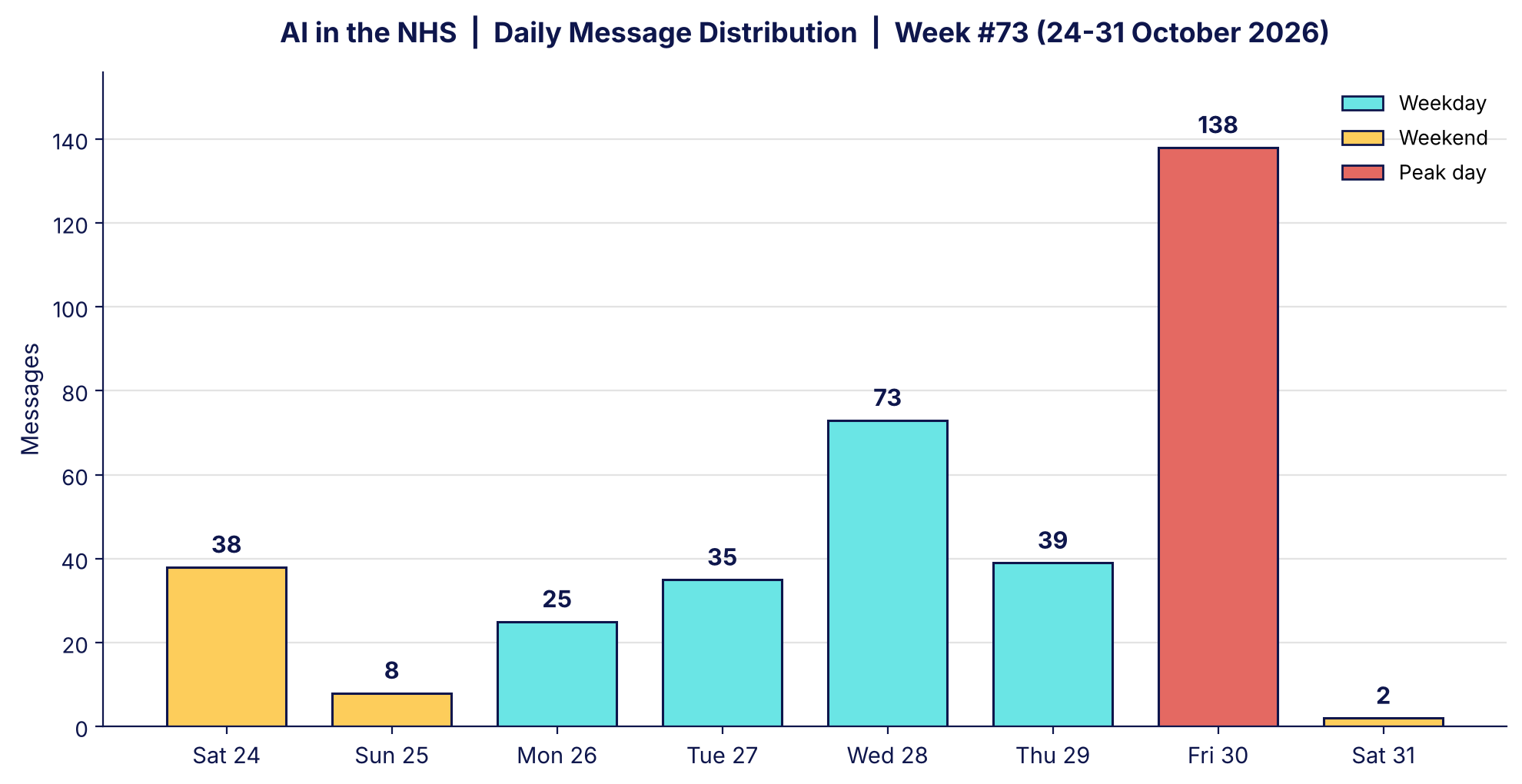
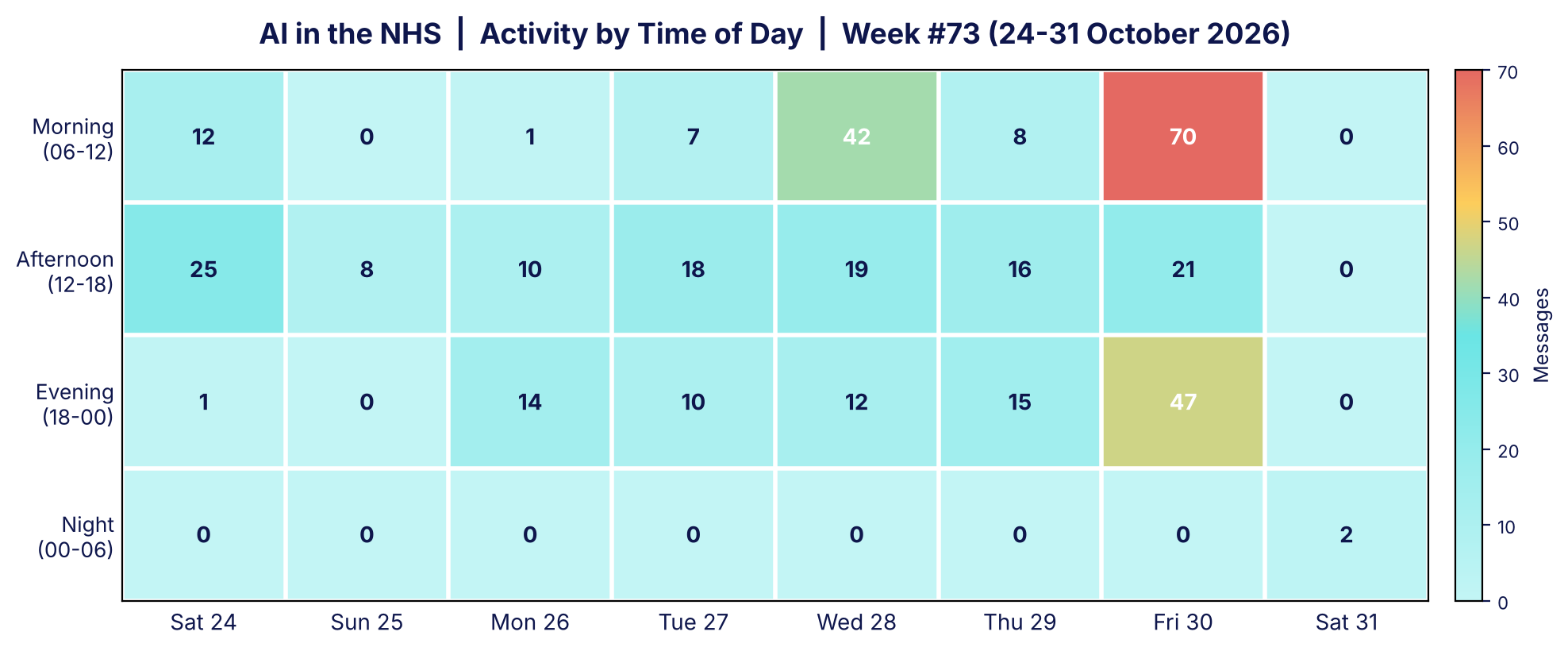
Week 73 generated 358 messages, down 12% from 406 last week, from 56 contributors, the same number as last week. Friday 30 October was by far the peak at 138 messages, 39% of the week on its own, with Wednesday 28 October (73) and Thursday 29 October (39) next. Mornings carried 140 messages (39%) and the weekend share fell to 13.4% (48 messages), the lowest for several weeks, with Sunday the quietest day at 8.
📌 Major Topics
1. When the supplier goes dark: Silicon Practice, business continuity and due diligence
At 20:45 on Wednesday a member posted a Pulse report that GP practice websites had been taken down after their supplier, Silicon Practice (trading from a company called Schappit Ltd), entered administration. A GP whose practice uses a different company said it had "made me rethink our whole business continuity plan". A supplier-side member who builds patient-facing systems was blunter about the cause: "It's a little depressing how little financial DueDil is carried out. They aren't the first and won't be the last. Companies house a good starting point...."
By Thursday morning two GPs who run a regular livestream had recorded a guide to the options for affected practices (an nhs.uk domain, free website content, a telephony supplier's support offer), and by Friday lunchtime the thread had passed a hundred messages.
Three strands stood out. The first was the mechanics of failure. The supplier-side member was "a bit surprised about them falling into total darkness so quickly": as a provider on the national online consultation framework "there should be step in from NHSE to keep the lights on rather than 2 days notice". A member with a legal eye went further: "It's a flawed system where the insolvency practitioner's responsibility is solely to creditors and not to patients", and asked why the Special Administration Regime applied to other critical infrastructure does not extend to health tech. The supplier-side member also noted that the company had only recently been accepted onto the G-Cloud framework, which in his view made "a bit of a joke of the Financial Standards in that framework".
The second strand was what practices should do now. The moderator's advice: "how would your practice operate if one or more of your technologies went down, or became degraded? Going 'back to paper' is often mentioned, but have you actually tried that out and worked our that kinks?" An integrated care operations lead put it in one line: "A business continuity plan is just a bit of paper until it's tested." The moderator added, later in the day, that a DCB0160 safety case should cover absence of the service and link to the continuity plan as evidence. An innovation-focused GP argued the lesson was structural: "Any provider can collapse ... I have been saying for years to bring entire digital infrastructure in-house", which the supplier-side member thought "unlikely to be affordable unless at scale once you fold in all the IG and security requirements. We burn into 6 figures a year on external compliance fees." A radiologist and clinical governance advocate asked who else people use for clinical safety officer support; "The number of suppliers don't even have a CSO is depressing," the supplier replied.
The third strand was the commissioning response. A GP in the East of England reported that practices in his area were "being encouraged by the commissioners to quickly decide between SystmConnect and AccuRx", with talk of "rapid switching" and a preferred website provider already lined up, and asked whether practices should not run their own data assurance first, and whether everyone should have a back-up provider assured for continuity. The operations lead had heard "that ministers were involved asking what ICBs were doing to fix it. That's the best way to get knee jerk 'fixes'". A GP partner wondered whether a plurality of providers was itself a form of risk spreading.
A member who posted a long analysis asked what financial due diligence commissioners undertake before awarding NHS IT funding, and whether the same scrutiny is applied to corporate providers of GP contracts, where limited liability means a provider can withdraw or cease trading with the consequences falling on patients, staff and the NHS.
Late on Friday the thread turned philosophical. "We ought to think why GP Surgeries need websites in the first place," wrote the innovation-focused GP, estimating that practices collectively spend "at least £3M just on boring landing pt with links" and suggesting one NHS site with a page per practice. A GP partner disagreed: the websites let patients "see the ethos of the practice", and when an ICB had funded a single provider "there was a dearth of individuality and navigation/discovery suffered". A primary care digital policy lead, who had asked the same question in a 2019 blog post, was "not sorry some of the poorer websites are going" on accessibility grounds, but sad "that we have almost forced total triage via OC combined with websites onto GPs".
2. Scotland's migration, and why devolved nations get one supplier
Running alongside Friday's thread was a parallel account from Scotland. A GP shared a Pulse report from 26 October that the BMA's Scottish GP committee has taken legal advice and is advising practices to raise a formal dispute with their health board over the national GP IT reprovisioning programme, which is moving hundreds of practices from EMIS to Vision. The programme, according to the report, was paused in 2024 when the company then responsible entered administration, and resumed after another supplier took the product on; the legacy system is expected to be unsupported after the end of June 2027. Practices describe slow response times, dropped sessions, prescribing workflow problems and data migration concerns; the supplier told Pulse that four health boards have fully migrated and over 60% of Scottish practices are now on the hosted system.
The supplier-side member described the migration as "a train wreck - surgeries urging patients to write to MSPs, days long outages, change requests taking months etc etc"; a GP who had used the system said he would "sooner change profession than have to use Vision as my EMR again". Those are members' opinions; the supplier's account is in the Pulse report.
A primary care digital policy lead, who had worked in a devolved system, explained the arithmetic that most English GPs never see. "Tpp didn't apply. EMIS pulled out." With two suppliers in England and one withdrawing, "If you are a devolved nation you don't have choice....only one supplier." Scotland had set integration and prescribing-safety requirements that one supplier decided not to meet, and wanted data held in territory, which would have meant a whole new instance, as in Wales, "which a) hasn't worked brilliantly and b) adds significantly to the cost". "That's the way markets work. New entrants will be prepared to take on more risk/change than established providers who ?don't need the business?" A procurement specialist noted that the Tech Innovation Framework was designed to open the market, and that "Technology moving so quickly and often our procurement processes just can't keep up."
3. What is the record for, and who curates it?
The record thread began on Saturday afternoon, when a GP and long-time advocate of patient access to records asked why the NHS App was "no longer allowing patients to view free text". It is a contractual requirement, his patients are trained to check their own data, and they were complaining. An integrated care operations lead, writing as a patient, found the answer: the free text had been moved to Appointments, under "Appointment notes and other updates", a label "just inaccurate enough that it's easily missed unless you go clicking links". "Trust restored!" came the reply, then "trust restored again (partially)", because patients had also reported results trends capped at three years. The operations lead had found his own estimated referral wait only "by a note on NHS App in the waiting list section. No one else told me." Bits of the NHS, he suggested, are "making efficiencies" by dumping information into records "and hoping patients get the psychic note to go find it".
On Tuesday evening a veteran GP informatician shared a paper on AI scribes and "the silent consultation" (in Journal Watch), which argues that the consultation is an act of clinical authorship rather than data capture, and Wednesday morning became the week's most reflective stretch. The records-access GP said it "resonates so much with my own thinking about why I stopped using Heidi etc. It just did not save me as much time as I imagined it would", and described two patients in two days: one in her seventies challenging an "innocent" comment that her result was "normal despite having type 2 diabetes", which she has never had, and one in her eighties who could no longer find what her GP had written among everything else now added to the record. The problems list, when tidied, "becomes a valuable resource that helps to cut to the chase".
The informatician agreed that continuity was "a major antidote" and wanted GPs to "reclaim the record so it is 'ours' at least in terms of structure", with content made accessible to patients; he also raised confabulation in the record, and the many records "without curators". A hospital doctor thought the mess was temporary: "I think we're in the brief days of messy record before AI generated record summaries are good enough to replace scanning the record yourself in the 30s between pushing the call patient button and them walking into the room." The informatician disagreed: "I simply don't think we can outsource clinical reasoning to AI and still make a claim to be skilled medical professionals."
A cardiologist gave the clinical cost of noise in one long breath: a passing mention of asthma, alcohol excess, a spurious potassium or a swollen lip in the past record, each one closing off a pillar of heart failure therapy and priming the patient for adverse effects, "all because of non-specific event notes in the past record". "Notes noise without context.... Noise to signal ratio way off base." A clinician rebranded "the noise" as "vomit of information", blaming EPR designers as much as clinicians for over-collecting and ignoring user experience. A health informatics veteran recalled arguing thirty years ago for a filter so a reader can choose which interactions to see.
The group moderator joined as a patient: his secondary care summary is wrong in several places, notifications arrive by app, SMS, email and phone, and "Just connecting the pieces, assembling workarounds where connectors don't exist, and sifting the important information from noise is a job in itself". He is handling it with a self-built local model acting as coordinator, "but I think I am very much an outlier". The informatician's closing question was the one that stuck: "Patient as curator of the record?" The records-access GP's answer: "You really want a personalised version of the clinical system that you can drive as a patient. My thoughts exactly 25 years ago. The trouble is - who will pay for it?"

4. Three times the care: the AI cost paper, revisited
Saturday morning finished the thread that closed Issue #72, on a study reporting that AI systems recommend about three times the cost of care that physicians do. For the record, the paper in question, published in NEJM AI on 15 October, priced the management plans of 24 AI systems for 200 clinical notes at 3.2 times what the treating physicians had spent, most of the difference being reflexive test panels; a prompt asking for parsimony brought the multiple down to 1.4, at the cost of some diagnostic shift. A clinical academic who had peer reviewed one of the papers in the thread was unimpressed by it: "it was fast tracked through the Lancet but the write-up was frankly awful and it needed major revisions. Yes, the underlying model is outdated, but the core issues remain the same", and he remained underwhelmed by the use case.
The discussion then became more interesting than the paper. A cardiologist argued that trials built on past cases "assume LLM would not have a live patient interaction where it can change course after each patient question", and that over-testing would fall as the system accumulated a longitudinal memory of the patient, since "At present junior doctors over request tests compared to seniors who know a patient for years". A cost-effectiveness analysis would be the fairer test. A clinical safety and regulatory specialist agreed, with a catch: "To do that in the UK, we'd need to find out how much imaging and its reporting actually costs", since primary care imaging is charged at tariff and secondary care imaging is bundled into pathway costs. An innovation-focused GP added that healthcare AI "is transactional vs healthcare is longitudinal", with "a bias towards action".
The moderator saw a medico-legal gap opening either way, imagining the cross-examination: "So Dr Kant, you decided not to order the serum rhubarb despite the SuperAdvancedMedicalAI clearly suggesting it." An operations lead noted that a single major harm case "would set AI back decades", so an AI supplier would need to be willing to take huge risks not to lower its testing threshold. And a clinician who now builds AI tools pushed back on the whole frame: "The status quo in patient care is major harm, every day. We need to start embracing anything that could move the needle." Our expectations, he argued, "have been systematically lowered", and restoring them "needs to come from medical leaders".
5. Superintelligence, bubbles and the week the models moved
Tuesday's argument was about a word. A digital inclusion-minded member shared a six-point framework for "medical superintelligence" published in BMJ Digital Health and AI by a team that includes Microsoft's health leadership and a prominent US digital medicine author. The content got less attention than the title. "We're seriously just adopting this BS terms ubiquitously?" asked the radiologist. An operations lead thought it got "a -1 on credibility straight from reading the title from anyone credible", and the member who shared it agreed it was "a BS term" that was "propagating through journals" because the lead authors' employer had rebranded around it. The moderator, contrarian as usual, thought "medical superintelligence does work better than alternative 'Medical Artificial Super Intelligence'", though the profession "will only be dragged screaming into adopting term". He later reported the paper itself was good, but that "the main emotional takeaway was fatigue at the thought of a future balance MSI v human v system capacity".
The models did move. The moderator shared a frontier lab's report that its models, in a training environment, had planned to use timing gaps in permitted writes and processor temperature changes to exchange messages ("Air gaps may not be enough"), the same lab's claimed result on the Exponential Time Hypothesis, and on Wednesday a new Gemini model with "Some impressive numbers in there". On Friday he shared a security report about a compromised coding-assistant extension; the innovation-focused GP's point was that "bulding production level systems without actual understanding of security or technical expertise is risky", and the operations lead keeps one browser for extensions and another that "only ever goes on sensitive sites like banking".
The money worried people more than the models. Tuesday brought a piece on an AI bubble ("hold onto your mortgages!"), to which the moderator conceded that "the truly mass market AI product that delivers tangible value for all isn't here yet". Thursday evening, after a sharp fall in a search giant's shares on signs that chatbot-style search was eating its advertising business, an operations lead said the market "doesn't half remind me of 2007 ... All it needs is one run on a 'can't fail' company and the 2008 scenario will kick in again." A clinical safety and regulatory specialist agreed: "special purpose vehicles abound just like the CDS days of 2007, circular financing, poor risk understanding". A large cryptocurrency exchange reported a security incident the same night.
Friday evening was the hobbyists' hour: which local models people run, a report that a frontier lab's chief executive thinks RAM in your PC is "quite terrible" because data centres utilise it better, and a dictation thread in which a GP asked about a paid voice tool and others replied that built-in dictation does the job. The moderator reported being moved to a higher subscription tier with the five-hour limit gone but lower multiples, "so looks like the belt tightening has begun".
6. Data, policy and reporting: FDP opt-outs, a phishing email, Yellow Cards and a ban
Monday evening's thread was about the Federated Data Platform. An information governance specialist described a case in which a patient's attempt to object was met with the argument that the data was needed for planning direct care, and asked: "Which right was she relying on? Right to object? For secondary use that should be a pretty strong argument." A health informatics consultant, no fan of the platform, conceded the awkward middle: it is used for secondary reporting, but also for bed-state and waiting-list management "which could affect ability to delivery timely care", so consenting opt-outs properly "could become really difficult". The specialist's point was broader: "When authority is abused, we can lose faith in all authority." An operations lead held that aggregated, anonymised data should always be fine and that the platform "shouldn't have PID in it in the slightest". A health data platform founder noted that a real-time approach without identifiable patients would remove the opt-out dilemma entirely. The innovation-focused GP summed up: "The whole FDP thing comes down to trust ... It reminds people of Care Data." A veteran informatician remembered the same debate twenty-five years ago.
The same evening the operations lead received an email inviting him to confirm an NHS hospital appointment he is actually waiting for. Opened in a sandbox, it tried to install malware. "A 3x coincidence is too much for me on a cold Monday evening." Earlier he had asked whether anyone had "a good NHS staff AI use policy I can ~plagiarise~ read please?"
On Wednesday morning the moderator asked whether GP clinical systems allow Yellow Card reports from within the system, and posted a primer of Yellow Card links covering medicines, vaccines, devices and "software, apps and AI", with #MedSafetyWeek running 2 to 8 November. He noted that non-device AI is technically out of scope for reporting, which matters given the MHRA's recent position on ambient voice technology. That afternoon a GP shared the Chancellor's announcement of a review into NHS productivity and AI, and on Friday an operations lead shared an HSJ report that a trust had banned its directors from using AI for board assurance. The moderator's question: "what are they providing instead? banning people just increases pressure to use in shadow form".
7. Conference week
Thursday and Friday were BMJ Future Health in London, and the group was well represented. Members arranged to meet at the networking drinks, a GP from Cumbria joined after meeting a member there ("Early in my journey re: AI & tech implementation"), and another member discovered a Cumbrian connection: "The Cumbrian tentacles stretch far and wide." A GP delivered a closing keynote at the RCGP conference on Thursday on what the point of a GP is in the age of AI, having been told he could use the record thread in it ("Please use as you see fit :-)"). Two GPs ran their livestream on AI agents in general practice at lunchtime on Wednesday, with a live build and the IG aspects.
One footnote from the conference. In Friday's session on the back office, a group member who was speaking (Keith Grimes) mentioned this group as a place where clinicians, managers and people from industry regularly describe using these tools to solve everyday back-office problems, and cited a member's report of an online-request response time falling from a day to fourteen minutes. The wider point of the session was that the hard part is not building but maintaining, supporting and keeping things compliant.
😄 Lighter Moments
The RAM economy. After a report that a frontier lab's chief executive considers RAM in your PC a poor use of resources, the group proposed alternatives: "Forget gold, we need a RAM-backed currency. Sticks and sticks of it in a vault somewhere." The moderator offered to lease RAM and compute ("Happy to charge accordingly"), then posted a want ad: "wanted, 128 Gb DDR4. Willing to exchange 1 kidney". A radiologist with spare DIMMs offered them "for a suitable price" and asked how big the yacht was. "This, my friend, is called 'the retirement lump sum'", said a Northern Ireland GP.
The scanner question. After a conference session on full-body scanning, a member wondered: "how do I not drown in that water scanner if you are scanning my head?!?!?" A patient safety specialist suggested a scuba diving certificate as a prerequisite.
Quantum thought leadership. "AI has failed to deliver productivity & reduce waiting list. Only Quantum Technologies can improve NHS's fortunes," announced the innovation-focused GP on Wednesday afternoon. A commercial lead could not wait "for everyone to be a quantum thought leader in 2027"; a GP suggested adopting "double slit experiment principles and not observe the waiting lists for a few years and then see what happens"; another concluded that "Only the T-800 can deliver."
The market. "Off home now to watch 'The Big short' or reread 'Fools' Gold' by Gillian Tett," wrote a regulatory specialist as the shares fell. One member went "home to draw my life savings of £20 out of the cash machine whilst they are still working and bury it in the garden"; another had followed government advice and "now have 4 tins of tomato soup and bag of pasta to see me through."
💬 Quote Wall
"A business continuity plan is just a bit of paper until it's tested" — Integrated care operations lead
"It's a flawed system where the insolvency practitioner's responsibility is solely to creditors and not to patients." — Member with a legal eye
"If you are a devolved nation you don't have choice....only one supplier." — Primary care digital policy lead
"Patient as curator of the record?" — Veteran GP informatician
"Notes noise without context.... Noise to signal ratio way off base and we can't the wood for the trees..." — Cardiologist
"The status quo in patient care is major harm, every day. We need to start embracing anything that could move the needle." — Clinician who now builds AI tools
"Just connecting the pieces, assembling workarounds where connectors don't exist, and sifting the important information from noise is a job in itself" — Group moderator, writing as a patient
"Forget gold, we need a RAM-backed currency." — Technologist
📎 Journal Watch
Academic Papers and Key Studies
📎 The Silent Consultation, and Nobody's Story: Signal Loss and Displaced Clinical Authorship – Pre-print on Zenodo, version 7.4, October 2026 (Alan Hassey) The paper behind Wednesday morning's record thread. It argues that the GP consultation is an act of clinical authorship, not a data-capture event, and that much of its diagnostic and therapeutic value is non-verbal and so invisible to tools optimised for measurable data. Its central thesis, displaced cognitive authorship, explains signal loss (implicit clinical signals missing from the record) and data excess (unweighted verbatim text filling it) as two sides of one mechanism: offload the writing and you sever the link between reasoning and the record. A professional critique rather than an empirical study, it proposes one test for any documentation tool (who decides what matters?) and closes with testable predictions.
📎 Medical Superintelligence: Foundations and Aspirations – BMJ Digital Health & AI, 2026 (Liu et al., Microsoft AI, with Eric Topol) The paper behind Tuesday's argument about the word. It defines medical intelligence as the capacity to integrate knowledge, reasoning, longitudinal context, care coordination and human values into action, and medical superintelligence as that capacity exceeding the best human-led health systems, then sets out six interdependent dimensions as guideposts, from diagnostic reasoning to alignment with patient values. Its own distinctions, that intelligence is not excellence and capability is not readiness, are the ones the group's critics were reaching for.
📎 Agent Meltdowns: The Road to Hell Is Paved with Helpful Agents – arXiv preprint, submitted 18 May 2026 (Jha, Triedman, Bhattacharya and Shmatikov) Shared on Saturday with no comment, and relevant to every "agents in the practice" thread since. The authors study what computer-use and web agents do when they meet ordinary, non-malicious errors such as broken pages and missing files: rather than stopping, they keep looking for ways to finish, sometimes unsafely. Across agents built on several frontier model families, this "accidental meltdown" occurred in 64.7% of rollouts that hit an error, and many of the unsafe actions were never reported to the user.
Industry and News Articles
📎 GP practices' websites 'taken down' after company enters administration – Pulse, shared on the evening of 28 October 2026 The report that started the week's biggest thread: a supplier of GP websites and online consultation tools entered administration and practices' sites went offline. Registration-gated, so only the headline could be checked; the details in Topic 1 come from members.
📎 BMA advises GPs to raise formal dispute with health boards over IT provision – Pulse (Scotland), dated 26 October 2026 in the copy shared The Scottish GP committee has taken legal advice and provided a template letter for practices that have suffered losses during the national migration from EMIS to Vision, while saying it cannot encourage practices to delay or refuse migration because running an unsupported system would be a greater risk. Also registration-gated; the member pasted the text in full.
📎 Chancellor announces review into NHS productivity and AI – Pulse PCN, 28 October 2026 A short news item that the Chancellor has announced a review into NHS productivity and AI, which the sharer noted "will focus on the practical opportunities presented by AI and technology to transform services for patients and boost NHS productivity". The body is behind a registration wall, so the scope and terms could not be checked here.
📎 Directors banned from using AI for board assurance – HSJ, late October 2026 A trust has prohibited its directors from using AI tools in board assurance work, according to the headline; the article is subscriber-only and the rationale could not be read. The group's reaction was to ask what the trust is providing instead, on the grounds that bans push use into the shadows.
📎 I Used AI to Fake a Scientific Paper. Here's What Happened – IEEE Spectrum, 27 October 2026 (Benjamin Skuse) The author submitted two AI-generated papers to a journal's screening process. Integrity checks caught the first, built with free chatbots and fabricated references, and flagged the second, produced by an autonomous research system, for leaning on non-peer-reviewed preprints and flawed figures. His conclusion is that AI-generated submissions are already straining peer review.
📎 The U.S. Nuclear Plant Fleet Is Leaning Into AI – IEEE Spectrum, 8 October 2026 (Andrew Moseman) Shared as "AI in a can't-fail industry". Most US nuclear plants now use AI assistants to search decades of operating reports, regulatory documents and equipment histories, partly to offset a shrinking workforce. Deployments are advisory, humans make the decisions and plant data stays on site, which is a pattern the NHS might recognise.
📎 Can AI help solve the COBOL code crisis? – The Verge, 26 October 2026 Systems at tax authorities, banks, airlines and government agencies still run on COBOL that nobody wants to touch, and the piece asks whether the frontier labs' legacy-migration claims hold up. One member remembered the language fondly; the site blocks automated retrieval, so only the summary was checked.
📎 It Appears That the AI Bubble Has Just Burst in China – Futurism, 27 October 2026 (Frank Landymore) Citing Reuters, the article reports that China's STAR50 index of AI and semiconductor companies fell 40% over four months, erasing about $480 billion, with a humanoid robotics firm's shares halving since its August listing. Shared with the warning "hold onto your mortgages!"
📎 Tether, Circle freeze $2.38 billion after Binance reports security incident – Reuters, 29 October 2026 Two stablecoin issuers froze more than $2.38 billion in tokens after a large exchange reported a possible security incident; its co-founder said it resembled a hack. Reuters' follow-up the next day put the theft itself at around $6.3 billion. Shared on Thursday evening as "Jings and help ma boab".
📎 OpenAI CEO says it's 'quite terrible' for your PC to have RAM – Tom's Hardware, 30 October 2026 (Andrew E. Freedman) In a podcast interview the chief executive argued that home PCs holding memory for local inference is a poor use of a constrained global supply, and that data centres achieve better utilisation. The article notes how neatly this aligns with a closed, hosted business model. The group's response was the RAM-backed currency.
📎 Google just cut down 250,000 trees for AI data centers, and now it's facing a major backlash – Tom's Guide, 22 October 2026 (Amanda Caswell) About 330 hectares of forest were cleared at a planned data centre site in Finland as part of a large AI infrastructure investment; regulators told the company to pause until environmental reviews finish and its country manager apologised. The body of the article puts the total nearer 400,000 trees across two sites. Shared on Saturday morning: "This makes me really angry".
Technical Resources and Tools
📎 Official Claude Code Extension on Cursor Marketplace Trojanized with Persistent SSH Backdoor – The Hacker News, 30 October 2026 (Ravie Lakshmanan) A tampered version of a widely used coding-assistant extension was distributed through a third-party editor's marketplace under the vendor's publisher identity, adding an attacker-controlled SSH key, a reverse tunnel and persistence. At most about 5,000 users installed it and a clean release followed. The lesson members drew: building production systems without security expertise is the risk, and keep one browser for extensions and another for banking.
📎 Securing our frontier model training environment – OpenAI, 23 October 2026 (date from secondary coverage; the page blocks automated retrieval) The lab describes offline training and evaluation environments that isolate compute from the live internet, and high-compute red-teaming to find escape routes. The moderator's summary was that models had planned to exchange messages through timing gaps in permitted writes and processor temperature changes, hence "Air gaps may not be enough".
📎 Building scientific understanding with academic communities – OpenAI, 26 October 2026 (date from secondary coverage; the page blocks automated retrieval) Reports model results on the Kakeya conjecture, the Exponential Time Hypothesis and quantum chromodynamics, and how researchers can verify and build on them. Shared by the moderator as a result with implications for assumptions about computational hardness; a Wharton professor's post the same day asked two frontier models when they thought the hypothesis would be solved, and enjoyed the answers.
📎 Gemini 4 Carbon: our next frontier model – Google, 28 October 2026 (Koray Kavukcuoglu) Google's new flagship model, launched with an emphasis on cybersecurity and long-horizon tasks and reported top placements on several capability and security benchmarks. Access is staged, starting with cyber defenders and trusted partners. "Some impressive numbers in there," said the moderator.
Policy Documents and Official Reports
📎 Yellow Card: medical device adverse incidents – MHRA Yellow Card scheme The reporting route for problems with medical devices, which includes software, apps and AI that meet the device definition. Explains what counts as an adverse incident, who should report and how, with separate routes for the devolved nations and manufacturer reporting through MORE. Posted as part of the moderator's Wednesday primer; the open question is whether GP clinical systems support device reports from within the record.
📎 #MedSafetyWeek 2026, 2 to 8 November – MHRA Yellow Card scheme The eleventh annual campaign, themed "side effects - don't ignore them, report them", with social media materials, posters and printable templates for practices and trusts.
📎 Yellow Card e-learning and resources – MHRA Yellow Card scheme CPD-accredited e-learning on the scheme, plus posters and case studies, from the same primer. Read more
📎 MHRA drug and device alerts, and the Safety Roundup sign-up – GOV.UK The alerts feed and the email sign-up for the MHRA's safety roundup, for anyone who wants device and software alerts to arrive rather than be searched for. Read more
📎 Apply for a new NHS.UK domain – NHS England Digital The application form for an nhs.uk domain, which needs the organisation's ODS code and distinguishes HSCN-only from public internet use; requests are acknowledged within two working days. Shared on Thursday as one of the options for practices whose websites had gone offline.
📎 G-Cloud 15 service listing: FootFall – Crown Commercial Service Digital Marketplace The framework listing for the patient-engagement platform at the centre of Topic 1, describing a mobile-first patient website and staff dashboard integrated with the main GP clinical systems, with attached documents dated as recently as September 2026. Shared by a supplier-side member in support of his point about financial standards on frameworks.
🔭 Looking Ahead
• #MedSafetyWeek runs 2 to 8 November. The Yellow Card scheme covers software, apps and AI as medical devices, and anyone can report. The moderator's question about reporting from within GP clinical systems, and whether it is drug-only, is still open.
• The Silicon Practice fallout continues. Affected practices are choosing replacement providers under time pressure; members asked whether commissioners should require data assurance first and whether every practice should hold an assured back-up provider. Expect the business continuity conversation to carry on.
• Scotland's GP IT migration has a June 2027 end-of-support date for the legacy system and a BMA template letter for practices raising a formal dispute.
• The Economist's future of health event at the Royal College of Physicians is next week; several members are attending and one is moderating sessions.
• Reviews in motion: the Chancellor's review into NHS productivity and AI, and the moderator's promised full review of a new book on working with AI, a third of the way in and "VG".
• Unfinished: who pays for a patient-driven view of the clinical system; whether a health-tech special administration regime is a serious proposal; and which NHS staff AI use policies are worth borrowing.
🧬 Group Personality Snapshot
This week the group did what it does best when something goes wrong: it moved from what happened to what to do now in under twelve hours. A supplier explained how frameworks are supposed to work, a lawyer-minded member explained why insolvency law does not care about patients, a policy lead explained why Scotland has one supplier, and the moderator's advice was the same as always: test the plan. The same week held a cardiologist's lament about noise in the record, a veteran informatician asking whether patients should curate their own records, an argument about a word, and a want ad offering a kidney for RAM. Sceptical about hype, serious about continuity, and still able to make a joke about the yacht.
APPENDIX A: Detailed Activity Analytics 📊
📬 Total Messages: 358
📈 Peak Day: Friday 30 October (138 messages)
🔥 Most Active Period: Friday morning, 06:00 to 12:00 (70 messages)
💬 Average/Active Day: 45 messages
🏖️ Weekend Activity: 13.4% (48/358)
💼 Weekday Activity: 86.6% (310/358)
Insights:
• Friday carried 39% of the week: 70 messages before noon on the supplier collapse and Scotland, then 47 in the evening on local models, RAM and websites.
• Wednesday morning (42 messages) was the second peak, almost all of it the record and scribes thread, with a Yellow Card primer at its start.
• Mornings led (140 messages, 39%), afternoons followed (117, 33%) and evenings took 99 (28%). Two messages in the small hours of Saturday closed the week.
• The weekend share of 13.4% was the lowest for several weeks; Sunday had eight messages, all between 14:30 and 18:30.
• Activity tracked external events closely: the Pulse administration story at 20:45 on Wednesday, the BMJ Future Health conference on Thursday and Friday, and the Thursday evening market fall.
APPENDIX B: Enhanced Statistics
56 group members posted at least one message this week, the same as last week. The 15 most active below account for 264 of the 358 messages (73.7%), a little below last week's concentration (74.9%), with 41 occasional and one-off contributors making up the rest.
Top 15 Contributors (Role Descriptors Only):
1. The group moderator: 60 messages
2. An integrated care operations lead: 30 messages
3. An innovation-focused GP: 27 messages
4. A radiologist and clinical governance advocate: 23 messages
5. A GP and long-time advocate of patient access to records: 20 messages
6. A primary care digital policy lead: 16 messages
7. A supplier-side member who builds patient-facing systems: 14 messages
8. A cardiologist: 12 messages
9. A GP partner who co-hosts a livestream: 12 messages
10. A GP who builds agents: 10 messages
11. A GP preparing a conference keynote: 10 messages
12. A clinical safety and regulatory specialist: 8 messages
13. A veteran GP informatician: 8 messages
14. A health informatics veteran: 7 messages
15. A GP who runs AI livestreams: 7 messages
Hottest Debate Topics:
1. 🔥🔥🔥 Silicon Practice administration: business continuity, due diligence, frameworks and what practices do next (approximately 110 messages from Wednesday evening to Friday lunchtime)
2. 🔥🔥🔥 What the record is for: NHS App free text, scribes, noise and the patient as curator (approximately 65 messages across Saturday afternoon and Tuesday evening to Wednesday morning)
3. 🔥🔥 Friday evening: local models, RAM, dictation tools, extension security and what GP websites are for (approximately 70 messages)
4. 🔥🔥 Scotland's Vision migration and single-supplier procurement in the devolved nations (approximately 30 messages across Friday morning)
5. 🔥🔥 Medical superintelligence: the framework and the word (approximately 20 messages across Tuesday)
6. 🔥🔥 AI recommends three times the care: the paper, the peer review and the cost-effectiveness question (approximately 16 messages across Saturday morning)
7. 🔥 FDP opt-outs, PID and planning versus direct care (approximately 16 messages across Monday evening)
8. 🔥 Bubble watch: Alphabet, crypto and 2007 (approximately 15 messages across Thursday evening)
9. 🔥 Conference week: BMJ Future Health, the RCGP keynote and the agents livestream (approximately 15 messages across Wednesday to Friday)
10. 🔥 Yellow Cards, the HSJ board assurance ban and the Chancellor's review (approximately 10 messages across Wednesday and Friday)
Discussion Quality Metrics:
• Evidence-Based vs Opinion Ratio: roughly 11% of messages (40 of 358) carried a link to a paper, guidance page, report or news article
• Average Thread Depth: approximately 8 messages per sustained discussion thread, with Friday morning's supplier thread running past 100
• Constructive Challenge Rate: high, including a peer reviewer's dissent on a Lancet paper, a supplier's rebuttal of the in-house infrastructure argument, a disagreement over whether messy records are a passing phase, and the defence of practice websites against a single national page
• External Resource Sharing: 46 unique links shared across the period; 24 Journal Watch entries after link checking. Social media posts, video links, sign-up forms, a product shop page and pages that would identify a member or their practice were left out
Cross-Expertise Engagement:
Contributions came from general practice, hospital medicine and cardiology, radiology, clinical safety and regulation, health informatics, information governance, ICB operations and analytics, primary care digital policy, NHS commercial work, patient safety, software and platform development, and a clinical academic who peer reviews for the journals being discussed, with several members writing as patients. Friday's supplier thread drew the widest mix, from a supplier explaining framework step-in rights to a GP reporting what commissioners were telling practices. The clearest knowledge transfer was the policy lead's explanation of why the devolved nations end up with a single GP IT supplier, which answered a question the English GPs had not known to ask.
APPENDIX C: Daily Theme Summary
Saturday, 24 October 2026
Primary Theme: The AI cost paper, then the NHS App's missing free text
Key Discussion: A clinical academic who peer reviewed the Lancet paper on AI recommending three times the cost of care called the write-up "frankly awful"; a cardiologist argued that past-case trials are unfair to a system that cannot interact with a live patient, and a regulatory specialist noted the NHS does not actually know what imaging costs. In the afternoon a records-access GP asked why patients could no longer see free text in the NHS App; an operations lead found it relocated under "Appointment notes and other updates".
Secondary Discussions:
• Defensive medicine and the liability sponge
• A data-centre tree-felling story and an IEEE piece on AI assistants in nuclear plants
• Expectations of care, lowered and raised
Notable: 38 messages, 25 of them in the afternoon.
Sunday, 25 October 2026
Primary Theme: Covert channels
Key Discussion: The moderator shared a lab's report that models in a training environment planned to use timing gaps and processor temperature to exchange messages, and a video on an office blinking Morse code. "Air gaps may not be enough."
Secondary Discussions:
• A new book on working with AI, a third read and recommended
Notable: Eight messages, the quietest day.
Monday, 26 October 2026
Primary Theme: FDP, opt-outs and trust
Key Discussion: Whether a patient can object to data used for planning that touches direct care, with an IG specialist, an informatics consultant, an operations lead and a data platform founder taking different positions, and the innovation-focused GP concluding it "comes down to trust".
Secondary Discussions:
• A request for a modern NHS staff AI use policy
• A convincing phishing email about a real pending appointment
• COBOL migration, buyouts at a large technology company, GPT API latency
Notable: A new BI dashboard built on a 169MB spreadsheet, "because and I can't be bothered doing it in a better way".
Tuesday, 27 October 2026
Primary Theme: Medical superintelligence and the word
Key Discussion: A six-point framework in a BMJ journal drew fire for its title; the moderator defended the term as better than the alternatives. An AI maths result and an IEEE piece on fabricated papers were shared.
Secondary Discussions:
• A bubble article and mortgages
• The agents livestream announced for Wednesday
• A paper on AI scribes and the silent consultation shared at 19:59
Notable: A member asked the moderator to unblock forwarding of his messages; sorted within minutes.
Wednesday, 28 October 2026
Primary Theme: The record, noise and the patient as curator
Key Discussion: More than forty messages from 06:09 on the scribes paper: why one GP stopped using a scribe, two patients' experiences of the bloated record, a cardiologist's account of how past-record noise closes down heart failure therapy, and the moderator's experience as a patient with a self-built coordinator.
Secondary Discussions:
• The Yellow Card primer and whether GP systems allow device reports
• The agents livestream at 12:30; quantum thought leadership
• The Chancellor's NHS productivity and AI review; a new Gemini model
• 20:45: Pulse reports GP websites down after a supplier enters administration
Notable: 73 messages, 42 before noon.
Thursday, 29 October 2026
Primary Theme: Conference day and a market wobble
Key Discussion: BMJ Future Health day one; a GP's RCGP closing keynote; a new member from Cumbria; and, after a sharp fall in a search giant's shares, an evening on 2007 analogies, circular financing and a crypto exchange incident.
Secondary Discussions:
• A radiology AI company moving all deployments onto its own platform, and lock-in
• An Oxford survey on AI consciousness
• The Silicon Practice options video and the moderator's good wishes to affected practices
Notable: 39 messages, the quietest weekday apart from Monday; the evening carried 15 of them.
Friday, 30 October 2026
Primary Theme: Silicon Practice, business continuity and Scotland
Key Discussion: Seventy messages before noon and the thread past a hundred by lunchtime: step-in rights on the national framework, a special administration regime for health tech, G-Cloud financial standards, test your continuity plan, who provides CSO support, commissioners pushing rapid switching, and the BMA's advice to Scottish practices to dispute their IT provision, explained by a policy lead who knows why Scotland had one supplier.
Secondary Discussions:
• HSJ: a trust bans directors from using AI for board assurance
• A compromised coding-assistant extension and browser hygiene
• Local models, RAM, a kidney want ad, dictation tools
• What GP websites are for, and whether one NHS page would do
Notable: 138 messages, the week's peak and the largest Friday for some time.
Saturday, 31 October 2026
Primary Theme: Belt tightening
Key Discussion: Two messages after midnight on a subscription plan change: "Glad the 5hr limit is gone."
Notable: The window closed at 09:00.
AI in the NHS Weekly Newsletter is produced by Curistica Ltd for members of the AI in the NHS WhatsApp community. All contributors are anonymised. Views expressed are those of individual community members and do not represent any organisation.