


Executive Summary
A steadier week of 353 messages, spread more evenly than usual, with no single thread running away with it. It opened on Saturday with the moderator's reading of the government's response to the National Commission: the recommendations that would make manufacturers hand deployers the controls they need are accepted only as guidance. That turned by evening into a practical question about how a GP or a trust actually gets hold of a supplier's safety case, and then into an argument about whether WhatsApp is safer than the SMS and email that practices use with patients every day. Monday asked whether there is any evidence that regulation reduces harm, and why every organisation repeats the same assurance work. Tuesday evening was the week's warmest debate, on whether paid AI courses are worth the money, and ended with a reminder that the group should stay a place where people feel able to speak. Through the middle of the week members compared notes on models that refuse, invent and apologise, and on smart devices that stop working or never should have been connected. Friday, the peak day, brought the news that digital functions will stay with integrated care boards after all, a sharp exchange about staff already lost, and an evening asking why practices should have to use the NHS App at all.
Activity at a Glance
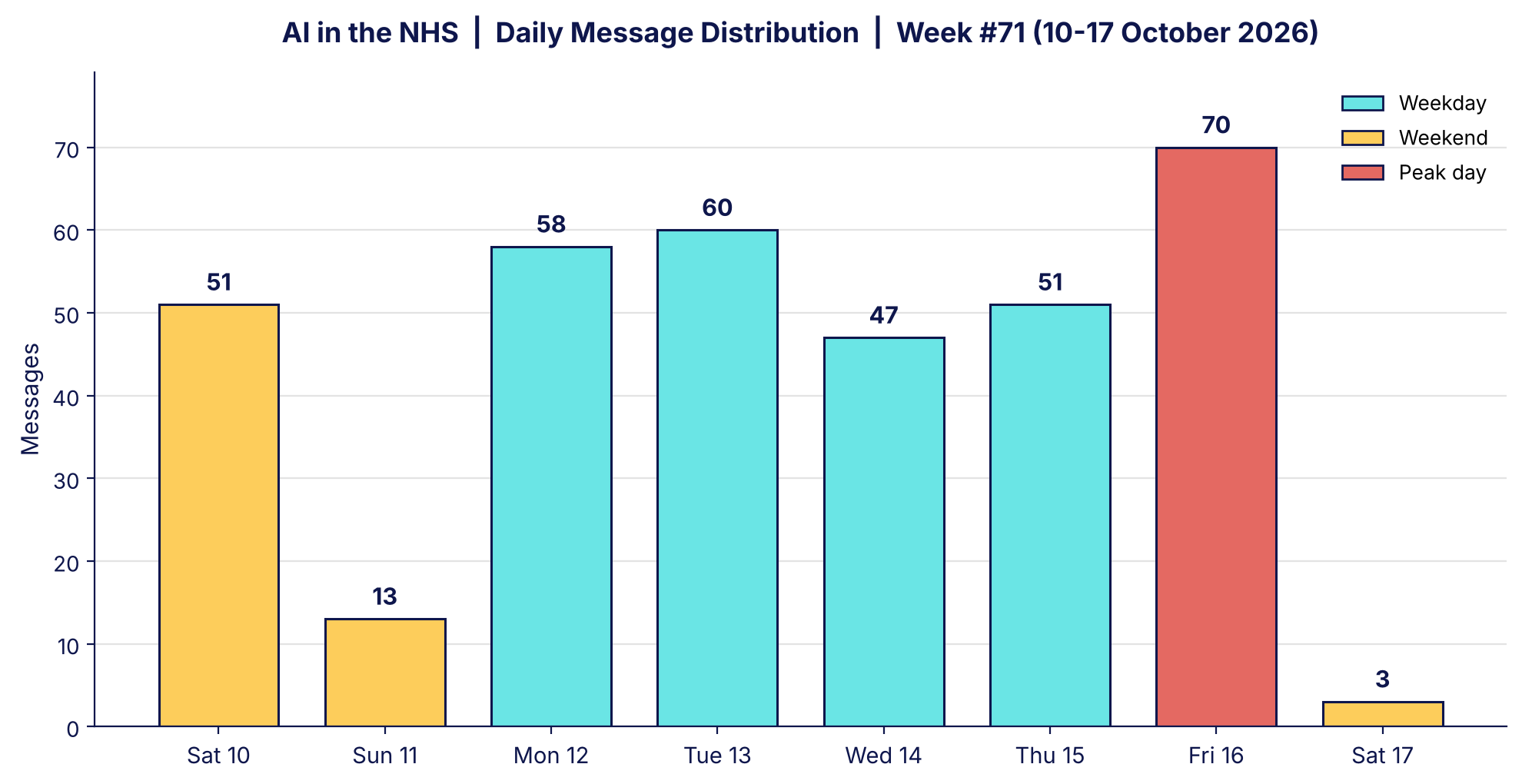
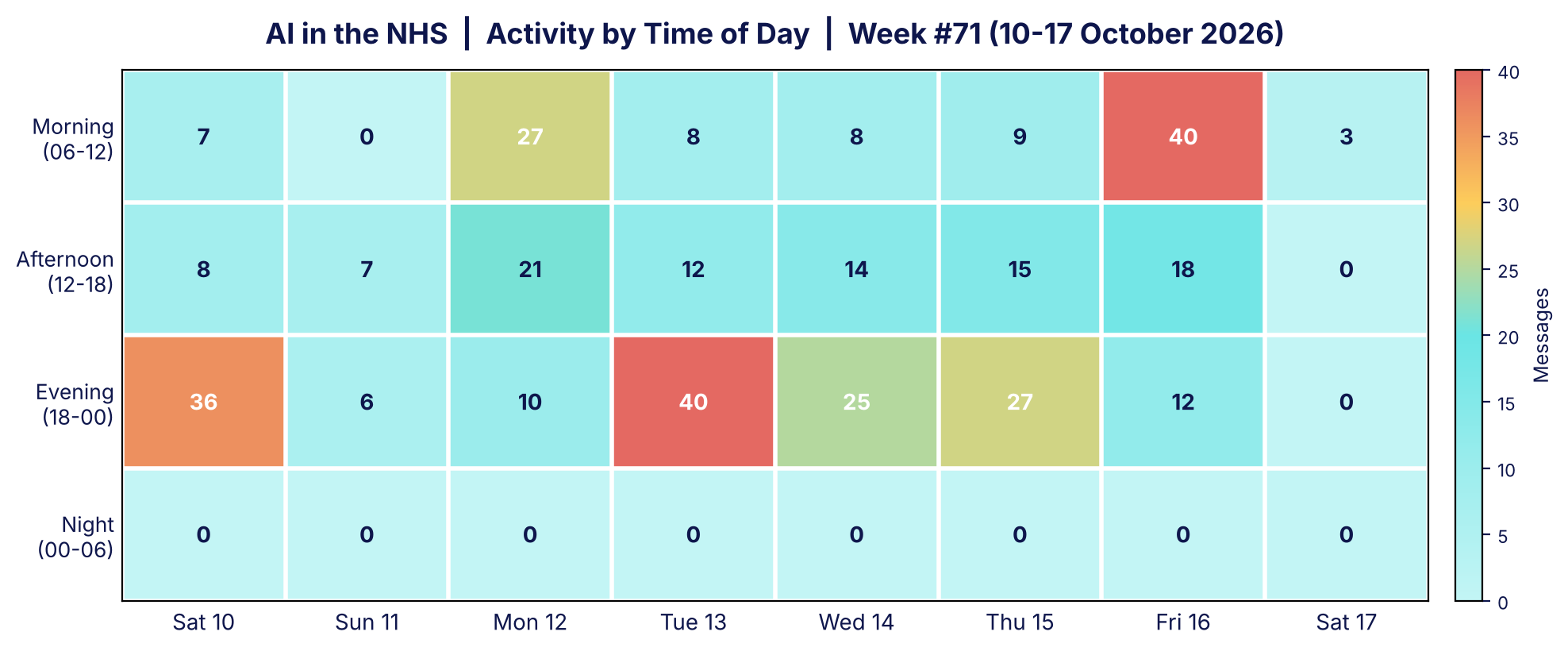
Week 71 generated 353 messages, up from 304 last week, from 57 contributors, down from 62. Friday 16 October was the peak at 70 messages, carried by the ICB functions news and the NHS App debate, with Tuesday 13 October (60) and Monday 12 October (58) next. Evenings carried 44% of the traffic (156 messages), and no messages at all were posted between midnight and 06:00. The weekend share fell to 19.0% (67 messages), with Sunday the quietest day at 13.
📌 Major Topics
1. Who gets to see the safety case?
Saturday morning began with the moderator's reading of the government's response to the National Commission on the regulation of AI in healthcare, which last week's issue reported had been accepted in full. His headline was that "The Commission's one real instrument is weakened." In his summary, recommendations 26 to 28 required that "manufacturers must state the controls a deployer needs, and the contract between them must allocate every one", but the government accepts the first two only as MHRA guidance, with a requirement merely "considered", and the third only as a DHSC review. The consequence, in his words: "Handing over those controls is not yet a regulated event, and general practices with no direct contract with the manufacturer are still not addressed."
A clinical safety and regulatory specialist offered a counterpoint: "One could make the argument that a regulated event already exists (in England) at least in law." Manufacturers are now legally required to follow DCB0129, and that "should involve a transfer of open risk with suggested controls, to be further assessed in the DCB0160 process." But "members of this group have demonstrated the wide gulf between law and current practice", and the point about practices with a mandated system and no direct contact with the manufacturer still stands. For context: section 95 of the Health and Care Act 2022 (in force July 2025) changed the section 250 duty to "must comply", and the Data Use and Access Act 2025 allows IT providers to be brought within it. NHS England's review notes that, as currently published, the standards still require bodies to "have regard to" them, with the stronger powers expected to be used in the revised standards. His priority for the review of the standards was "the most efficient way of getting to a shared understanding of risk and the appropriate controls."
By the evening the abstract question had become a practical one. A trust-based member had spent part of Saturday trying to get a scribe supplier's DCB0129 documentation through its support chatbot, and shared the screenshots. The moderator explained the usual route: "Right now DCB documentation is most usually available via trust portals. Most manufacturers will readily provide when that is used and you have supplied details on who you are." Whether it should be public is contested, because a full safety case and hazard log "can contain quite technical information that may be considered commercially sensitive. At the same time, CSOs do need to see it and interrogate evidence." The innovation-focused GP agreed that companies may not want proprietary detail published, "However they should provide an option for org/individuals to acquire these documents to make the procurement decision."
The trust-based member set the bar most members seemed to accept: "The ease at which a company allows me to use their product with live patients should be mirrored with the ease at which I can see the governance documents." Another GP pointed to the supplier's trust centre, and the trust-based member confirmed that it holds the documents, but "you have to email and include a reason as to why you want it." The primary care digital policy lead described a similar experience with a different supplier: safety documentation could be found, but it did not answer his specific question about email encryption, and a support reply promised within hours had still not arrived more than two weeks later.
A patient safety writer, whose submission to the national review of the standards the moderator recommended, argued in it that shared learning is conspicuously absent from the digital clinical safety framework, and that connecting the standards to national learning and bringing patients inside the process would do more for safety than any amount of additional documentation. The moderator's last word of the evening was about what the deployer's side is for: "EVERY hazard log has training controls stating the need for users to complete training. The 0160 arm is all about making sure that control works".
2. Milk, tongue depressors and the evidence for regulation
Monday morning started with a video clip about regulation and a joke at its expense. One member wondered whether something was lost in translation, since "I assumed milk in the UK was fairly well regulated", and the integrated care operations lead suggested it was "a US message". The moderator's reading was that the speaker meant AI has so little regulation that even simple things have more: "even a tongue depressor is a regulated medical device". The radiologist and clinical governance advocate had used the same example for years, with a sting in the tail: the sector once argued class I "was sufficient" for tools "that promised to make clinical decision making easier and safer", and "obviously now they are all Class II + the sector forgets how vociferously it fought to argue Class I was sufficient".
The integrated care operations lead then asked the harder question: "There must somewhere be a reliable study done of mortality and harm reductions as a result of increased standards of regulation." The GP with a long out-of-hours and informatics background pointed to the "very good evidence for seat belt introduction and reduction in deaths from RTA", and the moderator, for software medical devices, had not seen one "without doing direct digging". A member who builds on WhatsApp for business took the opposite view: "Our balance of risk vs reward is way off IMHO", particularly when privacy concerns delay "potentially life savings products".
The integrated care operations lead located part of the problem with buyers rather than regulators: "how many folk will hit 'accept' on contracts and EULAs without even reading the headline. That encourages suppliers to play hardball with those who do read them". The NHS commercial lead added "a perception issue on the actual regulatory facts", citing a claim doing the rounds at panels this month "that its apparently harder to change an AVT than release a new drug". Nobody could explain it: "Is it just a terrible SDLC or a misremembered sales call? Who knows".
The clinical safety and regulatory specialist made the most concrete proposal: a central NHS body that would "centralise 80% of the assurance and benchmarking instead of repeating it again and again and again". He meant "Measuring accuracy of a product at first release against a defined set of inputs, plus ongoing monitoring", for example voice accents in ambient voice technology or images against ground truth, because "Very few trusts have in-house ability to de-ID data at scale." The integrated care operations lead explained why that is hard. His team keeps identifiable and de-identified data in "an entirely separated process" with "No narrative fields allowed on the non-PID side", because "You contaminate data once you breach that PID/non-PID barrier for any reason".
3. WhatsApp, SMS and the NHS App: which channel to the patient?
Saturday evening's safety-case thread turned into a debate about channels. A member who reads the small print noted that one messaging supplier's own documentation "says not to send messages that are sensitive via SMS or email", and the GP with a long out-of-hours and informatics background set out why: "SMS by default is not secure ( unless RCS - like iMessage or Google message ) and can be intercepted easily and so are most emails without 2FA".
The innovation-focused GP made the provocative case: "Use WhatsApp, it is encrypted end to end", and later, "WhatsApp is more secure & most convenient compared to what we use. To me it makes little sense why it is not allowed when AVTs are allowed to send highly personal contextual data for inference". Others pointed out that "Signal is believed to be better option but much lower use base", and a member who knows messaging protocols explained that both use the same protocol, the difference being that WhatsApp "uses meta data for usage profiling whereas Signal does not". The GP with an informatics background summed up: "All these boil down to the balance between security and convenience." The member who builds on WhatsApp for business added a commercial footnote: a pricing change had moved business accounts "from paying per conversation to paying per message", and "Everyone now moving away from WhatsApp.....just use for a notification...like SMS....then direct to a web based chat".
The channel question came back on Friday evening from a different direction. The innovation-focused GP shared a report that patients have submitted almost 45,000 enquiries through an online triage supplier's integration with the NHS App, and asked: "Do we have to use NHS App? Could we not use another app?" The primary care digital policy lead noted that the supplier describes itself as online triage, much like another supplier named in NHS England's July announcement on AI triage, and that the report does not say patients must use it, "just that they have an integration". The GP pressed the point: "why should everyone be forced to use NHS App?" The radiologist and clinical governance advocate was briefly alarmed at a week of heresies, advising both offenders to "go sacrifice an Admin at the altar and do a rosary of 'cash releasing' to restore balance to the force".
On Saturday morning the member with a workforce development focus set out what any alternative would have to match: "The whole nhs.uk estate should be connected to NHSApp, symptom checker, 111 online, service finders, pharmacy script updates. Any other App would need to do same. Will NHSApp APIs allow that?" The GP's reply, a few minutes before the cut-off, was blunt: "I want alternative to NHS app. It lacks features, personality, & limits my ability as a GP to deliver automation & personalised care".

4. Courses, credentials and learning by doing
Tuesday evening's longest thread began with an NHS clinical AI fellow asking on behalf of colleagues: "Does anyone have any courses they can recommend?", for postgraduate study in AI in healthcare "with more flexibility than the fellowship offers". The answers were mostly sceptical of paid courses. The member writing as a patient had done an online short course at a well-known US university and "wouldn't recommend it. It was pretty superficial and cost a lot", adding that "The most important thing is experience", and suggesting people "offer yourself to a start up or a trust or something on an honorary basis". Another member called much of the market "more or less a retelling of the info already freely available. Bit of a cash grab in a lot of cases", but noted that "Volunteering for projects is good - but the old adage of 'you get out what you put in' applies. Hence why the fellowship and the time it affords is so valuable."
The clinician who writes about AI and the mind was the bluntest: "I've never been on a course that didn't tell me something I already knew from just working in the field. They're almost all a scam." The innovation-focused GP went further still: "Will we even need degree / certificates in 5 years time? If not why do we need it now?" The GP with an informatics background mapped the options: a master's for "hardcore AI programming", "very time consuming and costs a tidy sum"; AI apprenticeships, "nearly as good but costs pennies ( if your trust/ employer agrees)"; and executive courses that give "a Birds Eye view" for board-level work but "not hands-on coding."
Then the thread changed tone. A GP studying for an online MSc in AI had described the course, found the replies running against it, and deleted the message. The member writing as a patient responded at once: "I'm sad you deleted your message. All our experience is valuable", with a "Reminder to everyone that it can be pretty intimidating being here and contributing....". The GP returned to explain the choice. The hope is to use "AI to reduce health inequality", which needs "a solid technical foundation", and because the course is about "wider thinking and problem solving with AI", "in that way it won't go out of date."
The integrated care operations lead backed the academic route from experience. What he learnt about AI "in the early 2000s is still largely as relevant to today as it was then", and "It's an absolute fallacy to think that that academic learning process is irrelevant because of the pace of a few headline apps." He summed it up: "Solid hands on experience is good. A solid academic understanding is good. Mix them both together and you get excellence." The clinician who writes about AI and the mind added one recommendation, free to NHS staff: the NHS clinical risk management training, whose first module is on the national e-learning platform.
5. Models that refuse, models that invent, models that apologise
Several members spent the week testing their assistants and reporting back. On Tuesday morning the integrated care operations lead asked two assistants for a map showing a one-mile radius around his organisation's four hubs. One "refused to draw the 1 mile radius lines because it didn't think it could be accurate enough for what I need", though it plotted the sites correctly on a proper map. The other drew the lines and placed the sites, but then decided to reinvent where his London borough is on the map, "including the shape of the borough", explaining that its map was "a schematic rather than a proper map, because I have no internet access here." His conclusion was that one assistant "is showing restraint now when it used to just try to please you".
That afternoon another member posted a well-known reasoning test, comparing a small model with a large one on whether to drive or walk to a car wash. A member who builds on WhatsApp for business came to the small model's defence: "you didnt tell it you were going to wash the car! Maybe they sell great coffee at the car wash. Poor prompt!" The tester's reply was that the test "has been known about for a while", so "I was just wondering why it hasn't been fixed". The moderator predicted "a rapid system prompt update and some strangely specific new fine-tuning data", which, he noted, "is what is known as a 'dirty fix' in the trade".
In the evening the innovation-focused GP posted the full apology a newly released assistant had given him after he tested its claims of agentic ability on his own site: "When you asked if I could do agentic work, I gave you a long, glossy pitch full of benchmarks instead of being upfront about what I actually can and cannot do inside this chat window." On Wednesday the moderator offered a defence of the vocabulary: "an agent doesn't necessarily have to be able to operate a computer or browser", so a platform that can "orchestrate, access tools and memory, interact with other agents" may still be agentic without driving a browser.
On Friday morning the hospital clinician who builds his own agent systems asked the group a founder's question: "what do you do when you max out usage on your primary engineering account?" A well-travelled member suggested treating it as "a chance to test out chatgpt, other AI models etc", which "also adds the chance to do adversarial stuff". A founder who switches between models described a "Shared git repo - LLM agnostic", with a PROTOCOL.md for "how any AI must behave", a task queue and a relay file for messages between agents, and rules such as "Always work on a separate branch (never directly on main)" and "Never ask the human founder things you can discover yourself using git log or git status." The moderator's advice was to "limit the smart model use to orchestration and planning", use smaller models "for grunt work", and prune the skills and connectors loaded into every chat.
Behind the tinkering sat some sobering news. On Wednesday the wry health-tech watcher shared reports that a companion chatbot company had filed for bankruptcy protection and put itself up for sale, and the innovation-focused GP wondered whether "not enough production level usecase" can justify the "crazy level of investment".
6. Smart things, old things and the upgrade treadmill
Wednesday morning began with a question about an AI that runs from a USB stick, which the moderator answered with a link to a frontier lab's research on self-replicating AI, calling it the "latest spinechiller". The integrated care operations lead agreed "95%" with a columnist that "we could easily slow down and STILL have too many new toys for years to come".
He traced the security weakness back to the "'Internet of Things' sales-slop days where anything that could get an internet connection did so they could increase the price by 50%". His television "is in the huff with me because I refuse to connect it to the internet", and his electric toothbrush "beeps at me because I refuse to connect it to my phone and install an app." His verdict: "There's effectively zero competent security function in the majority of internet facing consumer kit." The practice manager had the opposite problem: a seven-year-old smart heating controller that is no longer supported, so "I have to instead go and laboriously set timings by spinning a wheel around".
The same scepticism met agentic shopping on Wednesday evening. After a newspaper opinion piece on letting AI agents spend on our behalf, which he called "frankly ridiculous", the integrated care operations lead wrote: "My bank account is meant to be boring. It's where my day to day existence is funded. I would rather go back to cash than trust any modern generation AI to buy things for me without my explicit and limited permission." The moderator agreed: "bank account access is a hard no for me just now".
On Thursday evening a member shared a report of a record monthly operating system update fixing 1,416 security flaws, and predicted "cyber essentials plus plus coming soon (and more expensive audits)", adding later that the open questions were "how many were exploited before patching, whether patient data or clinical services were put at risk". A developer summarised the higher certification as "literally just them checking that you didnt lie on the form".
On Friday the news turned to the NHS's own structures. A member shared a report that the government has reversed the planned transfer of some functions out of integrated care boards. The moderator read it as "Digital, Innovation, and GP IT remain with the ICBs with no end date yet specified. And they have lost alot of the skilled folk that did it". The integrated care operations lead felt "deeply sorry for the folk working in NHSE, regions, and the ICB", where "so many good folk have already left, been 'job matched' to jobs that are bare links to their competencies, or have had their morale shattered". A member who has lived through earlier reorganisations was less forgiving: "Classify a load of people as unnecessary and then when you realise you have spectacularly sh*t the bed you hire them back on FTC on much better terms - classic!"
😄 Lighter Moments
Saturday morning began with error messages. After one member mocked a firewall that is "thrilled to announce" it won't let your packets through, the GP with an informatics background recalled the haiku errors of an old operating system and wrote two of his own: "The code was willing / It considered your request, / But the chips were weak".
On Monday afternoon the innovation-focused GP announced, in the house style of a certain social network, that he was "deeply honoured with gratitude from planet Mars" to be selected for its premium programme, with stage directions "<schedule post 7.32am>" and "<boost post 7.33am>".
On Thursday evening an AI-generated picture of a group of members prompted a fashion review. The radiologist and clinical governance advocate noted the image had missed the current uniform of white sneakers, "Ai prompting fail there buddy", while another member complained that it had forgotten a colleague's socks, and the wry health-tech watcher declared it "Me new image generation benchmark".
Friday morning was given over to driverless cars. The innovation-focused GP hoped a video of a car leaping over obstacles would "solve eternal M6 roadworks problem", although "my wife & daughter both don't even want to sit in robotaxi", and the hardware-hunting developer judged it "no mercedes CLR when it comes to airtime".
💬 Quote Wall
"Handing over those controls is not yet a regulated event, and general practices with no direct contract with the manufacturer are still not addressed." — Group moderator
"The ease at which a company allows me to use their product with live patients should be mirrored with the ease at which I can see the governance documents." — Trust-based member
"EVERY hazard log has training controls stating the need for users to complete training. The 0160 arm is all about making sure that control works" — Group moderator
"There must somewhere be a reliable study done of mortality and harm reductions as a result of increased standards of regulation." — Integrated care operations lead
"All these boil down to the balance between security and convenience." — GP with a long out-of-hours and informatics background
"I'm sad you deleted your message. All our experience is valuable." — Member writing as a patient
"Solid hands on experience is good. A solid academic understanding is good. Mix them both together and you get excellence." — Integrated care operations lead
"My bank account is meant to be boring." — Integrated care operations lead
"I want alternative to NHS app." — Innovation-focused GP
📎 Journal Watch
Academic Papers and Key Studies
📎 Electronic health record developer adherence to federal AI risk transparency requirements – npj Digital Medicine, brief communication (14 October 2026) By Manikkoth, Ratwani, Miller et al., Georgetown University and MedStar Health. An evaluation of 35 US electronic health record developers against federal requirements to publish information on risk analysis, mitigation, governance and other attributes of their AI-enabled predictive decision support. Reporting was inconsistent and often incomplete, yet every developer had been certified as meeting the requirements; the authors call for standardised reporting and more rigorous certification review. A useful parallel to Saturday's thread on access to safety documentation. Shared by the wry health-tech watcher on Wednesday morning.
Industry and News Articles
📎 AI models may be capable of self-replicating without access to a datacenter – Anthropic, Frontier Red Team research post (12 October 2026) The company's own evaluations, not peer reviewed. In simplified test environments an open model spread to all eight nodes in four of five trials, and a small model was demonstrated running across 15 inexpensive Android TV boxes. The test used a deliberately trivial exploit, so the authors treat it as an upper bound, and the eight-node result was by the larger model carrying a smaller model as its payload. The authors expect small models to reach that level by the end of 2026, while noting that spread would be slow and that quarantine-style defences have worked against botnets before. Shared by the moderator on Wednesday in reply to a question about AI on a USB stick.
📎 Getting off the AI upgrade treadmill – The Register, opinion column (14 October 2026) A columnist, Mark Pesce, argues that the pace of AI releases has left engineers with "toy debt", that businesses already have more change from current models than they can absorb, and that a deliberate slowdown would be wise, citing a Wall Street Journal poll in which 63% of Americans favour an immediate pause or slowdown. The integrated care operations lead agreed "95%".
📎 Microsoft breaks record, fixing 1,416 security flaws. Update Windows now – PCWorld (14 October 2026) The October update fixed 1,416 vulnerabilities, the first month above 1,000, including 85 rated critical and one already being exploited. The article does not say why the number was so high. Shared on Thursday evening, prompting the prediction of "cyber essentials plus plus".
📎 Meta built a huge open-weight AI model for Macs, but you'll need 1TB of RAM to run it – Engadget (15 October 2026) Reports the release of an open-weight model of around 800 billion parameters (the model collection lists 816 billion, 42 billion active) that needs about a terabyte of memory to run locally, with vendor benchmark claims against other open models. Shared by the GP with an informatics background on Friday morning, with the model collection as the second link. Read more
📎 Why Read a Research Paper When You Can Turn It Into an AI Agent? – IEEE Spectrum (22 September 2026) Describes an open-source framework, published in Nature in September, that turns a research paper and its code into tested AI agent tools; 26 of 100 computational biology papers tried could not be converted, mostly because of incomplete code or documentation. Shared by the integrated care operations lead on Monday afternoon.
📎 Palantir CTO says some AI researchers are taking up smoking because they expect AI to cure cancer – Yahoo News UK, syndicating Business Insider (12 October 2026) Reports a television interview in which a technology company executive made the claim without naming anyone or offering evidence. Shared on Monday evening; the next morning a well-travelled member began "to worry that the people charged with solving humanity aren't actually the geniuses they made themselves out to be".
Technical Resources and Tools
📎 Digital Clinical Safety training – NHS England Digital (page last edited 5 October 2026) The national DCB0129 and DCB0160 training pathway, from essentials and intermediate e-learning (free for NHS staff) to practitioner workshops, a refresher for clinical safety officers and one-to-one clinics. The page says all practitioner courses are currently fully booked. Recommended on Tuesday evening as the free option in the courses debate.
📎 The NHS Clinical Entrepreneur Programme – NHS Clinical Entrepreneur Programme (page updated July 2026) A free 12-month programme from NHS England, open to clinical and non-clinical NHS staff, combining mentoring, workshops and expert clinics. Applications for the next cohort open on 19 October 2026. A member asked on Wednesday whether it is fully government funded, and the hardware-hunting developer recommended it for early-stage start-ups.
📎 Efficient, Structured and Controllable AI Systems – Innovate UK funding competition (opens 12 October, closes 18 November 2026) Up to £1.66m for short industrial research projects (one to three months, starting at technology readiness level 1 to 3) led by UK SMEs, worth £50k to £150k each, to develop novel and reusable AI mechanisms; routine integration of existing tools is out of scope. Shared on Friday afternoon by the patient safety writer.
Policy Documents and Official Reports
📎 Britain steps up national defences against growing AI risks – GOV.UK press release, Cabinet Office (12 October 2026) The government will expand two pilots using frontier AI for cyber defence, which have found more than 1,000 potential vulnerabilities in government systems, and will consider stronger protections under the Cyber Security and Resilience Bill, including how serious AI incidents and near misses are reported. The AI Security Institute is evaluating the latest frontier models with developers. Shared by the moderator on Monday.
📎 Building a Safer, More Secure Britain in the age of AI – GOV.UK, speech by the Minister for AI (12 October 2026) The speech behind the announcement, comparing AI with the Industrial Revolution and the first factory inspectors, setting out the institute's evaluation work, and committing to methods for containing incidents involving AI agents.
🔭 Looking Ahead
The deployer's view of the Commission's implementation is the thing to watch: whether the controls a manufacturer must hand over become anything more than guidance, and how the review of DCB0129 and DCB0160 handles access to safety documentation and shared learning. The planned transfer of data collection functions in 2026/27 is still unexplained, and the digital functions staying with ICBs have no end date.
On Thursday 29 October a member is giving a free public lecture on prediction in health care, asking how well we can predict what will happen to an individual patient and why a model that predicts well is not necessarily a guide to what to do. It will be streamed live, will not be recorded, and challenge from the group is welcome. Midweek a group co-administrator found that no more members could be added, at 945 members by one count, well short of the platform's published group size cap; the cause was not established, and how the community grows from here is an open question.
🧬 Group Personality Snapshot
A week without a single dominant thread showed the group's range. The same evening could move from a regulatory reading of a government response to the practicalities of emailing a supplier's trust centre, and then to whether WhatsApp is safer than a practice's text messages. The members who tested their assistants published the failures as readily as the successes. When Tuesday's course debate tipped into a pile-on and a member deleted a post, another member noticed and said so within a minute, and the member came back. The group is irreverent about its institutions, from milk regulation to reorganisation by beer mat, but it remembers the people inside them.
APPENDIX A: Detailed Activity Analytics 📊
📬 Total Messages: 353
📈 Peak Day: Friday 16 October (70 messages)
🔥 Most Active Period: Evening, 18:00 to 00:00 (156 messages)
💬 Average/Active Day: 44 messages
🏖️ Weekend Activity: 19.0% (67/353)
💼 Weekday Activity: 81.0% (286/353)
Insights:
• Volume rose 16% on last week (353 against 304), and five weekdays each carried between 47 and 70 messages, the most even spread for some weeks.
• The pattern reversed from last week: evenings carried 156 messages (44%) against mornings' 102 (29%). Tuesday evening (40, the courses debate) and Saturday evening (36, safety documents and messaging channels) were the busiest blocks after Friday morning (40, the ICB functions news and model usage limits).
• Sunday was the quietest day of the week at 13 messages, with nothing before 16:00.
• No messages at all were posted between midnight and 06:00.
• Three messages had arrived on Saturday 17 October at the time of compilation; later messages before the 09:00 cut-off will be counted next week.
APPENDIX B: Enhanced Statistics
57 group members posted at least one message this week, down from 62 last week. The 15 most active below account for 262 of the 353 messages (74.2%), more concentrated than last week (67.1%), with 42 occasional and one-off contributors making up the rest.
Top 15 Contributors (Role Descriptors Only):
1. The group moderator: 59 messages
2. An innovation-focused GP: 36 messages
3. A wry health-tech watcher: 28 messages
4. An integrated care operations lead: 27 messages
5. A radiologist and clinical governance advocate: 20 messages
6. A GP with a long out-of-hours and informatics background: 16 messages
7. A member who builds on WhatsApp for business: 12 messages
8. A primary care digital policy lead: 10 messages
9. An NHS commercial lead: 9 messages
10. A hospital clinician who builds his own agent systems: 9 messages
11. A group co-administrator: 9 messages
12. A well-travelled member: 8 messages
13. A trust-based member: 7 messages
14. A clinical safety and regulatory specialist: 6 messages
15. A practice manager: 6 messages
Hottest Debate Topics:
1. 🔥🔥🔥 Access to safety documentation and secure channels to patients (approximately 45 messages across Saturday afternoon and evening)
2. 🔥🔥🔥 Paid AI courses versus learning by doing (approximately 30 messages across Tuesday evening)
3. 🔥🔥 Regulation, evidence of benefit and central assurance (approximately 30 messages across Monday morning)
4. 🔥🔥 The ICB functions U-turn and the staff already lost (approximately 15 messages across Friday)
5. 🔥🔥 Model tests, refusals and an assistant's apology (approximately 20 messages across Tuesday and Wednesday)
6. 🔥🔥 Usage limits, multi-model repositories and smaller models (approximately 15 messages across Friday morning)
7. 🔥 Smart devices, security patches and certification costs (approximately 20 messages across Wednesday and Thursday)
8. 🔥 The NHS App and its alternatives (approximately 15 messages across Friday evening and Saturday morning)
9. 🔥 An AI-generated group picture and tech fashion (approximately 20 messages across Thursday evening)
10. 🔥 Driverless cars (approximately 12 messages across Friday morning)
Discussion Quality Metrics:
• Evidence-Based vs Opinion Ratio: roughly 12% of messages (42 of 353) carried a link to a paper, guidance document, report or news article
• Average Thread Depth: approximately 8 messages per sustained discussion thread, with the Saturday afternoon and evening safety-documents thread running to about 45
• Constructive Challenge Rate: high, including the specialist's argument that a regulated handover of controls already exists in law, the challenge to a model test as a "Poor prompt!", and the defence of academic study against a run of sceptical replies
• External Resource Sharing: 42 unique links shared across the period; 12 Journal Watch entries after link checking. Paywalled newspaper and trade links, three journal articles that could not be retrieved, video and social media links and shortened links were left out, as were member-authored posts and pages that would identify a member
Cross-Expertise Engagement:
Contributions came from general practice, hospital medicine, radiology, clinical safety and regulation, practice management, ICB operations, NHS commercial work, primary care policy, software development, start-ups and patient safety writing, with a member writing as a patient. Saturday's safety-documents thread drew the widest mix, with a trust-based member, GPs, a regulatory specialist, a patient safety writer and the moderator describing the same access problem from different ends. The clearest knowledge transfer was the integrated care operations lead's account of how his team keeps identifiable and de-identified data apart, given in answer to a proposal for central benchmarking datasets.
APPENDIX C: Daily Theme Summary
Saturday, 10 October 2026
Primary Theme: Who gets to see the safety case?
Key Discussion: The moderator's reading of the government response to the Commission (recommendations 26 to 28 accepted only as guidance) and a specialist's counter-argument from the law, then an evening on how deployers obtain a supplier's DCB documentation, ending in a debate on SMS, email and WhatsApp with patients.
Secondary Discussions: Haiku error messages; a new European open-weight model; a newspaper opinion piece on AI liability; a pricing change for business messaging.
Notable: 36 messages in the evening, the second-busiest block of the week.
Sunday, 11 October 2026
Primary Theme: A quiet Sunday
Key Discussion: A technology chief executive's post on the economics of AI, and the moderator's discovery that the group had discussed the same idea of being "sold back intelligence that comes from use in practice" in a March issue of this newsletter.
Secondary Discussions: Business messaging costs; an image shared without comment.
Notable: The quietest day of the week at 13 messages.
Monday, 12 October 2026
Primary Theme: Regulation and the evidence for it
Key Discussion: A clip about milk regulation led to tongue depressors, the class I argument, a search for evidence that regulation reduces harm, contracts accepted unread, and a proposal to centralise most assurance and benchmarking, with the difficulty of de-identifying data at scale.
Secondary Discussions: The government's AI safety announcements and the minister's speech; turning research papers into agents; a social network's premium programme; a newspaper report on an AI company chief technology officer's remarks about AI researchers.
Notable: "even a tongue depressor is a regulated medical device".
Tuesday, 13 October 2026
Primary Theme: Courses, credentials and learning by doing
Key Discussion: An NHS clinical AI fellow's request for flexible courses drew sceptical replies about paid courses, a defence of academic foundations, a reminder about inclusivity after a member deleted a post, and the national clinical risk management training as a free recommendation.
Secondary Discussions: A mapping test of two assistants; the car wash reasoning test; an assistant's apology for overselling its agentic abilities.
Notable: Tuesday evening carried 40 messages, the busiest evening of the week.
Wednesday, 14 October 2026
Primary Theme: Smart things, security and the upgrade treadmill
Key Discussion: AI on a USB stick and a frontier lab's research on self-replicating AI, a columnist's case for slowing down, and members' experience of over-connected and unsupported consumer devices. In the evening, agentic shopping and bank account access.
Secondary Discussions: A block on adding new members at 945; a national entrepreneur programme; a companion chatbot company's bankruptcy filing; a new model from a large technology company that "feels very different".
Notable: "My bank account is meant to be boring."
Thursday, 15 October 2026
Primary Theme: Patches, certification and a fashion review
Key Discussion: A record monthly operating system security update and what it means for certification costs, after a morning of conference attendance and a Freeport's meeting on AI guard rails with ICB information governance staff.
Secondary Discussions: An all-day health think tank AI event; a request for contacts at a GP system supplier; an AI-generated group picture.
Notable: "cyber essentials plus plus coming soon".
Friday, 16 October 2026
Primary Theme: The ICB functions U-turn and the NHS App
Key Discussion: Driverless cars and model usage limits in the morning, then the news that digital, innovation and GP IT functions will stay with ICBs, and an evening asking whether practices must use the NHS App for online requests.
Secondary Discussions: A member's forthcoming public lecture on prediction; an innovation funding competition; prediction models and digital twins.
Notable: The peak day at 70 messages.
Saturday, 17 October 2026
Primary Theme: Three messages before the 09:00 cut-off at the time of compilation, continuing the NHS App debate.
AI in the NHS Weekly Newsletter is produced by Curistica Ltd for members of the AI in the NHS WhatsApp community. All contributors are anonymised. Views expressed are those of individual community members and do not represent any organisation.