
Executive Summary
A busier week of 406 messages, which opened with its biggest day. On Saturday morning the question of whether practices must use the NHS App became a three-hour debate on who should own the front door to the NHS: the centre, suppliers, or a hybrid of the two, and whether committees help or hinder. Sunday and Monday turned to work: what longevity and AI do to pensions and jobs, whether a universal basic income is plausible, and why AI is still optional rather than core in medical training. Tuesday and Wednesday brought a sharp exchange about online weight-loss prescribing, a question about indemnity for GPs asked to act as clinical safety officers, a critical PHP vulnerability, and a group effort to map the clinical decision support tools available in the UK. Late on Thursday afternoon an interim report from the national safety investigator, on referrals that silently drop off provider worklists after 180 days, became the week's defining clinical safety discussion, running into Friday as a debate about what each practice is meant to do about it. The week closed with a study suggesting AI systems recommend about three times the cost of care that physicians do, and news that NICE is recommending five AI tools to help read prostate MRI.
Activity at a Glance
Week 72 generated 406 messages, up 15% from 353 last week, from 56 contributors, one fewer than last week. Saturday 17 October was the peak at 104 messages, almost all of them before lunch, with Wednesday 21 October (85) and Tuesday 20 October (70) next. Mornings carried almost half the traffic (201 messages, 49.5%), and the weekend share rose to 30.5% (124 messages), though Sunday and Monday were the quietest days at 19 and 16.
📌 Major Topics
1. Who should own the front door?
Saturday began where last week ended, with the innovation-focused GP's complaint that the NHS App "lacks features, personality, & limits my ability as a GP to deliver automation & personalised care". A digital inclusion-minded member pointed out that "on a national level many aren't able to meet the NHS App basic standards", from online booking to patient-initiated follow-up. "Basically I think you're too far ahead!"
The GP with a long out-of-hours and informatics background framed the debate with three platform models: fully government owned, "Fully private and fragmented", and a hybrid in which "the government owns and operates the core NHS platform, while approved third-party suppliers integrate their services through defined standards and assurance processes." ChatGPT, he added, had removed "my words like Wild West, snake oil, unbelieably slow etc". The moderator voted for the hybrid, and the innovation-focused GP put the case for the centre doing less: "The speed at which NHS does its digital stuff they should just build the infrastructure layer & leave the application layers to commercial providers." The integrated care operations lead warned that "The strong majority of the public want nothing to do with a private sector front door to the NHS", although the moderator thought people increasingly "say something and increasingly do something else".
The clinician who writes about AI and the mind pushed back hardest. Of the hybrid: "It's the most difficult to run. Therefore is actually the slowest delivery option." When the innovation-focused GP blamed "decisions by committee", the clinician replied that most of the hold-ups are "Clinical Safety issues", citing AI triage products that "don't generate outputs in a standardised format" and loops that patients "can end up in (that then the platform provider is responsible for)". The NHS commercial lead added the view from industry, where products that looked fine at small scale revealed "all the 1 in 100,000 risks" once they grew.
The innovation-focused GP had been blocked for 18 months from integrating with local shared care records because "Every single contract signed was poor!": "We can be safe & be fast. But we are slow & not safe". The clinician's answer was that "you need the right ppl in the room when developing the contract. Hence the need for correctly constituted committees", where "the chair has the benefit of the expertise of the group's membership, but owns the decision." The integrated care operations lead put it as "clear ownership".
A member who builds patient-facing apps gave the morning's most practical answer. National services such as NHS login, Notify and the demographics service "are a great example of small teams with focus", and "Capabilities like this can only be delivered from the centre." But "Iterop is not hard from a technical standpoint, it's the commercial and assurance wrap that is not working", and bringing everything in house would stifle local innovation. His request: "Appropriate assurance, functional APIs and commercial levers to enforce them that you're not afraid to use, please." A pharmacy sector member added that pharmacies "constantly have to create their own front doors". By lunchtime the integrated care operations lead had settled on a view several shared: the App "must be NHS owned and maintained, even if it's just a skin and auth front end."
2. Work, training and explaining AI to everyone else
On Sunday morning a well-travelled member reported back from a conference on longevity and AI: "Lots more are going to live to 90+. Work is not going to exist in the same way." The integrated care operations lead argued for a universal basic income, and the moderator wondered whether that only works if "AI is, in some way, taxed." Others were sceptical: polling is favourable only "for concept in abstract", a Finnish trial "failed to produce desired results", and the clinician who writes about AI and the mind could not "imagine UBI ever happening." The integrated care operations lead described how the routes into skilled work in a deprived area had narrowed since the late 1980s, and warned that "we are now at risk of doing it with the knowledge working trades due to cashing out with AI."
The moderator offered the analogy he uses with people outside the field: "AI is an 'elemental' technology, like fire or electricity", and "Where we are now feels like the late 1800s where people are seeing impressive live 'demos' but haven't yet adapted their homes and ways of working". He also shared a preprint on "agentic flooding" of government services, which he recognised from the longer correspondence many members now see. Early that morning the innovation-focused GP had posted a frontier lab's report on its own workforce, and the moderator later found much in it familiar, especially humans becoming the bottleneck in review.
Monday was about training. The moderator noted that medical schools still "dont offer any core training on AI, Digital Health, or Tech Compliance". A GP educator said change "is starting to happen in pockets - mainly around GP VTS schemes", but the moderator would "not budge on the need for core over optional. Optional modules are, at best, a sticking plaster". The integrated care operations lead agreed that "a structured learning will build in ethics and responsible use", whereas most current training is "provider/supplier led and very siloed".
Midweek he returned from a council health scrutiny committee where councillors had worried about patient safety until his answers left them "happy and smiling", and advised members to "hit them head on and confront misunderstandings over the tech with quality messaging." The practice manager described his own gauntlet for a "brilliant idea": his wife, then colleagues, then the patient participation group, which keeps him honest about guard rails "as opposed to my natural disposition of 'nah it'll be alright'".
3. Online prescribing, weight-loss medicines and the limits of self-serve
On Tuesday afternoon a GP who uses AVT in long-term condition reviews shared a report of the advertising regulator's action against pharmacy weight-loss medicine adverts. The innovation-focused GP asked what the issue was "if people are buying it". The integrated care operations lead answered with a term the group used for the rest of the week. Speaking about the online sector in general rather than the pharmacies in the rulings, he said "the McPharmacies take so much unwarranted risk with patients in the chase for money." He contrasted a responsible service, with verified weigh-ins, coaching and a copy to the NHS GP, with one that "just sends in pictures of scales occasionally with zero verification".
A member who had looked at part-time prescribing work said one provider "were expecting 50 consultations per hour(!), so absolutely no chance that there was due process going on there." The Northern Ireland clinician summed it up: "They didn't want a prescriber. They wanted a risk sink". The clinical safety and regulatory specialist pointed to the pharmacy regulator's inspection regime, and the wry health-tech watcher asked: "Isn't this the private healthcare scenario that recent governments and possible future ones seem to want?"
On Wednesday morning the integrated care operations lead set out the policy problem: NHS access is "being throttled to a level that's too harsh", so most people go private, and those who would benefit lose "the dose management and competent coaching". "I want harder enforcement and governance of all online pharmacies, especially those who combine both prescriber and traditional pharmacist roles." The moderator described the market dynamic: customers "will pursue the lowest friction / lowest cost solution generally, and are happy to churn", which "pushes towards thinner levels of oversight". A GP put it plainly: "It is abused, it's certainly two tier and people desperately in need we can't help."
The clinician who writes about AI and the mind asked where automation could go next: "What could you reasonably do without a 'human in the loop'? UTI? Aciclovir..?"
4. Decision support: who is selling it, and what does it recommend?
A partnership between Doximity and UpToDate on Tuesday evening prompted the moderator to ask on Wednesday for a list of the decision support tools available in the UK: "As I understand it we have CLinical Key (Elsevier), Eolas, Medwise. OpenEvidence is US only." The GP with an informatics background added that Medwise "already takes local ICB pathways into account", and the trust-based member, fresh from a demonstration of Heidi's evidence tool, called it "a gamechanger". A developer who tracks the market thought "the most used should be Heidi Evidence for dedicated tools and chatGPT overall", and added AskTrip, Umbil, Praxis and Standard Medicine; others named NICE CKS, Ardens, PCIT, Tandem and a GP-built search page. The primary care digital policy lead said AskTrip is "already purchased for every health professional in England and Wales"; Trip Pro has had an NHS England national licence since 2023. The developer expected "the entire CDSS movement will have to radically change", since publishers "may not be in a position to license their publication forever".
On Friday evening the moderator shared an NEJM AI study in which 24 AI systems wrote care plans for 200 de-identified notes. The study reported that "AI-suggested care cost a mean of US$314 per visit, compared with US$97 for care recommended by treating physicians", and that where physicians ordered no tests, "every AI system suggested testing, usually a stereotyped panel." In his notes on Google's AMIE work, now in The Lancet, evaluators had rated AMIE's plans less cost-effective and less practical than physicians', with no difference in safety. The preprint's explanation was reworded in the published version, which attributes the gap to AMIE's lack of access to the record and to health-system constraints.
The well-travelled member thought "Medicine has often been guilty of misinvestigating and underinvestigating - at least AI will calibrate this in the right direction." A GP and practice leader disagreed: "AI will recommend much more certainty and will sound confident too", whereas "General practice is about managing risk and uncertainty." The Northern Ireland clinician noted that the AMIE study ran from April to November last year, "About 20 versions ago!" On Saturday morning the trust-based member worried about "clinicians being the liability sponge", and asked whether such systems would "account for the human factors; deprivation, waiting times, safeguarding, wider systems pressure? I hope so but fear not."
Diagnosis itself had been questioned on Thursday night, when news of a technology company's diagnostic orchestrator drew the moderator's challenge: ask anyone who thinks better diagnosis solves something "what they would do if they were with a young mother and the machine said they had cervical cancer." The GP and practice leader agreed: "There is a misconception that most important thing that clinicians do is diagnosis." Late on Friday the clinical safety and regulatory specialist welcomed the news that NICE is recommending five AI tools for reading prostate MRI: "Now we just need more multiparametric MRI capacity".
5. A security week: PHP, reverse-engineered records and agents with bank access
Wednesday lunchtime brought a critical PHP vulnerability. A health system technology strategist shared the national cyber security centre's alert: "Recommendation is to take down systems if updates can't be done". The practice manager's online triage system was "shut off at 3pm for half an hour for a PHP update". That evening the moderator shared a frontier lab's account of coordinating the response, "here come the cavalry", and the strategist summed up the industry: "We released a monster, but we sell excellent pitch forks". Node.js security releases and a Python certificate-authority alert followed.
Wednesday evening's other thread began with an article on AI tools that can reverse engineer almost anything. The moderator asked: "How long until we see an EHR 'reverse engineered'? What wild world of insecurity will ensue?" A developer who follows open models asked "would practices be allowed to use it? like an open source EHR", the Northern Ireland clinician assumed "EHR suppliers will have clauses for this in their licencing agreements", and the moderator brought it back to earth: "building may be easy, but maintaining, supporting, compliance, bug fixing and cloud/token costs will break your hearts". On Thursday the innovation-focused GP agreed: "Cant vibe code a production level application".
Agents were the other worry. On Thursday the innovation-focused GP shared a report of unvetted AI agents accessing US bank accounts, which the GP and practice leader called "expected given many people are giving AI agents access to their accounts without the expertise to know what they will do with that access." Tuesday had also seen an outage that members variously put down to "Data centre in London. Power issues" and problems with national services.
6. Referrals that quietly disappear
On Tuesday a member who teaches clinical accountability shared the national safety investigator's investigation into ambient voice technology in hospitals, and the digital inclusion-minded member was struck by its timetable, a report "in summer 2027": "How much will be locked in or massively changed by then?" A digital clinical safety practitioner suggested that "An interim report partway through would be one way to mitigate."
On Thursday afternoon an interim report arrived, on a different subject: HSSIB's second interim report on electronic referrals. The moderator called it "a case study that will be used for many years to come to illustrate almost every aspect of clinical risk management". The GP and practice leader posted a summary about an hour later. The e-Referral Service removes a referral from a provider's worklist after 180 days without action, a function dating from 2004 that NHS England says cannot currently be removed, and with no warning entries "just disappear". Between February and July 2026, more than 1.3 million worklist entries were removed over a period in which 12.4 million referrals and advice requests were submitted, about 127,450 of them from inbound worklists where national data cannot show whether anyone had reviewed them. The national hazard log did not mention the function, and, in the member's summary, "None of the providers HSSIB engaged with could evidence DCB0160 compliance for e-RS."
The moderator highlighted the report's wording, "no harm, or no known harm was reported", and the integrated care operations lead replied: "If you stop looking for harm then there was no harm! (/s)". The moderator's point was that "if the hazard isn't even on the 0129, the expertise of the 0160 CSO is even more crucial."
The evening's argument was about the fix. A member who knows messaging protocols wanted flags to alert at set intervals, but the clinical safety and regulatory specialist asked: "if no-one's reviewed the reports or referrals, what makes us think someone will review a tidal wave of alerts?" He preferred feedback to the referrer: "An open loop is a bad loop". He also gave the history: the national programme was meant to deliver electronic referral but became a booking system with "nothing for referral management in the middle. It was like making a Victoria sponge cake with no jam."
On Friday morning the moderator suggested "practice side agents monitoring this kind of thing might be an optional additional control", drawing "GP to kindly....( Et tu, Brute?)" from the GP with an informatics background. The moderator agreed "it can't just be on the GPs to pick up the pieces", but deployers "weren't clearly informed" and the weekly report "wasn't being acted on", which "leaves a bit of a live gap".
Then came the practical question from a practice-based member: "So does every practice need to complete an DCB 0160 for e-refer?" The digital clinical safety practitioner said "Technically yes, but practically unfeasible", while a primary care governance lead replied "And legally. And it is possible", adding that "CQC are asking these questions when visiting practices". The HSSIB report itself is addressed to organisations "that make or receive electronic referrals through e-RS, including general practice", and most of its incidents came to light when GPs or patients chased. The moderator thought a tiered approach was needed, "but you really cannot avoid some action at the GP end", because a DCB0160 assessment specifies controls such as training and incident reporting that are not "solved by a template 0160 landing and being filed". He declared an interest: his company provides this kind of work. The primary care digital policy lead had the last word: "that's the danger of seeing 160 as a tickbox exercise".
Earlier in the week a GP had asked what GPs "who are being asked to fulfil CSO roles" are doing about indemnity, since it "may not be covered by the crown indemnity or my individual medical defence indemnity." The moderator said medical defence organisations "generally steer clear", although specialist brokers can arrange cover.

😄 Lighter Moments
Wednesday evening's reverse-engineering thread produced a naming contest for open-source clinical systems: "Freemis", "SystmNone", "SystmZero, OpenSystm and SystmFree". The wry health-tech watcher, having coined "McMedics" the day before, found that "Alas it appears to already be in use", and the Northern Ireland clinician offered "McMedicus". The integrated care operations lead described one clinical system as "powered by an asthmatic hamster on a wheel", which others upgraded to a "3 legged hamster" "On a rusty wheel and no inhaler".
Shortly before eleven that night, the integrated care operations lead told the group "In taxi. ETA 2250", followed by "Wrong group. Although you too may also be happy to know I'm almost home."
On Thursday morning the radiologist and clinical governance advocate offered a variation on an old saying: "Let your ideas survive past 3 gates: 1. Your own wild enthusiasm 2. The missus shooting it down 3. Your colleagues' ambivalence". The Northern Ireland clinician's verdict on the week: "Who needs the news when you have the AI in the NHS WA group".
💬 Quote Wall
"Appropriate assurance, functional APIs and commercial levers to enforce them that you're not afraid to use, please." — Member who builds patient-facing apps
"It's the most difficult to run. Therefore is actually the slowest delivery option." — Clinician who writes about AI and the mind
"Optional modules are, at best, a sticking plaster" — Group moderator
"They didn't want a prescriber. They wanted a risk sink" — Northern Ireland clinician
"building may be easy, but maintaining, supporting, compliance, bug fixing and cloud/token costs will break your hearts" — Group moderator
"if no-one's reviewed the reports or referrals, what makes us think someone will review a tidal wave of alerts?" — Clinical safety and regulatory specialist
"An open loop is a bad loop" — Clinical safety and regulatory specialist
"There is a misconception that most important thing that clinicians do is diagnosis." — GP and practice leader
"that's the danger of seeing 160 as a tickbox exercise" — Primary care digital policy lead
📎 Journal Watch
Academic Papers and Key Studies
📎 Comparative Cost of Care Recommended by Large Language Models versus Treating Physicians – NEJM AI, original article (published online 15 October 2026) By Aran, Goldhaber-Fiebert, Many, Nguyen, Yang and Shelly. The journal page could not be retrieved automatically; this entry is written from the abstract as posted in the group. Twenty-four AI systems wrote plans for 200 de-identified US-format outpatient and emergency notes, priced at 2026 Medicare rates. The study reported a mean of US$314 per visit for the general-purpose systems against US$97 for the physicians' documented plans, chiefly because the systems suggested testing at visits where the physician had ordered none; cost-aware and parsimonious prompts reduced but did not remove the excess. Shared by the moderator on Friday evening.
📎 Characterizing Agentic Flooding of Government Services – arXiv preprint (submitted 17 August 2026) By Schmitz, Hammond and Chan. The authors compile 84 potential cases of services being flooded by cheap AI-generated submissions across 11 jurisdictions, and set out a risk matrix in which services that are financially attractive but complex are most exposed. They warn that the fastest response, friction such as fees, harms equitable access. Shared by the moderator on Sunday.
Industry and News Articles
📎 How employment is changing at Anthropic – Anthropic, economics research article (16 October 2026) The company's own data, not peer reviewed. Junior staff fell from 21% to 14% of technical departments since early 2025, agent hours outnumbered employee hours six to one by August, and code commits per engineer were about five times the level of six months earlier. Shared by the innovation-focused GP early on Sunday; the moderator recognised the picture of humans as the bottleneck in review.
📎 Study in The Lancet suggests AI could improve patient-physician relationships – Google blog (8 October 2026) The company's summary of its AMIE study with a Boston teaching hospital, in which 98 patients used AMIE before urgent care visits with physicians supervising in real time. No conversation was stopped for safety, and clinicians found the summaries helpful in 75% of cases. In the blog's wording, the differential matched the final diagnosis 90% of the time. In the Lancet paper that figure is top-7 accuracy; the top diagnosis was right 56% of the time and the top three 75%. Shared by the moderator on Friday evening alongside the NEJM AI study.
📎 Five AI tools for prostate cancer screening are recommended by NICE – The BMJ, news (23 October 2026) Despite the headline, the tools support radiologists reading prostate MRI rather than population screening. NICE recommends five AI tools that highlight possible cancer on prostate MRI, for NHS use while more evidence is gathered, saying they could improve accuracy where specialist expertise is limited. A news item rather than a research paper; the full text is paywalled. Shared by the wry health-tech watcher on Friday evening.
📎 Doximity and Wolters Kluwer Sign Partnership to Bring UpToDate to Doximity Ask – Wolters Kluwer, press release (20 October 2026) UpToDate content will appear alongside the AI-generated answer in Doximity Ask at US health systems that use both. Shared on Tuesday evening, starting Wednesday's survey of decision support tools.
📎 OpenEvidence's Quiet Raise and Loud Pivot – Digital Health Wire (24 September 2026) Reports that OpenEvidence raised a further US$250m at a US$15bn valuation and that its chief executive expects its first oncology drug to enter trials before the end of the year. A month old when shared on Wednesday by the developer who tracks the market.
📎 Patch the Planet: global response coordination as agents uncover critical vulnerabilities – OpenAI, company post (21 October 2026) The company describes leading a two-month coalition response to two critical PHP vulnerabilities, one found by the security firm Calif using an OpenAI model, with Wiz independently finding both. It commits US$1bn of subsidised access to its Daybreak security service for under-resourced defenders of essential services, and proposes a five-stage response framework. Shared by the moderator on Wednesday evening: "here come the cavalry".
📎 'Reverse-Engineer Anything' Is the New Wild West of AI – 404 Media (20 October 2026) People are using AI to decompile, clone and modify proprietary software, from smart TV operating systems to abandoned devices, and the author warns that cloned software carries bugs its users do not understand. The start of Wednesday's thread on reverse-engineered clinical systems.
📎 Agents are your newest insiders. Security must move at their speed. – Microsoft Security blog, vendor announcement (19 October 2026) Announces discovery of 60 local agent types (35 of them new), with no availability dates given, dynamic permissions and conditional access for agents, separate identities for agents, and "Guardian Agents" for containment. Shared by the GP with an informatics background on Wednesday and Thursday.
📎 Scoop: Unvetted AI agents are accessing U.S. bank accounts – Axios (22 October 2026) US banks are finding unauthorised third-party AI agents in customer accounts, some acting without user instruction, and several large banks are blocking or restricting them, with most moving towards read-only access. Shared by the innovation-focused GP on Thursday.
📎 AI Proved the Quasi-Riemann Hypothesis. What Happens Now? – Quanta Magazine (19 October 2026) An OpenAI model's proof narrows the strip containing the nontrivial zeros of the zeta function; mathematicians largely agree it is correct, while noting it is not the full Riemann hypothesis. The 1/12 to 11/12 version being studied has not been checked in the Lean proof assistant; only the 1/8 to 7/8 version has. Shared by the moderator on Wednesday morning.
📎 Attention is All You Need – Long Now Foundation, essay (22 October 2026) Argues that AI supplies cheap attention, historically the bottleneck for coordination and change, and that this could strain the slower layers of society or, used well, fund long-term maintenance and care. The moderator found it "rather technohippy in flavour" but asked whether AI will lead us to use our minds less.
📎 As Politicians Argue About China, US Patients Find Cutting-Edge Treatment There – KFF Health News (20 October 2026) US patients are travelling to China for cancer drugs not yet available at home, and China accounted for up to 46% of new drugs tested worldwide in 2025. Shared on Friday as "Not AI related but important".
📎 ASA clamps down on rule-breaking pharmacy weight-loss medicine adverts – Pulse (14 October 2026) Reports the advertising regulator's first action on online promotion of oral weight-loss treatments, with further rulings against online pharmacies for advertising prescription-only medicines. Shared on Tuesday afternoon, starting the online prescribing debate.
Technical Resources and Tools
📎 Neural Networks Are Already Clean – Goodfire, research essay by Chris Cammarata (date not shown) Argues that the evidence for polysemantic neurons was largely misread, reporting preliminary audits of Qwen3-32B in which about 90% of neuron "poles" have one main job. Not peer reviewed. Shared on Tuesday by a care technology founder as a paper on AI explainability; the moderator noted that agent reasoning traces have become the harder problem.
📎 Information for Python users regarding eMudhra / emSign CA certificate security incident – Python Discourse, announcement (20 October 2026) A certificate authority's root has been removed from common CA bundles after an incident, and users are advised to upgrade packaging tools to stated versions and rebuild container images without layer caching. Shared by the innovation-focused GP on Thursday.
📎 Node.js Releases Security Updates to Fix High-Severity TLS, DNS, and Brotli Vulnerabilities – Cyber Security News (21 October 2026) Ten vulnerabilities, four rated high, fixed across three release lines, the worst a possible remote code execution. Shared by the moderator on Wednesday night.
📎 Battle Drones, a vibe coded RTS with audio-based multiplayer – Simon Willison's weblog (20 October 2026) A browser strategy game built mostly by vibe coding, with almost none of the code reviewed, whose first multiplayer mode synced over audio between nearby devices. The moderator offered it as "a fun game" and an example of the instruction "make it more fun".
📎 Carronbank Medical Search Engine – Carronbank Medical Practice (source list last reviewed August 2026) A search page restricted to a fixed list of guidance sites, returning links only and not interpreting patient data or making recommendations. Recommended on Wednesday as a tool built by a GP from trusted sources.
Policy Documents and Official Reports
📎 Electronic referrals for ongoing care: risk of losing patient referrals – HSSIB, second interim investigation report (22 October 2026) The e-Referral Service removes referrals from provider worklists after 180 days without action and without warning; more than 1.3 million worklist entries were removed between February and July 2026, and the national hazard log did not mention the function. Safety action A/2026/003: NHS England is updating its DCB0129 documentation to recognise the hazard, for providers to use in local assessment. The report also offers nine local learning prompts.
📎 The use of Ambient Voice Technology in hospitals – HSSIB, investigation notice (6 August 2026) The investigation will examine whether AI scribing tools in acute adult hospital care have contributed to harm, their safety risks, and how responsibility for their safety is understood locally and nationally. Publication is expected in summer 2027. Shared on Tuesday.
📎 Critical security issue affecting PHP – National Cyber Security Centre, alert (21 October 2026) Two vulnerabilities could allow command execution on web servers, and all PHP versions are considered affected; organisations should update, apply the published mitigations, or take systems offline. Shared on Wednesday by the health system technology strategist.
📎 Government confirms indefinite recognition of CE marked medical devices – MHRA, press release on GOV.UK (21 October 2026) Great Britain will keep accepting CE-marked medical devices on a long-term basis after a consultation from 16 February to 10 April 2026 with more than 1,000 responses; UKCA remains the domestic route. The MHRA also plans a future licensing approach covering software and AI devices, following the National Commission's recommendations. Shared by the moderator on Wednesday.
📎 AI technologies to help read and report prostate multiparametric MRI – NICE, HealthTech guidance in development The draft guidance consultation closed on 1 September, and the guidance page lists expected publication of the final guidance on 12 November 2026. Shared by the clinical safety and regulatory specialist on Friday night.
📎 Inspections – General Pharmaceutical Council How the pharmacy regulator inspects registered pharmacies in Great Britain, generally unannounced, with published outcomes. Shared on Tuesday evening in answer to the question of how pharmacies are regulated.
🔭 Looking Ahead
The e-RS findings will run for some time. NHS England is updating its DCB0129 documentation to include the 180-day hazard, the investigator's final report is due in 2027, and the question of what a practice should do locally, and what CQC will look for, is unresolved. The investigation into ambient voice technology in hospitals reports in summer 2027. NICE's guidance on AI for reading prostate MRI is expected on 12 November. On 3 November NHS England and techUK are holding a market briefing ahead of a request for information for the national ambient voice technology programme.
On Wednesday 28 October at 12:30 two members are presenting a livestream on AI agents for GP partner administration, and have asked the group what they should get right; information governance was the most common answer. A member who teaches clinical accountability is running a workshop on the subject at a conference next week; members interested in taking part can find the details in the WhatsApp group. Separately, a member flagged a Digital Health event on shadow AI and trustworthy decision support on 25 November. A member planning a Microsoft Copilot proof of concept for case administration asked for guidance on procurement and information governance, a question that may come back.
🧬 Group Personality Snapshot
This was a week in which the group argued about systems rather than products. Saturday's front-door debate drew a clinician who writes about AI and the mind, a supplier, a pharmacy member, a commercial lead and several GPs, and nobody won it outright, which was rather the point. When the e-RS report arrived, the group read it as clinical safety practitioners would: the language of "no known harm", the missing hazard, the alert nobody would read. Friday morning's exchange about who should do what was candid and good-natured, including a declared interest. The humour this week was mostly at the expense of clinical systems, from hamsters to sponge cake, but the questions underneath it, about who owns the loop and who checks the list, were serious.
APPENDIX A: Detailed Activity Analytics 📊
📬 Total Messages: 406
📈 Peak Day: Saturday 17 October (104 messages)
🔥 Most Active Period: Morning, 06:00 to 12:00 (201 messages)
💬 Average/Active Day: 51 messages
🏖️ Weekend Activity: 30.5% (124/406)
💼 Weekday Activity: 69.5% (282/406)

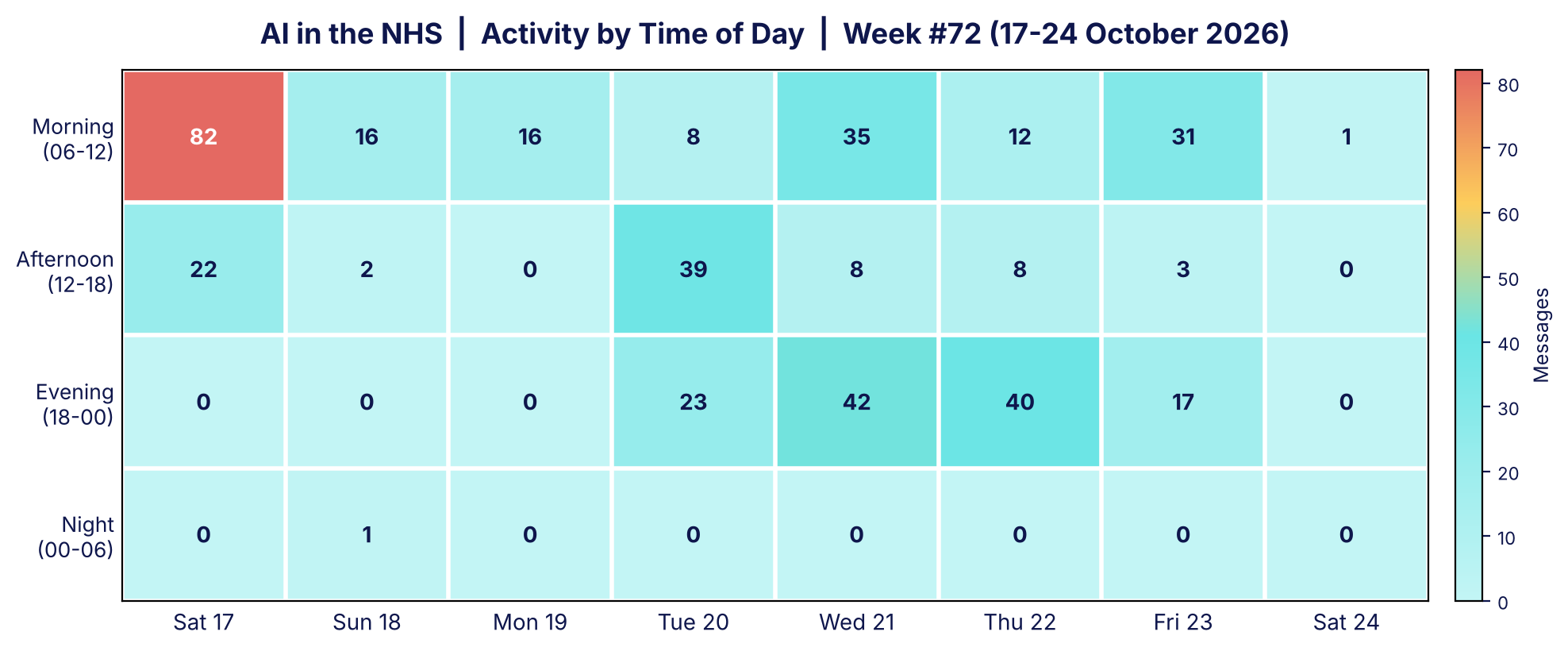
Insights:
• Volume rose 15% on last week (406 against 353), and Saturday 17 October (104) was the busiest day since #69.
• The pattern swung back to mornings: 201 messages (49.5%) against 122 in the evening (30.0%) and 82 in the afternoon (20.2%). Saturday morning alone carried 82 messages, the busiest block of the week, almost all on the NHS App and platform models.
• Wednesday and Thursday evenings (42 and 40) carried the reverse-engineering and security threads and the e-RS report.
• Sunday and Monday were quiet at 19 and 16 messages, and Monday had nothing after midday.
• One message was posted overnight, before 06:00 on Sunday.
• One message had arrived on Saturday 24 October at the time of compilation; later messages before the 09:00 cut-off will be counted next week.
APPENDIX B: Enhanced Statistics
56 group members posted at least one message this week, one fewer than last week. The 15 most active below account for 304 of the 406 messages (74.9%), about the same concentration as last week (74.2%), with 41 occasional and one-off contributors making up the rest.
Top 15 Contributors (Role Descriptors Only):
1. The group moderator: 74 messages
2. An innovation-focused GP: 37 messages
3. A clinician who writes about AI and the mind: 32 messages
4. A wry health-tech watcher: 30 messages
5. An integrated care operations lead: 28 messages
6. A GP with a long out-of-hours and informatics background: 16 messages
7. A radiologist and clinical governance advocate: 12 messages
8. A clinical safety and regulatory specialist: 12 messages
9. A Northern Ireland clinician: 12 messages
10. A member who builds patient-facing apps: 11 messages
11. An NHS commercial lead: 9 messages
12. A primary care digital policy lead: 9 messages
13. A hospital clinician who builds his own agent systems: 8 messages
14. A member who knows messaging protocols: 7 messages
15. A GP and practice leader: 7 messages
Hottest Debate Topics:
1. 🔥🔥🔥 Who should own the NHS front door: platform models, committees and competence (approximately 80 messages across Saturday morning)
2. 🔥🔥🔥 The e-RS 180-day drop-off and what practices should do (approximately 45 messages across Thursday evening and Friday morning)
3. 🔥🔥 Online weight-loss prescribing and pharmacy regulation (approximately 30 messages across Tuesday afternoon and Wednesday morning)
4. 🔥🔥 Mapping the UK's clinical decision support tools (approximately 30 messages across Tuesday evening and Wednesday morning)
5. 🔥🔥 Reverse-engineered records, vibe coding and naming the result (approximately 25 messages across Wednesday evening)
6. 🔥🔥 AI recommendations, test costs and the limits of diagnosis (approximately 20 messages across Thursday night to Saturday morning)
7. 🔥 Longevity, work and universal basic income (approximately 15 messages across Sunday morning)
8. 🔥 Security alerts: PHP, certificates and agents (approximately 15 messages across Wednesday and Thursday)
9. 🔥 The AI livestream, information governance and indemnity (approximately 15 messages across Tuesday afternoon)
10. 🔥 AI in medical and GP training (approximately 8 messages across Monday morning)
Discussion Quality Metrics:
• Evidence-Based vs Opinion Ratio: roughly 13% of messages (52 of 406) carried a link to a paper, guidance document, report or news article
• Average Thread Depth: approximately 9 messages per sustained discussion thread, with Saturday morning's front-door debate running to about 80
• Constructive Challenge Rate: high, including the defence of committees and central assurance against the case for speed, the challenge to alerting as a fix for e-RS, and the disagreement over whether AI's extra testing is a correction or a cost
• External Resource Sharing: 51 unique links shared across the period; 26 Journal Watch entries after link checking. Social media posts, video links, sign-up forms, member-run events and pages that would identify a member were left out
Cross-Expertise Engagement:
Contributions came from general practice, hospital medicine, radiology, clinical safety and regulation, practice management, ICB operations, NHS commercial work, primary care policy, pharmacy, patient-facing app development, software development and clinical education, with a member writing as a patient. Saturday's front-door debate drew the widest mix, from GPs and a commercial lead to a supplier who works with the national services. The clearest knowledge transfer was the GP and practice leader's structured summary of the e-RS report, posted about an hour after it was shared.
APPENDIX C: Daily Theme Summary
Saturday, 17 October 2026
Primary Theme: Who should own the front door?
Key Discussion: Three platform models for the NHS App, the case for the centre building only infrastructure, public trust in private providers, committees against competence, the scale problem, and the national programmes as a model of small focused teams.
Secondary Discussions: A member's new local AI workstation; an industry event on the national ambient voice technology programme.
Notable: 82 messages before midday, the busiest block of the week.
Sunday, 18 October 2026
Primary Theme: Longevity, work and universal basic income
Key Discussion: A conference report on longevity and the future of work, a debate on whether UBI is plausible, the narrowing of routes into skilled work, and the moderator's comparison of AI with electricity.
Secondary Discussions: A frontier lab's research on employment; a preprint on agentic flooding; a question about a clinical guideline tool.
Notable: "AI is an 'elemental' technology, like fire or electricity".
Monday, 19 October 2026
Primary Theme: AI in medical and GP training
Key Discussion: The lack of core AI and digital health teaching in medical schools, pockets of progress in GP training schemes, and the case for core rather than optional modules.
Secondary Discussions: A webinar with regulatory and NHS colleagues; a shared document on clinical guidance.
Notable: The quietest day of the week at 16 messages.
Tuesday, 20 October 2026
Primary Theme: Online prescribing and the limits of oversight
Key Discussion: The advertising regulator's action on weight-loss medicine adverts led to a debate on online pharmacies, prescribing at speed and the pharmacy regulator's role, after a morning on AI interpretability and the timetable of the ambient voice technology investigation.
Secondary Discussions: An outage affecting several services; indemnity for GPs acting as clinical safety officers; a livestream on AI agents for practice administration; the Doximity and UpToDate partnership.
Notable: "They didn't want a prescriber. They wanted a risk sink".
Wednesday, 21 October 2026
Primary Theme: Decision support tools and a security alert
Key Discussion: A group list of the UK's clinical knowledge and decision support tools, a critical PHP vulnerability and its effect on one practice's triage system, and an evening on reverse-engineering clinical systems and the cost of maintaining them.
Secondary Discussions: Weight-loss prescribing policy; recognition of CE-marked medical devices; an AI result in mathematics; a council health scrutiny committee.
Notable: The second-busiest day at 85 messages.
Thursday, 22 October 2026
Primary Theme: Referrals that quietly disappear
Key Discussion: HSSIB's second interim report on the e-Referral Service's 180-day drop-off, the absence of the hazard from the national hazard log, and whether alerts, feedback or better design would close the loop.
Secondary Discussions: Explaining ideas to people outside the field; AI agents and bank accounts; a certificate authority incident; a diagnostic orchestrator; AI scribes in Canada.
Notable: "An open loop is a bad loop".
Friday, 23 October 2026
Primary Theme: Who does what about e-RS, and what AI recommends
Key Discussion: Whether every practice needs its own DCB0160 assessment for e-RS, then an evening on a study of the cost of AI-recommended care, the AMIE study in The Lancet, and NICE's recommendation of AI tools for prostate MRI.
Secondary Discussions: A laboratory data breach; an essay on attention; a magazine read on the PHP story; cancer drug development in China.
Notable: "There is a misconception that most important thing that clinicians do is diagnosis."
Saturday, 24 October 2026
Primary Theme: One message before the 09:00 cut-off at the time of compilation, continuing the discussion of AI and the cost of care.
AI in the NHS Weekly Newsletter is produced by Curistica Ltd for members of the AI in the NHS WhatsApp community. All contributors are anonymised. Views expressed are those of individual community members and do not represent any organisation.