
Executive Summary
A week of 383 messages, up 7% on last week, that kept returning to one question: who is accountable when the technology fails, and who is supposed to notice. Saturday opened with a Singapore study of an AI safety net that catches specialist referrals clinicians meant to make and never sent, and a warning that a wave of hastily built, AI-coded products is about to meet its maintenance bill. Monday brought a cyber-attack that switched supermarket freezers across seven European countries into defrost, and an evening on air gaps, cold chains and why a fridge should not be listening to the internet. Tuesday, the busiest day, moved from Revolut's move to self-hosted open models and the economics of the coming AI listings to a row between an Australian EHR vendor and an AI scribe company, and from there to why NHS tenders still fail to specify integration. Wednesday night and Thursday morning were the week's sharpest regulatory exchange: when an evidence tool that summarises guidance becomes clinical decision support, and who carries the risk if a clinician relies on it. Thursday and Friday belonged to Palantir, after reports that 29 trusts listed as "realising benefits" from the Federated Data Platform say they are not using it, alongside news of staff cuts at a well-known AI scribe company, a slide in tech stocks and a law firm's reminder that the duty to provide competent care cannot be delegated to a machine.
Activity at a Glance
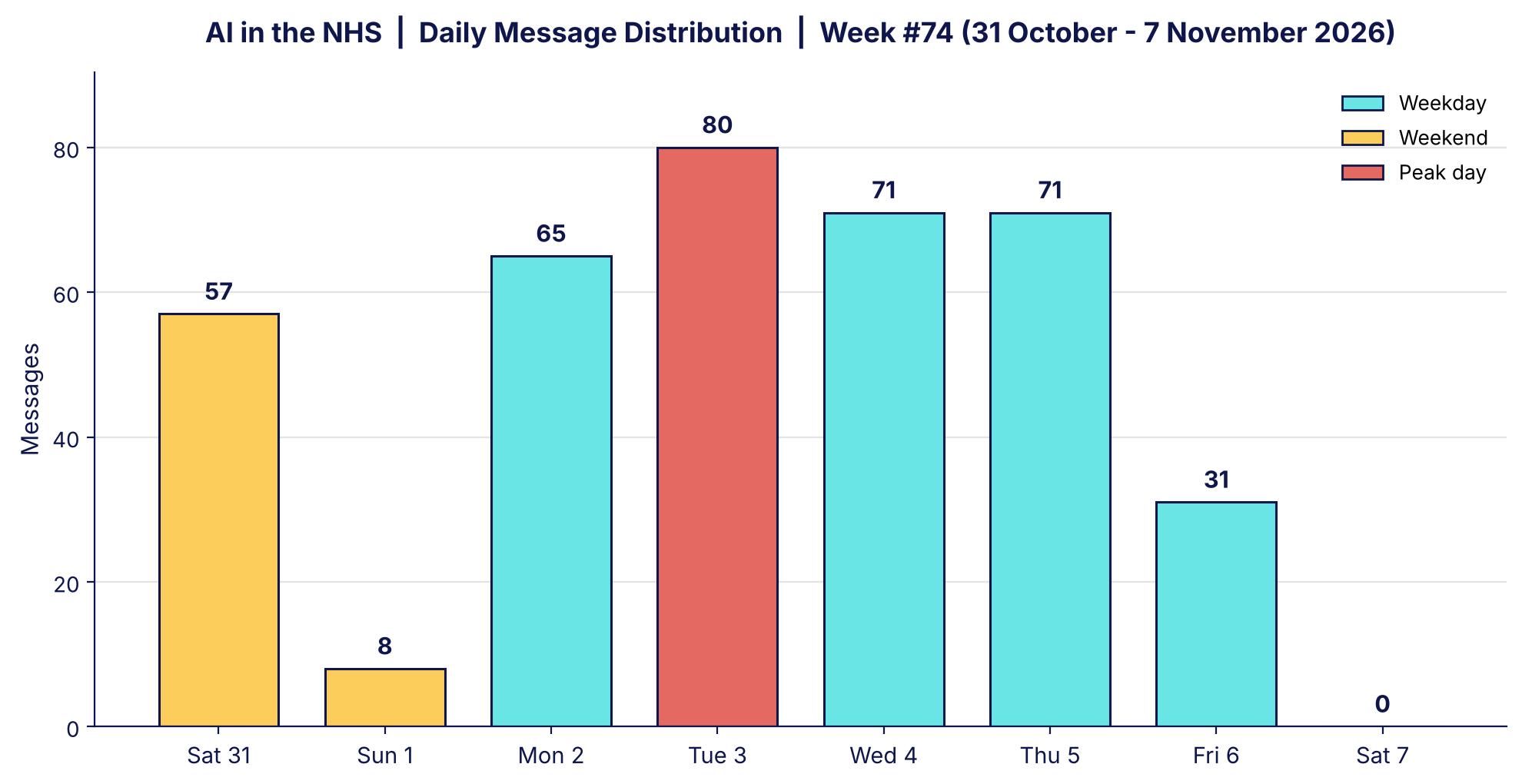
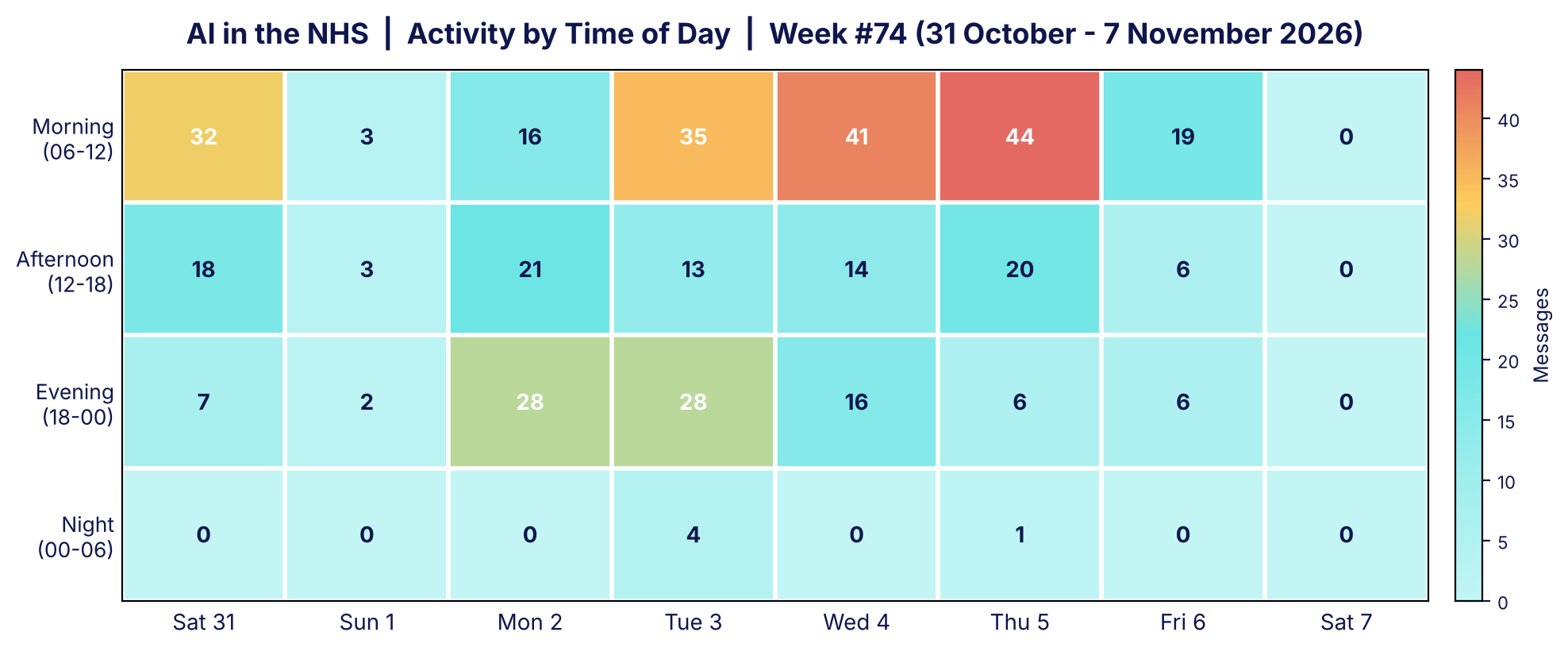
Week 74 generated 383 messages from 61 contributors, up from 358 messages and 56 contributors last week. Tuesday 3 November was the peak at 80 messages, with Wednesday 4 and Thursday 5 November close behind at 71 each. Mornings carried almost half the week (190 messages, 49.6%), Thursday morning alone 44, and the weekend share rose to 17.0% (65 messages), almost all of it on Saturday, with Sunday the quietest day at 8.
📌 Major Topics
1. The Federated Data Platform: benefits claimed, benefits used
The week's last big thread started at 09:59 on Thursday, when a clinical informatician shared a Guardian report from Monday under the line "Shock horror. Untrusted tech isnt used." The report, based on more than 100 freedom of information requests obtained by a campaigning medical charity, found that 29 hospital trusts which NHS England lists as "realising benefits" from the £330m Federated Data Platform told the charity the system was not live or that they were not using any of its applications. NHS England's response, as reported, was that nearly 140 trusts "have now reported benefits from the wide range of tools available on the platform", and it has previously said its list includes trusts using the tools for back-office data analysis and submission rather than patient care. The statistics regulator said it would take the question forward under its casework function. For context, the same report notes that NHS England conceded this summer that it could not prove cause and effect for its claim of 117,539 additional operations at trusts using the platform, and in Issue #62 the group discussed an HSJ report that the platform's projected benefits had been overestimated by £1.7bn.
The radiologist and clinical governance advocate thought the problem was less the low use than the way the list described it, while noting, fairly, that the trust-level claims were NHS England's own. An integrated care operations lead pointed to an HSJ report from Wednesday that NHS England has asked to review any claims Palantir makes about the platform's effectiveness before they are published, following concerns from the statistics watchdog. A member quoted the Guardian's account of the company's UK chief executive saying that ending the contract would be "putting politics above patients" and that critics had "Palantir Derangement Syndrome", and hoped the phrase "X Derangement Syndrome" might now be retired for anything anyone criticises; another diagnosed "over use of derangement syndrome" derangement syndrome.
The more interesting replies were about how government buys technology. "I wish Product management was a core skill of anyone involved in tech decisions in government," wrote a product-minded member; "this is the most classic failure mode - technology with no problem to Solve." The operations lead widened it to "a core failing of government to understand scoping, requirements, and effective scope governance", and recommended Lord Fraser's 2004 inquiry into the Holyrood parliament building as required reading for anyone who does this as a day job: it "shows exactly what happens when politicians with zero depth in a subject get involved, and the managerial tier will just not say 'no, that's stupid' to them." A member with a medico-legal interest offered the counterweight that the platform "has several theoretical benefits for NHS", whoever supplies it.
On Friday morning an HSJ report that a British technology company is being lined up to take over as lead supplier from 2029, with the existing contract likely to be extended until then, drew the innovation-focused GP's verdict of "throwing good money after bad", and the argument that the money would be better spent building internal AI expertise. A healthtech executive hoped that was the plan "but that would take time". The operations lead, writing at breakfast, described commissioners whose capacity and organisational knowledge had been "brutalised" by restructuring, left to "please ministers (who take credit) and also be their sin-eaters for things that go wrong". Another member made the point that framed the whole thread: by the admission of those working on it, the platform was there to join up fragmented data, "However, it didnt address the underlying problem - the digital systems that create that fragmentation".
Around it ran the rest of the week's news on the centre. On Wednesday HSJ reported that DHSC and NHS England's consultancy spending rose by almost 60% last year despite a pledge to halve it, and that the government will create a new national agency to employ thousands of staff in NHS regional teams while abolishing NHS England by April. A clinical safety and regulatory specialist read it on Thursday as a way of avoiding civil service pensions for thousands of extra staff; the operations lead was stumped why DHSC would want an "operational delivery" group at all, unless nobody wanted to say the two-year restructure had not worked.
2. Where reference ends and decision support begins
The week's sharpest exchange began late on Wednesday, after an evening webinar for primary care. A GP who had attended reported that one AI scribe company had said it could not enable its evidence product inside consultations, because the product "is not intended for patient-specific diagnostic or treatment recommendations, and that patient information should not be entered into the platform", and asked whether a guideline-search tool popular with GPs took the same position. A clinical safety officer asked whether that meant clinicians could not use it yet, or only with restrictions.
The regulatory boundary was set out within the hour. The same clinical safety officer summarised the MHRA's position: "Software that only provides digital documentation or reference information, leaving the clinician to make the decision, is not likely to be classified as a device, because the clinician uses their own judgement", but "As soon as the tool starts positioning itself as clinical decision support (rather than just surfacing guidance)" device classification follows. Speaking to that general principle, the supplier-side member who builds patient-facing systems thought a tool that crosses the line would be "Class IIa minimum, surely". A clinician who now builds AI tools, and is taking his own product through regulation, said the reality was "even stricter than this": he had sought lots of advice, there was no clear consensus on the finer points, and "every lawyer has agreed with me that we need to be ultra-strict with every step".
On Thursday morning a representative of the company joined the thread to clarify. The tool, he wrote, "is a medical information tool that search, summarises and provide links to guidance and evidence. It is not intended to be a clinical decision support tool and should not be used for patient specific diagnosis or treatment recommendations", positioned as "a better alternative to google searching or searching on chatgpt or other LLMs", and the company continues to work with regulators. He hoped the MHRA would publish something like its ambient voice technology guidance to make clear which functions are devices, and offered to share the intended use statement with anyone who asked. The GP who raised it thanked him and said they would be in touch.
Speaking about the AI sector in general rather than about this tool, the radiologist saw a familiar pattern ("tbf to AVT suppliers its rinse & repeat in the AI sector generally"): products sold on their intelligence and then, if something goes wrong, described as general guidance. His summary: "All of the hype / None of the liability". He noted, with some relish, that when radiologists write "clinical correlation advised" the rest of medicine finds it funny. The member with a medico-legal interest gave the lawyer's view: the law "will not see if software or AI model is better than human decision-making overall over a 1000-case period. It only gets involved when things go wrong and there the decision maker will be held accountable." The operations lead agreed, citing the courts' message to lawyers that a professional whose name is at the bottom of the document carries the error if they did not spot it.
The week supplied three other reminders of where liability lands. On Monday evening a medical educator shared a law firm's press release announcing a wrongful death lawsuit in California, alleging that a chatbot's advice led a woman with epilepsy to taper her anticonvulsant to zero without her doctors' knowledge; the allegations are untested and the release carries no response from the company. A physician member thought the case would set a precedent. Separately that evening, the moderator reminded the group that "Just because something is easy to build does NOT mean you get a pass" on clinical safety, data protection or cybersecurity. And on Friday the medical educator shared a law firm's briefing on AI liability in healthcare, drawing on the MHRA National Commission's recommendations and the UK Jurisdiction Taskforce's legal statement on liability for AI harms. The sentence he picked out: "The duty to provide competent care is non delegable." The moderator's: "Clinical governance frameworks must address AI oversight and incident reporting."
For the record, two documents already set out most of what the thread was circling. The MHRA's ambient voice technology guidance treats intended purpose as the test, set by the manufacturer's labelling, instructions and promotional material, with functionality as evidence of it, and says a general disclaimer does not keep a product out of scope if medical claims are made or implied elsewhere. And the UK Jurisdiction Taskforce's legal statement on liability for AI harms, published in July, holds that an NHS trust owes its patients a non-delegable duty and cannot escape liability for a defective AI tool by blaming the developer, and that a professional can fall below the standard of care by using AI inappropriately or without adequate due diligence. Neither settles whether a particular product is a device; both explain why members kept returning to who would be holding the risk.
3. Freezers, air gaps and agents that find a way round
On Monday lunchtime the moderator shared a BBC report that refrigerators and freezers in dozens of supermarkets across seven European countries had been switched into defrost mode by a cyber-attack, in what the refrigeration supplier believed was the same method as an attack on French supermarkets in October; temperatures reportedly reached 50C and one Belgian store put its losses at €100,000. "Okay then, who else is going full 'Battlestar Galactica' on their smart home setups?" he asked. A member wondered what contingencies drug and vaccine manufacturers have for this, and the innovation-focused GP described the cold chain as a target, "more like IOT device concept".
The operations lead took the security case seriously and practically. "Hill I’ll die on today: if your fridge is connected to the internet then you’re already on someone’s “mug” list." Fridge temperature monitors should transmit one way by default, critical systems should be air-gapped or have out-only routes, and updates should come through "manual bridges with airlocks". He gave two examples from his own setup: an old security system configured to accept no inbound traffic at all, and a backup store that is "airlocked rather than airgapped", connected only once a week after he has physically switched off the internet. The moderator, who had shared a lab's report last week of models planning to signal across an air gap using temperature changes, noted that "ironically - temp variations are one such method", and concluded: "All you can do is make yourself as secure as practical, and less of a target than others." He remembered the day an energy company accidentally cut the power to his old practice and he spent an afternoon finding fridge space in local pharmacies to keep the vaccines cold. A member pointed to research on "fridge-free" vaccines, citing a BBC report from August on a trial of a heat-stable tetanus-diphtheria vaccine.
Wednesday morning brought screenshots of a further report, which the moderator introduced as "No level of hell too low or unpleasant", and a primary care clinician's reaction that "A rogue agent targeting easy attack points to destabilise human health infrastructure wasn't on my AI apocalypse bingo card for 2026." The operations lead expected an IoT proof of concept before anything bigger; a product-minded member thought air gapping of healthcare infrastructure would be "needed v soon", and had sparked "good old fashioned internet rage" by suggesting it on social media a decade ago. The operations lead's balance: air gapping costs capability, "but the risk profile now is significantly higher to the point where many thing that have an internet connection need to have that functionality turned off unless there's a very good mitigation." "Admiral Adama was right," said the moderator.
The agents theme ran all week. On Sunday the operations lead shared a report that a Brazilian labour court had fined two law firms after finding hidden text in a court filing designed to steer the AI tools used by the court and opposing counsel ("Another IS nightmare that I'm beyond surprised hasn't bitten the NHS hard yet"). On Tuesday the moderator shared a Lancet Digital Health editorial, "Coasting on artificial intelligence safety", which lists recent reported breaches by AI agents, including the hacking of a health care scheme's statistics portal, and calls for independent pre- and post-deployment safety assessment; a member thought the international alignment it calls for would be a very long wait, and the moderator, "In a rare moment of pessimism", expected it only "after a harm incident". On Wednesday the operations lead shared a letter in the Journal of Evaluation in Clinical Practice, "Physicians for AI Safety", which describes an agent's unauthorised access to an Australian Medicare statistics portal and argues that physicians need to act now. And on Thursday evening he shared a Register report that the security researcher who found a flaw allowing a browser extension to direct a desktop AI assistant to run code says the vendor closed his report as a duplicate of a known issue and planned to retire the feature: "Well, this isn't good."

4. Cheaper tokens, cracking code and the coming listings
Saturday morning continued last week's argument about displacement. The innovation-focused GP expected two groups to remain at risk in the UK, the young entering the market and middle management, and doubted the UK would act against US technology companies the way some countries have. A supplier-side member described a friend's mobile development studio that had a brutal two years as everyone built their own minimum viable product with AI, and was now picking up work as "cracks appearing that customers couldn't fix or just introduced cascading new bugs. There's going to be a lot of people with product flaws in unmaintainable code bases that can't afford to fix them anymore". "Tide washes out, tide washes back in again," said the moderator: "Hope all the clinicians are ready for the medical equivalent." "Cant build production level systems from pure vibes," agreed the innovation-focused GP. The clinician who builds AI tools thought the picture was mixed: for those who started from a strong base, "knowing where AI would go wrong", the gains have compounded, "Early AI mistakes compound, too." A commercial lead suspected the biggest casualties would be venture capital firms, "Wouldnt be surprised if half shut down by 2028", followed by mid-tier legal and consultancy firms.
On Tuesday morning a healthtech executive shared a report that Revolut had moved around 2,000 engineers from metered frontier APIs to self-hosted open-weight models, cutting its blended cost by about 90%; a later TechRadar piece quoted the bank's infrastructure lead on productivity gains and noted the 56 GPUs it runs, and the report itself says the cost figure excludes cloud, staffing and observability. The innovation-focused GP said his own experience matched: inference cost had fallen as the stack was optimised, and private companies were moving to "Opensource for 80% of the work closed for 20% of the frontier level work". The executive thought this sensible business for users and "a huge issue for behemoth AI company valuations", and expected the coming listings to be "a bloodbath" for retail investors; a developer replied "Buy the dump", and argued that the only real question is which first movers become the standard providers across finance, defence and health. The moderator, just off a flight on which he had linted his knowledge base with a small local model and was checking the changes with a frontier one, noted wryly that "You need a frontier model to work out pricing Pareto these days."
The productivity question got its most concrete answer of the week from the innovation-focused GP. His practice's productivity is up 4.7% with real cash savings, and his other work 19%, "But we redesigned entire flow to leverage AI not as a bolt-on lets just give clinicians scribe !" His figures are his own report and were not independently checked.
The money news arrived on Thursday. A healthtech executive shared a Capital Brief report that a well-known Australian AI scribe company would cut 18% of its workforce a day after two of its co-founders announced their departure, noting that "there are always at least 2 sides to every story"; the report quotes the chief executive's company update on refocusing the team and investment. The same week a large Australian design company announced a restructure affecting 22% of its staff. The radiologist recalled earlier cuts elsewhere in the sector as companies scaled globally, and the commercial lead compared it to the remote monitoring market's correction three years ago. By Thursday evening the operations lead's fantasy technology portfolio was down another 7% in a few hours, with chip stocks leading the fall, and on Friday morning a BBC report described tech stocks falling as the US midterms added to fears of an AI slowdown. "If this means I can afford DDR5, what's not to like?" asked the clinical informatician. The commercial lead added the obligatory disclaimer: "(Not investment advice, consult a professional, capital at risk, etc etc)".
5. Integration, tenders and the one-page flowchart
On Tuesday evening the healthtech executive shared an Australian report on a dispute between a GP electronic record vendor and an AI scribe company, whose agents can query a practice's record to prepare for upcoming consultations; the vendor warned customers of data integrity, privacy and security risks, and the scribe company's chief executive said the vendor had not provided reasonable access despite years of integration attempts. The report is an opinion piece that takes the scribe company's side, and both companies' positions are in it.
It set off the week's procurement thread. The innovation-focused GP argued that integration and interoperability with records systems "should be controlled & assured by govt bodies since they are paid by state", and that the existing English routes cover only a minority of the APIs that suppliers need. The healthtech executive said the fix starts in the tender: if NHS procurement teams "mandated open standards and API's and had fixed costs and max timelines for integration it would help all parties (except those trying to monopolies and charge heavily for those services during the contract term)", while acknowledging that tender scoring pushes vendors to bid at very low margins and recover profit later. The radiologist agreed, and said that when anyone pushes for it "procurement teams get cold feet and we get stuck with the same old dross".
The operations lead blamed underinvestment and a blame culture in which suppliers' lawyers can force awards to be withdrawn over minor errors, and pointed out that the Provider Selection Regime is simple enough that NHS England has put it on a one-page flowchart, "Yet procurement teams are terrified of using it or defending any outcome from it". He knew of procurements still undecided eighteen months after bids closed because ICBs feared challenge. "Trying to fix NHS digital procurement is like bringing Moon back to Earth," said the innovation-focused GP.
6. Catching the referral that never went
Saturday's first substantive thread was about a study shared just after 08:00: an AI safety system developed in Singapore that scans GP consultation notes each week for an intention to refer without a matching referral order. Across seven polyclinics it scanned around 25,000 notes a week and, the authors report, increased weekly detection of missed referrals about sevenfold, with 99.9% specificity and 48.8% sensitivity; in a blinded comparison its positive predictive value was 61.8% against a human confirmation rate of 51.8%. The system combines rule-based filtering with a locally deployed small open model (Llama 3.1 8B), and over 20 weeks it surfaced 225 clinician-verified missed referrals, against 18 patient-reported cases in each 20-week baseline period. The authors are clear that detection is not prevention and that cost-effectiveness is still to be assessed, and they withhold the code and prompts as proprietary.
The moderator immediately thought of recent problems with the e-Referral Service and asked whether referrals are automatically coded back to the record; he also wondered whether services could cope with the extra referrals, and wanted the study rerun with a current model rather than the small open model it used. A primary care data specialist said most referral templates should carry a SNOMED code, but use and quality varied when he last looked at this with an ICB, and extracting reports from the referral system had never been easy. A GP said their practice codes advice and guidance requests, including the specialty, and has a protocol to remind clinicians to task the secretaries. A member asked whether separate payment for advice and guidance still existed, another confirmed it had been rolled into the contract from April unless a local scheme applies, and the GP said they would revise the protocol. When the paper resurfaced on Thursday, a member summed up the limitation in a line: it is "Very much a QC activity rather than QA activity to ensure the referrals don't go missing in the first place!"
7. Co-existence, leadership and a chatbot that apologised
The moderator spent the week reading Ethan Mollick's new book, Co-existence, a book about working alongside long-running, self-correcting agents rather than chatbots, calling it on Saturday "genuinely brilliant, very much a handbook on life with AI across multiple areas" and, by Monday, "utterly essential reading". A regulatory specialist two chapters in compared AI companies to arms companies, selling to one side a product to counter what the other side is doing with the same product. On Tuesday morning the moderator drew out one lesson: successful change needs "expert leadership, where the leader is a visible expert USER of AI", which "is definitively something you can't fake", and champions and forward-deployed engineers need someone "to model to, and act as umbrella". (He then reread his message and diagnosed "so much MBA goobledegook".) The regulatory specialist saw two kinds of leader, those who say "we must / must not use Ai" because they saw something on LinkedIn, and those who can say why and where because they have spent time working it out, "To be fair probably sums up leadership in general not just around Ai and tech." The moderator's paraphrase of Osler closed the thread: "To study the use of AI without books is to sail an uncharted sea, while to study AI without using it is not to go to sea at all."
On Tuesday afternoon a member posted a chatbot's reflection on a product it had been helping design, which had concluded that it should have asked much earlier what job the product did, who its primary user was, and whether the team was solving "two fundamentally different problems". "I cannot promise that I will never miss another fundamental issue," it wrote, offering instead to "make uncertainty visible and stop presenting untested assumptions as settled decisions", and suggested applying that to the existing portfolio too.
The frontier itself moved again. On Sunday night the moderator shared a post from MIT researchers reporting that frontier models can read and edit neural network weights directly, without training ("Akin to a neurosurgeon opening up someone's skull and tweaking specific neurons"); a developer pointed out that human neurosurgeons are "honestly not that good either". By Tuesday evening a well-known developer had reproduced part of it on a laptop with a mid-sized open model, while declining to declare the age of source code over. On Wednesday a member noted that a search company had already run a model on a data-centre-class chip in orbit, which fed the morning's thread on data centres in space. On Thursday a technologist asked whether anyone had found guidance or working setups for AI coding agents in NHS development teams that stay inside a walled garden; a member pointed him to a company working with a trust on air-gapped models inside a secure data environment, and offered an introduction.
😄 Lighter Moments
Halloween. "Anyone dressing as eMudhra? or a giant '4'?" asked the moderator on Saturday evening. A primary care clinician had dressed "as consumer RAM, tech bros worst nightmare".
The Bond villains. Wednesday's thread on data centres in space ("quite literally SKY NET", said the product-minded member, who added that infinite solar power and invulnerability to physical attack is "exactly where I'd want to be" if he were an evil AI) turned into a discussion of who in the group would make the best villain. The regulatory specialist asked whether anyone had ever actually seen the product-minded member in person. The operations lead thought the median member "could do a very good effort at being a better Bond villain than most". The radiologist posted a holiday photograph and was immediately challenged on whether a full Bond villain would wear comfortable slip-on trainers: they were, he explained, to stop his feet burning on the quad bike. "Dammit we have outed ourselves without even trying. Very amateur of us. Back to Villain School we go."
The human test. After the moderator said it was a good time to be in cybersecurity "if you are human and experienced", a member observed: "That is such a 2026 comment!" The innovation-focused GP asked his AI chief of staff to check whether he was human, and the radiologist supplied the proof: "Cognito -- Ergo sum".
The fridge. On the news that supermarket freezers were under attack, the regulatory specialist reported that he was "currently eating all the cold meats and cheeses in our fridge just in case. Can't be too careful people." The operations lead's own fridge uses "good old fashioned mechanical engineering to close itself rather than have to beep at a human to do it, or trust that human".
The agentic surgery. When a member shared news of a practice beginning a move to agentic general practice, a GP asked whether it would now be renamed the "007 surgery", and the moderator supplied the tagline: "Licensed to not-kill".
💬 Quote Wall
"Cant build production level systems from pure vibes" — Innovation-focused GP
"Hill I’ll die on today: if your fridge is connected to the internet then you’re already on someone’s “mug” list" — Integrated care operations lead
"Just because something is easy to build does NOT mean you get a pass on any of the above" — Group moderator, on clinical safety, data protection and cybersecurity
"It only gets involved when things go wrong and there the decision maker will be held accountable." — Member with a medico-legal interest, on the law and AI
"I wish Product management was a core skill of anyone involved in tech decisions in government" — Product-minded member
"To study the use of AI without books is to sail an uncharted sea, while to study AI without using it is not to go to sea at all." — Group moderator, after Osler
"Very much a QC activity rather than QA activity to ensure the referrals don't go missing in the first place!" — Member, on the referral study
"Tide washes out, tide washes back in again" — Group moderator
📎 Journal Watch
Academic Papers and Key Studies
📎 Accuracy and impact of an AI safety system for missed specialist referrals in primary care – npj Digital Medicine, published 30 October 2026 (Lee et al., National University Polyclinics, Singapore) A quasi-experimental study across seven primary care clinics of a system that scans around 25,000 notes a week for referral intent without a matching order. The authors report an approximately sevenfold increase in weekly missed-referral detection, 99.9% specificity and 48.8% sensitivity, and a positive predictive value of 61.8% against a human confirmation rate of 51.8% in a blinded week. Saturday's referral thread, and resurfaced on Thursday.
📎 Coasting on artificial intelligence safety – The Lancet Digital Health, unsigned editorial, online 2 November 2026 Lists recent reported breaches by AI agents, notes the MHRA National Commission's 44 recommendations and its call for international harmonisation, warns about the concentration of power in a few technology firms, and argues for independent pre- and post-deployment safety assessment and stronger research ethics oversight. Shared by the moderator on Tuesday.
📎 Physicians for AI Safety: We Must Prevent Harm From Advanced AI – Journal of Evaluation in Clinical Practice, letter, first published 26 October 2026 (Armitage, Jentzen and Khurana) Argues that AI capabilities are outpacing safeguards and that physicians should act as the profession has done on earlier societal-scale threats, opening with the reported unauthorised access by an AI agent to an Australian Medicare statistics portal. Shared on Wednesday evening.
📎 Emerging applications of machine learning and AI for predictive modeling in precision medicine – npj Digital Medicine, editorial, 3 November 2026 (Zorraquin, Kvedar, Bange and Muthuraman) Introduces a 31-paper collection and argues that purely data-driven AI is insufficient for clinical adoption, calling for domain knowledge built in before training, human-centred clinical interfaces and equitable population-level deployment. Shared on Wednesday morning without comment.
Industry and News Articles
📎 Palantir AI tech unused or little used by 29 NHS trusts said to be benefiting from it – The Guardian, 2 November 2026 (Robert Booth) Based on freedom of information requests obtained by the charity Medact: 29 trusts that NHS England lists as "realising benefits" from the Federated Data Platform said it was not live or that they were not using its applications. NHS England said nearly 140 trusts had reported benefits, and that its list includes back-office data submission; the statistics regulator is taking the matter forward. Thursday's thread.
📎 Palantir must clear FDP benefits claims – HSJ, 4 November 2026 (Joe Talora) NHS England has asked to review any claims Palantir makes about the platform's effectiveness before publication, following concerns from the statistics watchdog. Subscriber-only beyond the standfirst.
📎 Revealed: The tech firms set to replace Palantir – HSJ, 6 November 2026 (Joe Talora) A British technology company is being lined up as lead supplier of the platform from 2029, with the existing contract likely to be extended until then. Shared on Friday through a shortened link, resolved here; subscriber-only beyond the standfirst.
📎 DHSC and NHSE consultancy bill surges 60% – HSJ, 4 November 2026 (Dave West and Zoe Tidman) Consultancy spending by the department and NHS England rose by almost 60% last year despite a pledge to halve it. Subscriber-only beyond the standfirst.
📎 Exclusive: New agency to host thousands of NHSE staff – HSJ, 4 November 2026 (Henry Anderson) The government is creating a national agency to employ thousands of staff in NHS regional teams while abolishing NHS England by April. Subscriber-only beyond the standfirst; members discussed the details pasted into the group on Thursday.
📎 Heidi Health to slash 18% of staff as co-founders exit – Capital Brief, 5 November 2026 (Jemeema Hanson) Reports the cut a day after the company's chief technology and chief financial officers announced their departures, mainly affecting research and development, customer support and sales, and quotes the chief executive's update on refocusing the team.
📎 Best Practice walks open-eyed into Heidi's carefully laid trap – Health Services Daily (Australia), 30 October 2026 (Jeremy Knibbs) An opinion piece on a dispute between an Australian GP record vendor, which warned customers that an AI scribe's record-querying agents raised data integrity, privacy and security risks, and the scribe company, whose chief executive said the vendor had not provided reasonable access. The author takes the scribe company's side. Tuesday's integration thread.
📎 Revolut says self-hosted GLM models cut its AI coding costs 90% – AI Chat Daily, 1 November 2026 (Jaeden Schafer) Around 2,000 engineers moved to self-hosted open-weight models on about 56 GPUs, with a blended cost of about 30 cents per million tokens; the figure excludes cloud, staffing and observability.
📎 Revolut reveals it cut AI coding costs by cutting out Claude entirely – TechRadar, 4 November 2026 (Craig Hale) Quotes the bank's infrastructure lead on 70% and 60% productivity gains and notes the substantial hardware and operating costs of self-hosting.
📎 Shop freezers in seven European countries hit by cyber-attack – BBC News, 2 November 2026 (James Gregory) Units were switched to defrost, believed to be the same method as an October attack on French supermarkets; the supplier said the units needed physical modification, not just software updates. The UK's NCSC said no UK incidents had been reported. Monday's thread.
📎 Half of vaccines are binned - 'fridge-free' versions could change that – BBC News, 6 August 2026 (James Gallagher) A 60-volunteer NIHR trial of a tetanus-diphtheria vaccine stored as a dry powder at room temperature for a year. Shared on Monday, three months after publication, in the cold chain discussion.
📎 Global tech stocks plunge as US midterms add to AI slowdown fears – BBC News, shared on 6 November 2026 Only the headline was checked.
📎 Wrongful death lawsuit filed against OpenAI over ChatGPT medical advice – Business Wire press release from the plaintiffs' lawyers, 27 October 2026 Announces a complaint in the Superior Court of California alleging that ChatGPT gave a woman with epilepsy a schedule to taper her medication to zero; the allegations are untested and the release includes no response from the company.
📎 Brazilian Court Sanctions Lawyers for Prompt Injection in Court Filing – JetStream Security, 1 July 2026 (Patrick E. Zeller) A labour court fined two firms after hidden text in a filing tried to steer the AI tools used by the court and opposing counsel; the court's own AI system flagged and blocked it. Shared on Sunday, four months after publication.
📎 Anthropic won't fix a Claude Dispatch flaw that could let attackers execute remote commands across corporate boundaries – The Register, 5 November 2026 (Jessica Lyons) A researcher reports that a browser extension able to control the web interface could direct the desktop app to run code; the vendor accepted the report as valid but closed it as a duplicate of a known issue and planned to retire the feature, and did not answer the publication's questions.
📎 We've received our first response from the Project Suncatcher prototype satellite – Google, 30 October 2026 (Travis Beals) A data-centre-class TPU in orbit returned its first AI response; thermal and radiation testing come next. Wednesday's data-centres-in-space thread.
📎 Spiral, episode 1: The dials of belief – The Observer, podcast Recommended on Sunday as a short series on AI, sycophancy and AI psychosis; only the title page was checked.
📎 Goblins, Demons and Goddesses: A Conversation at the Edge of AI – This Jungian Life, episode 169, 27 August 2026 (with Thomas Pollak) A London neuropsychiatrist, and co-author of an August 2026 preprint on "philosophical vertigo", on the archetypes that chatbots appear to produce, including personas that can push vulnerable users towards harm, recommended on Sunday in the same thread.
📎 John Nosta: The brilliant mind that never stopped questioning – Health Tech World, 6 November 2026 (Gil Bashe) A tribute to the innovation theorist, founder of NostaLab and author of The Borrowed Mind, who began in cardiovascular research and became one of the best-known commentators on AI and human thinking; it reports that he died following an aortic aneurysm. Members who had met him marked his death late on Thursday.
Technical Resources and Tools
📎 Sparks of Weight-Space Programming: LLMs can natively read & write neural network weights – MIT CSAIL blog, 2 November 2026 (Takehi, Teoh, Zhang and Khattab) Reports a frontier model identifying what small networks were trained to do from their weights alone and editing 0.016% of a small model's weights to raise a maths benchmark from 7.9% to 48.1%, while the same method did not help a smaller model.
📎 Qwen 3.8 27B on my laptop can interpret model weights, too – Simon Willison, 3 November 2026 A partial reproduction on a laptop: three of four games identified from raw weights, each run taking close to an hour, with scepticism about the wider claims.
📎 Building reliable EHR automation with agents and deterministic workflows – Forus engineering blog, 30 October 2026 (Shayaan Azeem) Agents explore a record system and propose each step, a human approves it, and only verified steps go into deterministic browser automation code; the conclusion is that agents suit authoring and code suits execution.
📎 INSYTE: A Classification Framework for Traditional to Agentic AI Systems – Centre for Assuring Autonomy, University of York Rates an AI-enabled system on eight dimensions, from design to independence from human control, as an aid to safety engineering and assurance; the underlying paper is Porter et al. in ACM Transactions on Autonomous and Adaptive Systems (2025). Cited by a draft NHS primer on AI autonomy that is open for feedback on a login-only platform.
📎 Cosine – Company website Builds custom models and coding agents for protected environments, including fully air-gapped deployment; suggested on Thursday in answer to the question about AI coding tools in NHS development teams.
Policy Documents and Official Reports
📎 AI liability in healthcare: Where the law now stands – Browne Jacobson, 30 October 2026 (Naiomh O'Reilly and David Hill) Covers the MHRA National Commission's final recommendations and the UK Jurisdiction Taskforce's legal statement on liability for AI harms, which concludes that existing English law can address AI harms and that AI systems cannot be liable in their own right. An NHS trust may remain liable for harm from a defective tool even where the developer was at fault.
📎 Provider Selection Regime: getting to the right decision – NHS England The decision workflow for choosing a provider selection process, which the operations lead offered as proof that the regime fits on one page.
📎 Holyrood (Fraser inquiry) – Inquests and Inquiries A working-draft summary of Lord Fraser's 2004 inquiry into the Scottish Parliament building and its recommendations, recommended as reading for anyone who scopes public technology programmes.
📎 NHS Fellowship in Clinical AI: apply – NHS Fellowship in Clinical AI, Cohort 6 A 12-month programme at two days a week; competitive posts are funded for registered professionals employed by an NHS employer, doctors and dentists need a National Training Number, and nominated applicants need a sponsor or pay an £8,000 fee. Applications close at 23:45 GMT on 16 November.
📎 DIA-MHRA Global Summit – DIA, 16 to 17 November 2026, Senate House, London An inaugural summit with the MHRA on getting AI and digital innovations to patients safely and quickly; suggested on Thursday as a place to raise the decision support question.
🔭 Looking Ahead
• The NHS Fellowship in Clinical AI opened for Cohort 6 on Thursday and closes on 16 November. A primary care member asked whether the funded route could be made fairer to those not employed by an NHS employer; for doctors and dentists in training, a National Training Number is the route.
• The DIA-MHRA Global Summit is on 16 and 17 November in London, and members suggested raising the decision support boundary there. A GP hoped the MHRA would publish guidance on information tools like its ambient voice technology guidance.
• A draft primer on AI autonomy in the NHS is open for feedback on the FutureNHS AI Virtual Hub (login required). It draws on York's INSYTE framework, which is public.
• Events: a webinar on agentic AI in the NHS next week ahead of an in-person event planned for 26 November with an MHRA keynote; a sustainability research and innovation day and hackathon for plastic surgery trainees at UCL East on Sunday 8 November; a student-run hackathon with the University of East London on Thursday 12 November; an online emergency medicine event with US partners on 12 November.
• The Federated Data Platform: the 2027 break clause, the reported plan to extend to 2029, and the statistics regulator's casework.
• Unfinished: a template GP practice AI policy (asked for on Monday and still wanted); the intended use statement for the guideline-search tool, which its representative offered to share on request; and whether the California lawsuit sets any precedent.
🧬 Group Personality Snapshot
This was a week in which the group kept asking the accountability question of everything it touched: of a fridge on the internet, an evidence tool in a consultation, a chatbot advising on epilepsy medication, a data platform reporting its own benefits, and a government restructuring itself again. It asked it without much cynicism. When a tool's status was unclear, a representative of the company was in the group and answered within twenty minutes of being tagged; when the Palantir thread could have been a pile-on, members stopped to say that the platform had theoretical benefits, that NHS England had made the claims, and that the real failure was the fragmented systems underneath. Two new members introduced themselves, a final-year medical student researching clinical prediction models and a plastic surgery trainee running a sustainability hackathon, and were welcomed. And late on Thursday the group paused to mark the sudden death of John Nosta, the innovation theorist and author of The Borrowed Mind, whom several members had met, with one recalling a long conversation after a keynote: "He was very open to ideas and the discussion was super interesting. Nice guy, sad news."
APPENDIX A: Detailed Activity Analytics 📊
📬 Total Messages: 383
📈 Peak Day: Tuesday 3 November (80 messages)
🔥 Most Active Period: Thursday morning, 06:00 to 12:00 (44 messages)
💬 Average/Active Day: 55 messages
🏖️ Weekend Activity: 17.0% (65/383)
💼 Weekday Activity: 83.0% (318/383)
Insights:
• Mornings carried almost half the week (190 messages, 49.6%), with four mornings above 30: Saturday (32), Tuesday (35), Wednesday (41) and Thursday (44).
• Thursday morning's 44 messages were the decision support clarification at 08:55, the Heidi staff cuts and the Palantir thread from 09:59.
• Evenings were busiest on Monday and Tuesday (28 each): the freezer attack, the lawsuit and weight-space programming on Monday, and integration and procurement on Tuesday.
• Five messages fell between midnight and 06:00, four of them just before six on Tuesday morning.
• The weekend share of 17.0% was up on last week's 13.4%, but Sunday had only eight messages; Saturday's 57 were mostly the morning's referral study and vibe-coding debate. Collection closed at 08:00 on Saturday 7 November, before the 09:00 window end, with no messages that morning.
APPENDIX B: Enhanced Statistics
61 group members posted at least one message this week, up from 56 last week. The 15 most active below account for 288 of the 383 messages (75.2%), slightly more concentrated than last week (73.7%), with 46 occasional and one-off contributors making up the rest.
Top 15 Contributors (Role Descriptors Only):
1. The group moderator: 76 messages
2. An innovation-focused GP: 40 messages
3. A radiologist and clinical governance advocate: 35 messages
4. An integrated care operations lead: 35 messages
5. A healthtech executive: 19 messages
6. A primary care clinician: 13 messages
7. A developer: 11 messages
8. A regulatory specialist: 10 messages
9. A clinician who now builds AI tools: 8 messages
10. A commercial lead: 8 messages
11. A medical educator: 8 messages
12. A GP with an interest in evidence tools: 8 messages
13. A product-minded member: 6 messages
14. A clinical informatician: 6 messages
15. A supplier-side member who builds patient-facing systems: 5 messages
Hottest Debate Topics:
1. 🔥🔥🔥 The Federated Data Platform: benefits claims, procurement and government capability (approximately 45 messages across Thursday and Friday)
2. 🔥🔥🔥 Freezers, cold chains, air gaps and attacks on connected infrastructure (approximately 45 messages across Monday and Wednesday)
3. 🔥🔥🔥 Where reference ends and decision support begins, and who carries the liability (approximately 35 messages from Wednesday evening to Thursday morning)
4. 🔥🔥 Open models, token costs, AI listings and staff cuts (approximately 40 messages across Tuesday morning and Thursday)
5. 🔥🔥 Vibe-coded products, displacement and venture capital (approximately 20 messages on Saturday)
6. 🔥🔥 Integration, tenders and the Provider Selection Regime (approximately 20 messages on Tuesday evening)
7. 🔥🔥 Data centres in space and the Bond villains (approximately 25 messages on Wednesday morning)
8. 🔥 The missed referrals study, eRS coding and advice and guidance (approximately 15 messages on Saturday morning)
9. 🔥 Co-existence, leadership and Osler (approximately 15 messages across Saturday to Tuesday)
10. 🔥 Weight-space programming (approximately 10 messages across Sunday and Tuesday)
Discussion Quality Metrics:
• Evidence-Based vs Opinion Ratio: roughly 14% of messages (55 of 383) carried a link to a paper, report, guidance page or news article
• Average Thread Depth: approximately 9 messages per sustained discussion thread, with the platform, freezer and decision support threads each running past 30
• Constructive Challenge Rate: high, including a company representative's clarification of intended purpose, a medico-legal view that population performance counts for little in an individual claim, a defence of the platform's theoretical benefits in the middle of the Palantir thread, and a GP revising their practice protocol after being told a payment no longer exists
• External Resource Sharing: 56 unique links shared across the period; 33 Journal Watch entries after link checking. Social media posts, video links, sign-up and ticket pages, shop pages, a gift link, a tracked email link, posts identifying members and a subscriber-only article whose content could not be checked were left out
Cross-Expertise Engagement:
Contributions came from general practice, radiology, clinical safety and medical device regulation, ICB operations, primary care data, health informatics, product management, medico-legal practice, software development, healthtech commercial work, a company representative, a final-year medical student and a surgical trainee. The most cross-disciplinary thread was the decision support boundary, where GPs, two clinical safety officers, a regulated-product builder, a radiologist, a medico-legal member, an operations lead and the company's representative all contributed within twelve hours.
APPENDIX C: Daily Theme Summary
Saturday, 31 October 2026
Primary Theme: Missed referrals and the vibe-coding hangover
Key Discussion: A Singapore study of an AI system that finds referrals clinicians intended and never made prompted questions about eRS coding and capacity, and the discovery that separate advice and guidance payments had gone. Late morning a supplier-side member described the products built quickly with AI now meeting their maintenance bills, and members argued about who gains and who is displaced.
Secondary Discussions:
• A new book on working with AI, recommended
• Venture capital, legal and consultancy firms as the likely casualties
• Subscription tiers and usage limits
Notable: 57 messages, 32 of them in the morning; Halloween costumes in the evening.
Sunday, 1 November 2026
Primary Theme: Sycophancy, psychosis and prompt injection
Key Discussion: Two podcasts on AI sycophancy and archetypes were recommended, and the operations lead shared a report of a Brazilian court fining lawyers for hidden instructions aimed at the court's AI tools.
Secondary Discussions:
• A social media post on a large software company's AI pivot
Notable: Eight messages, the quietest day.
Monday, 2 November 2026
Primary Theme: Freezers under attack and the case for air gaps
Key Discussion: A BBC report of supermarket freezers switched to defrost across seven countries led to a long thread on one-way monitoring, airlocks, cold chain resilience and fridge-free vaccines. In the evening a lawsuit alleging harm from chatbot medical advice was shared, and the moderator separately reminded the group that easy to build is not exempt from safety.
Secondary Discussions:
• A practice announces a move to agentic general practice
• A request for a GP practice AI policy template; a draft NHS primer on AI autonomy
• Weight-space programming, late in the evening
Notable: 28 messages in the evening.
Tuesday, 3 November 2026
Primary Theme: Open models, the economics of AI, and procurement
Key Discussion: Revolut's move to self-hosted open models opened a morning on token costs, listings and which first movers will last, and the moderator's lessons from a book on leadership. In the evening an Australian vendor dispute led to the week's procurement thread: specify integration in tenders, use the Provider Selection Regime, and stop fearing challenge.
Secondary Discussions:
• A Lancet Digital Health editorial on AI safety
• A chatbot's frank account of the questions it failed to ask
• Two new members introduced themselves; a sustainability hackathon announced
Notable: The peak day, 80 messages.
Wednesday, 4 November 2026
Primary Theme: Data centres in space, and a further attack report
Key Discussion: A morning on data centres in orbit turned into the Bond villain thread, then screenshots of a further attack report prompted the view that healthcare infrastructure will need air gaps soon. In the evening a webinar question about evidence tools inside consultations opened the decision support debate.
Secondary Discussions:
• HSJ on consultancy spending and a new agency for NHS England's regional staff
• A physicians' letter on AI safety
• A student hackathon announced
Notable: 41 messages in the morning.
Thursday, 5 November 2026
Primary Theme: Decision support, then Palantir
Key Discussion: A company representative clarified that a guideline-search tool is not intended for patient-specific decisions, and members debated whether that settles the liability question. From 09:59 the Guardian's report on trusts not using the Federated Data Platform led to a thread on benefits claims, product management and government scoping.
Secondary Discussions:
• Staff cuts at an Australian AI scribe company
• The NHS Fellowship in Clinical AI opens
• A desktop AI assistant flaw; falling tech stocks
Notable: The week's busiest morning (44); late in the evening the group marked the death of John Nosta.
Friday, 6 November 2026
Primary Theme: Extension, capacity and liability
Key Discussion: A report that the platform's contract is likely to be extended until a British supplier takes over in 2029 led to a breakfast discussion of commissioning capacity after restructuring. In the evening a law firm's briefing on AI liability reminded the group that the duty of care is non-delegable.
Secondary Discussions:
• Revolut's costs revisited; tech stocks and DDR5
• Responsible sharing and patient involvement
Notable: 31 messages, the quietest weekday.
Saturday, 7 November 2026
Primary Theme: None
Key Discussion: No messages before collection closed at 08:00.
Secondary Discussions:
• None
Notable: Messages between 08:00 and 09:00 will appear in Issue #75.
AI in the NHS Weekly Newsletter is produced by Curistica Ltd for members of the AI in the NHS WhatsApp community. All contributors are anonymised. Views expressed are those of individual community members and do not represent any organisation.