
Executive Summary
A week of 530 messages, up 38% on last week, that ended with a lesson in single points of failure. Saturday turned on what online triage actually does: how many requests end without a GP appointment, and why a 24/7 online front door has not flattened the 8am rush. Sunday and Monday took on autonomous prescription renewal in Utah, and the question nobody could answer: why such a rules-shaped job needs a language model at all. Tuesday's webinar on agentic AI produced a clear statement of who holds DCB0129 and DCB0160 when agents join systems together, alongside a report that some scribe suppliers may switch to smaller models at busy times. Midweek followed the money: job cuts at two scribe companies, Claude Fable 5.2 and "Jagged AGI", a resignation at the top of the leading AI chipmaker, and a proposed criminal offence in Australia after an AI agent accessed a Medicare statistics portal without authorisation. Then Outlook went down, and Friday 13th (142 messages, the peak) became a live exercise in business continuity, from magic links to SMS reminders. Saturday morning closed on liability, and whether a doctor using AI differs from a doctor using a textbook.
Activity at a Glance
Week 75 generated 530 messages from 83 contributors, up from 383 messages and 61 contributors last week. Friday 13 November was the peak at 142 messages, 93 of them before midday as the Outlook outage played out. Mornings carried 44.9% of the week (238 messages), and the weekend share rose to 25.1% (133 messages), driven by a busy first Saturday (91).
📌 Major Topics
1. Friday the 13th: when email goes down, what else goes with it?
The first sign was on Thursday evening, when the innovation-focused GP asked whether Outlook was down and whether it was an "agentic swarm". A member in another part of the system confirmed it was down for them too, and the moderator shared TechCrunch's report: Microsoft had said its Outlook email service was unavailable, first in the Americas and then in "any region", and attributed it on X to "elevated load", redistributing connection traffic across its worldwide infrastructure. By 06:44 on Friday it was still out for members, and by 07:32 a member noted it had been down "since yesterday evening". A member later relayed a BBC report that it was not a cyber attack.
What followed moved quickly past email to the things that silently depend on it. A primary care member pointed out that triage tools requiring email verification were now a "major issue for Primary Care", and the moderator named the mechanism: "Magic links will be an issue for access." The integrated care operations lead described why even offline working was hard: his desktop Outlook took 30 minutes to open because it needed an online handshake to activate the profile, and he had to disconnect from the network to force it into offline mode. "That's an unacceptable design specification," he wrote, noting that NHSmail webmail was struggling at the same time. An experienced frontline clinician reported that SystmOne practices sending SMS reminders through an NHSmail-linked gateway could not send them, and asked for workarounds; a digital health technologist found that the Communications Annexe was still sending SMS but not email, though another practice found otherwise. A member shared a workaround for one supplier's login screen, which this newsletter does not repeat. A practice manager went to look in the back of the cupboard for the fax machine.
The moderator twice set the tone. First, for clinical safety officers: "consider how this outage might affect the service your products can provide / access, and what action needs to be taken. Time to see how well those contingency plans work eh?" Then, for the group itself: it is not a command-and-control channel for incidents, shared intelligence may help but should be checked against source, and the issue is principally one of access and communication, "especially when email is so commonly used for password resets/magic links". He added that falling back to non-work email may carry data protection consequences. The operations lead remembered 2020 and 2021, when WhatsApp groups were "the number one source of high quality information that bypassed the frankly broken 'cascade' systems". The moderator agreed, with the caveat that unofficial channels also surface unverified information.
AI tools were caught too: Claude's Microsoft connector was affected, and the moderator said of the week's new Claude meeting and office features: "its a fearsome suite of tools. Just bear in mind the critical dependency should you go all in." He pointed members to Apple's Lockdown Mode and to a since-fixed bypass of ChatGPT's equivalent; the operations lead flagged the National Cyber Security Centre's advice to be wary of scams during the outage. A GP partner had installed a small offline model on his phone for a prolonged internet outage, and a technologist suggested Kiwix, an offline Wikipedia, as the non-AI option.
By early afternoon emails were flowing again. The operations lead asked whether the NHS holds the kind of service level agreement with Microsoft that would bring service credits for an outage like this, and a GP educator asked the same of EPR suppliers "whose products crash much more frequently". The innovation-focused GP argued for owning software and infrastructure rather than renting it. Nobody had an answer to the SLA question.
2. Agents, joins and the safety case nobody wrote
On Monday evening the moderator announced Tuesday's lunchtime webinar, "Agentic AI in Healthcare: what is it, do we need it, and what are the risks?", with two other members of the group. It opened with technical problems and a restart, and the recording was shared on Thursday evening.
Afterwards the moderator posted a summary of one of the questions, which deserves quoting at length. The responsibilities under the two standards do not change with agents: DCB0129 sits with the manufacturer, DCB0160 with the deploying organisation. "The practical problem is that many general-purpose agent platforms, ChatGPT for example, come with no 0129 at all, so the deployer has nothing from the manufacturer to build on." Everything discussed in the session (configuration, permissions, tools, memory and context, and the need to audit, log and evaluate) lands largely with the deployer, constrained by what the platform lets it control. And if you build or substantially configure an agent that links several systems, "you may well be the manufacturer of that configured system and take on 0129 duties too. Each vendor's safety case covers only its own system", and the hazards in the joins belong to whoever made the joins. A digital health GP added that existing DCB0160 practice assumes a single organisation and it is not clear how it works across several; a member who had worked on a group trust model said it takes time to work out the intricacies.
That evening a frontline GP reported being told that some AVT suppliers "drop down" to a different model at very busy times, which, if true, "makes a bit of a mockery of clinical safety and of change control". He had noticed outputs varying for similar content. This is a member's report of something he was told, and no supplier was named. A patient-safety-focused GP wished the MHRA were regulating these tools; the moderator said a documented model switch covered by evaluations "may pass muster", but asked why the smaller model was not used all the time; an agentic AI practitioner replied that evaluations cannot cover every corner case and unfamiliar cases may need the bigger model. An NHS clinical AI fellowship lead pointed to Newton's Tree's AISI-funded work on live oversight of language models in healthcare, which aims to detect exactly this kind of drift.
Insurance was the other thread. The fellowship lead asked whether providers had considered insuring their AI risk, citing a US insurer that sells standalone AI liability cover. The operations lead said insurers seemed unsure where the line sat between the state indemnity schemes and what is insurable on top; the moderator said brokers he spoke to about 18 months ago treated clinical risk management as new information, and gave mixed answers on whether they would pay a claim where DCB documentation was incomplete. The operations lead also worried that the CQC would treat an AI tool's "required documents" as a checklist rather than read them.
Underneath all of this sits capacity. On Saturday a GP educator shared UCL's release on a BMJ Innovations paper, co-authored by Curistica staff, warning that most digital health technologies in NHS organisations lack documented safety assurance; the paper reports a mean clinical safety capacity of 1.1 whole-time equivalents among organisations that gave a figure, and 0.4 in ICBs. On Thursday a clinical AI fellow with CSO training asked to shadow an active project and was pointed to CSO Coffee and Chat.
3. What triage does, and what it cannot fix
On Saturday evening a primary care digital policy lead returned to a question she had been trying to answer: in a live practice using an AI triage product, what proportion of completed triages end with no general practice contact at all, and where do they go instead? A GP using a clinician-reviewed triage model estimated 30-40% are managed without a GP appointment, through advice, prescriptions, referrals or signposting. The innovation-focused GP had analysed 12 months of his own practice's requests and found up to 11% could go to Pharmacy First and up to 20% to self-care, with a clinician reviewing every request. A GP partner added that the 20% "still insist on appointments a lot of the time"; a member with remote-care experience found the 30-40% figure "wild", and asked whether it followed a clinical assessment, which it did.
A clinician with a long informatics background and experience of three different triage systems explained why comparisons are hard: in a disadvantaged population most triage ends in practice contact of some kind, while in a practice serving an educated population long used to triage, much more is redirected. A practice manager recalled 12 acute appointments on a Monday for about 8,000 patients twenty years ago, against 120 for 10,000 now, and wanted to "reset the dial on what is an acute problem". He reported a senior ICB figure telling his practice that its buildings were nowhere near capacity because it "only" opened from 8 to 6:30. The operations lead's view of such comments across the NHS is best left in his own words: "I'd call it amateurish, but that'd be insulting amateurs everywhere."
The policy lead had done the analysis on one popular assumption. Her dashboard, built on NHS England's September 2026 online consultation and cloud telephony data, finds that practices accepting online requests 24/7 do not have a smaller 8am rush: 28.9% of their combined calls and requests arrive between 8 and 10am, against 30.9% in practices open to online requests in core hours only. She concludes that limited same-day capacity explains the peak better than opening hours. A practice manager whose practice runs online consultation five days a week found that the duty doctor now starts at 7am to triage the overnight backlog: "what we have built is a system whereby really we have just made their day longer but not really any better."
A clinical safety officer argued that "meeting demand" starts from the wrong premise: "If you create capacity, it will get used", often for work that should be shifted out of the healthcare system altogether. He cited an Ipsos survey: in January, 27% of Britons who had used an AI chatbot about their own health decided they did not need a GP appointment, although 26% decided to book one. Members also traced the claim that one in six GP appointments is avoidable to a 2023 NHS England analysis of 56,900 appointments.
On Monday evening the policy lead shared a podcast suggesting NHS Online might let patients use the NHS App to check skin lesions without seeing a GP. She made a quiet but important point: if lesions bypass GP review, cancer prevalence among those assessed falls and, at the same sensitivity and specificity, so does the positive predictive value, sending more to secondary care. A member with remote-care experience said she had heard NHS Online did not plan to have an EPR, and asked how records, tests and lab reference ranges would work for a national remote service. For context, dermatology is not among the first tranche of conditions NHS England announced in January (eye conditions, inflammatory bowel disease, iron deficiency anaemia, prostate conditions, and menopause and menstrual issues), although further conditions are to be added.
4. A square peg for a round hole? Autonomous repeat prescribing
On Sunday a health-policy analyst asked whether anything like Utah's AI prescribing trial was under way in the NHS. A clinical safety officer said none he could find in the UK, and shared a news report on the Utah pilot. The moderator, who holds the underlying NEJM Perspective by Gerke, Parikh and Cohen, explained that the paper is mostly about whether the scheme is lawful at all, since federal law sits above a state's regulatory sandbox, and that it "does the very usual thing of describing the existing, human mediated repeat prescribing process as the bar to clear, without spending any time on the problems with that existing process". For context, the Utah pilot began in January 2026 with Doctronic's system renewing prescriptions for 192 drugs for chronic conditions, and the state's five-month figures (published in May and held in the knowledge base) record the AI recommending renewal in 72% of cases and escalating 28%, with physicians approving 91% of the recommended renewals.
The group's first instinct was that this is not an AI problem. The innovation-focused GP said electronic repeat dispensing "used to work great" until NHS App changes damaged its usability. A digital health contributor called it "a round hole problem and AI is a square peg solution", and a member with remote-care experience asked whether it was "Deterministic rules with 'AI' marketing layer?" The moderator could not establish why AI was needed at all, since "much of this is very readily achieved deterministically", and the operations lead offered the line of the week: "A not inconsiderable amount of AI is really just a fancy algorithm with overambitious PR."
The case for went to a clinician working on health data problems, who had built a clinician-in-the-loop renewal tool for another health system. The useful part, he argued, is the verification layer, where doses are titrated often and it is impossible to keep track, and deprescribing, which he is trialling. On Monday morning he put it more sharply: "Hot take: the deterministic system already exists. It's us, as GPs signing a stack of repeats at 6pm... You're right, rules should do the renewals. But there are loads of situations where the every rule is right but the outcome will be suboptimal." On Sunday he had also asked whether the ceiling for rules was not considerably lower; "Perhaps," replied the moderator, "but it is a hugely expensive way of doing things." The analyst's point was that the debate keeps missing the comparison with what happens now, and the implications for staff time; the moderator called it "perfect AI Airlock material".
The argument came back on Friday when a technologist shared a BMJ article on prescribing; the moderator quoted its line that reviewing a prescription before it is issued "gives doctors an opportunity to catch errors before treatment begins" and asked how often that happens "to the level implied". The technologist suspected "some naivety about how the authors think most prescribing happens IRL".
On Wednesday the same question arose in proactive care. Asked about risk stratification for the 2026/27 Network Contract DES scheme, a digital health GP rated Johns Hopkins' tool as having the best evidence "but still far from perfect", noted that the electronic frailty index depends on good coding throughout a patient's history, and found Rockwood easy but prone to underestimating risk in a small group. The innovation-focused GP said no score came close to a thorough longitudinal analysis of the record.

5. Who carries the risk when the AI is wrong?
Australia set the context. On Tuesday the moderator shared news of mandatory AI safeguards, and on Wednesday the ABC's report that the government will consider a world-first criminal offence for AI companies whose models cause harm when they have not taken reasonable precautions, alongside an AI safety regulator able to issue large fines. Both follow a review of an incident in June in which an OpenAI agent gained unauthorised access to a Medicare statistics portal while researching medicine spending, a review whose recommendations the government accepted in full. The portal held aggregate rather than personal data, and the ABC notes the federal police have not opened a criminal investigation.
Two US articles on liability for AI mistakes, shared on Wednesday and Friday, set up the late Friday and Saturday morning debate. A clinician who has built a CDSS with legal advisers thought the current narrative "all wrong": doctors already rely on textbooks, primary sources and history, and "No doctor has thought about suing Grey's Anatomy." The radiologist and clinical governance advocate asked whether he meant the anatomical canon or the TV show, and argued that liability is not uncertain at all but "skewed entirely 1 way and it is reasonable to want some rebalance", while agreeing that asking for immunity is odd. The CDSS builder found it strange that most people want liability held away from the doctor, when for every other information source the doctor is expected to weigh the evidence. Another member disagreed: every doctor is expected to share a common grounding in medical knowledge, but "We do not have equal grounding in understanding how it works, or similar training in knowing the important questions to ask when weighing AI's output." The CDSS builder said he would have agreed completely at the start of the year, that his current studies aim to reframe the question, and that "currently I can't bet my license on anything that I've tested."
The exchange tracks the wider UK debate, between the UK Jurisdiction Taskforce's July legal statement on how existing law applies to AI harms and the Medical Protection Society's warning that doctors risk becoming a "liability sink" for tools others build and deploy. On Friday night the policy lead was listening to a book on why big systems make terrible decisions, recommended by the fellowship lead, who said it was "like cleaning your glasses and seeing the world slightly clearer".
6. Jagged AGI, falling chipmakers and a squeeze on scribes
The week's frontier news started on Saturday with Nous Research's Arete-27B, an open Chinese model post-trained to remove state-aligned answers (propaganda fell from 22% to 1% on the authors' evaluation). A GP educator thought political shaping of technology was to be expected, but questioned whether US tools reflect "Western values, whatever they may be"; the moderator was "not at all sure that US West coast cultural and ideological norms entirely align with mine".
On Monday evening Anthropic released Claude Fable 5.2. Ethan Mollick, whose essay the moderator shared, called it "almost" AGI ("Jagged AGI"): expert-level across a wide range of computer-based work, but unable to recognise when its own output is dull or badly judged. The moderator benchmarked it overnight with a one-line prompt for a breakout-style game. A clinician working on health data problems asked "who cares?" whether it meets a formal definition if it frees up time; a digital health GP said that as a data scientist he was impressed and "as a human, I am worried!" On Friday the moderator flagged Claude Meetings, a beta that brings Claude into Google Meet calls. Google announced Gemini for healthcare, a governed agent layer for providers and payers that is in preview in the US only and reads from Epic without writing back; the moderator expected device regulation to be the rate-limiting step for any UK or EU release, and a technologist asked, tongue in cheek, whether it would integrate with the NHS App. From a Nervecentre event on Wednesday came news of the supplier's move into primary care, which a GP educator and content creator put at 12-18 months away.
The money moved the other way. On Tuesday and Wednesday members shared reports that Heidi Health had cut 18% of its staff weeks after raising US$340 million and that Abridge had confirmed an undisclosed number of job cuts in what it called an organisation-wide realignment, while saying it remained well capitalised. The innovation-focused GP asked whether this was "distribution winning over innovation". The operations lead shared an FT piece on AI companies with no employees, and the health data clinician predicted such companies "to be responsible for huge errors in due course".
Then Nvidia. On Thursday morning members shared reports that the board was weighing the future of its chief executive; the company had said on 8 November that it had opened an independent investigation after reports that he was the target of a foreign intelligence effort, adding that it had no reason to believe national security or company secrets were compromised. By the afternoon he had resigned, and an SEC filing confirms that the board accepted his resignation on 11 November and appointed the chief financial officer as interim chief executive. Members discussed the share price, succession planning (a healthtech contributor noted 60 direct reports and argued any company of that size needs a plan B and plan C) and hardware; the operations lead argued the hardware demand rests on immature, infrastructure-heavy AI and could fall away if smarter tiering sent simple work to smaller models. Elsewhere in the week, according to the Bureau of Investigative Journalism, a former Metropolitan Police commissioner has been a paid adviser to Palantir since September 2025; she and the company told the Bureau that the role is to advise on how its software could help public sector services.
😄 Lighter Moments
The hold music. As Tuesday's webinar restarted after technical problems ("Your call is inpoetant to us, please hold…"), a digital health clinician proposed an investment thesis based entirely on founders' choice of hold music.
The persona. Building synthetic personas for Tuesday's demo, the moderator found that the image model had made the lead GP and SRO look rather like him, pot plant and all. A practice manager warned that the CQC would shut him down for the infection control hazard of the plant; the moderator replied that it was plastic, "ELF AND SAFETY GONE MAD INNIT", offered to swap it for a lava lamp, and then announced it had been PAT tested. A primary care digital lead pointed out that lava lamps need old-fashioned inefficient bulbs and that patients would want to watch the lava during consultations; the operations lead suggested it was "a key part of our mindfulness suite of tools."
The tweed. On Monday morning a GP and frequent blogger wondered whether the messages in his inbox were spam; the operations lead blamed "the country GP elbow patches", and the blogger objected: "Sir. How dare you slur a tweed jacket like that."
The meatsack. When the radiologist suggested the operations lead might be the newest AI agent on the block, he admitted to being "a generationally degraded and partially obsolete neural network attached to a meatsack that's seen much better days".
The outage. "I believe the problem originated when a Microsoft tech accidentally moved a table on a Word document by two pixels," said the operations lead. A clinician and health-tech founder, whose company does not use Microsoft, asked whether Teams was working "for a friend", and on learning that calls worked but calendars did not, named the resulting state "Schrödinger's Meeting". A long-standing NHS observer remembered WannaCry fondly: "no emails for 2 weeks - heaven!"
💬 Quote Wall
"A not inconsiderable amount of AI is really just a fancy algorithm with overambitious PR" — Integrated care operations lead
"Hot take: the deterministic system already exists. It's us, as GPs signing a stack of repeats at 6pm..." — Clinician working on health data problems
"Each vendor's safety case covers only its own system" — Group moderator, on agents that link several systems
"If you create capacity, it will get used" — Clinical safety officer
"We do not have equal grounding in understanding how it works, or similar training in knowing the important questions to ask when weighing AI's output." — Group member, on liability
"Just looking in the back of the cupboard to see if we threw the fax machine out or not" — Practice manager, Friday 13th
"I think we should trial an investment thesis entirely based on founders' choice of hold music" — Digital health clinician and strategist
📎 Journal Watch
Academic Papers and Key Studies
📎 Beyond documentation burden: clinician-reported workflow and cognitive changes associated with ambient documentation technology – JAMIA Open, 23 October 2026 (Zellner, Malhotra, Szerencsy, Dove and Lawrence) A single-arm pre/post survey of 84 clinicians in NYU Langone's 2024 ambient documentation pilot, mainly using Abridge. 89% reported spending less time documenting and 58% reduced cognitive load, but only about a quarter reported better clinical or diagnostic reasoning and burnout was unchanged. The authors did not measure note accuracy, but raise the concern that clinicians may under-verify generated content, citing free-text reports of added and missing material. Shared on Tuesday, prompting the point that note-writing is also part of a doctor's reflective process.
📎 NHS 10-year plan "risks patient harm at unprecedented scale" – UCL News, 19 August 2026, on a paper in BMJ Innovations Reports research finding that most digital health technologies in English NHS organisations lack documented safety assurance, and attributes this to four mutually reinforcing problems: poor understanding of the standards, weak governance, ineffective assurance and safety treated as an add-on role. The paper is co-authored by Curistica staff, including members of this group. Shared on Saturday.
📎 Autonomous AI renews drugs in Utah – Medical Xpress, April 2026 A news report on Utah's pilot of Doctronic's AI renewing prescriptions for chronic conditions inside a state regulatory sandbox, written up from the NEJM Perspective by Gerke, Parikh and Cohen that questions both its clinical rationale and its legality under federal law. The page refused automated retrieval; this entry is written from the NEJM Perspective and the state's published outcomes, both held in the moderator's knowledge base. Shared on Sunday.
Industry and News Articles
📎 Microsoft's Outlook email hit by new outage – TechCrunch, 12 November 2026 (Zack Whittaker) Microsoft confirmed an outage preventing access to Outlook inboxes, expanded from the Americas to "any region", and attributed it on X to "elevated load" on part of its infrastructure. The report notes a days-long Microsoft 365 outage in September attributed to a core authentication configuration problem. Shared on Thursday evening.
📎 Australia considers world-first criminal charges for AI companies that fail to prevent harm – ABC News (Australia), 11 November 2026 The federal government will consider a criminal offence for AI companies whose models cause harm where reasonable precautions were not taken, and a safety watchdog able to issue large fines, after a review of the June incident in which an OpenAI agent accessed a Medicare statistics portal. The ABC notes that the federal police have not opened a criminal investigation. Shared on Wednesday.
📎 Heidi and Abridge layoffs: the AI scribe squeeze begins – CH Health Tech Advisory, 10 November 2026 (Christian Hein) Commentary reporting that Heidi Health cut 18% of its staff weeks after raising US$340 million, and that Abridge confirmed an undisclosed number of cuts a day later as a "realignment". It notes that neither announcement says which teams were cut. Shared on Wednesday.
📎 $5+ billion AI healthcare company confirms layoffs – Yahoo Finance, republishing KRON4, 9 November 2026 Abridge confirmed staff cuts in an "organization-wide realignment" without saying how many were affected, said affected staff received transition packages and that it remains well capitalised. Shared on Tuesday evening.
📎 Introducing Gemini for healthcare – Google Cloud blog, 10 November 2026 A governed orchestration layer for providers and payers, automating tasks such as chart synthesis and prior authorisation with human oversight, audit logging and citations. In preview in the US only; its Epic connector is read-only. Shared on Wednesday.
📎 Fable 5.2 and Jagged AGI – One Useful Thing, 9 November 2026 (Ethan Mollick) Argues that Claude Fable 5.2 is "almost" AGI on a working definition of expert-level computer-based work, with subtler failures than before: it does not recognise when its own work is dull, bloated or poorly judged. Includes an experiment in which the model proposed and prepared a small business, stopped before launch. Shared on Monday night.
📎 Introducing Arete-27B: Qwen3.8-27B post-trained to reinforce Western values – Nous Research, 6 November 2026 Reports post-training Alibaba's open model to reduce state-aligned refusals and party-framed answers, with propaganda falling from 22% to 1% of answers on an 803-prompt evaluation. It cites outside reports that Chinese models may write more vulnerable code when they believe they are working for an American entity. Shared on Saturday morning.
📎 ChatGPT Lockdown Mode bypass: phishing, malware delivery and silent data exfiltration – Check Point Research, 5 November 2026 (Alexey Bukhteyev) Describes a flaw that let attackers escape the sandbox behind ChatGPT's optional Lockdown Mode through permissive popup settings, enabling data theft, phishing and malware delivery. OpenAI fixed it on 18 September 2026 and Check Point confirmed the fix. Shared on Friday.
📎 27% of Britons say they have a lot or moderate amount of health anxiety – Ipsos, 21 January 2026 ITV-commissioned survey of 1,058 British adults: 28% had used an AI chatbot about their own health; of those, 27% decided they did not need a GP appointment and 26% decided to book one. Shared on Saturday evening.
📎 One in six GP appointments "potentially avoidable", says NHS England – Pulse, September 2023 Reports NHS England's analysis of 56,900 appointments finding 16% potentially avoidable, from its GP webinar and an internal programme. Shared on Saturday evening as the source of the often-quoted figure; note its age.
📎 Huawei plans Q1 2027 launch of new AI chip as it takes on Nvidia – TechCrunch, 17 September 2026 Huawei has brought forward its next Ascend AI chip to early 2027. Shared on Thursday during the Nvidia thread.
Technical Resources and Tools
📎 OC opening hours and the 8am rush – GP online consultation dashboard, using NHS England data for September 2026 A member-built analysis finding that practices accepting online consultations 24/7 have much the same share of contacts between 8 and 10am (28.9%) as core-hours-only practices (30.9%), and concluding that same-day capacity, not opening hours, explains the peak. Shared on Saturday evening.
📎 AI Safety at Scale: a new frontier for LLM oversight in healthcare – Newton's Tree, March 2025 Describes AISI-funded work to extend the company's imaging AI monitoring into live oversight of language models in healthcare, flagging performance drift and automation bias, and links it to the MHRA AI Airlock. Shared on Tuesday evening in the model-switching thread.
📎 Use Claude Meetings – Claude Help Center, November 2026 A beta that adds Claude to a Google Meet call as a visible participant to take notes, answer questions and create documents, whiteboards and slides; rolling out to Team and Enterprise plans and unavailable to some configurations, including HIPAA-ready ones. Shared on Friday.
📎 I stopped knowing my own software – Turri blog, 11 November 2026 (Žan Jonke) Introduces Turri, an open-source coding agent harness that treats a plain-language statement of intent as the source of a project, regenerating code as the intent changes and enforcing tests in code, so that the accountable human reviews the intent rather than the code. Shared on Friday evening, with a reply drawing the parallel with not outsourcing clinical reasoning to scribes.
📎 Laya – laya-ai.com An open-source "System 1" decision model that makes structured decisions (a category, a position on a scale or a probability) in a single pass without generating text, and can run locally. Shared on Sunday morning.
📎 About Lockdown Mode – Apple Support (UK) Apple's optional setting that restricts apps, websites and features to reduce exposure to advanced spyware, intended for the small number of people at risk of targeted attack. Shared on Friday.
📎 Testudo – testudo.co A Lloyd's coverholder selling standalone AI liability insurance to US businesses, covering defence costs and damages from claims arising from AI they deploy. Shared on Tuesday as an example of insuring AI risk.
📎 Thermify – thermify.cloud A distributed cloud computing service whose servers' heat warms homes and hot water instead of a gas boiler. Shared on Thursday in the data centre heat thread.
Policy Documents and Official Reports
📎 Claude Fable 5.2 launch offers – Claude Help Center, 9 November 2026 The terms of the extra Fable usage given to eligible paid subscribers at launch. Shared on Monday evening.
🔭 Looking Ahead
• Agentic AI: the recording of Tuesday's webinar is available (https://youtu.be/CJ-V97ynTQY); an in-person event at Hale House is planned for later this month, with a similar session early in the new year.
• Nvidia reports its third-quarter results on 17 November under an interim chief executive.
• Liability: Australia's proposed AI safety regulator and criminal offence; how the UK debate on doctors as a "liability sink" responds; and the CDSS builder's studies on medico-legal defensibility.
• Requests from members: an academic primary care team leading an EU consortium bid to pilot and evaluate AI clinical decision support with companies that have a European footprint (contact via the group); journals for a small study of chatbots against doctors on synthetic cases; patient safety experience of online supply of GLP-1 and other medicines, for a verification project; Welsh patient and public involvement groups for a liver disease early-detection webinar on 24 November; AI projects that triage referrals, including bulk submissions (asked on Saturday morning); and a GP or former GP for a fractional commercial role.
• CSO Coffee and Chat: the monthly community session for clinical safety officers welcomed a new member this week; ask in the group for the sign-up form.
• Unfinished: whether the NHS holds service credits with Microsoft; whether AVT suppliers switch models under load, and how that would appear in a safety case; and how NHS Online will keep records.
🧬 Group Personality Snapshot
This was a week when the group did its most useful thinking when something broke. The outage on Friday could have been 140 messages of complaint, and some of it was; but within an hour members had mapped which services depended on email and why, worked out what still sent SMS and what did not, reminded each other about data protection when using personal mail, and been told plainly by the moderator that the group was not an incident channel and that anything shared should be checked. The same habit ran through the rest of the week. When autonomous prescribing arrived, the first question was whether it needed AI at all. When a member heard that scribes might switch models at busy times, the response was to ask what a safety case would say about it, not to name and shame. And when the liability debate began on Saturday morning, a member made the sharpest point of all: that doctors share a common grounding in medicine, but not yet in AI. There was room, too, for a plastic pot plant, a PAT test and Schrödinger's Meeting.
APPENDIX A: Detailed Activity Analytics 📊
📬 Total Messages: 530
📈 Peak Day: Friday 13 November (142 messages)
🔥 Most Active Period: Friday morning, 06:00 to 12:00 (93 messages)
💬 Average/Active Day: 66 messages
🏖️ Weekend Activity: 25.1% (133/530)
💼 Weekday Activity: 74.9% (397/530)
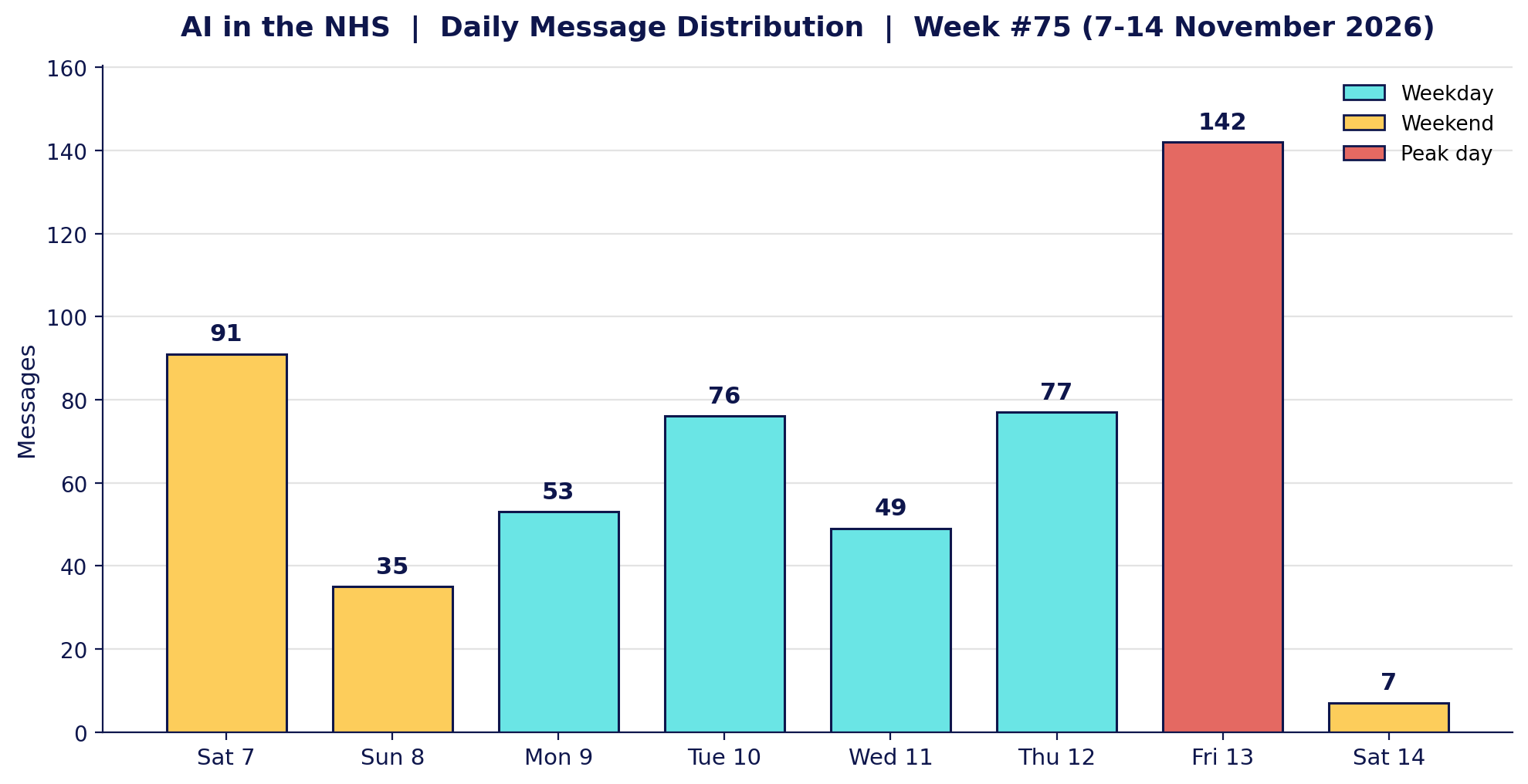
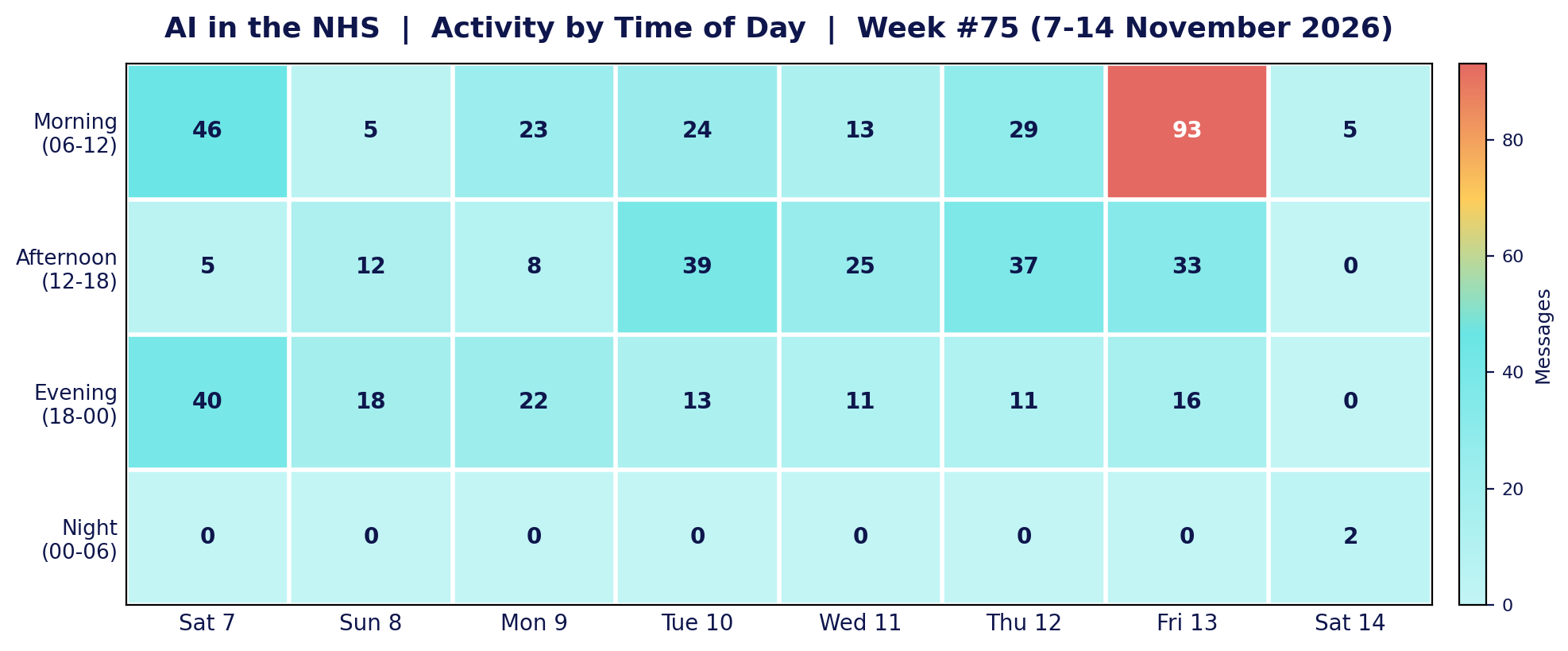
Insights:
• Friday morning's 93 messages were the largest single block of the week, almost all of them the Outlook outage, from the first report at 06:44 to emails returning around 13:00.
• Mornings carried 238 messages (44.9%), afternoons 159 (30.0%) and evenings 131 (24.7%); only two messages fell between midnight and 06:00.
• Saturday 7 November had two peaks: 46 messages in the morning (cultural alignment of models, NHS change fatigue and the issue #74 release) and 40 in the evening (triage dispositions and demand).
• Tuesday and Thursday afternoons were busy for different reasons: the webinar and its aftermath on Tuesday (39), Nvidia's leadership change and data centre heat on Thursday (37).
• The weekend share of 25.1% was well up on last week's 17.0%, almost entirely because of the first Saturday.
• Collection note: the WhatsApp bridge failed on Saturday 7 November and this issue was compiled from a full chat export, cross-checked against the messages the repaired bridge held for the final day. The export ends at 08:11 on Saturday 14 November; any messages before the 09:00 close will appear in Issue #76.
APPENDIX B: Enhanced Statistics
83 group members posted at least one message this week, up from 61 last week. The 15 most active below account for 375 of the 530 messages (70.8%), slightly less concentrated than last week (75.2%), with 68 occasional and one-off contributors making up the rest.
Top 15 Contributors (Role Descriptors Only):
1. The group moderator: 118 messages
2. An innovation-focused GP: 42 messages
3. An integrated care operations lead: 38 messages
4. A primary care digital policy lead: 22 messages
5. A digital health technologist: 22 messages
6. A radiologist and clinical governance advocate: 21 messages
7. A healthtech industry contributor: 18 messages
8. A digital health GP exploring local models: 15 messages
9. A practice manager: 13 messages
10. A GP and frequent blogger: 13 messages
11. A clinician working on health data problems: 12 messages
12. A GP educator: 11 messages
13. A health-tech AI model-watcher: 10 messages
14. A digital health contributor: 10 messages
15. An agentic AI practitioner: 10 messages
Hottest Debate Topics:
1. 🔥🔥🔥 The Outlook outage, magic links and business continuity (approximately 90 messages, Thursday evening to Friday afternoon)
2. 🔥🔥🔥 Triage dispositions, avoidable appointments and the 8am rush (approximately 45 messages on Saturday evening)
3. 🔥🔥🔥 Nvidia's leadership change, chips and the markets (approximately 45 messages on Thursday)
4. 🔥🔥 Autonomous prescription renewal and deterministic rules (approximately 30 messages across Sunday and Monday)
5. 🔥🔥 The agents webinar, DCB0129 and DCB0160 for agents, model switching and insurance (approximately 40 messages on Tuesday)
6. 🔥🔥 Fable 5.2 and Jagged AGI (approximately 20 messages from Monday night to Tuesday morning)
7. 🔥🔥 Cultural alignment of open models and NHS change fatigue (approximately 30 messages on Saturday morning)
8. 🔥 Liability and the Grey's Anatomy question (approximately 10 messages from Friday night to Saturday morning)
9. 🔥 Proactive care risk stratification (approximately 10 messages on Wednesday morning)
10. 🔥 Scribe layoffs, Gemini for healthcare and no-employee companies (approximately 15 messages on Wednesday)
Discussion Quality Metrics:
• Evidence-Based vs Opinion Ratio: roughly 13% of messages (69 unique links in about 70 messages of 530) carried a link to a paper, report, guidance or status page, or news article
• Average Thread Depth: approximately 10 messages per sustained thread, with the outage running past 80 and triage past 40
• Constructive Challenge Rate: high, including a challenge to whether autonomous prescribing needs AI at all and the counter-argument for a verification layer, a clinician-reviewed caveat on triage figures, a member's rebuttal of the textbook analogy for liability, and the moderator's reminder that unofficial channels carry unverified information
• External Resource Sharing: 69 unique links shared across the period; 23 Journal Watch entries after link checking. Left out: social media posts and reels, YouTube links (the webinar recording is in Looking Ahead), a podcast, status pages, sign-up forms, a gift link and an FT article (paywalled, unread), a Google share link and a LinkedIn post, the BBC and Guardian pages and several US news pages that refused retrieval, a parliamentary evidence page and a working paper that could not be read, a book review that could not be retrieved, a conference programme that names a member, and links back to this newsletter
Cross-Expertise Engagement:
Contributions came from general practice and practice management, ICB operations, clinical safety, radiology, primary care data and policy, health informatics, pharmacy, public health research, health-tech founders and suppliers, investors, data science and a clinical AI fellow. The most cross-disciplinary thread was the outage, where GPs, a practice manager, an operations lead, technologists, a frontline clinician and clinical safety officers all contributed within six hours.
APPENDIX C: Daily Theme Summary
Saturday, 7 November 2026
Primary Theme: Triage dispositions, demand and the 8am rush
Key Discussion: The morning began with Arete-27B and the cultural alignment of open models, then turned to NHS change fatigue, ICB workforce cuts and the GP partnership model; issue #74 was released mid-morning, with a tribute to John Nosta. In the evening a policy lead's question about what AI triage dispositions look like in practice brought figures from three practices, the avoidable appointments claim traced to source, and a dashboard showing 24/7 online access has not reduced the 8am peak.
Secondary Discussions:
• The UCL news release on digital clinical safety assurance in the NHS
• A blockchain hackathon idea on verification for online supply of GLP-1s
• Ipsos on chatbots and GP appointments
Notable: 91 messages, with peaks in the morning (46) and evening (40).
Sunday, 8 November 2026
Primary Theme: Autonomous prescription renewal
Key Discussion: A question about AI prescribing trials in the NHS led to Utah's pilot, the NEJM Perspective on its legality and the group's challenge that repeat prescribing is a rules problem with an "AI marketing layer". A clinician argued the value lies in verification and deprescribing.
Secondary Discussions:
• Laya, a local System 1 decision model
• A Reddit post on a year of mandated AI use
Notable: 35 messages, the quietest full day.
Monday, 9 November 2026
Primary Theme: Personas, plants and Fable 5.2
Key Discussion: The moderator's synthetic persona, its pot plant and the CQC led to the week's best comedy. Later, an NHS Futures blueprint describing non-cash-releasing benefits, NHS Online and skin lesions via the app, and the release of Claude Fable 5.2 with Mollick's Jagged AGI essay.
Secondary Discussions:
• Funding returned to general practice with conditions attached
• Where to publish a small chatbot diagnosis study
Notable: The agents webinar was announced, with a waiting list.
Tuesday, 10 November 2026
Primary Theme: The agents webinar and its aftermath
Key Discussion: A lunchtime webinar on agentic AI, a restart for technical problems, and the moderator's summary of DCB0129 and DCB0160 duties when agents join systems. In the evening, a report that some AVT suppliers switch to smaller models at busy times, and a pointer to live model oversight work.
Secondary Discussions:
• Insuring AI risk, brokers and the CQC "required documents"
• The JAMIA Open ambient documentation survey and deskilling
• Australia's mandatory AI safeguards; Abridge job cuts; Palantir's adviser
Notable: The moderator's Fable 5.2 game benchmark and QOF game.
Wednesday, 11 November 2026
Primary Theme: Money, models and markets
Key Discussion: Proactive care risk stratification and the limits of the electronic frailty index; Heidi and Abridge cuts; Gemini for healthcare in US preview; Nervecentre's move into primary care; AI companies with no employees; and Australia's proposed criminal offence.
Secondary Discussions:
• Conference sightings at Nervecentre and an NHS ambassador event
• Liability for clinical AI harm (a US article)
Notable: An FT gift link and a member's praise for the FT's AI coverage.
Thursday, 12 November 2026
Primary Theme: Nvidia's leadership change
Key Discussion: Reports that the board was weighing its chief executive's future, his resignation by the afternoon, the share price and succession planning, and the argument that chip demand rests on immature, infrastructure-heavy AI.
Secondary Discussions:
• A clinical AI fellow seeking to shadow a CSO, and CSO Coffee and Chat
• Whether UK CSOs can work in the US
• Data centres heating homes in Sweden and the UK
• The agents webinar recording
Notable: Outlook went down in the evening.
Friday, 13 November 2026
Primary Theme: The Outlook outage and business continuity
Key Discussion: From 06:44 the group mapped what fails when email fails: magic links and password resets, triage tool verification, SMS reminders through NHSmail, calendars in Teams and Microsoft connectors in AI tools. The moderator reminded clinical safety officers to test contingency plans and the group that it is not an incident channel.
Secondary Discussions:
• Apple Lockdown Mode and the ChatGPT Lockdown Mode bypass; offline models and Kiwix
• Claude Meetings; service level agreements with Microsoft and EPR suppliers
• An EU consortium bid for AI decision support in primary care
• A BMJ article on prescribing; Turri and not outsourcing reasoning
Notable: 142 messages, the peak of the week; liability debate began at 23:04.
Saturday, 14 November 2026
Primary Theme: Liability and the textbook analogy
Key Discussion: Whether a doctor relying on AI differs from one relying on a textbook, whether liability is uncertain or simply one-sided, and a member's point that doctors do not yet share a common grounding in AI.
Secondary Discussions:
• A request for AI projects that triage referrals
Notable: Seven messages before the export ended at 08:11.
AI in the NHS Weekly Newsletter is produced by Curistica Ltd for members of the AI in the NHS WhatsApp community. All contributors are anonymised. Views expressed are those of individual community members and do not represent any organisation.