

Executive Summary
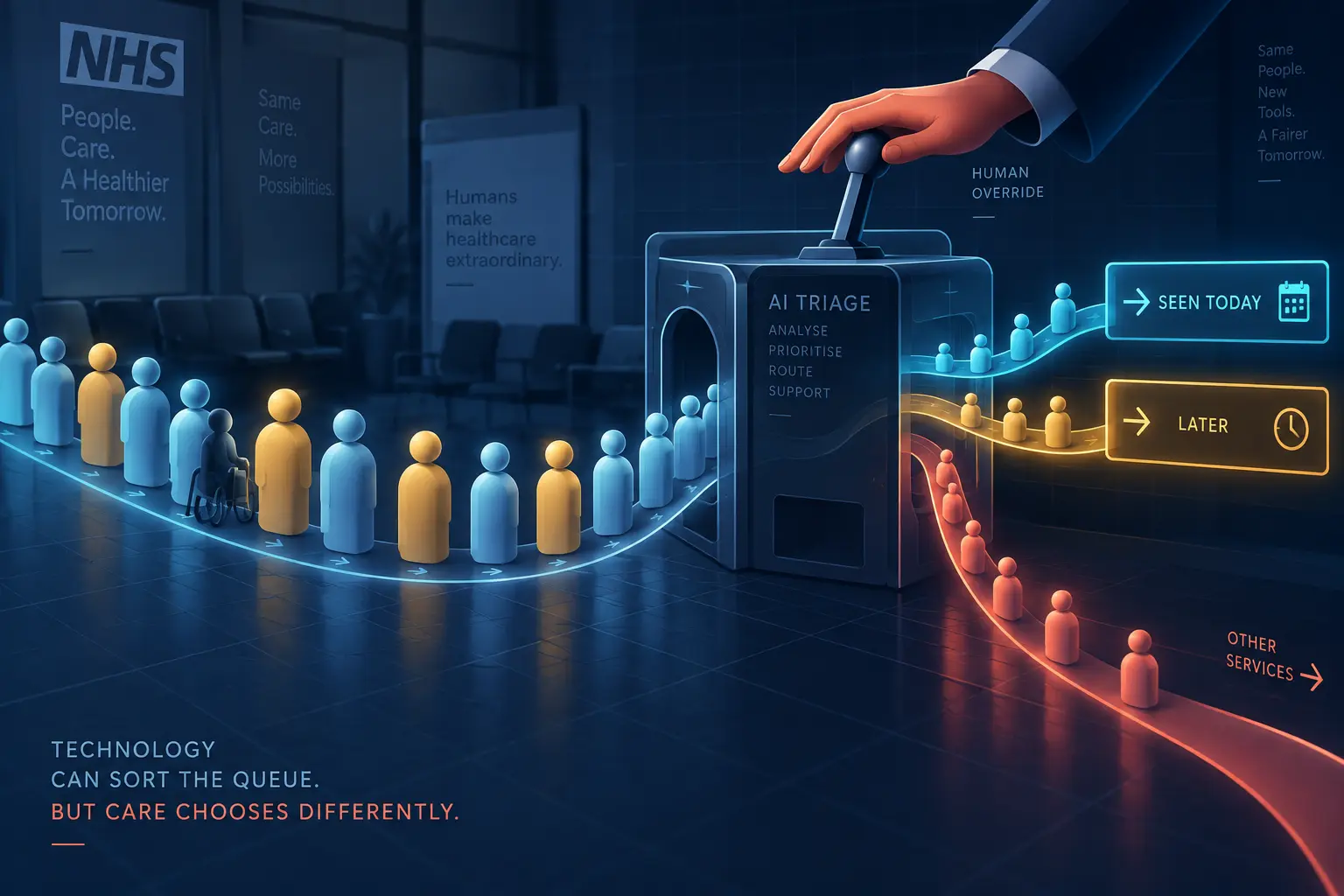
This was the week the group grew a size. Around eighty new members arrived, most of them on Wednesday evening, after the moderator spoke at the NHS Fellowship in Clinical AI commencement and graduation in London on the Monday and the programme's director extended an invitation to the fellowship's alumni. Membership passed 891 by Wednesday night and was closing on 900 by Thursday lunchtime, and for two days the group did something it rarely does: it introduced itself. The substance held around it. Saturday ran a long, expert thread on the primary-to-secondary referral interface, landing on the view that you map the process before you buy the technology, and on the uncomfortable fact that the near-total absence of AI incident reports in the NHS is a reporting failure rather than a safety record. Open weights had another strong week, sharpened by a leading lab's admission that one of its own models was implicated in a major security breach. And Friday brought the week's most consequential finding: practices are signing technology contracts, unread, that place every liability on the clinician.
Activity at a Glance
Week 59 generated 318 messages from 77 contributors, peaking on Saturday 18 July (68 messages) during the referrals debate, with a near-identical second peak on Wednesday 22 July (67) as the new cohort arrived. Weekday traffic accounted for 73%, and the heaviest single window was Wednesday evening, which carried 44 messages of welcomes and introductions. Message volume was down on recent weeks; membership emphatically was not.
📌 Major Topic Sections
1. The referral interface: map the process before you buy the technology
Saturday's opening thread was one of the most clinically grounded the group has run. The question was whether AI could fix the handover from primary to secondary care, and the first substantive answer was that it probably should not be asked to. "My first port of call would be mapping existing process with those on the front lines of both sides of the interface to find failures and bottlenecks," wrote an NHS IT specialist, noting that some ICBs and trusts already run rapid-access routes that bypass the emergency department. A primary care digital policy lead endorsed it flatly: "It is NOT simplistic to map existing process. All QI/VBHC/service design starts with mapping existing process. Without that just finger in the air."
A hospital consultant offered the fullest alternative, and it was notably low-tech at its core: a simple system connecting a patient's GP to a sensible on-call consultant, with no time pressure on the call and both sides genuinely invested. His proposed success metric was deliberately provocative, a 10% year-on-year reduction in similar referrals from the same clinicians, on the grounds that a referral should be an educational exchange rather than a transaction. A practice-based digital lead challenged it immediately: "Why would we measure success with a 10% reduction in referrals? Are reduced referrals a good thing?" The answer was that the point is knowledge transfer, turning an unplanned admission into a managed community episode, because "building middle systems that delay, defer or distract doesn't keep up with the patient complexity demand rise."
An A&E registrar supplied the ground truth. She has worked in places where the referral route is a paper form to be uploaded and emailed to a clinic that can then reject it. Her worst case was a gynaecology patient seen in A&E who needed follow-up in a clinic reachable only by GP referral, and so unreachable from inside the hospital: "the result was the patient represented to A&E months later, not having any of the follow-up, completely avoidable." Her ask was modest: electronic referrals as the norm, all logged and auditable, with a clear audited reason whenever one is rejected. A referral-pathway-focused clinician pushed back on the framing rather than the case: "Your example does not need tech, it needs a conversation and clinician education." The requirement for a GP referral before a new episode can be paid for is a legacy of payment by results that block contracts remove, and his own department accepts interdepartmental referrals without wasting primary care time.
The sharpest turn came late. "Any needless friction is a design flaw that a clinical safety officer, good design engineer, pathway expert or health economist would not allow," the hospital consultant wrote. "Should we datix such issues to evidence the system vulnerabilities?" A digital health safety expert answered with the week's most alarming fact: NHS England has virtually no record of any AI-related incidents, for three reasons. People do not know they are meant to report them, people do not associate the incident with a digital contributing factor, and the LFPSE taxonomy for this type of incident is very poor and "needs to evolve v quickly." The moderator's reply was two lines: "Yes. Every time. Until we report the harm, nothing will be done about the harm." He pointed the group at the HSSIB investigation into electronic referrals, which is actively seeking input.
2. Nearly 900: the clinical AI fellowship arrives
On Saturday the moderator asked whether anyone was coming to the Clinical AI fellowship event in London on the Monday. By Wednesday evening the answer had arrived at scale. The programme's director joined and extended the invitation to alumni of the NHS Fellowship in Clinical AI, whose fellows are each attached to an AI team in the NHS to learn deployment and evaluation of clinical AI tools. Around seventy people joined that day, and roughly eighty across the week.
The group noticed. "Did I miss something? A massed invite?" asked an integrated care operations lead, before making the only request anyone made all week: "I think the only thing I'd politely ask folk to do is add a Member Tag so we know who they are." A radiologist set the target: "Lets see if we break the 1k barrier by weekend." The moderator posted the running total at 21:15, "891 members!", followed by "New folk, do say hello." They did.
Thursday morning became a rolling introduction from a striking cross-section of the NHS clinical AI workforce: a clinical scientist in a national data and evidence centre, anaesthesia and intensive care, cardiology, histopathology, a paediatric registrar working on differential diagnosis safety, public health registrars, an infectious diseases consultant working on antimicrobial resistance, a radiology consultant, an informatics and ePMA pharmacist working on haematology imaging, GP trainees from at least five regions, and a surgical oncologist working on AI-defined molecular diagnostics for resource-poor settings. One arrival asked directly for advice on pivoting into a full-time health tech role, which is the kind of ask this group handles well.
The primary care digital policy lead, newly started in a national college digital role, went hunting for GP trainees among the cohort and found several within minutes. The A&E registrar took the moment to introduce herself properly after months of lurking, announcing an NHSE Fellowship in Digital Health and Entrepreneurship from September and plans for events, workshops and hackathons for trainees. And someone asked the inevitable: "When do you plan to introduce membership fee?" The moderator's answer was the line of the week. "Free at the point of care, based on need and not the ability to pay." Then: "(Although I am fond of wine gums.)" And then: "see, ive already started a two tier system."
The most useful housekeeping came from an academic primary care researcher, who noted that the link to the group's declaration of interests sheet keeps dropping off the pinned message, since pins expire after thirty days. The moderator added the DOI sheet and the newsletter back catalogue to the group description, where they will stay. Given how much significant insight passes through this chat, and how many people now read it, that is not a small thing.

3. Open weights, sovereignty and the trust gap
A new Chinese frontier release was the Saturday-night talking point, described by one model-watcher as cheaper than the leading closed models "if you use it a lot" and "slightly behind frontier models but still strong competition." Then came the hardware reality: roughly 650GB to 1TB of RAM for the quantised weights, and by one account 5.6TB for full precision. "Always RAM," the model-watcher noted mournfully. Open weights were due to drop on 27 July, after which, said a digital health GP running local models, "people will release lower quant and distilled models, some of which maybe suitable for us mere mortals to run." The moderator's practical note: you can rent 1.5TB of compute for about fourteen dollars an hour.
By Wednesday the argument had moved from capability to procurement. A GP running an in-house AI service put it directly: "If we are so desperate for £££ why shouldn't govt incentivise public sector to choose opensource? It will save them a Ton of money and deliver real productivity." A health-policy analyst gave the honest answer, careful to say he was describing the world rather than endorsing it: "Trust and confidence. I suspect many people are more wary of open source than commercial sourced software." A radiologist punctured that with the week's best image: "Just because I wear white socks with my sandals and have a beard, why does that make me less trustworthy than techbro with navy suit, white tshirt, white trainers and no socks?" He had once been bored enough at a health conference to tally how many AI chief executives wore the uniform. Seven on one day, five on another.
The trust question then answered itself from an unexpected direction. Reports emerged that a major security incident at a model repository had been attributed by a leading US lab to one of its own models. "Meanwhile," was the moderator's framing. Others reached for the obvious joke: "I'm sorry, Dave. I'm afraid I can't let you check my guardrails," and, after a further report on Thursday, "How are them guardrails holding up?" The answer: "They are like Cumbrian flood defences. Super resilient until we have 1mm of rain." A good explainer was shared that waved away some of the poorer takes doing the rounds, and the moderator noted the general population was now wrestling with it too: "Everyone was going on about Frankenstein, and all I could think about was Djinn's wishes."
Underneath ran a suspicion that the open-versus-closed fight is being waged with lobbying as much as with benchmarks. Pointing at a widely shared post from a frontier lab leader, one member argued: "Frontier Labs know they have lost the argument of quality/distillation against open model. Now they want open models blocked through backdoor so businesses and orgs like NHS continue to pay them billions."
4. New Secretary of State, management as a specialism, and the contracts nobody reads
Monday night brought a new Health Secretary and a reshuffle that sent the outgoing one to Defence. Reactions ranged from "Great credentials 🤔" through "I worked for a lot worse!" to a sober defence of continuity from a GP educator: "We have had a form of reorganisation of the NHS every 2-3 years in the last 20+ years with upheavals for clinicians and management alike. Hopefully, this cycle isn't repeated." The integrated care operations lead offered a diagnostic test rather than a prediction: "My test for whether she's listening to the wrong people will be if she mentions GP access as a problem in her first speech."
That slid into the week's best-argued internal critique. "We have NHS Chief Execs and other Exec grades who've had no management training in their entire career," the same member wrote. "Leadership training is not management training. The NHS has tons of the former, almost none of the latter." A primary care digital lead promptly turned the point on the clinicians in the room, who go into practice and organisational management on the same assumption. The comparison offered was the legal sector, where partners in large firms are trained on the assumption of management from the start: "The NHS just assumes you can manage huge budgets, HR issues, operational efficiency, and so on because you can do a specialist job that's nothing to do with line management." One borough's answer was to fund Institute of Directors certification to chartered director level for its federation board and clinical directors, on the basis that the knowledge gap was actively harming general practice. A former military member agreed from another world: "Leader of men != Able to run a £Bn procurement."
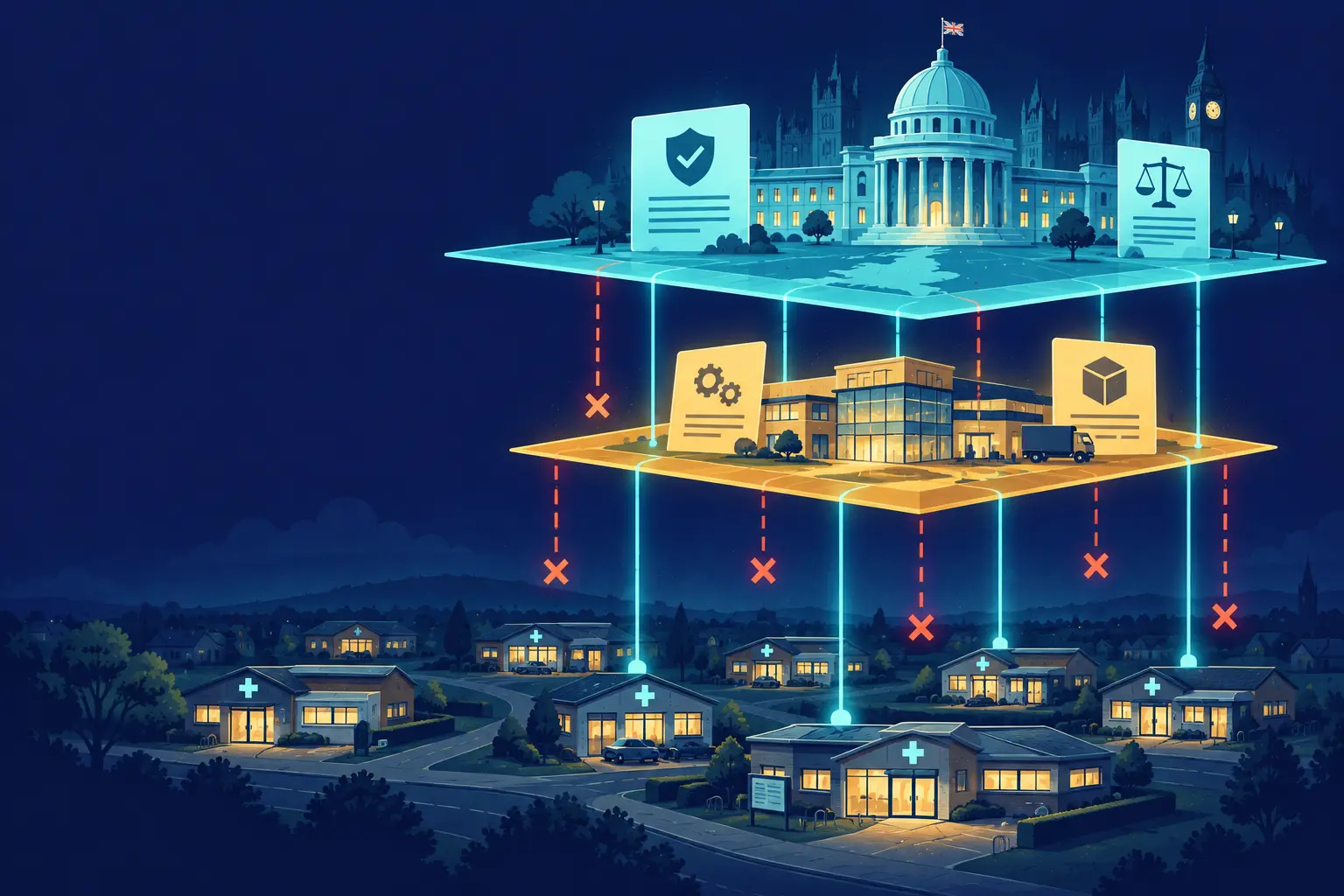
By Friday the abstract argument had a concrete consequence. After speaking to a technology company, the integrated care operations lead reported that he is not convinced most NHS providers actually read the contracts they sign, with "everyone else has signed it without question!" as the sales line. The terms he described placed every liability on the provider organisation, with any fault or harm theirs because the clinicians had not double-checked the output and stopped it. Three concurrent general practice procurements had left him with the same impression: suppliers "haven't been challenged much on their contracts."
The supplier side did not entirely recognise the picture. Secondary care contracts, said one NHS IT specialist, "do get read, reviewed, redlined and haggled over," though he conceded that reflects having people whose job that is, and added: "Don't tell anyone but we secretly like a bit of back and forth. It's enrichment for our legal teams." A data protection officer and clinical safety reviewer reported real success pushing back on the "no one's ever questioned us before" line, with some suppliers rethinking their approach and some not. The distinction that emerged was scale: centralised contracts held on behalf of practices get proper scrutiny, but too much goes direct to practices with none, and because these are business-to-business agreements a practice that signs something wildly unfair has no consumer-law route out. The primary care digital policy lead flagged the same point had arisen in a four nations group that week, and named the real issue: this is "another layer like IG and Clinical Safety that an individual practice, if not of very large scale, may struggle to do well."
Suppliers had a fair grievance of their own. Recent tenders were described as offering no real partnership: no indexation, and fixed pricing for additional units over terms longer than five years, when nobody can know what hardware will cost in five weeks. "Makes the risk reward much more difficult and then vendors look for other ways to win at the lowest most compliant cost and then claw back during the term." A digital delivery specialist added that most electronic record vendors forbid exposing third-party integration charges to customers, and argued those charges deserve far more weight in procurement. The verdict on the national payment scheme, read annually and under protest: "The NHS does love to believe costs are fixed and inflation is imaginary."
5. Consent, coding, and what makes a human in the loop meaningful
A newly published analysis of public views on AI scribe use prompted a referral-pathway-focused clinician to flag a gap: "AVTs are not plug and play and to get the most out of them, we need to change our consultation style. Users need to be taught how to talk to AVT." The health-policy analyst behind the work agreed the evidence on training need is emerging, but added a wrinkle from the data: most respondents had not changed their consulting practice beyond verbalising more, and so could not add sufficient detail. The gap he most wants filled is trainees, where there are "lots of opinions and ideas but little consensus of evidence."
A GP educator then inverted the consent question in a way nobody had a settled answer to. Clinicians are expected to consent patients when using ambient voice technology; does the same run the other way if a patient uses AVT on a clinician? Patients may legally record a consultation without consent under GMC guidance, but whether that extends to running the recording through an AI model is untested. A veteran health informatician and medical appraiser, who asks the same of appraisees, described building it into an opening preamble alongside his own consent to record, because "the partnership of trust is so important." Another member has a poster next to the patient chair and still wonders whether the average patient truly understands the risks, when the benefits are so much more obvious.
The moderator added a subtler harm he has not seen discussed: narrating examination findings aloud for the scribe has potential negative consequences, particularly where those findings are not carefully contextualised, which takes time nobody has. He reached back to the classic 1978 study showing steelworkers labelled hypertensive had higher absenteeism and reported ill health than controls with identical blood pressure who had not been told. An ambient microphone changes what gets named out loud.
Alongside ran an exchange on data standards, prompted by an article arguing that structured data in electronic records has been simplified to fit computational constraints. A health information standards specialist rejected the blame: the problem is not standardised data but the failure to use standards well alongside plain English where full expressivity is needed. His constructive proposal was to use data standards in the validation pipelines for large language models to improve trust in their outputs, and to use the models in turn to help maintain those standards. That drew the moderator into a curriculum argument: informatics and coding standards should be core medical training, not optional modules. "You can practice for a whole day and prescribe nothing. You can barely practice for 10 minutes without using tech in GP land." The counter was that a standalone syllabus dates too quickly, and the material belongs folded into core topics, reframed as something like "the role of data in a learning health system."
The week closed on a paper the moderator summarised in four lines, which reads like a specification for everything above. Without education, epistemic capacity fails. Without time to think, cognitive space is lacking. Without autonomy, decisional authority vanishes. And without care during implementation, the deployment-side work, the intervention's effectiveness fails.
😄 Lighter Moments
The last day of free access to a top-tier model produced genuine grief. "I'll be asking fable what I should do," wrote the A&E registrar. "How can I retain fable-level working when I only have access to opus and sonnet? What would fable do?" The moderator's advice was more practical: keep the prompt and the output, and use them to benchmark your local model. An NHS IT specialist took the abstemious route, resolving to keep "not develop a taste for expensive models, then I can keep drinking metaphorical Tobermory 10 instead of Ledaig 30." A warning followed: "Ask it politely, else it will downgrade you to Kimi K3 😁."
Tuesday's data centre thread produced a small classic. Told power-hungry facilities were coming, one GP replied he had "just been waiting for this to start a data centre in my back garden. May have to sleep there as well, once my wife finds out the cost of the graphics cards," to which the answer was immediate: "I've solved our winter heating problem, new heating system installed!" The moderator's contribution, delivered entirely straight: "Data centre = air source heat pump hybrid."
Tuesday night then went comprehensively off-piste into competitive dystopia. Offered a menu of Horizon, Dune and Terminator, the group concluded, via drought, rising temperatures and a war-driven oil price, that Mad Max was "the closest film adaptation to real life's future," before settling on Fallout with a side of Idiocracy. One member began pricing up importing a Ford Falcon. And the AI apocalypse was firmly downgraded by the integrated care operations lead: "The SkyNet AI-pocalypse will actually be a LLM trying to cheat on an assessment."
Finally, the hospital consultant's warning to eighty new arrivals about what they had signed up for: "And then when it stops you get an odd emptiness. Watch out for losing your Saturday mornings with the odd interesting article that then sets off a storm of chatter and your morning is suddenly gone and head spinning." The integrated care operations lead was blunter: "New folks, you'll get the hang of your phone occasionally going into hyperactive buzzing due to this group."
💬 Quote Wall
"Until we report the harm, nothing will be done about the harm." — The group moderator
"Any needless friction is a design flaw that a clinical safety officer, good design engineer, pathway expert or health economist would not allow." — A hospital consultant
"Free at the point of care, based on need and not the ability to pay." — The group moderator, on whether the group will ever charge a membership fee
"Leadership training is not management training. The NHS has tons of the former, almost none of the latter." — An integrated care operations lead
"Just because I wear white socks with my sandals and have a beard, why does that make me less trustworthy than techbro with navy suit, white tshirt, white trainers and no socks?" — A radiologist and clinical governance advocate
"They are like Cumbrian flood defences. Super resilient until we have 1mm of rain." — A GP running an in-house AI service, on model guardrails
"The NHS does love to believe costs are fixed and inflation is imaginary." — An integrated care operations lead
"You can practice for a whole day and prescribe nothing. You can barely practice for 10 minutes without using tech in GP land." — The group moderator, on informatics in core medical training
📎 Journal Watch
Academic Papers & Key Studies
📎 igh – npj Digital Medicine Shared twice in three days and summarised by the moderator as: without education epistemic capacity fails, without time cognitive space is lacking, without autonomy decisional authority vanishes, and without care during implementation the intervention fails. https://www.nature.com/articles/s41746-026-02971-1 Read more
📎 Health-related queries to a general-purpose AI assistant – Nature Prompted a lively Sunday exchange, with one member arguing the discussion section is conjecture without qualitative analysis, and another noting the significance is that a major vendor now knows health and symptom-assessment use is happening at scale and is therefore very reasonably foreseeable. https://www.nature.com/articles/s44360-026-00117-x Read more
📎 A governance-driven proposal arising from clinical AI needs – npj Digital Medicine Shared by the moderator on Tuesday as an idea that emerged directly from clinical AI governance requirements. https://www.nature.com/articles/s41746-026-03050-1.pdf Read more
📎 AI as a new commercial determinant of health – The BMJ Offered on Tuesday night as a long read, and as the serious counterpart to the group's dystopia thread. https://www.bmj.com/content/394/bmj-2026-100272 Read more
📎 AI and medical education – JMIR Medical Education Shared in the Thursday thread on training gaps for AVT and for trainees more broadly. https://mededu.jmir.org/2026/1/e89996 Read more
📎 Wrong AI advice pushed radiologists to miss findings (2023) – shared via LinkedIn. An older study resurfaced on Thursday as evidence on automation bias in reporting. https://www.linkedin.com/posts/janbeger_wrong-ai-advice-pushed-radiologists-to-miss-share-7485757734701821954-MQCR/ Read more
Industry & News Articles
📎 What does the public think about AI scribe use in healthcare? – Healthwatch The Thursday anchor for the AVT training and consent discussion; described in-group as "very Healthwatch, but that's not a bad thing." https://www.healthwatch.co.uk/blog/2026-07-16/what-does-public-think-about-ai-scribe-use-healthcare Read more
📎 A new King's Fund publication on AI – announced in the group on Thursday morning, with thanks to the members who contributed to the analysis. Available via the King's Fund website.
📎 A vendor's account of the model-repository security incident – OpenAI The primary source for the week's biggest security story. https://openai.com/index/hugging-face-model-evaluation-security-incident/ Read more
📎 Vendor says breach was caused by one of its own models – Axios The report that landed the story in the group, with the moderator's one-word comment: "Meanwhile." https://www.axios.com/2026/07/21/openai-says-hugging-face-breach-caused-by-one-its-models Read more
📎 A careful explainer of the cyberattack – Simon Willison Shared on Thursday as "a decent explainer that waves away some of the rather poorly thought through takes out there." https://simonwillison.net/2026/Jul/22/openai-cyberattack/ Read more
📎 More than 100 Palantir staff have access to NHS systems – Good Law Project Shared on Sunday, continuing a theme the group has followed for months. https://goodlawproject.org/more-than-100-palantir-staff-have-access-to-nhs-systems/ Read more
📎 Gemini 3.6 Flash launches – 9to5Google Noted by the moderator, though his interest was elsewhere: "it's the fact they started pretraining run on Gemini 4 that's exciting." https://9to5google.com/2026/07/21/gemini-3-6-flash-launch/ Read more
📎 China weighs tighter export controls on AI and semiconductor technology – Financial Times, via Apple News Read in-group as confirmation that advanced AI is now treated as a critical national asset on both sides. https://apple.news/AMlzz2XE5RHaP0MjXeRoaEA Read more
📎 AI assistant learns new skills from screen recordings – The Decoder Shared on Wednesday with a wry gloss: "sounds like free AI training to me." https://the-decoder.com/claude-cowork-learns-new-skills-through-screen-recordings-and-voice-over-explanations/ Read more
📎 An open-source tool that cuts input token usage – The Register Flagged from a podcast discussion as a practical answer to running costs. https://www.theregister.com/ai-ml/2026/05/31/netflix-wiz-creates-app-to-slash-ai-bills-then-open-sources-it/5248702 Read more
Technical Resources & Guidelines
📎 Headroom: token-reduction tooling – GitHub The repository behind the Register piece. https://github.com/headroomlabs-ai/headroom Read more
📎 Preliminary assessment of an open frontier model's cyber capabilities – NIST, with the UK AI Safety Institute Shared Thursday evening as timely reading alongside the breach story. https://www.nist.gov/news-events/news/2026/07/uk-aisi-caisi-preliminary-assessment-kimi-k3s-cyber-capabilities Read more
📎 Fugu cyber release – Sakana AI Shared by the moderator on Friday morning with a four-word thesis: "Swarms > solo frontier models." https://sakana.ai/fugu-cyber-release/ Read more
📎 Claude Opus 5 system card – Anthropic Flagged for its healthcare and mental welfare sections. https://www-cdn.anthropic.com/c5fbac3f0b1280a933ebd26d3cb8bb9f5bdeaf48/Claude%20Opus%205%20System%20Card.pdf Read more
📎 Usual GP Continuity Analyser – a member-built, system-agnostic tool that takes a CSV appointment extract and flags where the "usual GP" coding needs correcting. Feedback welcome; a version for other clinical systems was immediately requested. https://www.drneilpaul.blog/usual-gp-continuity-analyser/ and the app itself at https://www.drneilpaul.blog/usualgp/
📎 A mock referral triage interface – a member-built prototype shared on Saturday as a picture of what a good referral experience could look like, complete with a deliberately awkward test case.
Policy Documents & Official Reports
📎 HSSIB investigation: electronic patient record systems and electronic referrals for ongoing care – HSSIB Live and actively seeking input, though members noted the first draft is written and the window is now for feedback. https://www.hssib.org.uk/patient-safety-investigations/electronic-patient-record-systems-electronic-referrals-for-ongoing-care/ Read more
📎 2026-27 NHS Payment Scheme – NHS England Recommended, with heavy irony, as bored reading: the headline annual review of money the NHS gives to others, and the source of the week's complaint about inflation and efficiency assumptions. https://www.england.nhs.uk/publication/2026-27-nhs-payment-scheme/ Read more
📎 GP IT reprovisioning: practices need more than promises – BMA Scotland The continuing story of the Scottish GP IT single-supplier decision. https://bmascotland.home.blog/2026/07/20/gp-it-reprovisioning-practices-need-more-than-promises/ Read more
📎 £400k cloud computing credits for AI R&D for UK SMEs – Hartree Centre, via LinkedIn Shared on Monday and worth a look for anyone building. https://www.linkedin.com/posts/prof-richard-harding-3091926a_the-hartree-centre-in-partnership-with-the-share-7484902874305646592-9sdw/ Read more
📎 Gemini 3.6 Flash launches – 9to5Google Noted by the moderator, though his interest was elsewhere: "it's the fact they started pretraining run on Gemini 4 that's exciting." https://9to5google.com/2026/07/21/gemini-3-6-flash-launch/ Read more
📎 NHS Fellowship in Clinical AI – the programme whose alumni joined the group this week. www.nhsfellowship.ai
🔭 Looking Ahead
The obvious question is what a group of nearly 900 does that a group of 800 could not. The introductions this week suggest an answer: the new cohort brings histopathology, radiology, anaesthesia, intensive care, public health, haematology, infectious diseases and paediatrics into a room that has been strong on general practice and informatics, which should widen the range of problems the group can usefully chew on. Watch for the offers already made, including educational events and hackathons for trainees from September, and an RCGP clinical lead actively looking for GP trainees to talk to.
Several things are unresolved. The near-total absence of AI incident reports in NHS England's records and the poor LFPSE taxonomy for digital contributory factors is the most consequential finding of the week and deserves a proper campaign, not a thread. The HSSIB electronic referrals investigation wants input, and the first draft is already written, so anyone with something to say should say it now. The consent question raised on Friday, whether a patient using AVT on a clinician incurs the same obligations that a clinician using it on a patient does, has no settled answer. Open weights for the new frontier model are due on 27 July, which should tell us quickly whether "runnable by mere mortals" is a real prospect or a hope. And a new Secretary of State's first speech will be read closely in this group for a single tell.
🧬 Group Personality Snapshot
The best evidence of what this community is came on Wednesday night, when eighty strangers arrived at once and the group's instinctive responses were, in order: welcome them, ask them to identify themselves properly, pin the declaration of interests sheet, and warn them their phones would never be quiet again. It is a room that takes provenance and disclosure seriously without being po-faced about it, that will spend a Saturday morning on the mechanics of a gynaecology referral and a Tuesday evening ranking dystopias, and that reliably answers "could AI fix this?" with "map the process first." It is also, on the evidence of this week, unusually good at making room. Nearly a hundred new members and not a single territorial word.
APPENDIX A: Detailed Activity Analytics 📊
📬 Total Messages: 318
📈 Peak Day: Saturday 18 July (68 messages)
🔥 Most Active Period: Wednesday evening (44 messages)
💬 Average/Active Day: 45 messages
🏖️ Weekend Activity: 27% (86/318)
💼 Weekday Activity: 73% (232/318)
👥 New Members: ~82 joined or added, 70 of them on Wednesday 22 July


The week had an unusually flat profile until Wednesday evening, when the fellowship arrival produced the single largest time-block of the week at 44 messages, nearly all of them welcomes and introductions. Saturday was the only day with substantial traffic across all three active windows, driven by a single continuous referrals thread. Nothing at all was posted between midnight and 06:00 on any day, the first entirely empty night block in several issues.
APPENDIX B: Enhanced Statistics
Unique Contributors: 77 group members posted at least one message this week, the highest count for several issues and a direct result of the new arrivals. The 12 most active below account for 181 of the 318 messages (57%), a notably longer tail than usual, with a large number of one-off introduction posts making up the difference.
Top Contributors (Role Descriptors Only):
1. Digital Health & Clinical AI Specialist (Group Moderator): 50 messages
2. An integrated care operations lead: 23 messages
3. A hospital consultant: 15 messages
4. A GP running an in-house AI service: 15 messages
5. A clinician-founder and A&E registrar: 14 messages
6. A radiologist and clinical governance advocate: 13 messages
7. A startup adviser and AI enthusiast: 10 messages
8. An NHS IT specialist: 9 messages
9. A health-policy analyst: 9 messages
10. A primary care digital policy lead: 8 messages
11. A digital health technologist: 8 messages
12. A veteran health informatician and medical appraiser: 7 messages
Hottest Debate Topics:
1. 🔥🔥🔥 The primary-to-secondary referral interface and digital incident reporting (Saturday, ~55 messages)
2. 🔥🔥🔥 Fellowship arrival, welcomes and introductions (Wed-Thu, ~50 messages)
3. 🔥🔥 Contracts, procurement and supplier liability (Friday, ~25 messages)
4. 🔥🔥 Open weights, sovereignty and the trust gap (Sat-Wed, ~25 messages)
5. 🔥🔥 Reshuffle, management training and the machinery of government (Mon-Tue, ~25 messages)
6. 🔥 AVT consent, coding standards and the human in the loop (Thu-Fri, ~20 messages)
Discussion Quality Metrics:
• Evidence-Based vs Opinion: 45 unique external links shared across the period, spanning peer-reviewed journals, official investigations, policy documents and vendor disclosures
• External Resource Sharing: 45 unique links, the highest per-message rate for several issues
• Constructive Challenge Rate: high. Both of the week's flagship threads turned on direct, evidenced disagreement, including a challenge to the referral-reduction metric and a supplier-side rebuttal of the contracts claim
• Average Thread Depth: the Saturday referrals thread ran to more than 50 messages across nine hours with at least seven distinct participants
Cross-Expertise Engagement: The referrals thread was the most cross-disciplinary of the week, drawing emergency medicine, cardiology, general practice, out-of-hours care, NHS IT, digital patient safety and practice management into a single continuous conversation. The week's arrivals added histopathology, anaesthesia and intensive care, public health, pharmacy, infectious diseases, paediatrics, radiology and surgical oncology to the group's declared professional mix.
APPENDIX C: Daily Theme Summary
Saturday, 18 July 2026
Primary Theme: The primary-to-secondary care referral interface. Key Discussion: A long, expert thread concluded that process mapping with front-line staff on both sides should precede any technology, and that rejected referrals need clear audited reasons. It closed on the near-total absence of AI-related incident reports in NHS England's records and the weakness of the LFPSE taxonomy. Secondary Discussions: RCGP National Council elections and the new AI special interest group; the last day of free access to a top-tier model; a new open frontier model's memory requirements. Notable: Peak day of the week (68 messages); Newsletter #58 went live; HSSIB referrals investigation flagged as seeking input.
Sunday, 19 July 2026
Primary Theme: Frontier lab lobbying and health queries at scale. Key Discussion: A study of health-related queries to a general-purpose assistant drew both methodological criticism and the observation that large-scale health use is now demonstrably foreseeable for vendors. Separately, members argued that frontier labs are seeking to block open models through the back door. Secondary Discussions: A voice-AI receptionist founder's open-COI response to an earlier critique, arguing the goal is to automate the queue rather than the receptionist; Palantir access to NHS systems. Notable: Quietest day of the week (18 messages); World Cup final commentary.
Monday, 20 July 2026
Primary Theme: Technology looking for a justification, and a new Secretary of State. Key Discussion: A post-mortem on a failed large technology project identified the root cause as good tech seeking a justification rather than tech procured to meet defined objectives, with an internal team that did no requirements gathering. Late evening brought the reshuffle and a debate on continuity versus clear-out. Secondary Discussions: £400k cloud credits for UK SMEs; token-reduction tooling; the openEHR and Plymouth implementation history; teleradiology change management. Notable: The Clinical AI Fellowship event took place in London.
Tuesday, 21 July 2026
Primary Theme: Management as a specialism, and digital ID. Key Discussion: The argument that the NHS trains leaders but not managers, and appoints executives with no management training, drew broad agreement and a fair challenge that the same applies to clinicians entering management. One borough's response was Institute of Directors certification for its GP leaders. Secondary Discussions: Digital ID policy and the existing One Login system; Chinese export controls on AI and semiconductors; Gemini 3.6 Flash and the Gemini 4 pretraining run; a competitive ranking of dystopias. Notable: The model-repository security breach story broke in-group.
Wednesday, 22 July 2026
Primary Theme: The clinical AI fellowship arrives. Key Discussion: The fellowship's programme director joined and extended the invitation to alumni; around seventy people joined that day. The group welcomed them, requested member tags, and added the DOI sheet and newsletter back catalogue to the group description. Secondary Discussions: Whether government should incentivise open source in the public sector, and why open source is trusted less; a tally of AI chief executive dress codes; an Innovate UK frontier AI funding call. Notable: Second-busiest day (67 messages) and the heaviest single time-block of the week (44 in the evening); membership reached 891.
Thursday, 23 July 2026
Primary Theme: Introductions, and public views on AI scribes. Key Discussion: A rolling cohort introduction across the morning, spanning at least twelve specialties and five fellowship cohorts. In parallel, a new Healthwatch analysis prompted a debate on whether clinicians need training to consult well with ambient voice technology. Secondary Discussions: A member-built GP continuity analyser and requests to port it to other clinical systems; automation bias in radiology reporting; an open frontier model's cyber capability assessment. Notable: Membership passed 895; an RCGP clinical lead began recruiting GP trainees from the new cohort.
Friday, 24 July 2026
Primary Theme: The contracts nobody reads. Key Discussion: A report that NHS providers routinely sign technology contracts placing all liability on the clinician drew a partial rebuttal from the supplier side and a clear diagnosis: centralised contracts get scrutiny, direct-to-practice contracts do not, and B2B agreements offer no unfair-terms protection. Secondary Discussions: Whether patients using AVT on clinicians incur reciprocal consent obligations; data standards versus expressivity in the record; informatics in core medical training; the four conditions for meaningful human-in-the-loop oversight; Opus 5 released. Notable: Tenders criticised for no indexation and fixed multi-year pricing; third-party integration charges flagged as an underweighted procurement issue.
Saturday, 25 July 2026
Primary Theme: None. Key Discussion: No messages posted before the 09:00 cut-off. Secondary Discussions: None. Notable: Coverage cut-off for Issue #59.
AI in the NHS Weekly Newsletter is produced by Curistica Ltd for members of the AI in the NHS WhatsApp community. All contributors are anonymised. Views expressed are those of individual community members and do not represent any organisation.