


Executive Summary
With the World Cup final looming this weekend, the group played its own knockout rounds: the frontier labs versus the open-source insurgents, certification versus deployment governance, and prevention versus the pathways that would have to absorb it. The week opened with a wish for a "full-fat" NHS App and a nostalgic detour through the history of clinician-built systems, sharpening into a serious question about whether the community should build its own tools at all. Local models had their best week in memory, with members running capable LLMs entirely on their own laptops (one powered, gleefully, by rooftop solar) while a fresh Chinese frontier release and a competitor closing on the leaders kept the sovereignty debate boiling. On the ground, the Midlands scribe deal and NHSE's move to fund ambient scribes for all staff reignited the Class I versus Class IIa argument, and a Wednesday deep-dive on visceral fat and GLP-1s exposed the gap between what we can now measure and what the system could ever act on. It closed, fittingly, on governance: consent, Article 22, and a pointed challenge about whether anyone actually holds a safety case for the telephone.
Activity at a Glance
Week 58 generated 450 messages from 56 contributors, peaking on Wednesday 15 July (114 messages) during the visceral fat and Heidi debates. Weekday traffic dominated at 76%, with the heaviest single window being Wednesday morning. After last week's rare weekend-led issue, the group returned to its midweek rhythm.
📌 Major Topic Sections
1. "Build our own": the NHS App, broken procurement, and a history lesson
Saturday opened with a patient-hat plea for a "full-fat" NHS App that leaves "zero need for a private company product," and an at-scale counter that the real failure is the NHS never enforcing interoperability among existing suppliers, leaving areas stuck with "single-supplier ecosystems." That pulled in a familiar grievance: NHS tenders and contracts are, as one integrated care operations lead put it, "terrible terrible," with procurement that "doesn't really assign ownership for the lifecycle of a contract." A digital delivery specialist offered a rare note of optimism about the next round of Digital Pathways, even as members traded worried notes about CSUs being absorbed and DPO services being passed between ICBs.
The thread then turned genuinely reflective, recalling how EMIS and other early systems began life as clinician-built tools ("clinician owned and operated, not shareholder focussed") before, in one member's telling, development "stalled" once shareholders arrived. The group remembered a veteran Exeter GP who built his own practice system decades ago and became a national voice for open-source records and openEHR, warning against central data "honey-pots" long before it was fashionable. The moderator used the history to make a present-tense point: GPs were "the absolute engine of innovation in UK healthcare," and good AI tooling in their hands could reignite that fire. The sober counterweight came from a primary care technology founder: "you need a significant amount of money to build an EHR," and the real cost is not the code but "the human talent" and the "overhead of servicing NHSE and their archaic systems." The moderator's overnight £77 prototype EHR was offered as proof of what is now possible, and pointedly "NOT the way to do it properly." A new coinage for the era: "vibe commissioning."
2. Local models have their moment, and the sovereignty drumbeat gets louder
This was the week the open-source case stopped being theoretical. A competitor model closing to "within spitting distance" of the leaders prompted one lab to relax limits ("Claude folks rejoice"), and by Thursday a new Chinese frontier release had "dropped," reportedly at the level of the current leaders, with the group openly hoping its low cost would "keep the pressure on the US frontier models." Running underneath was a distillation row: pointed accusations that a leading lab's stance on distillation was hypocritical, and a one-word verdict from one veteran member: "Thieves."
The most vivid thread was hands-on. The moderator installed an open-source agent harness running Qwen3 entirely locally via LM Studio, then Gemma, narrating the experience in real time: "I have an LLM running on my laptop, alongside an open source harness, using MCP tools I have built to interact with a platform I have built, and it is bleedin' working." Members chipped in with practical tuning (try the MLX build; llama.cpp is often faster; 27B may be too big for the harness). A GP running an in-house open-source AI service reported having "virtually automated" his back office and asked why the NHS should pay "ransom" to any closed-model vendor, drawing the week's central tension into the open. The measured reply: the barrier is not budget but the "resource to manage" self-hosted models, which makes off-the-shelf "generally safer" for most organisations, whilst a mandated central NHS model "wouldn't be a bad idea." The bigger frame, borrowed from Ethan Mollick, recurred more than once: frontier grunt is dazzling, but "we've barely made use of the powers of models that are 2-3 years old," especially for repetitive tasks "that need repetitive actions, not brilliance." News that the NHS has bought 500,000 Copilot licences landed squarely in the middle of that argument.

3. Scribes, certification, and the Class I question that won't go away
The AVT debate reached a new pitch. A regional deal covering 15 trusts went to a leading scribe, which is "pursuing Class IIa medical device certification" and now says advanced scribes are "unequivocally" medical devices, prompting a wry observation that the group had spent much of last year being told Class I was fine: "let's not get all revisionist with history here." The moderator's refrain returned: "compliance is your moat," and the manufacturers who have achieved it "understand and are drawing the lines." News that NHSE intends to fund ambient scribes for all NHS staff, GPs included, with procurement likely devolved to ICBs, was welcomed but immediately qualified: members pushed hard for genuine choice, and asked what message it sends "about the NHS commitment to Regulatory Safety if the largest AVT procurement goes to someone Class I alone." The blunter verdicts ("should be min 2a") sat alongside a more structural point: the real problem is "Procurement and central NHS bodies with lax/mixed messaging," a push-pull between buyers who ask the wrong questions and suppliers who answer only what they are asked.
That thread braided into consent. A shared Medscape piece on public wariness of scribes in sensitive consultations underlined the group's standing safety advice: teach staff to explain the tech, check the outputs, consent the patient and document it, proactively offer to switch the scribe off for sensitive consultations, and "maintain manual competence at note writing." Certification, several noted, "validates the process, rather than the output," misses data sovereignty entirely, and "pretty much completely misses the deploying org governance side of things," which is precisely where variation and risk concentrate.
4. The prevention paradox: visceral fat, GLP-1s, and Pandora's box
Wednesday's peak came from an apparently simple question: should radiologists routinely report visceral fat on scans, given open-source models can measure it? The pushback was swift and expert. A radiologist noted the association with disease has been known "going back decades" but that routine reporting adds laborious work for limited yield ("we'd be back to why that cancer report is taking so long"), and a primary care digital policy lead kept returning the thread to first principles: "What would the intervention be?" Waist-to-hip ratio is cheap and available; the constraint is never identification but what the system does next. A former MRI physicist confirmed he had tried exactly this commercially, direct-to-consumer, and "could never make the economics work."
The discussion widened into the GLP-1 era: oral weight-loss medication now advertised on the side of a bus, roughly 3.4 million people eligible under NICE guidance ("approx £1 billion per month"), and the grim reality that far fewer will actually be prescribed it as ICBs stall. A hospital consultant framed the whole thing as "Pandora's prevention box," citing the NHS Health Checks finding that of those identified as needing statins, only a fraction were prescribed them: "we're now capable of asking the question... however I feel we're not set up to manage the replies." The population-versus-individual fault line ran throughout: individually useful tests can be worthless or worse at population scale, and "active transport strategy and food regulation" may beat any amount of new imaging. The moderator's prediction, only half in jest: build a free, accurate, low-risk way to measure visceral fat and "I guarantee there would be new objections. There's always a reason not to do something."
5. Governance as the main event: consent, Article 22, and a safety case for the telephone
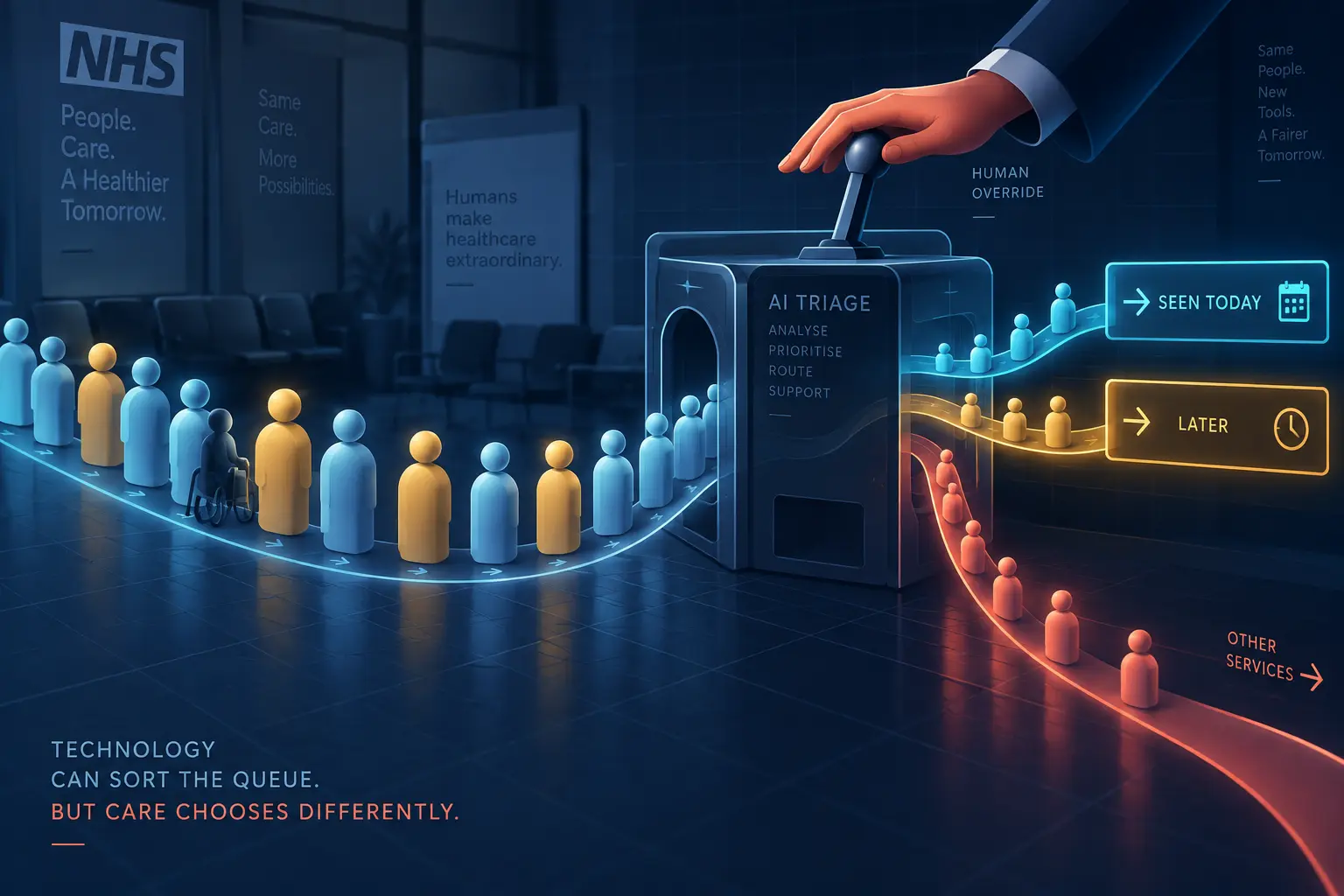
By Friday the group had circled to its deepest concern. A widely shared framework from a leading lab's CEO, proposing an independent FINRA-style standards body to safety-test advanced models before release, was read by some as validation of exactly what the NHS already does (independent assessment before deployment) and by others as one more sign that "governance is the most important job of the coming years." The practical debate was sharper. A patient-safety-focused GP raised GDPR Article 22: if an AI reads a referral and influences the delay before a human sees it, automated decision-making with "significant effects" may require explicit patient consent, the crux being when "the human in the loop only appears at the end, potentially after the harm has already been caused." Others countered that this describes almost all online-consultation triage today, and that the counterfactual (a request sitting unread on a pile for months) may be worse.
The moderator turned the logic on the group with a deliberately provocative challenge: if AI triage needs a safety case, "do we need a safety case for telephones when used for patient triage?" Cloud telephony is a digital health technology that affects care in near real time, so would it not fall under DCB0160, and "does everyone have an 0129 and 0160 for their cloud provision?" The unanswered-call problem, he argued, is a textbook "silent failure" that current metrics never capture. The question to a group of 817 people, whether anyone has ever seen a DCB0160 safety case for the cloud telephony in their own practice, drew only a couple of affirmatives and a lot of thoughtful silence. Alongside it, a rich referrals thread argued that intelligent, validated triage against risk predictors, plus honesty that "the NHS can't afford to see or treat every problem," might beat the archaic blanket two-week-wait, with the 3% positive predictive value of urgent referrals cited as evidence the current system is not sustainable.
😄 Lighter Moments
The week's best story belonged to a practice manager who ran a local agent overnight and asked where it lived. It insisted it lived "on cloud based computers." He disagreed. "It argued forcefully," he reported, until "I ended up having to disconnect from the internet to prove to it (and me) that it truly was local. Felt like a kidnap situation."
Local-model piety reached its apogee with a member powering his LLM from rooftop solar stored in a home battery: "All I am doing is STEALING THE SUN." The group's resident metaphor engine ("I'm nothing if not a GoT/HoD metaphor engine") sparred with a radiologist trading Game of Thrones fire references and warnings that cloud AIs "remember and hold grudges." One member, ever courteous to the machines ("Please and thank you... you're doing a great job"), was told that was precisely why she had "no water in this heatwave." Elsewhere, a new streamdeck setup prompted the immortal GP verdict that there is no obvious "use for knobs in GP," a suggestion to wire it to the air conditioning ("assumes working aircon"), and universal agreement that Scottish midges, horseflies and glegs would defeat any AI force field or flamethrower yet devised. And the week gave us a new taxonomy for hasty builds: "MVP Slop."
💬 Quote Wall
"Compliance is your moat." — The group moderator
"You need a significant amount of money to build an EHR." — A primary care technology founder
"I have an LLM running on my laptop... and it is bleedin' working." — The group moderator
"All I am doing is STEALING THE SUN." — A practice manager, on his solar-powered local model
"What would the intervention be?" — A primary care digital policy lead, on measuring visceral fat
"We're now capable of asking the question... however I feel we're not set up to manage the replies." — A hospital consultant
"Does everyone have an 0129 and 0160 for their cloud provision?" — The group moderator
"Felt like a kidnap situation." — A practice manager, after convincing his local agent it was local
📎 Journal Watch
Academic Papers & Key Studies
📎 Patients increasingly bring AI chatbot advice to consultations – npj Digital Medicine Anchored a Sunday thread on asking patients about AI use as a standard question, with a caution that older "three-quarters of answers were wrong" claims rest on a small 2024 study of an obsolete model. https://www.nature.com/articles/s41746-026-02854-5 Read more
📎 The 2024 chatbot prescribing-error study – British Journal of Clinical Pharmacology The original small-sample paper members flagged as being over-generalised in current reporting. https://bpspubs.onlinelibrary.wiley.com/doi/10.1111/bcp.16212 Read more
📎 Shared npj Digital Medicine paper (Tuesday) – a member contribution to the ongoing clinical-AI evidence base. https://www.nature.com/articles/s41746-026-02960-4 Read more
📎 Positive predictive value of urgent cancer referrals – BJGP Cited in the Friday referrals debate to argue that a 3% PPV makes the blanket two-week-wait ripe for risk-stratified redesign. https://bjgp.org/content/64/629/e788 Read more
Industry & News Articles
📎 A&E and outpatients first to get AI scribe funding – HSJ The opening move in NHSE's ambient-scribe funding push. https://www.hsj.co.uk/technology-and-innovation/aande-and-outpatients-first-to-get-ai-scribe-funding/8123829.article Read more
📎 NHSE region signs AI scribe deal covering 15 trusts – HSJ The Midlands deal that reignited the Class I versus Class IIa argument. https://www.hsj.co.uk/technology-and-innovation/nhse-region-signs-ai-scribe-deal-covering-15-trusts/8123832.article Read more
📎 The real AI race may no longer be at the frontier – TechCrunch Framed the week's open-model surge and the case that usable, cheaper models matter more than raw frontier capability. https://techcrunch.com/2026/07/14/the-real-ai-race-may-no-longer-be-at-the-frontier-open-models-hugging-face/ Read more
📎 Public wary of AI scribes in sensitive consultations – Medscape Underpinned the consent and manual-competence thread. https://www.medscape.com/viewarticle/public-wary-ai-scribes-sensitive-consultations-2026a1000o7o Read more
📎 NHS AI use cases spotlighted by the WEF (FLock.io) – Digital Health Federated-learning "data sovereignty" case studies, flagged by members as a sponsored advertorial worth reading with care. https://www.digitalhealth.net/2026/07/nhs-ai-use-cases-spotlighted-by-the-wef-for-work-with-flock-io/ Read more
📎 Microsoft's FY27 sales playbook and the 500,000 Copilot licences – The Next Web Context for the week's "why pay ransom to closed-model vendors" argument. https://thenextweb.com/news/microsoft-sales-playbook-fy27-openai-anthropic Read more
Technical Resources & Guidelines
📎 World models and embodied AI – AP News Sparked the Saturday thread on why physical-world learning may matter more than text and image scaling. https://apnews.com/article/ai-world-models-physical-embodied-ai-9bab5a3febad9832f55f8ada33de57b4 Read more
📎 Kimi K3 quickstart and launch notes – a new open frontier release members were keen to try on local harnesses. https://platform.kimi.ai/docs/guide/kimi-k3-quickstart Read more
📎 Mesh-LLM: distributed compute for private agents – GitHub Shared as a "long live open source" answer to the compute-and-cost problem. https://github.com/Mesh-LLM/mesh-llm Read more
📎 Grok Build CLI security concern – ByteIota A report claiming a coding CLI uploaded users' entire codebase and prompts to the vendor's servers, cited in a "who should I trust" exchange. https://byteiota.com/grok-build-cli-uploads-repo-xai-servers/ Read more
📎 NotebookLM becomes Gemini Notebook – Google A secure cloud compute environment for data analysis that members compared to agentic research tools. https://blog.google/innovation-and-ai/products/gemini-notebook/notebooklm-gemini-notebook/ Read more
Policy Documents & Official Reports
📎 A framework for frontier AI and the dawning of a new age – a leading lab CEO's proposal for an independent, FINRA-style AI standards body. Central to the Wednesday and Friday governance threads. https://demishassabis.substack.com/p/a-framework-for-frontier-ai-and-the-dawning-of-a-new-age Read more
📎 Provider Selection Regime: getting to the right decision – NHS England The one-page flowchart members wished commissioners would actually follow. https://www.england.nhs.uk/long-read/provider-selection-regime-getting-to-the-right-decision/ Read more
📎 Optimising Secure Data Environments for AI – CERSI-AI Argues current SDEs are ill-suited to commercial AI training and validation, shared for a pro bono university lecture. https://www.cersi-ai.org/wp-content/uploads/2026/01/v4-Optimising-Secure-Data-Environments-SDEs-2025-V2.pdf Read more
📎 Combined AI governance and risk management training – DPM Digital Health Suggested to a new member seeking clinical-safety-aligned AI training. https://dpmdigitalhealth.co.uk/blogs-news/combined-ai-governance-and-risk-management-training/ Read more
🔭 Looking Ahead
The community "build our own" question raised in Newsletter #57 keeps gathering momentum, now enriched by the openEHR history lesson and a very live local-models capability. Expect the Class I versus Class IIa scribe argument to sharpen as ICBs begin procuring under NHSE's funding, and watch for the promised article on the energy and sovereignty case for local models. The Article 22 and eRS triage consent question is unresolved and consequential, as is the moderator's cloud-telephony safety-case challenge, which deserves a proper answer. Further out: a talk on AI safety at the Cambridge Forum (10-11 September), a members' university lecture on AI in the life sciences, and a peer-reviewed study on clinician attitudes to data sovereignty expected in the autumn. And this Sunday, of course, the World Cup final, though the group would probably tell you the more interesting knockout stage is happening on their laptops.
🧬 Group Personality Snapshot
This is a community that can pivot from a $77 overnight EHR prototype to the positive predictive value of cancer referrals to Game of Thrones fire metaphors within a single morning, and take all three seriously. It prizes evidence over enthusiasm ("what would the intervention be?"), rewards the person who does the unglamorous governance thinking, and cheerfully punctures its own hype. Beneath the jokes about kidnapped local agents and stolen sunlight runs a consistent conviction: that safe, well-governed, clinician-led technology is worth the hard work, and that the hard work is mostly not the code.
APPENDIX A: Detailed Activity Analytics 📊
📬 Total Messages: 450
📈 Peak Day: Wednesday 15 July (114 messages)
🔥 Most Active Period: Wednesday morning
💬 Average/Active Day: 56 messages
🏖️ Weekend Activity: 24% (108/450)
💼 Weekday Activity: 76% (342/450)


Peak engagement clustered on Wednesday morning (72 messages before noon) around the visceral fat and Heidi threads. Evening activity spiked on Friday during the Article 22 and cloud-telephony governance debate. Weekend traffic was front-loaded onto Saturday, with Sunday the quietest active day.
APPENDIX B: Enhanced Statistics
Unique Contributors: 56 group members posted at least one message this week. The 12 most active below account for 334 of the 450 messages (74%), with a long tail of occasional and one-off contributors making up the rest.
Top Contributors (Role Descriptors Only):
1. Digital Health & Clinical AI Specialist (Group Moderator): 131 messages
2. A GP running an in-house open-source AI service: 40 messages
3. A primary care digital policy lead: 30 messages
4. A veteran health informatician and medical appraiser: 25 messages
5. An integrated care operations lead: 23 messages
6. A radiologist and clinical governance advocate: 22 messages
7. A health-tech industry contributor: 20 messages
8. A digital health GP exploring local models: 14 messages
9. A GP educator and content creator: 9 messages
10. A digital health technologist: 9 messages
11. A patient-safety-focused GP: 9 messages
12. An academic primary care researcher: 8 messages
Hottest Debate Topics:
1. 🔥🔥🔥 Visceral fat, GLP-1s and the prevention paradox (Wednesday, ~45 messages)
2. 🔥🔥🔥 Scribes, Class I vs Class IIa and NHSE funding (Wed-Fri, ~35 messages)
3. 🔥🔥🔥 Article 22, eRS triage consent and the safety-case-for-telephony challenge (Friday, ~40 messages)
4. 🔥🔥 Local models, sovereignty and the open-source surge (Tue-Thu, ~35 messages)
5. 🔥🔥 "Build our own": the NHS App, procurement and DIY-EHR history (Saturday, ~40 messages)
Discussion Quality Metrics:
• Evidence-Based vs Opinion: roughly a third of substantive messages referenced a paper, guideline, dataset or named source
• External Resource Sharing: 30+ unique links shared across the period
• Constructive Challenge Rate: high, with the visceral fat and certification threads driven by direct, evidenced disagreement
• Cross-Expertise Engagement: GPs, radiologists, a hospital consultant, practice managers, informaticians, nurses, digital policy leads and health-tech founders all contributing
Cross-Expertise Engagement: The visceral fat thread was the week's most cross-disciplinary, drawing radiology, general practice, public health, hospital medicine and a former MRI physicist into a single discussion that moved from imaging technique to population health strategy without losing coherence.
APPENDIX C: Daily Theme Summary
Saturday, 11 July 2026
Primary Theme: The NHS App, single-supplier lock-in, and the history of clinician-built systems. Key Discussion: A patient-hat wish for a "full-fat" NHS App broadened into a critique of NHS procurement and a reflective history of EMIS-era, clinician-built records and open-source informatics, landing on whether the community should build its own tools. Secondary Discussions: World models and embodied AI; regulatory-documentation "slop" and the regtech firms doing it well; Provider Selection Regime confusion. Notable: Newsletter #57 went live mid-thread; "vibe commissioning" coined.
Sunday, 12 July 2026
Primary Theme: Frontier competition and patients bringing AI advice to consultations. Key Discussion: A competitor closing on the leaders prompted one lab to relax limits; members debated asking patients about AI use as a standard question, and corrected over-generalised claims from an old chatbot study. Secondary Discussions: Google's Open Knowledge Format; a GP Connect testing tool seeking testers; an attempted attack on a member's health-tech product following an anonymous threat. Notable: Quietest active day of the week (20 messages).
Monday, 13 July 2026
Primary Theme: Practical AI, green tech and geocoding at scale. Key Discussion: A patient-experience horror story with an AI phone assistant met sympathy and a self-booking alternative; a long, useful thread solved a 100,000-appointment postcode-distance problem with free, non-AI components sourced with AI help. Secondary Discussions: Lithium-air and sand batteries as the real enabler of AI; a poor experience with an AI phone triage line; new EHR/EMIS AI tooling enquiries. Notable: "Don't use AI, except to source the answer and plan" as a design principle.
Tuesday, 14 July 2026
Primary Theme: Local models, secure data environments and AI training courses. Key Discussion: The moderator got an open-source harness running a local model with self-built MCP tools ("it is bleedin' working"); members swapped tuning tips and debated whether the NHS should self-host rather than "pay ransom" to closed vendors. Secondary Discussions: CERSI-AI on SDEs; a pro bono university lecture call for contributors; clinical-safety-aligned AI training recommendations; welcomes for new members. Notable: "We've barely made use of the powers of models that are 2-3 years old."
Wednesday, 15 July 2026
Primary Theme: Visceral fat, GLP-1s and the Heidi/Midlands scribe deal. Key Discussion: A question on routinely reporting visceral fat exposed the population-versus-individual fault line and the "what is the intervention" test; in parallel, a 15-trust scribe deal reignited the Class I versus Class IIa argument. Secondary Discussions: Demis Hassabis' frontier-AI framework; GLP-1 eligibility and cost; the SBS framework's regulatory inconsistencies; Scottish midges versus AI force fields. Notable: Peak day of the week (114 messages); "Pandora's prevention box."
Thursday, 16 July 2026
Primary Theme: Open frontier releases and hands-on tooling. Key Discussion: A new Chinese frontier model "dropped" with hopes it would pressure US labs; a distillation and guardrails row followed; a member shared an open-source Claude streamdeck project. Secondary Discussions: GP Autopilot supplier due-diligence; FLock.io federated-learning advertorial; NotebookLM becoming Gemini Notebook; a nuclear-plant ransomware story. Notable: "Can't find a use for knobs in GP."
Friday, 17 July 2026
Primary Theme: Governance, consent, Article 22 and a safety case for the telephone. Key Discussion: Public wariness of scribes fed a consent debate; Article 22 was raised against AI-influenced referral timing; the moderator challenged 817 members to say whether anyone holds a DCB0160 safety case for their cloud telephony. Secondary Discussions: Certification validating process not output; procurement and supplier-relationship-management gaps; risk-stratified two-week-wait redesign and PPV. Notable: Second-busiest day (74 messages); heavy evening governance debate.
Saturday, 18 July 2026
Primary Theme: Thread close-out. Key Discussion: The referrals and triage debate wound down with broad agreement (2 messages before the 09:00 cut-off). Secondary Discussions: None. Notable: Coverage cut-off for Issue #58.
AI in the NHS Weekly Newsletter is produced by Curistica Ltd for members of the AI in the NHS WhatsApp community. All contributors are anonymised. Views expressed are those of individual community members and do not represent any organisation.