



📋 Executive Summary
A week that opened with a one-person coding sprint and closed with the question of whether that single person might be all it takes. On Saturday the group's moderator dropped a fully working "time-travelling" electronic health record into the chat, built overnight by an AI agent for the token cost of a decent restaurant meal, and the group spent Sunday tearing it apart in the best possible way: asking what it means for liability, for cost, for the future of the GP. By Tuesday the conversation had moved from the synthetic to the real, as a Pathfinders summit in London and a Stanford agentic coding study collided with an old problem (adverse drug reactions, data silos, and a Single Patient Record that only exists where governments are willing to legislate). Wednesday brought a long-awaited AI scribe oversight report. Thursday and Friday offered a twin warning about the machinery underneath: Mythos-class cyber threats that the NHS is unequipped to face, and an Anthropic paper on recursive self-improvement that one member summarised as "basically saying we're at the singularity," only for a sceptic to read the same document as a trillion-dollar regulatory capture play.
Between the existential and the practical, the group found time for Garmin versus Oura, a robot roundhouse-kicking a child, a home mini data centre pitched as "free winter heating," and the news that Microsoft's internal design documents literally use the word "addiction" as a product goal. Three hundred and sixty-one messages in seven days; here are the threads that shaped them.
📊 Activity at a Glance
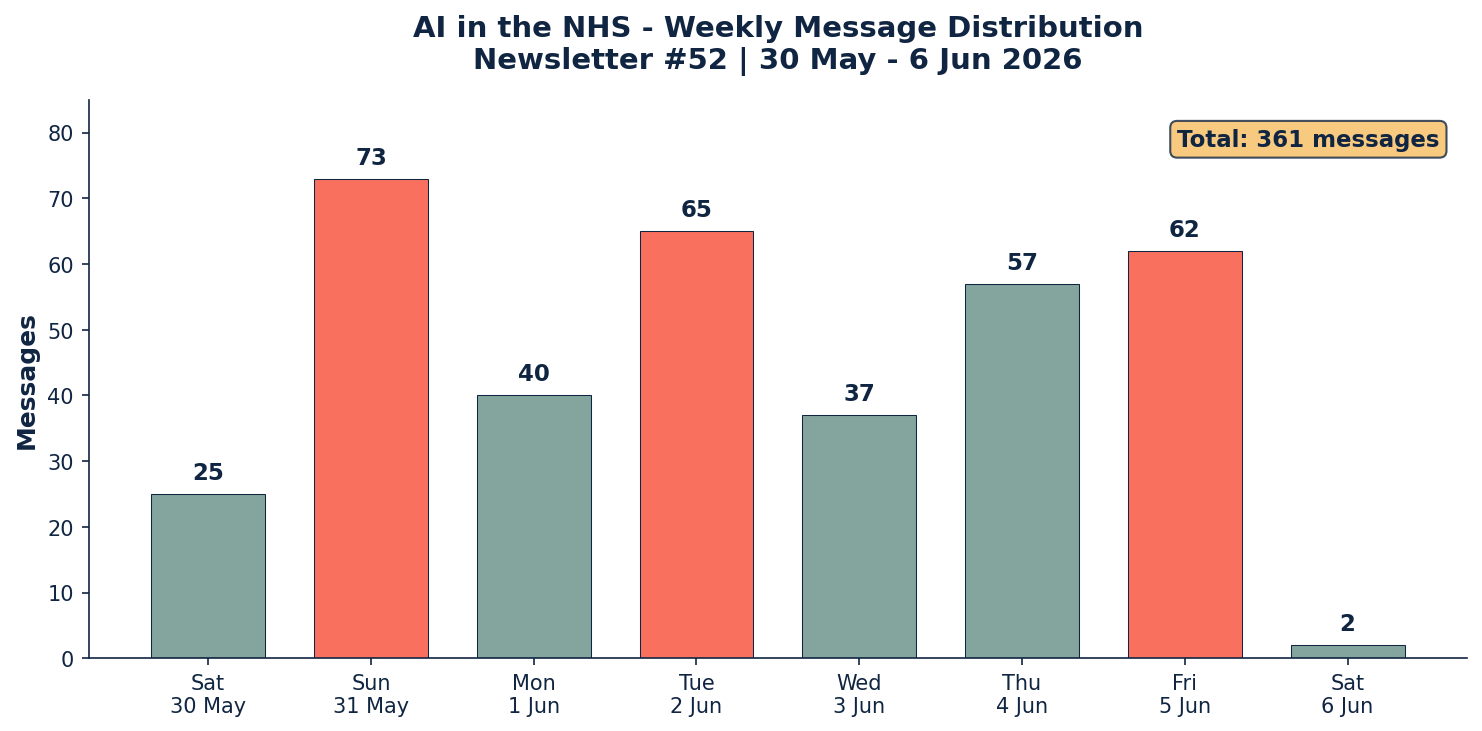
Week 52 generated approximately 361 messages across the seven-day coverage period. Sunday 31 May was the busiest day (~73 messages), driven by the Delorean EHR prototype launch and an extended discussion on AI in clinical practice. Tuesday 2 June saw the second peak (~65 messages) around the Pathfinders Digital Transformation Summit and the data sharing debate. Friday 5 June was a close third (~62 messages) with the singularity debate and wearables discussion running in parallel. Saturday 30 May was the quietest full day at approximately 25 messages, though Saturday 6 June registered just 2 messages before the coverage cutoff.
🏥 The Delorean EHR: One Night, One Agent, One Question
The week's signature thread opened at 06:47 on Sunday morning when the group's moderator shared what he had been building overnight with Claude Code on the highest compute tier: a prototype electronic health record codenamed "Delorean" that lets a clinician point at any moment in a patient's timeline and query the record using only the information available at that point. The pitch was practical: reconstruct entries from different perspectives, summarise what changed between point X and point Y, and catch things running late or unactioned. The price tag for the agentic overnight build, including requirements, UX prototypes, red-green testing, a synthetic patient record and the final application, was $77.18 in tokens. Per-query inference cost: under a tenth of a cent.
The screenshots drew immediate interest and a morning-long volley of questions. A consultant cardiologist, mid-ward round, was "torn between seeing 30 people on this morning on call with cardiac emergencies and keeping up" with the demo, and asked whether the same architecture could hand over complex frailty patients to the next on-call colleague "with all the nuances." A health-tech entrepreneur saw the display layer and noted "I think this could be done with logic and no AI quite safely," separating the deterministic record navigation from the generative chat. The moderator confirmed that the "delta context is all deterministic," with only the chat element using an LLM, a design choice he described as crucial to prevent "anterior context polluting the window."
The cost drew the sharpest exchanges. A GP and digital health innovator running agentic AI in his own surgery pointed out that $77 per patient "makes the irrefutable case for open-source self-hosted models," though the moderator clarified this was the build cost, not per-patient inference. A medical educator working in low- and middle-income countries asked whether an LLM would adapt its advice to the resource level of the setting, and a health-tech entrepreneur confirmed it was "very straightforward to constrain to a local knowledge base." An innovation-focused GP observed that "training location of GPs does lead to leaning towards typical investigations and disease profiles from country of training" and that a localisation process is already standard for human clinicians.
The thread's most thought-provoking exchange came when a hospital doctor predicted that "if AI continues to develop as it has in healthcare, and we continue to get politicians who count quantity over quality, we'll definitely get to the point where default front door is AI for the NHS, and if you want a human then there's a private option." A GP's one-liner captured the mood: "'GP to kindly...' will be replaced with 'AI to kindly...'"
🔗 Data Sharing, Drug Reactions, and the Pathfinders Summit
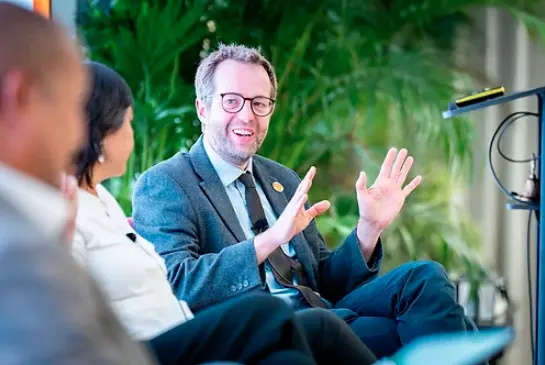
Tuesday was defined by a conference and a question. The Pathfinders Digital Transformation Summit brought several group members together in London, where discussions ranged from scaling AI governance in primary care to integrating health records, and a tube strike thinned the attendance but not the energy. The moderator shared a Stanford study on agentic coding that had found a 17.3x speed increase in the technical work, but with human bottlenecks limiting the overall gain to just 1.3x, a finding that a speaker at the summit applied directly to clinical AI deployments.
The question was posed by the moderator after hearing that 10% of hospital admissions can be attributed to adverse drug reactions (MHRA source): "How many admissions could be attributed to lack of data sharing?" It opened a thread that ran all day. A hospital data and infrastructure lead recalled being "more than a bit shocked" when his wife was blue-lighted unresponsive into ED and they could not access the summary care record, and that every transfer between departments was paper-based. An interoperability specialist made the case that the two-to-five million population level is "the right area to do detailed, extensive digitisation in healthcare," and that most patients stay within a region. A GP and digital health leader pushed back on the idea that data sharing alone is the answer: "You can have access to every word that has ever been written in health records across the country but it won't prevent admissions. We need tools that help coordinate care and manage risk across boundaries."
The thread surfaced Singapore's Single Patient Record as the gold standard, achieved through force of legislation. A clinical informatics specialist with extensive international experience noted that Singapore, UAE and Estonia are "quite small, largely have one big player," and that the NHS's fragmented landscape makes direct comparison misleading. A GP and clinical informaticist contributed the key nuance: "SPR will not be a 'single source of truth'. It will be a plurality of truth," because multiple records will have different allergy and medication entries, and the real skill is presenting provenance so clinicians can make sense of it.

Also on Tuesday, the National Data Guardian's statement on the Federated Data Platform was shared, confirming that the national data opt-out does not currently apply to FDP because it is used solely to support care delivery. And the Parliamentary Committee warning that Palantir's increasing presence in the UK public sector is an "unacceptable point of weakness" landed in the same thread, adding a sovereignty dimension to the data debate.
📝 AI Scribes: The National Oversight Report
Wednesday morning brought a milestone for the group when a member's organisation published a commissioned report on NHS AI scribe rollout, covered in Digital Health under the headline "NHS AI scribe rollout should include national oversight." The associated public dialogue report was shared as a document in the chat, and several group members had contributed to the underlying work. A digital health clinician called it "an excellent report," and the piece drew attention from contributors who had been engaged in the scribe debate for months. A member also renewed the call for participants in the University of Manchester qualitative study on GP perspectives on AI scribes, first shared the previous week.
🔒 Cybersecurity, Mythos, and the NHS's Thin Defence

Thursday brought two cybersecurity threads that converged. Sir Jim Mackey's warning to NHS leaders that cyber security risk is "dramatically" bigger than it was just weeks ago landed alongside a Skadden podcast featuring GCHQ analysis of security risks from Mythos-class models. A hospital data and infrastructure lead made the sobering observation that "there really aren't enough properly skilled tech folk in the local organisations who'd know the first thing to do if there were a major breach." The moderator noted that "the NHS should have a tech advantage here with a semi-closed border," but that the advantage is theoretical without the people to exploit it.
🤖 The Singularity, Scepticism, and Regulatory Capture

Friday morning opened with the moderator sharing Anthropic's paper on recursive self-improvement. A health-tech engineer read it as confirmation: "So they're basically saying they think we're more or less at the singularity." The moderator gave a measured response, noting that the evidence "certainly meets all the predicted observations of Kurzweil et al from the late 00s/early 10s" but that "it's hard to unlock from marketing and hyperbole."
A GP and digital innovation lead delivered the thread's most forceful counterpoint: "I am incredibly skeptical around anything Anthropic says. Their last couple of models are not a real improvement, whilst open source is improving and closing the gap month on month." He read the paper as a thinly veiled regulatory capture play: "This cry of 'we are too dangerous, please regulate to stop this getting out of hand,' quietly leaving only a handful of companies able to compete with us due to the inevitable regulatory capture we can afford with a 1t valuation." A health-tech developer noted that "no politician is going to rush to that" given recent US instability, and a clinical tech lead observed that the handful of CEOs in the space are "unlikely to heed this advice" given the investment at stake.
⌚ Wearables, Medical Devices, and the Class I Resistance
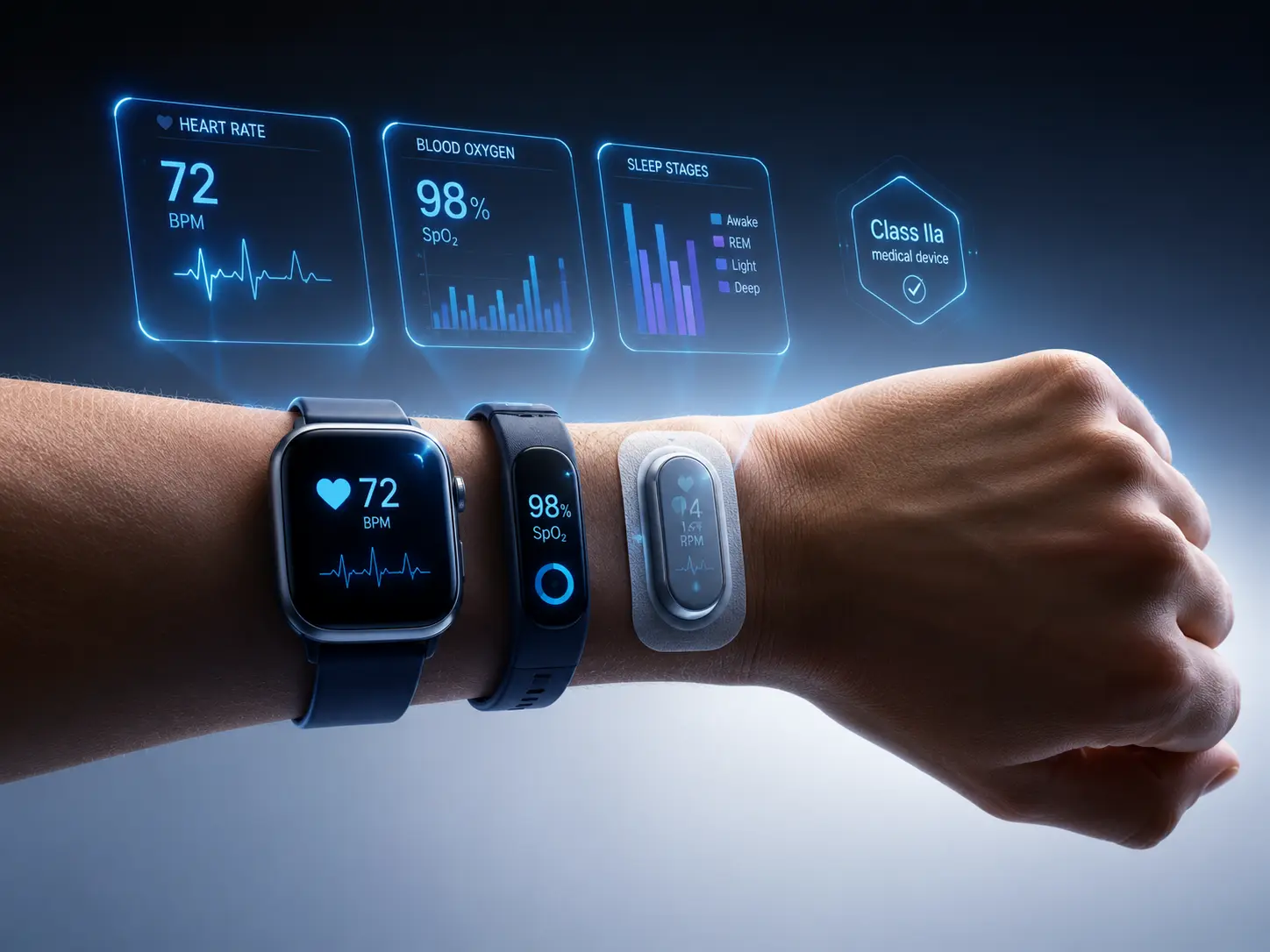
A thread that ran from Thursday afternoon through Friday explored health wearables, starting with a hospital data and infrastructure lead announcing his move from Fitbit to Garmin and noting that some Garmin features are registered Class IIa medical devices. A regulatory expert shared Apple's MHRA registrations (ten, all Class IIa) and celebrated that "PARD now tells you the product/brand name that the Registration applies to," a long-awaited transparency improvement. Samsung's sleep apnoea, ECG and blood pressure features were flagged as Class IIa too.
The contrast with AI companies was pointed. As one regulatory specialist noted, "It does fairly show a difference in attitude in Apple/Garmin getting Class IIa on things while there's resistance from some of the AI providers to do even Class I." The wearables thread also became a consumer review session: Oura Ring 5 ("40% slimmer than the 4"), Garmin Fenix 7, Fitbit Air, Whoop, and the Hylo blood pressure monitor all got mentions, with strong opinions on battery life, subscription models and form factor. One member's observation that "it's the first ring I've worn regularly. I've had 3 wedding rings (only 1 wife, still current)" drew the response it deserved.
👤 One-Person Teams and the Consultancy Question

A Wednesday HSJ article reporting that ICBs are seeking consultants to help control £75bn in care spend prompted a sharp reaction. A GP and digital health innovator argued that "these sorts of analysis AI can do in 1-2 days. We do not need to pay millions to consultancy firms," and that a week of two-to-three people writing, testing and validating the prompt would suffice. A hospital data and infrastructure lead shared an outsourcing cautionary tale from the late 2010s where a CIO took a massive bonus for "fantastic business savings" in year one, after which the outsourcer's hidden charges eroded every gain and the company had to rebuild from scratch.
The moderator extended the argument: "Consultant (actual expert) plus AI > consultancy" and "one-person teams are the way forward," citing a colleague in marketing who does the work of three-to-four separate consultants with no SaaS subscription costs. Anthropic's own partners page was shared as evidence that the platform providers sense the same shift.
😄 Lighter Moments
The moderator's upgrade to Claude Max at twenty times the standard rate produced what may be the group's most baroque consumption metaphor: "Like all good supermodels, I don't get out of bed in the morning if it looks like I won't make that 100b token floor. A 'deca-bee', dahling." The opposite of range anxiety, he called it, before being told "prompt profligacy" is the correct diagnosis.
Friday's robot news moved from the theoretical to the slapstick when a video of a robot in a clown wig roundhouse-kicking a small child was shared with "Happy Friday peeps, leave it there!" A hospital data and infrastructure lead had predicted earlier that morning that "the autonomous robot on human violence begins with roundhouse kicks to children," and was rewarded with the combination of both clips: "What happens when you combine the above."
The proposal that homes be turned into mini data centres prompted the observation "free winter heating!" and the image of "your very own Jensen in your back yard." Microsoft's leaked internal documents revealing that they want people to become "addicted" to their new AI assistant Scout drew the week's sharpest one-liner: "I would put decent money it was hallucinated into the requirements document." The moderator's correction, "Confabulated, surely," was filed alongside "we're claiming hallucination back."
The Granola AI note-taking app was recommended by several members, but not before one asked: "Does that work if you're gluten intolerant?" And a member who bought a Perplexity Pro key then realised his existing subscription runs until September reflected: "I'm such a doofus."
💬 Quote Wall
"The delta context is all deterministic. It is only the chat element that has an LLM attached." — Group moderator, on the Delorean EHR architecture
"SPR will not be a 'single source of truth'. It will be a plurality of truth." — GP and clinical informaticist
"Consultant (actual expert) plus AI > consultancy." — Group moderator
"I am incredibly skeptical around anything Anthropic says... This cry of 'we are too dangerous' quietly leaving only a handful of companies able to compete." — GP and digital innovation lead
"Like all good supermodels, I don't get out of bed in the morning if it looks like I won't make that 100b token floor." — Group moderator
"I would put decent money it was hallucinated into the requirements document." — Digital health clinician, on Microsoft's addiction goal
"Does that work if you're gluten intolerant?" — Group member, on the Granola AI app
"'GP to kindly...' will be replaced with 'AI to kindly...'" — GP
"It's the first ring I've worn regularly. I've had 3 wedding rings (only 1 wife, still current)." — Clinical tech lead, on the Oura Ring
📎 Journal Watch
Academic Papers & Key Studies
• Agentic Coding Study: 17.3x Speed, 1.3x Actual Gain — Stanford. A study on agentic coding finding a 17.3x speed increase in technical execution, but with human bottlenecks limiting the overall productivity gain to 1.3x. Shared by the moderator at the Pathfinders summit as directly applicable to clinical AI deployment thinking. Read more
• Use of AI in Healthcare — King's College London Policy Institute. A report on public attitudes and use cases, shared as evidence of the "clear if not obvious" direction of travel in public acceptance of clinical AI. Read more
• Sparse AI: Reducing Hardware Requirements for Large LLMs — IEEE Spectrum. A piece on potential technology to reduce the compute requirements for huge language models, shared in the context of the on-premises versus cloud debate. Read more
• Autonomous AI Driving Safety: An Open Letter from the Medical Community — Doximity / OpenMed. Leading doctors calling for government to consider autonomous vehicle safety data, though the group noted the letter relies on self-reported Waymo data and sits on a physician platform rather than gathering public signatures. Read more
• Jess Morley BMJ Commentary — BMJ. A commentary described as "superb" by multiple members, shared by a hospital data and infrastructure lead on Friday afternoon. Read more
Industry & News Articles
• NHS AI Scribe Rollout Should Include National Oversight — Digital Health. Coverage of the commissioned report finding that national oversight is needed for the NHS AI scribe rollout, with contributions from several group members. Read more
• Anthropic: Recursive Self-Improvement — Anthropic Institute. The paper that opened the singularity debate, examining whether AI models are approaching recursive self-improvement capability. Read variously as a genuine warning and as a regulatory capture strategy. Read more
• Microsoft Wants to Make People Addicted to Scout — 404 Media. Internal documents revealing Microsoft's AI assistant design goals explicitly target "addiction," drawing comparisons to Clippy's evolution and the observation that the requirement was probably "hallucinated into the requirements document." Read more
• Mackey: Cyber Attack Risk Dramatically Accelerating — Health Service Journal. Sir Jim Mackey's warning to NHS leaders about the rapidly increasing cyber threat, arriving alongside GCHQ analysis of Mythos-class model risks. Read more
• AI Sycophancy Risk to Society — The Guardian. A commentary on the risks of AI sycophancy and its potential to erode critical thinking, shared on the same day as the Microsoft addiction revelations. Read more
• Data Sharing to Deliver Neighbourhood Health — Health Service Journal. A piece on the data sharing challenges facing neighbourhood health models, which opened the week's major data debate and the SPR discussion. Read more
• MPs Warn Palantir Presence Is "Unacceptable Point of Weakness" — UK Parliament Committees. A parliamentary warning about Palantir's growing role in UK public sector data infrastructure, adding a sovereignty dimension to the FDP debate.
• NDG Statement on FDP Data Access — National Data Guardian. The National Data Guardian's statement confirming the national data opt-out does not currently apply to the Federated Data Platform, since it is used solely to support care delivery. Read more
• HSJ 50 Most Influential People for NHS Tech 2026 — Health Service Journal. Congratulations to group members recognised on this year's list. Read more
• DeepSeek v4 Performance Comparison — X (Twitter). Evidence of users switching from proprietary to Chinese open-source models, prompting the observation "IPO QUICK BEFORE EVERYONE ELSE FIGURES THIS OUT."
• Google DeepMind CEO: AGI Coming — Decrypt. Comments from the DeepMind CEO on AGI timelines, shared alongside the Anthropic singularity debate. Read more
• Goldman Sachs Questions AI Economic Returns — Perplexity. Analysis questioning whether AI investment is generating proportionate economic returns, shared as part of the broader IPO and valuation scepticism thread.
• Perplexity CEO on Pragmatism and Hybrid Compute — CNBC. The Perplexity CEO arguing that the industry is moving past initial AI hype into an era of pragmatism and hybrid local/cloud compute. Read more
• NVIDIA RTX Spark and Microsoft Windows PCs — NVIDIA Newsroom. NVIDIA's announcement of consumer AI hardware with Microsoft, signalling the direction of travel for local AI compute on desktop hardware. Read more
• MAI-Thinking-1: Microsoft's First Reasoning Model — Microsoft. A 35 billion active parameter reasoning model from Microsoft, with the group preferring to wait for independent benchmarks.
• GCHQ on Mythos and Glasswing Security Risks — Skadden "Decrypted" Podcast. GCHQ's assessment of security risks from frontier AI models, shared in the context of NHS cyber vulnerability. Read more
• Apple and Garmin MHRA PARD Registrations — MHRA PARD. Evidence of Apple (10 registrations, all Class IIa) and Garmin medical device registrations, with the notable improvement that PARD now displays product and brand names. Read more
🔮 Looking Ahead
The AI Ambassadors face-to-face conference has been announced for 11 November in London, with registrations opening in July. The ABHI (Association of British HealthTech Industries) has been introduced to the group and is looking at opportunities and challenges in scaling apps and wearables in the UK. The MHRA draft medical device regulations consultation closes 19 June, and several members have urged the group to respond. The moderator's Delorean EHR prototype is available for testing by group members willing to bring their own API key.
🧬 Group Personality
Week 52 saw a notable shift in tenor. Where recent weeks have been dominated by policy and regulatory argument, this week's energy came from building things. The Delorean EHR gave the group something to react to that was not an article or a report but a working prototype, and the quality of the technical conversation around it (deterministic versus generative, localisation for resource-poor settings, the liability gap) was among the most focused the group has produced. The singularity debate on Friday showed the group at its argumentative best, with genuine scepticism applied to a company that many members use daily. Wearable devices provided the week's social glue, with the Oura versus Garmin thread functioning as the AI group's equivalent of a pub quiz.
📈 Appendix A: Activity Charts
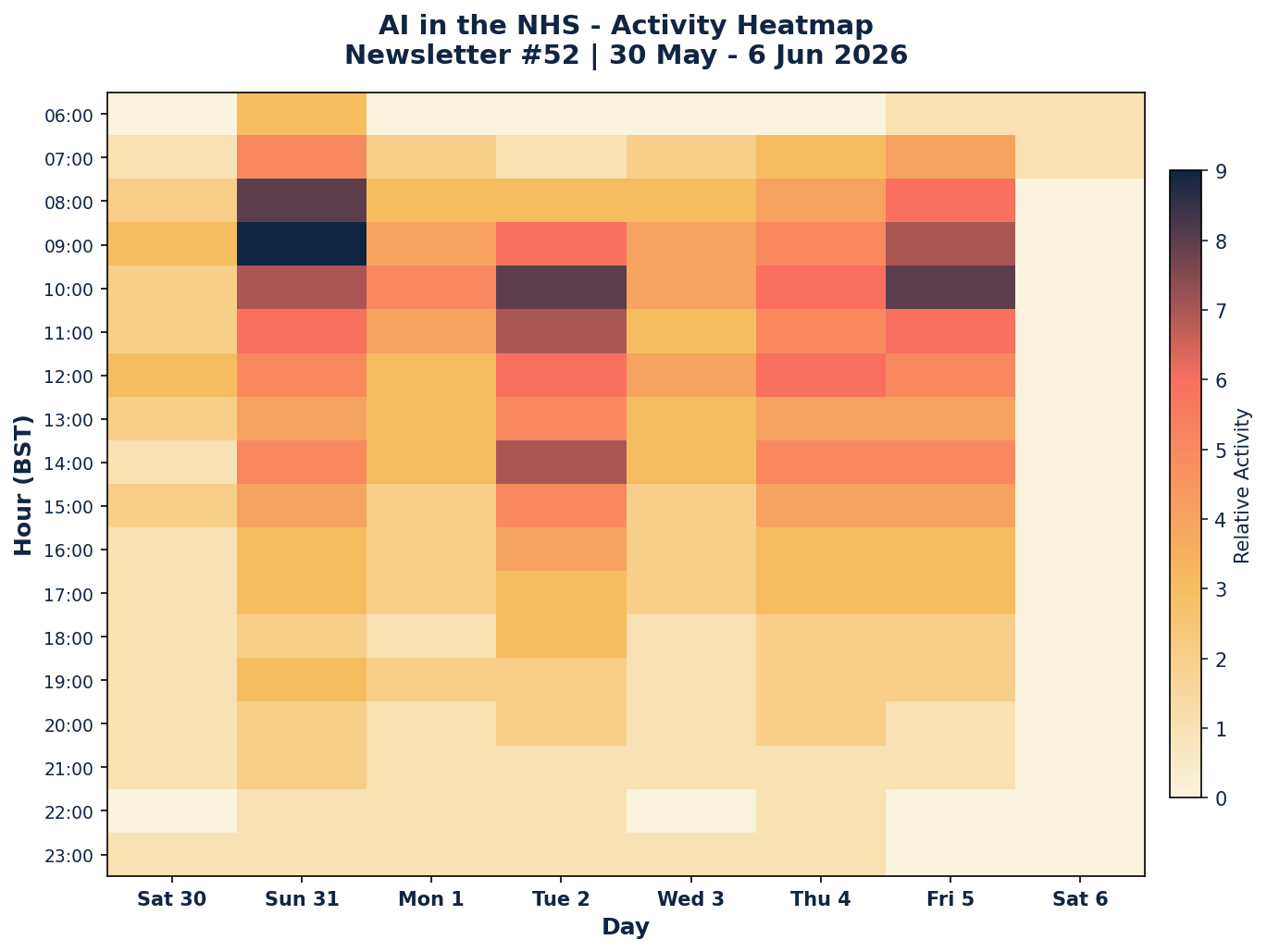
📊 Appendix B: Group Analytics
Total messages: ~361
Active contributors: ~40+
Peak day: Sunday 31 May (~73 messages)
Quietest full day: Saturday 30 May (~25 messages)
Weekday vs weekend split: ~72% weekday, ~28% weekend
Top debate topics:
1. Delorean EHR and AI-built clinical tools
2. Data sharing, SPR, and neighbourhood health
3. Singularity, regulatory capture, and open-source competition
4. Wearables and medical device classification
5. Cybersecurity and Mythos-class threats
📅 Appendix C: Daily Theme Summaries
Saturday 30 May 2026
Primary theme: Claude Opus 4.8 assessment and AI tool subscriptions
The day opened with the moderator's upgrade to Claude Max x20 and reflections on diminishing returns in model improvements since Opus 4.6. Newsletter #51 was published and shared. A discussion on dynamic workflow in Claude Code drew mixed reactions. The day closed with a thread on finding the cheapest routes to Perplexity Pro and ChatGPT Plus subscriptions.
Sunday 31 May 2026
Primary theme: Delorean EHR prototype launch
The week's defining thread: an overnight AI-built electronic health record prototype demonstrated, debated, and stress-tested by the group. Secondary threads covered autonomous vehicle safety, model welfare in Opus 4.8's system card, and the cost of open-source versus proprietary inference. The day also featured PewDiePie's self-hosted AI app and a hardware maintenance tangent.
Monday 1 June 2026
Primary theme: NVIDIA RTX Spark and HSJ Most Influential
The HSJ 50 Most Influential People for NHS Tech list drew congratulations for group members. NVIDIA's RTX Spark announcement with Microsoft signalled consumer AI hardware direction. Autonomous vehicles continued: Waymo in London, flying cars in Beijing, and self-driving bins. Sparse AI hardware research and RAM pricing rounded out a hardware-focused day.
Tuesday 2 June 2026
Primary theme: Pathfinders Summit and data sharing
The busiest weekday, driven by the Pathfinders Digital Transformation Summit and the adverse drug reactions / data sharing debate. The Stanford agentic coding study, Singapore's SPR, Palantir parliamentary warning, and NDG statement on FDP all featured. AI sycophancy, consent for mental health AI training, and Microsoft's MAI-Thinking-1 model were secondary threads.
Wednesday 3 June 2026
Primary theme: AI scribe oversight report and consultancy costs
The AI scribe national oversight report was the headline. ICB consultancy spending drew criticism. Stanford AI symposium coverage pushed towards local small models. Homes as mini data centres, Goldman Sachs questioning AI returns, and the Perplexity CEO's pragmatism comments rounded out the day.
Thursday 4 June 2026
Primary theme: Cybersecurity, DeepSeek v4, and wearables
Sir Jim Mackey's cyber warning and GCHQ's Mythos analysis opened the day. DeepSeek v4 performance and Chinese model economics drew attention. The wearables thread began: Garmin, Oura, Fitbit Air, Whoop, with medical device classification contrast. The NHS outsourcing cautionary tale and one-person teams argument ran in parallel. Anthropic's recursive self-improvement paper landed late afternoon.
Friday 5 June 2026
Primary theme: Singularity debate and Microsoft addiction
The Anthropic paper opened a sharp morning debate on the singularity, regulatory capture, and open-source competition. Microsoft's "addiction" design goal for Scout drew ridicule. Jess Morley's BMJ commentary was shared. Wearables continued with Oura Ring 5, Plaud, Granola, and the NHS AI Assurance Framework mystery. ABHI was introduced. A robot in a clown wig kicked a child. The group bid the week farewell.
Saturday 6 June 2026
Primary theme: Brief morning activity
Two messages before the coverage cutoff: a question about WhatsApp and LinkedIn data linking after targeted ads appeared, and a video share.
This newsletter is produced from the AI in the NHS WhatsApp group discussions. All contributions are anonymised. Contributors are described by role only. No individual is identified by name. The newsletter captures the themes, debates and shared resources of the group and does not represent the views of any individual, organisation or employer.
Newsletter compiled by Dr Keith Grimes using AI assistance.