

Executive Summary
This week the group threw itself into a sprawling set of debates that cut right to the heart of how the NHS uses technology. A deep-dive into the architecture and value of NHS 111 Pathways opened the period, before conversations shifted to the rumoured central NHS deal for ambient voice technology with Microsoft and whether such procurement serves the long-term interests of UK health tech sovereignty. The publication of a jailbreak report on a leading clinical AI scribe provoked fierce discussion about penetration testing and clinical safety assurance. Throughout the week, members shared their experiences building local LLM rigs, running autonomous agents, and vibe-coding their way through side projects, whilst policy announcements on the Neighbourhood Health Framework, AI copyright, and the Federated Data Platform kept the group on its toes.
Activity at a Glance
Week 41 generated 585 messages across 8 days with peak activity on Wednesday 18 March (134 messages). Weekday discussions edged ahead at 56.4% of traffic versus 43.6% at the weekend, with Saturday 14 March (106 messages) and Tuesday 17 March (92 messages) also posting strong numbers. A total of 73 messages contained links, reflecting the group's commitment to evidence-sharing.
📌 Major Topics
1. NHS 111 Pathways: Decision Trees, Data Lakes and the Case for a National Treasure
Saturday 14 March saw an extended, deeply technical exchange about the architecture behind NHS 111, prompted by a group member seeking clarity for a report. A senior 111 leader provided a masterclass on the system's design, explaining that while it uses decision trees, calling it purely "deterministic" undersells the complexity.
"It's a decision tree. But I still wouldn't say it's truly a deterministic model." — Senior NHS 111 leader
The discussion explored how clinical triage is sifting and sorting rather than pure diagnosis, how outcome data is fed back every eight weeks, and how 30% of triage traffic now runs through 111 Online. An urgent care clinician highlighted that their ARI hub achieved a 98% intervention rate this winter, proudly noting the value of using 111 data for service improvement.
The conversation continued into Sunday and beyond, with members debating whether healthcare demand is truly infinite. A health economist working on a paper argued that the evidence shows demand is finite, challenging the prevailing orthodoxy. A senior triage specialist countered that demand and need are not the same thing, and that operationalising "left shift" requires engaging people in self-care.
"For those who say demand is finite, I should remind them distance to moon is finite and measurable. However we have only reached the moon only a handful of times." — Innovation-focused GP
Several members shared academic papers on 111 outcomes and demand modelling, making this one of the most evidence-rich threads of the week.
2. The Microsoft AVT Deal: Sovereign AI and NHS Procurement Power
The rumour that NHS England is negotiating a central deal for ambient voice technology with Microsoft dominated Tuesday 17 March. Members wrestled with the implications: would this lock the NHS into a US mega-vendor, or was it a pragmatic route to rapid deployment?
"Here is the irony. Chancellor says we need to protect more British Tech Industry and NHS goes and signs AVT contract with US company." — Innovation-focused GP
A health tech strategist suggested it might be part of the Frontline Productivity Programme bidding process, whilst others pointed out that Oracle and Epic have both launched their own AVTs, and a recent East Midlands contract had already gone to a UK-based provider. The thread quickly widened into a passionate debate about NHS digital sovereignty, intellectual property from clinician-in-the-loop training, and whether the NHS should receive some form of return on the data and intelligence it generates.
"Do you see the difficulty of being sold back intelligence that comes from use in practice?" — Senior NHS triage leader
A Nuance/Microsoft data breach settlement, shared on Wednesday, added fuel to the fire. One member argued that the NHS should push for "own-grown or sovereign solutions." This theme of sovereign AI recurred throughout the week, from local LLM builds to the UK Sovereign AI Compute Unit's application form being shared on Wednesday.
A GP blogger's reflective piece on being an "enthusiastic early adopter" of AVT who has since stepped back was widely praised on Tuesday evening, with several members saying it mirrored their own experiences.
3. Clinical AI Safety: Jailbreaking, Pen Testing and Responsible Disclosure
The publication of a detailed jailbreak report against a leading clinical AI scribe tool bookended the week, surfacing on Thursday evening and sparking a vigorous Friday morning debate. The security firm demonstrated how the tool could be manipulated to produce harmful outputs. Reactions were split.
"Had no-one else not already done this anyway? Red-teaming clinical AI is pretty much the first thing I do." — Digital health and clinical AI specialist
An experienced compliance professional argued that a quality penetration test should be a "red line item" for any new web-facing NHS tool, and expressed frustration that many NHS organisations have never commissioned one. Others saw the report as responsible disclosure following standard practice, noting the vendor had been informed and had deployed a fix. A clinical safety officer framed it as reinforcing why these tools must be treated as medical devices with proper assurance frameworks.
The discussion connected back to the broader theme of deploying organisations needing to "know their stuff and test properly," with members sharing pen-testing resources and tools for those wanting to learn more.
4. Builders and Tinkerers: Local LLMs, Autonomous Agents and the Vibe-Coding Life
Running like a golden thread through the entire week was the group's irrepressible enthusiasm for building things. On Saturday, members discussed deploying apps with Docker, Vercel, and Cloudflare. By Sunday, the conversation had moved to Home Assistant integrations with Claude, complete with MCP servers and YAML automation.
Monday saw discussion of the Docman outage and GP system reliability, with members sharing frustrations about vendor accountability. By Tuesday, one member had installed an autonomous agent harness ("Hermes") on a local server and was communicating with it via Telegram. By Thursday evening, the same member was running Qwen 3.5 27B on a decade-old Nvidia P40 GPU, with local voice transcription, entirely sovereign and zero cost per token.
"As we speak I am messaging Hermes via Telegram app, asking it to make changes to a project I am working on, which is all running on my PC under my desk." — Local AI enthusiast
Meanwhile, discussions on vibe coding with Claude Code, VS Code integrations, and the relative merits of Codex CLI versus Claude ran through Thursday and Friday. A practice manager noted that "VS Code made things way more understandable for me," capturing the group's ethos of clinicians and managers rolling up their sleeves to build.
The release of Claude's Dispatch feature and 1 million token context window on Wednesday also generated excitement, with several members testing the new capabilities immediately.
5. NHS Policy and the Neighbourhood Health Framework
Wednesday's publication of the Neighbourhood Health Framework and the "Fit for the Future" population health delivery models document sparked debate about the future shape of primary care. Members questioned whether fully integrated data sharing at neighbourhood level was compatible with GP practices remaining independent contractors.
An HSJ editorial arguing the NHS should "invest in AI before more doctors and nurses" generated sharp reactions on Wednesday morning, with one member describing the editor as a "click-baitory twonk." Others took a more nuanced view, arguing that the real issue is shifting low-yield interventions and making systems more productive rather than simply replacing humans.
"Replacing humans with AI is back office finances done by folk who probably haven't been in a GP practice since they were a child." — Urgent care operational lead
The UK government's decision to ditch plans allowing AI firms to use copyrighted works without consent, shared on Monday night, was welcomed, as was a new AI copyright piece in The Times. On Thursday, the US President's new AI legislative framework was shared, with members noting the contrast with UK approaches.
😄 Lighter Moments
The week's lighter side was dominated by nostalgia. When a member shared that Unreal Tournament 2004 had been patched and re-released for free, a senior digital health specialist lit up with memories of lunchtime LAN parties during a Scottish NHS programme in the early 2000s.
"BE WARNED: I was very very good and very very competitive. It's like riding a bike, right?" — Digital health and clinical AI specialist
A Warhammer 40K mapping exercise (Six Nations teams as Space Marine Legions) generated a delightfully nerdy tangent, with one member noting that "France being Fulgrim's legion is on point." The discussion of local GPU hardware for running LLMs turned into a comedy of improvisation, featuring 3D-printed fan housings, decade-old server cards, and an offer to trade DDR4 memory for "barrels of crude oil." One member claimed to have memory "but it may be the old sort: beads of solder on bakelite thread."
When Claude gave one member a bizarre response featuring the word "Eliminate" repeated suspiciously, another quipped: "Might be expecting Skynet soon." And when a practice manager joked about investing in "smart headsets for reception," the linked video was not quite what anyone expected.
Wednesday evening saw the group bond over Liverpool's Champions League fortunes, with a radiologist revealing the particular agony of supporting Liverpool whilst living in Manchester. Football allegiances led to gentle ribbing across Manchester United, Liverpool, and even Bolton.
💬 Quote Wall
"It's not possible to have a probabilistic model running until someone is willing to set the parameters of probability." — Senior NHS 111 leader (Saturday 14 March)
"Medicine is replete with the use of poorly understood or explained technologies. Paracetamol and anaesthetics come to mind." — Digital health and clinical AI specialist (Saturday 14 March)
"Cost-effective practice requires that patients be helped to evolve not as consumers in episodic relationships, but as co-producers in continuing relationships." — Julian Tudor Hart 1992, shared by a medical educator (Sunday 15 March)
"Crowdsourced AMATEUR medical advice at that." — Urgent care operational lead (Monday 16 March)
"NHS is a strategic institute, it should be country's growth engine, but it has been turned into country's consumption engine." — Innovation-focused GP (Wednesday 18 March)
"The NHS is something to be proud of. It was founded when the country was on its knees." — RCGP AI SIG co-chair (Wednesday 18 March)
"(C)lord, take the wheel!" — Local AI enthusiast, on letting an autonomous agent run unsupervised (Thursday 19 March)
"Once a hacker and all that." — Digital health and clinical AI specialist (Friday 20 March)
📎 Journal Watch
Academic Papers and Key Studies
📎 PLOS ONE: Subsequent healthcare access following NHS 111 calls — Study tracking 111 contacts to primary care and A&E within 72 hours of the index call, relevant to the demand and outcomes debate. Read the paper (Shared 14 March)
📎 PMC: UK Biobank health records and data governance — Background paper on the UK Biobank data exposure story, covering governance and participant approval frameworks. Read the paper.) (Shared 14 March)
📎 NEJM: AI and Medical Education — Thoughtful summary of how AI impacts medical education, raising questions about which clinical skills must be preserved versus developed. Read the paper (Shared 15 March)
📎 Cambridge University AI Adoption Survey — Quantitative study on adoption barriers and determinants for AI tools supporting clinical decision, seeking respondents. Take the survey (Shared 18 March)
📎 NHS England AI Scribe Survey — Anonymous 4-minute survey on AI scribes in primary care following NHS England guidance, seeking all perspectives. Take the survey (Shared 19 March)
Industry and News Articles
📎 AI Agent Costs: Why £300 a Day Changes Everything for SMEs — Article arguing that AI agent pricing makes the technology accessible to smaller organisations. Read the article (Shared 14 March)
📎 The Guardian: Google scraps AI search feature that crowdsourced amateur medical advice — Report on Google removing a controversial medical AI feature. Read the article (Shared 16 March)
📎 HSJ: Virtual ward expansion stalls despite record take-up — Analysis of virtual ward capacity and the 90% occupancy challenge. Read the article (Shared 16 March)
📎 The Times: Labour ditches plan to let AI firms use copyrighted works — UK government steps back from controversial AI copyright exemption. Read the article (Shared 16 March)
📎 HSJ: The NHS must invest in AI before more doctors and nurses — Provocative editorial sparking fierce group debate. Read the article (Shared 18 March)
📎 Benn Gooch: I was an enthusiastic early adopter (of AVT) — Reflective GP blog on stepping back from AVT after initial enthusiasm, widely discussed. Read the article (Shared 17 March)
📎 Mindgard: Heidi Health AI jailbreak report — Security firm publishes responsible disclosure of clinical AI scribe vulnerabilities. Read the report (Shared 20 March)
📎 IEEE Spectrum: Digital Surveillance — Piece on ubiquitous data connections and the importance of privacy. Read the article (Shared 17 March)
Policy Documents and Official Reports
📎 Neighbourhood Health Framework — Government publication setting out the neighbourhood model for primary care. Read the framework (Shared 18 March)
📎 NHS England: Fit for the Future — Population Health Delivery Models — Long read on how ICSs and providers should organise integrated services. Read the document (Shared 18 March)
📎 HSSIB: Electronic Patient Record Systems — Risk from Loss of Functionality — Patient safety investigation into EPR system failures, relevant to the Docman outage discussion. Read the report (Shared 16 March)
📎 NHS Digital: Decommissioning developer.nhs.uk and FHIR servers — Notice of API and FHIR interface decommissioning, described as "a new casualty of NHS restructuring." Read the notice (Shared 14 March)
📎 US AI Legislative Framework — White House announcement of national AI regulatory approach. Read the announcement (Shared 20 March)
Technical Resources and Tools
📎 Percepta AI: Can LLMs Be Computers? — Exploration of LLMs as general-purpose computing platforms. Read the blog (Shared 17 March)
📎 Karpathy Jobs Board — Andrej Karpathy's new AI-focused jobs platform. Visit the site (Shared 17 March)
📎 Speaches: Local transcription — Open-source tool for local audio transcription. View on GitHub (Shared 16 March)
📎 Move AI Memory — Tool for migrating chat history between AI platforms. Visit the site (Shared 15 March)
📎 Heidi Health Hardware — New hardware device from Heidi for ambient recording. View the product (Shared 19 March)
📎 RCGP AI Special Interest Group — College AI group page, with AI now adopted as a core RCGP policy area. Visit the page (Shared 17 March)
📎 Wardley Maps blog — Colleague's blog on Wardley mapping, shared in context of NHS infrastructure discussion. Read the blog (Shared 18 March)
📎 Sovereign AI Compute Unit application — UK government initiative allocating national AI compute infrastructure to UK companies. Apply here (Shared 18 March)
📎 Modality Pathfinder Digital Transformation Summit 2026 — Follow-up event to last year's Birmingham summit. View the event (Shared 17 March)
🔮 Looking Ahead
The GP contract vote closes noon Wednesday 25 March, and the group was urged to ensure high turnout. The RCGP AI Primary Care Day is on the horizon, with the AI SIG now formally established as a core College policy area. Several research projects are gathering momentum: a Cambridge study on AI adoption barriers, an NHS England-aligned scribe survey, and a paper on the finiteness of healthcare demand. The Modality Pathfinder Digital Transformation Summit offers another networking opportunity. Meanwhile, the race to build fully local, sovereign AI stacks continues at pace, with several members now running autonomous agent harnesses on repurposed hardware. The Heidi jailbreak story will likely continue to reverberate through clinical safety conversations, and the outcome of the rumoured Microsoft AVT deal remains one to watch closely.
🧬 Group Personality Snapshot
This week captured the group at its best: a community that can move seamlessly from debating the architecture of national triage systems to trading DDR4 memory for crude oil. The depth of clinical, technical, and policy expertise on display is remarkable, but it is the willingness to share openly, disagree constructively, and build things in the open that makes this group distinctive. When a member asked about pen testing, others immediately shared tools and resources. When policy announcements landed, the group had informed commentary within minutes. When someone's Claude started saying "Eliminate" on repeat, the Dalek jokes were instantaneous. There is a palpable sense that this community is not just observing the AI revolution in healthcare but actively shaping it, one local LLM, one clinical safety review, and one UT2004 LAN party at a time.
APPENDIX A: Detailed Activity Analytics 📊
Metric: 📬 Total Messages Value: 585 Metric: 📈 Peak Day Value: Wednesday 18 March (134 messages) Metric: 🔥 Most Active Period Value: Morning (09:00-12:00) Metric: 💬 Average/Active Day Value: 73.1 messages Metric: 🏖️ Weekend Activity Value: 43.6% (255/585) Metric: 💼 Weekday Activity Value: 56.4% (330/585)
Daily Message Distribution:
[Chart image to be added via Webflow Designer]
Activity Heatmap by Time of Day:
[Chart image to be added via Webflow Designer]
Morning activity dominated the week, with Saturday and Sunday mornings particularly strong. Tuesday's unusual pattern saw the heaviest activity in the evening (52 messages) driven by the AVT sovereignty and IP debate. Wednesday was the only day with very high activity across all three daytime periods.
APPENDIX B: Enhanced Statistics
Top 10 Contributors (Role Descriptors Only):
- Digital Health & Clinical AI Specialist (Group Moderator): 99 messages
- Senior NHS 111 & Triage Leader: 54 messages
- Consultant Radiologist & Portfolio Career Advocate: 39 messages
- Urgent Care Operational Lead: 33 messages
- Medical Educator & Digital Health Researcher: 27 messages
- GP & AI Enthusiast: 25 messages
- Innovation-Focused GP: 25 messages
- Health Tech Developer & Ultra-Endurance Athlete: 23 messages
- Health Economics & AI Researcher: 22 messages
- Health Tech Infrastructure Specialist: 20 messages
Hottest Debate Topics:
- 🔥🔥🔥 NHS 111 architecture, triage models and healthcare demand (120+ messages across Saturday-Tuesday)
- 🔥🔥🔥 Microsoft AVT deal and NHS digital sovereignty (90+ messages across Tuesday-Wednesday)
- 🔥🔥🔥 NHS workforce, AI and the "invest before more doctors" debate (70+ messages across Wednesday)
- 🔥🔥 Clinical AI safety: Heidi jailbreak and pen testing (40+ messages across Thursday-Saturday)
- 🔥🔥 Local LLMs, autonomous agents and developer tooling (50+ messages across all days)
- 🔥 GP system outages and vendor accountability (25+ messages Monday)
Discussion Quality Metrics:
- Evidence-Based vs Opinion Ratio: approximately 38% of messages referenced papers, guidelines, data, or direct professional experience
- External Resource Sharing: 73 messages contained URLs, with links spanning academic papers, policy documents, technical tools and news articles
- Cross-expertise contributions from GPs, radiologists, urgent care, health economics, clinical safety, health informatics, practice management, and policy
Cross-Expertise Engagement:
- At least 12 distinct professional backgrounds contributing across the period
- Most cross-disciplinary discussion: NHS 111 architecture (clinical, operational, technical, health economics and policy perspectives)
- Notable knowledge transfer: senior 111 leader educating the group on triage design; security specialists explaining pen testing; hardware enthusiasts sharing local LLM build guides
- Approximately 65% of major discussion threads involved 3+ different professional perspectives
APPENDIX C: Daily Theme Summary
Saturday, 14 March
Primary Theme: NHS 111 Pathways architecture and the value of decision-tree triage Key Discussion: An extended technical exchange about whether 111 is deterministic, how outcome data feeds improvement cycles, and the potential for sandboxed Pathways at hack days. Included discussion of intervention rates, DOS capacity, and 111 Online uptake at 30%. Secondary Discussions: UK Biobank data exposure; AI agent costs for SMEs; Cowork vs Chat in Claude; Claude artefacts for medical education; hosting options for developer projects (Vercel, Cloudflare, Docker); Perplexity Computer; anti-surveillance technology; NHS developer API decommissioning Notable: New member joined. Energy efficiency comparison between AI and humans shared. E-RS and PACS integration question raised.
Sunday, 15 March
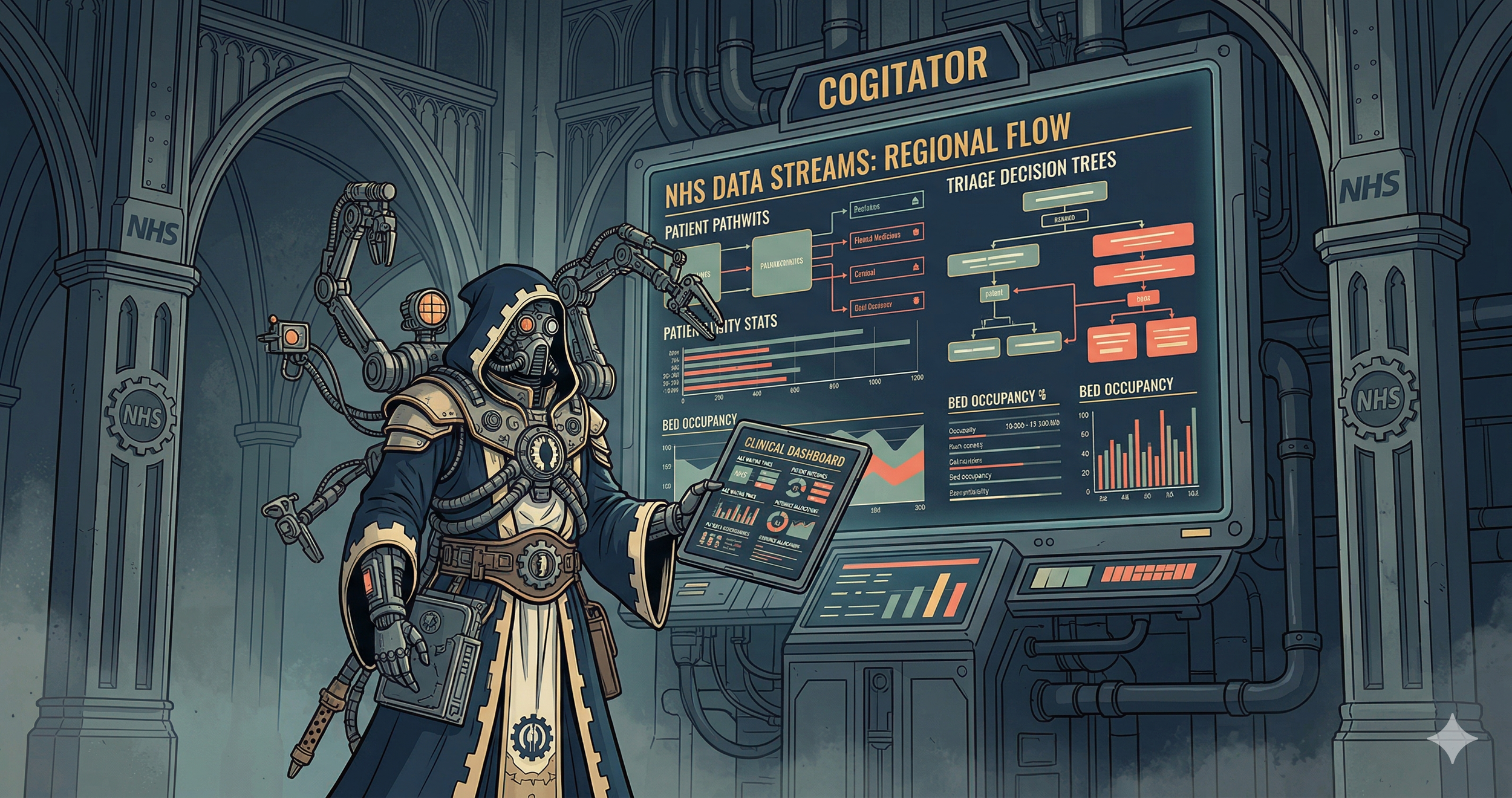
Primary Theme: Newsletter #40 launch, podcast feed announcement, and healthcare demand debate Key Discussion: Newsletter released with steampunk-themed images and a new podcast feed for group members. The finite vs infinite healthcare demand debate continued from Saturday, with a health economist arguing demand is provably finite. Secondary Discussions: Home Assistant and Claude integration; Copilot Cowork launch; Perplexity Computer experiences; FHIR and Simplifier.net; clinical reasoning and AI in medical education (NEJM paper); Unreal Tournament 2004 nostalgia; Claude off-peak usage promotion; Open Plaud MCP setup Notable: Julian Tudor Hart 1992 quote on co-production shared. Gaming Discord resurrected (briefly).
Monday, 16 March
Primary Theme: Google scraps amateur medical AI; GP system outages and vendor accountability Key Discussion: Google removing a crowdsourced medical advice AI feature was widely mocked. A national Docman outage and ongoing EMIS reliability issues prompted debate about billing vendors for lost hours and whether the NHS has appetite to enforce service-level agreements. Secondary Discussions: Vibe coding security risks; HSSIB patient safety investigations; Open Plaud local transcription tools; EMIS AVT rumours and pricing; virtual ward expansion; local GPU hardware for LLMs (P40, K80, 2080Ti); DDR4 price inflation; UK ditches AI copyright exemption; care home innovation contacts sought Notable: Claude hallucination incident reported, with the model producing bizarre business advice unprompted and repeating "Eliminate."
Tuesday, 17 March
Primary Theme: Rumoured central NHS AVT deal with Microsoft; IP and sovereignty Key Discussion: Rumours of a central Microsoft AVT deal dominated, sparking debate about procurement power, sovereign AI, clinician IP from in-the-loop training, and whether the NHS should get "kick back" for user data. Connected to a Nuance/Microsoft data breach settlement. Benn Gooch's AVT reflections widely shared. Secondary Discussions: Hermes autonomous agent harness; Karpathy jobs board; LLMs as computers; RCGP AI SIG formation and AI as core College policy; digital surveillance; NICE guidelines licensing for AI training; CQC digital compliance tool launched; Modality Pathfinder summit announced; Palantir advisor stepping down Notable: RCGP AI Special Interest Group formally announced as separate from HIG. AI confirmed as core RCGP policy area.
Wednesday, 18 March
Primary Theme: NHS workforce, AI investment, and the Neighbourhood Health Framework Key Discussion: HSJ editorial arguing for AI investment before more staff generated strong reactions. Neighbourhood Health Framework and "Fit for the Future" population health documents published. Extended debate on NHS infrastructure quality, international comparisons, and whether critique or celebration should dominate the conversation. Secondary Discussions: Cambridge AI adoption survey; doctors per capita internationally; Federated Data Platform concerns; Sovereign AI Compute Unit applications; NHS digital infrastructure ownership; NHoS closedown; Wardley mapping for health; Finland's health system; GDS parallels; portfolio career workshop; Microsoft suing Copilot; Claude Dispatch and 1M context window; local LLM builds Notable: Liverpool Champions League match prompted evening football tangent. Member running Qwen 3.5 on local hardware via Telegram by end of day. Eid and Nowroz celebrations acknowledged.
Thursday, 19 March
Primary Theme: Anthropic's pace of innovation; Heidi hardware launch; browser permissions debate Key Discussion: Members noted Anthropic's rapid feature releases. Heidi's new hardware device for ambient recording raised clinical safety questions about device classification. Debate about granting Claude full browser permissions, with some members declining and preferring controlled MCP connectors. Secondary Discussions: Perplexity using Claude under the hood; Codex CLI experiences; Meta-Google AI chip deal; GP contract vote call to action; AI scribe survey; AI company cross-ownership infographic; Cowork invites shared; Nvidia investment concerns Notable: New member joined. GP contract referendum vote called with urgency. A member joked about waiting for a turtle-shaped recording device from a competitor.
Friday, 20 March
Primary Theme: Developer tooling comparison and the Heidi jailbreak report Key Discussion: Members compared Codex CLI, Claude Code, and VS Code workflows for coding. The Mindgard jailbreak report on Heidi Health AI was shared, with discussion of responsible disclosure practices and why pen testing should be standard for NHS-facing tools. Secondary Discussions: NASGP podcast on locum GPs and AVT; US AI legislative framework; FDA Digital Health Centre of Excellence appointment; Plaud for HR use cases; GitHub issue management with AI; ISO readiness via AI-generated issue tracking Notable: Eid celebrated. Nowroz celebrated. US AI regulatory approach contrasted with UK.
Saturday, 21 March
Primary Theme: Heidi jailbreak continued; pen testing in the NHS Key Discussion: Morning discussion continued the Heidi jailbreak debate, with members arguing about whether the Mindgard report was responsible disclosure or "a comprehensive recipe for criminal behaviour." Consensus emerged that pen testing is standard good practice and the NHS needs to adopt it more widely. Secondary Discussions: Pen testing tools (sqlmap, Kali Linux, OWASP) shared for education Notable: Activity tailed off by mid-morning with 14 messages total, the quietest day of the period.
AI in the NHS Weekly Newsletter is produced by Curistica Ltd for members of the AI in the NHS WhatsApp community. All contributors are anonymised. Views expressed are those of individual community members and do not represent any organisation.