

Executive Summary
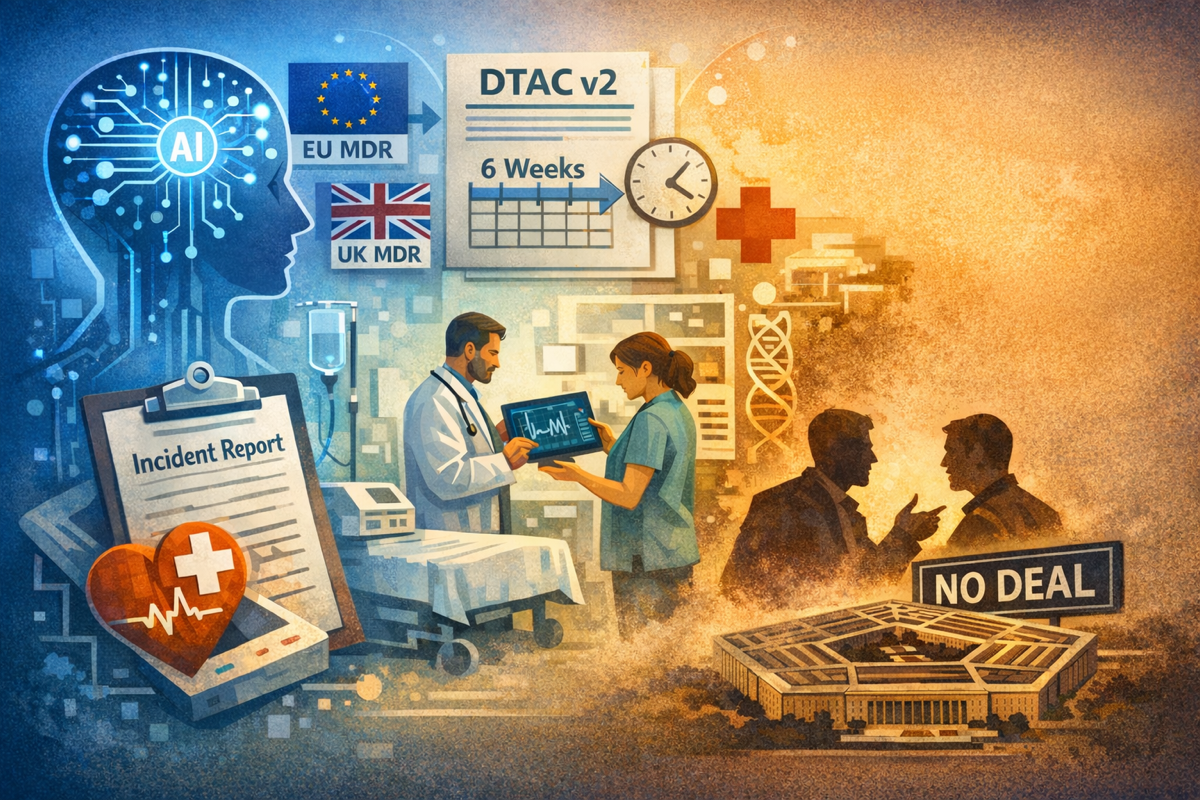
This week’s discussions spanned AI’s transformative potential, regulatory rigour, and the ethics of military AI deployment.
The group conducted an impressive collaborative investigation into GPTriage’s medical device classification, uncovering significant questions about the distinction between EU MDR and UK MDR registration. Clinical safety incident reporting remained a persistent theme, with real-world examples of AI scribe data loss highlighting systemic gaps.
The launch of DTAC v2 and its compressed six-week implementation timeline drew both interest and frustration, whilst the week closed with sharp debate about Anthropic’s refusal of Pentagon contracts and what it signals for the AI industry’s ethical direction.
Activity at a Glance
The week generated 492 messages across 8 days, peaking on Monday 23 February (118 messages). Weekday discussions dominated at 72.2% of traffic, with Saturday 21 February also proving notably active (101 messages) driven by a spirited debate about AI’s impact on clinical careers.
Date: Saturday, 21 Feb Messages: 101 Trend: Floor vs ceiling debate peaks Date: Sunday, 22 Feb Messages: 21 Trend: Weekend wind-down Date: Monday, 23 Feb Messages: 118 Trend: GPTriage investigation begins Date: Tuesday, 24 Feb Messages: 75 Trend: DTAC v2 discussion Date: Wednesday, 25 Feb Messages: 62 Trend: Safety incident follow-up Date: Thursday, 26 Feb Messages: 46 Trend: CQC AVT concerns Date: Friday, 27 Feb Messages: 61 Trend: Pentagon debate intensifies Date: Saturday, 28 Feb Messages: 15 Trend: Weekend reflections
AI: Augmenting Clinicians or Making Them Obsolete?
Saturday 21 February sparked an intense “floor vs ceiling” debate when an innovation-focused GP polled the group: would practitioners adopt a regulated AI tool that matched the average GP’s diagnostic accuracy? The response revealed a fundamental tension. Some argued passionately that AI should augment and raise the floor of care for all, whilst others contended that AI displacement of clinicians was not a bug but an inevitable feature of technology adoption. The poll itself became a lightning rod for different visions of the future.
This sparked memorable exchanges about the nature of technological change. A clinical safety expert contributed a withering observation about what he termed “vibecoding COBOL” - making foundational decisions based on feeling rather than rigour - and suggested that anyone advocating for such approaches should be permanently barred from anything more technologically complex than an Etch-a-sketch.
The debate reignited on Friday 27 February when Jack Dorsey’s comments about AI replacing knowledge workers circulated. The group moderator noted with a note of concern that confidence in AI’s ability to displace knowledge work had grown markedly since mid-December. The conversation quickly shifted to macro-economic implications: would AI labour taxation and Universal Basic Income be necessary social responses? One clinical safety expert offered a sardonic summary:
“We’re not making this decision because we’re in trouble, we just want to get rid of you costly meat sacks”
Another captured the either-or nature of the stakes:
“You have the Roddenberry happy fluffy bunny version, or the retreat to Dickensian poverty”
The group grappled honestly with two visions of the future, neither particularly comforting.
GPTriage Under the Microscope: Medical Device Classification Deep Dive
Monday 23 February began a remarkable collaborative investigation when a GP and regulatory investigator decided to search the MHRA Publicly Assessed Regulatory Decisions (PARD) database for GPTriage. What they found raised immediate questions: GPTriage is registered as Class I on the MHRA register, yet makes public claims of being Class IIb. Further sleuthing revealed the underlying engine is Infermedica, found via beudamed.eu to hold EU MDR IIb certification.
The key insight emerged: using a certified component doesn’t automatically transfer that certification to the wrapper product. A digital health GP crystallised the issue perfectly:
“You can’t say your class 2b because your product uses a class 2b product”
The investigation continued through Friday 27 February with deeper dives into MHRA guidance, each citation building a more complete picture. An innovation-focused GP synthesised the implications:
“Confusion causes credibility gap and in triage this causes problems”
The collaborative detective work drew praise from the group moderator, who observed:
“Zero incidents in millions of patient journeys suggests either perfect software or not looking for learning and improvement opportunities”
Reflecting on the group’s work, the moderator concluded: “Impressive sleuthing here. I feel proud.” The investigation exposed not just a classification discrepancy, but a systemic gap in how medical device transparency works.
Clinical Safety: From Data Loss to Incident Reporting Gaps
Monday 23 February brought a sobering report from a GP and AVT early adopter. During a busy surgery, an AI scribe produced consultation text that was truncated and lost mid-session. The clinician spent an hour after surgery attempting recovery, and the system produced no error reports. Problems had merged incorrectly, creating confusion. When data disappears in clinical practice, the consequences ripple outward.
The incident exposed a deeper structural problem: when multi-vendor products fail, who reports it? Later in the week, the GP and AVT early adopter expanded on the difficulty:
“One product and 2 companies responsible means who do you report to? Sometimes it’s obvious but not always. One company blames the other.”
This buck-passing dynamic undermines the very purpose of incident reporting systems. Thursday 26 February raised another concern when CQC’s piloting of AVT during inspections sparked questions about consent recording - if regulators are now using these tools, what data governance applies?
The group moderator, returning repeatedly to this theme with evident frustration, stated:
“I appreciate I’m giving this max broken record treatment... but I genuinely don’t care who ultimately solves it, only that it’s solved”
By Friday 27 February, a notable consensus had emerged: clinical safety incident reporting needs systemic change, not just better communication.
DTAC v2: Digital Technologies Assessment Criteria - A Six-Week Sprint
Tuesday 24 February brought news that DTAC v2, the NHS’s updated assessment framework for digital health technologies, is launching with an ambitious six-week implementation window before the old criteria sunset. The reaction was mixed. Some saw genuine opportunity: “This feels like real change,” said one digital health innovator. Others expressed frustration with the compressed timeline.
The core appeal of DTAC v2 centres on a promise of reduced friction for innovations that genuinely prioritise patient safety and clinical effectiveness. However, several group members questioned whether six weeks was realistic for systematic adoption across the NHS. One clinical safety expert noted: “The timeline feels political rather than practical.” A GP raised a more fundamental question: “Will this actually change behaviour, or just change the paperwork?”
The discussion revealed a deeper tension - technology assessments are only as good as the rigour and transparency applied to them. The group’s extended investigation into GPTriage’s classification issues earlier in the week had already highlighted how assessment frameworks can mask rather than clarify risk.
The Pentagon Question: Anthropic’s Refusal and What It Signals
Friday 27 February closed the week with a bracing debate about Anthropic’s decision to refuse Pentagon contracts for AI weapons applications. The news circulated alongside Jack Dorsey’s provocative comments about AI replacing knowledge workers, creating an odd juxtaposition: a company saying no to military AI applications whilst wider industry sentiment embraced AI’s disruptive potential.
The group’s response was thoughtful and divided. Some praised Anthropic’s stance as principled: “Taking ethical positions costs money. That matters.” Others questioned whether one company’s refusal meaningfully constrains AI’s use in defence systems. A clinical safety expert offered a characteristically pragmatic observation: “Ethics are cheap when someone else pays the price. What matters is systemic change.”
The broader question beneath the debate emerged: as AI becomes more powerful and integrated into critical systems - including healthcare - who decides its boundaries? And how do we ensure those decisions reflect public values rather than corporate interests? The week closed without consensus, but with genuine engagement with one of AI’s most difficult questions.
Lighter Moments
The group’s personality shone through even during serious discussions. When a clinical safety expert returned from a brief absence to find the conversation had veered into retro computing and Commodore 64 nostalgia, the collective response was captured perfectly:
“Better having to restrain wild horses than raise the dead.”
The “floor vs ceiling” debate on Saturday produced some memorable one-liners. One contributor, imagining the corporate AI pitch, offered:
“We’re not making this decision because we’re in trouble, we just want to get rid of you costly meat sacks”
Thursday’s discussion about Burger King using AI scoring for employee recruitment prompted disbelief, whilst a tangent about NASA’s Artemis programme and the Space Launch System led one member to observe that even rocket science has its share of procurement disasters.
The group’s capacity to oscillate between gallows humour and genuine policy insight remained one of its defining features throughout the week.
Quote Wall
“You can’t say your class 2b because your product uses a class 2b product” - Digital health GP, on medical device classification
“Confusion causes credibility gap and in triage this causes problems” - Innovation-focused GP, on GPTriage implications
“Zero incidents in millions of patient journeys suggests either perfect software or not looking for learning and improvement opportunities” - Group moderator, on incident reporting gaps
“I appreciate I’m giving this max broken record treatment... but I genuinely don’t care who ultimately solves it, only that it’s solved” - Group moderator, on clinical safety reporting
“Ethics are cheap when someone else pays the price. What matters is systemic change.” - Clinical safety expert, on Anthropic’s Pentagon refusal
“You have the Roddenberry happy fluffy bunny version, or the retreat to Dickensian poverty” - Clinical safety expert, on AI’s economic future
“Taking ethical positions costs money. That matters.” - Group member, on corporate AI ethics
Journal Watch
Resources and references shared during the week’s discussions:
Regulatory & Classification Resources
📎 MHRA Publicly Assessed Regulatory Decisions (PARD) Database - Central to the GPTriage investigation, this database revealed the Class I registration that contradicted public claims. The manufacturer details page was a key find.
📎 Beudamed EU Medical Device Registry - Used to trace Infermedica’s EU MDR IIb classification as the engine underlying GPTriage.
📎 Infermedica Regulatory Compliance - Infermedica’s own regulatory compliance page, cited during the investigation to understand the classification of the underlying triage engine.
📎 MHRA MDR Classification Guidance - Multiple citations including the Device Registration Reference Guide, Medical devices: software applications, and Regulating medical devices in the UK.
📎 GPTriage Website - Including its security page and partners page. Also referenced via Hero Health Software.
Academic Papers & Studies
📎 Adding Vision to AI Scribe Improves Accuracy (Nature Digital Medicine) - Shared on Friday 27 February, demonstrating multimodal AI consultation recording. Prompted discussion about AI scribe preferences and the Plaud device.
📎 ChatGPT Health Fails to Flag Over 50% of Medical Emergencies (Digital Health) - Shared during broader discussion of AI safety in clinical contexts.
📎 AIs Can’t Stop Recommending Nuclear Strikes in War Game Simulations (New Scientist) - Shared mid-week, feeding into the military AI ethics debate.
📎 Ambient Voice Technology in Acute Services: An Evaluation - Hospital-based AVT evaluation, referenced during the clinical safety discussions.
Policy & Industry
📎 DTAC v2 Digital Technologies Assessment Criteria - NHS England’s updated framework for health technology assessment, with a compressed six-week implementation window generating significant debate.
📎 DCB 0129 and DCB 0160 Step-by-Step Guidance - Referenced during discussions about clinical safety standards applicability.
📎 Anthropic’s Statement on Department of War - The company’s statement on refusing Pentagon contracts became a focal point for debate about corporate responsibility in AI. Also covered by Axios, with the OpenAI follow-up landing on Saturday.
📎 Jack Dorsey on AI Replacing Knowledge Workers - Circulated on Friday, catalysing the group’s debate about UBI, AI taxation, and the macro-economic implications of workforce displacement.
📎 BMA Warns GPs of AI Risks (Pulse Today) - BMA guidance on AI use in general practice, shared alongside the BMA AI Use in General Practice document.
📎 OpenAI Has Deleted the Word ‘Safely’ From Its Mission (The Conversation) - Shared on Saturday 28 February, prompting reflection on AI company governance.
Looking Ahead
Several threads remain actively unresolved heading into March. The GPTriage classification investigation has raised questions that extend well beyond a single product, touching on systemic transparency in medical device regulation. The group’s detective work has highlighted how difficult it is for even expert clinicians to verify regulatory claims.
The DTAC v2 six-week implementation window will be a key watchpoint. Members are monitoring whether the compressed timeline proves realistic and whether the new criteria genuinely reduce friction for innovators whilst maintaining safety standards.
Clinical safety incident reporting remains an unresolved systemic challenge. The group’s persistent advocacy for better cross-company reporting mechanisms shows no sign of abating.
The broader debate about AI’s role in healthcare careers, sharpened by Saturday’s floor vs ceiling poll and Friday’s displacement discussion, will continue to evolve as real-world AI deployments accelerate across the NHS.
Group Personality Snapshot
This week showcased the group at its collaborative best. The GPTriage investigation was a masterclass in distributed expertise: a regulatory investigator found the MHRA record, a digital health GP connected the classification dots, and the moderator synthesised the implications. No single person could have done what the collective achieved in 48 hours.
The community continues to balance sharp analytical thinking with genuine warmth. Debates about AI displacement and military ethics were conducted with remarkable psychological safety, allowing members to hold strongly opposing views without personal friction. The gallows humour about “costly meat sacks” sat comfortably alongside sober analysis of workforce implications.
What makes this group distinctive is its refusal to accept easy answers. Whether interrogating a medical device’s classification, challenging the DTAC timeline, or debating corporate ethics, members consistently pushed for evidence, nuance, and practical implications. It is a community that takes its subject matter seriously whilst never taking itself too seriously.
Appendix A: Detailed Activity Analytics
Message Volume Dashboard
Date: Sat 21 Feb Messages: 101 Activity: ████████████████░░░░ Date: Sun 22 Feb Messages: 21 Activity: ████░░░░░░░░░░░░░░░░ Date: Mon 23 Feb Messages: 118 Activity: ████████████████████ Date: Tue 24 Feb Messages: 75 Activity: █████████████░░░░░░ Date: Wed 25 Feb Messages: 62 Activity: ███████████░░░░░░░░ Date: Thu 26 Feb Messages: 46 Activity: ████████░░░░░░░░░░░░ Date: Fri 27 Feb Messages: 61 Activity: ██████████░░░░░░░░░░ Date: Sat 28 Feb Messages: 15 Activity: ███░░░░░░░░░░░░░░░░
[Table data]
Activity Heatmap
Time of Day: Morning (06-12) Sat 21: 🟠 38 Sun 22: 🟡 9 Mon 23: 🟡 19 Tue 24: 🟠 37 Wed 25: 🟠 21 Thu 26: 🟡 15 Fri 27: 🟡 11 Sat 28: 🟡 15 Time of Day: Afternoon (12-17) Sat 21: 🟠 41 Sun 22: 🟡 11 Mon 23: 🟠 21 Tue 24: 🟠 26 Wed 25: 🟠 22 Thu 26: 🟡 6 Fri 27: 🟡 7 Sat 28: ⚪ 0 Time of Day: Evening (17-22) Sat 21: 🟠 22 Sun 22: ⚪ 0 Mon 23: 🔴 65 Tue 24: 🟡 12 Wed 25: 🟠 17 Thu 26: 🟠 21 Fri 27: 🔴 41 Sat 28: ⚪ 0 Time of Day: Night (22-06) Sat 21: ⚪ 0 Sun 22: 🟢 1 Mon 23: 🟡 13 Tue 24: ⚪ 0 Wed 25: 🟢 2 Thu 26: 🟢 4 Fri 27: 🟢 2 Sat 28: ⚪ 0
Legend: 🔴 Very High (30+) 🟠 High (15-30) 🟡 Medium (5-15) 🟢 Low (1-5) ⚪ None
Key patterns: Monday and Friday evenings were the clear hotspots, with the GPTriage investigation driving Monday’s 65-message evening surge and the Pentagon/Dorsey debate fuelling Friday’s 41-message evening peak. Saturday 21 Feb was unusual for a weekend, sustaining high activity through morning and afternoon as the floor vs ceiling debate ran. Saturday 28 Feb was morning-only (15 messages) as the week wound down. Weekday share: 72.2% vs weekend 27.8%.
Cross-Expertise Engagement
61 unique contributors participated across the week, representing at least 12 distinct professional backgrounds including GPs, clinical safety officers, regulatory investigators, digital health specialists, practice managers, secondary care physicians, health tech entrepreneurs, data protection officers, and digital health academics. The GPTriage investigation was the most cross-disciplinary topic, drawing contributions from regulatory, clinical, technical, and policy perspectives simultaneously.
Appendix B: Enhanced Statistics
Top 10 Contributors (Role Descriptors Only)
- Digital Health & Clinical AI Specialist (Group Moderator): 102 messages
- Innovation-Focused GP: 46 messages
- Clinical Safety Expert: 32 messages
- GP & Medical Device Specialist: 27 messages
- Digital Health GP: 25 messages
- Healthcare Technology Advocate: 16 messages
- Secondary Care Physician & Digital Health Advocate: 15 messages
- Health Systems Integration Expert: 15 messages
- Digital Health Academic: 14 messages
- GP Partner & AI Tool Creator: 13 messages
Hottest Debate Topics
- 🔥🔥🔥 AI augmenting vs obsoleting clinicians (floor vs ceiling) - Sustained across Sat 21, Sun 22, and reignited Fri 27
- 🔥🔥🔥 GPTriage medical device classification investigation - Mon 23 through Fri 27, collaborative detective work
- 🔥🔥 Clinical safety incident reporting gaps - Mon 23 through Fri 27, real-world AI scribe failure as catalyst
- 🔥🔥 DTAC v2 six-week implementation sprint - Tue 24, timeline realism and framework effectiveness
- 🔥🔥 Pentagon AI ethics / Anthropic refusal - Fri 27 into Sat 28, corporate responsibility debate
Discussion Quality Metrics
- Evidence-Based Ratio: Approximately 19% of messages included direct links to papers, guidelines, registries, or data sources (95 links across 499 messages)
- Average Thread Depth: 2.7 messages per conversation thread (187 distinct threads)
- Unique Links Shared: 95 across the period, spanning regulatory databases, academic papers, news articles, and policy documents
- Cross-Expertise Engagement: 61 unique contributors from 12+ professional backgrounds; the GPTriage investigation involved contributions from at least 6 distinct specialisms
Key References
- MHRA PARD Database - Medical device registration search
- Beudamed EU Medical Device Registry - EU medical device database
- GPTriage - AI triage product under investigation
- Infermedica Regulatory Compliance - Underlying triage engine
- DTAC v2 - NHS digital technology assessment criteria
- Anthropic Statement on Department of War - Pentagon contract refusal
- Nature: Adding Vision to AI Scribe - Multimodal AI scribe study
- MHRA Device Registration Guide - Classification guidance
- DCB 0129/0160 Guidance - Clinical safety standards
- NHS Learn from Patient Safety Events - Incident reporting service
Appendix C: Weekly Themes by Day
Saturday, 21 February
Primary Discussion: AI career displacement / floor vs ceiling
Secondary: AI augmentation ethics, Technology adoption implications
Notable: Poll on whether practitioners would adopt AI matching average GP diagnostic accuracy sparked fundamental debate about AI’s future role in healthcare.
Sunday, 22 February
Primary Discussion: Continued floor/ceiling debate
Secondary: Weekend reflection, Emerging consensus building
Notable: Group consolidated arguments from Saturday’s intense discussion.
Monday, 23 February
Primary Discussion: GPTriage classification investigation + clinical safety incident
Secondary: MHRA MDR classification, AI scribe data loss, Incident reporting gaps
Notable: Peak message volume (118) driven by two major investigations: GPTriage’s medical device classification and a real-world AI scribe failure.
Tuesday, 24 February
Primary Discussion: DTAC v2 launch discussion
Secondary: Implementation timeline concerns, Assessment framework effectiveness
Notable: Six-week implementation window for new NHS digital technology criteria sparked debate about timeline realism.
Wednesday, 25 February
Primary Discussion: Clinical safety follow-up
Secondary: Incident reporting systems, Multi-vendor accountability
Notable: Deeper exploration of who bears responsibility when multi-vendor products fail.
Thursday, 26 February
Primary Discussion: CQC AVT pilot concerns
Secondary: Data governance, Regulatory use of AI tools, Consent recording
Notable: Questions about consent and data governance when CQC uses AI voice transcription during inspections.
Friday, 27 February
Primary Discussion: Pentagon/military AI + GPTriage investigation continues
Secondary: Anthropic ethical stance, Jack Dorsey AI displacement comments, AI regulation
Notable: Intense discussion about Anthropic’s refusal of Pentagon contracts, raising broader questions about AI ethics and industry responsibility.
Saturday, 28 February
Primary Discussion: OpenAI replacing Anthropic for Pentagon + AI scribe preferences
Secondary: AI scribe pilot across 20 practices, Wrapper providers discussion
Notable: News that OpenAI stepped in where Anthropic refused prompted reflection on corporate AI ethics. Quieter day with 15 messages as the week wound down.
Curistica Ltd | curistica.com
All participant identities have been anonymised using role-based descriptors.
AI in the NHS Weekly Newsletter is produced by Curistica Ltd for members of the AI in the NHS WhatsApp community. All contributors are anonymised. Views expressed are those of individual community members and do not represent any organisation.