

This week delivered a landmark announcement as NHS England unveiled its national registry for ambient voice technology (AVT) providers -- a direct response to what industry observers have called the "wild west IT market." Simultaneously, a government report authored by group members challenged healthcare leaders to confront uncomfortable truths about AI governance gaps. The community grappled with fundamental questions about professional responsibility in an AI-augmented workplace, debated the crisis in mental health services, and heard a moving account of a clinician-developer's five-year startup struggle. Throughout, the group maintained its characteristic blend of rigorous analysis and wry humour, whilst the technical conversations ranged from Raspberry Pi apocalypse preparedness to the economics of self-hosted AI models.
Major Topics
1. The AVT Registry: Taming the "Wild West"
Thursday 16 January marked a watershed moment as NHS England announced its national registry for AI note-taking tools. The announcement, accompanied by coverage from GOSH's research trial, listed 19 approved providers including 33n, AccuRx, Anathem, Tortus, Heidi Health, and Microsoft Nuance.
The group's reaction was characteristically nuanced. A digital health specialist noted the positive step forward whilst immediately highlighting what the announcement didn't say: provider-side compliance requirements (DCB0129/0160, DPIA) remain unchanged. The original April 2025 guidance continues to apply -- appearing on a registry doesn't exempt providers or healthcare organisations from their governance obligations.
Discussion quickly turned to notable omissions. Anima's absence sparked raised eyebrows, as did OpenAI's non-appearance. EMIS's listing (partnered with T-Pro for dictation services) was confirmed, whilst TPP/SystmOne wasn't listed separately. X-On received IM1 approval the same week, with final sign-off from EMIS and TPP expected imminently.
A clinical AI specialist crystallised the divergent expectations around AVT: NHS England assumes the technology will enable clinicians to see more patients; clinicians hope for reduced cognitive load and improved wellbeing. The outstanding questions -- funding for rollout and responsibility for information governance paperwork -- remain unanswered.
The discussion of AccuRx's new limitations (4-5 scribe sessions per day) prompted pragmatic advice about the 19-provider market: if one starts charging, another will likely remain free, at least temporarily.
2. Government Report: Uncomfortable Truths
Later on Thursday, two group members published a government report containing what was described as "slightly controversial recommendations" about AI regulation in UK healthcare. The report's LinkedIn posts drew engagement from across the digital health community, including a response from a prominent academic supporting calls for a National Commission into AI regulation.
The report's key message echoed sentiments expressed in an earlier BMJ Leader article: healthcare leaders face a choice between continuing to enthusiastically adopt digital solutions whilst inadequately governing them -- and facing consequences when things go wrong -- or demonstrating genuine leadership by demanding the resources and expertise necessary for proper governance.
The timing, coinciding with the AVT registry announcement, underscored the tension between encouraging innovation and ensuring safety. A practice manager's observation captured the mood: compliance continues to be the most important consideration -- regardless of how shiny the technology.
3. The AI Ethics Poll: When Slop Arrives in Your Inbox
Sunday's provocative poll sparked the week's most engaged debate: what do you do when a direct report sends you an AI-generated document packed with errors they clearly haven't read?
The results showed 18 votes for sending it back with polite feedback, 6 for harder feedback, and only 1 for treating it as an integrity issue warranting a serious meeting. The poll originated from a real conversation where a colleague had chosen the most severe option.
The ensuing discussion revealed deep fault lines. A digital transformation specialist argued that receiving something through an AI without it passing through the sender's cerebral cortex constitutes an integrity issue -- if you want ChatGPT's view, you can get that yourself. Others advocated for teachable moments over punitive responses, noting that rushing and being overstretched often explain sloppy AI use rather than malicious intent.
A healthcare analyst offered the week's most quotable synthesis: AI accelerates work -- it doesn't replace judgment. The time saved by AI drafting comes with an obligation: reinvesting it in sense-checking, editing, and understanding what you're sending. You need to read it, stand by it, and defend it.
The digital health specialist's approach of crediting Claude Opus 4.5 as co-author of newsletters was noted as one transparency model -- though the fundamental question of when AI assistance crosses from tool to substitution remained productively unresolved.
4. Mental Health Services: The System That Pretends to Exist
Friday's stark discussion of mental health service failures painted a bleak picture. One GP described outreach nurses in their patch as performing a role of pretending the service exists whilst rejecting desperately ill patients. Another reported 13 years in practice without a single CAMHS referral accepted.
A system analyst provided context on the brutal working environment within mental health trusts: patching people up, discharging the least unwell when someone more ill arrives (even when the discharged patient is utterly unfit), and justifying daily why critically ill patients are being shipped to private services due to decades of underinvestment.
The observation that this should be a national scandal but "the media don't care" resonated with other participants' experiences. The discussion connected to broader debates about AI's potential role -- could AI-based CBT help with lower-severity conditions, freeing human resources for complex cases?
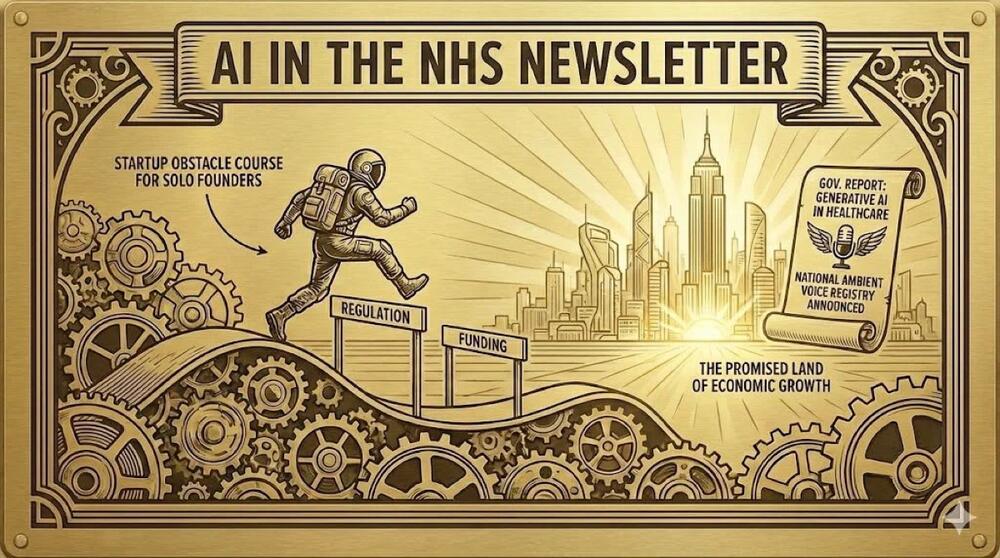
5. The Healthcare Startup Obstacle Course
Saturday's most poignant contribution came from a single-handed GP partner sharing five years of healthcare AI startup struggles. The narrative read like a systematic catalogue of NHS innovation barriers:
A rule-based clinical tool saving 1-5 per patient in GP workforce costs within three months. Over a year spent on security and compliance paperwork for Class 1 registration. Missing London-only automation funding despite having a functional product in daily GP use. An HIN advisor recommending abandonment because better-funded competitors were doing similar work. Discovering the dictation framework existed a week after it closed. Getting so excited when someone finally listened that an hour-long meeting passed without demonstrating the system. Being told by a spouse that funding a sales team from savings or quitting clinical work would mean divorce. Investors requiring 1M in sales before investing -- creating an impossible loop. Missing a 1.5M Surrey pilot funding opportunity by learning about it just after closure. Withdrawing from a recent application after discovering framework piggyback options too late.
The response from colleagues was supportive: one wished the GP "that moment of luck / serendipity that flicks you to the path of success." The narrative powerfully illustrated how framework requirements, geographic funding restrictions, and investment chicken-and-egg problems systematically disadvantage clinician-led innovation.
6. Technical Developments and Apocalypse Preparedness
Google's announcement of MedGemma 1.5 (medical image interpretation) and MedASR (medical speech-to-text) generated technical discussion about local deployment requirements -- at least an RTX 4060 for reasonable performance. One participant noted it runs on CPU but slowly, whilst another confirmed Gemma 3 27b runs on a Mac Mini.
The GabeCube announcement (a Steam Deck-style device at $600 base price) prompted gaming-adjacent banter, including observations about RAM prices going "crazy" and affecting self-hosting economics.
Wednesday's Raspberry Pi AI HAT Plus 2 announcement dovetailed with a thread about post-apocalyptic preparedness. The discovery of Kiwix (offline Wikipedia) prompted one practice manager to consider loading entire libraries into NotebookLM before realising they'd "just remade the internet."
The meshtastic mesh networking discussion for summer festivals touched on bitchat possibilities, with suggestions for HLTH Europe applications -- though requiring a reasonable mesh of users for effectiveness.
7. NHS Funding and the Starbucks Problem
Wednesday's taxation debate highlighted structural funding issues. One GP noted that the UK doesn't have high taxes -- it has high middle-class tax, undertaxed super-wealthy, and corporations paying minimal contributions. The Starbucks example (5M UK corporation tax on 95M gross profit) illustrated the scale of corporate tax avoidance.
The infrastructure deficit was starkly illustrated: one participant's local hospital Trust was built for less than half its current population, with 60,000 new houses approved but no mandated new GP practice and funding constantly delayed.
A consultant radiologist reported being told they couldn't advertise to replace three colleagues who resigned or retired, then being asked why backlogs were increasing. The sardonic response about Copilot increasing productivity by 92%, therefore creating surplus radiologists, captured the absurdity of expecting technology to substitute for adequate staffing.
Quote Wall
"AI accelerates work -- it doesn't replace judgment." -- Healthcare analyst on professional AI use
"There are 2 expectations here. NHSE assumes AVT will allow doctors to be more productive -- see more patients. Doctors assume they will be more productive -- reduced cognitive load leading to improved wellbeing." -- Clinical AI specialist on AVT divergent expectations
"Healthcare leaders can continue the current trajectory -- enthusiastically adopting digital solutions whilst inadequately governing them -- and face the consequences when things go wrong." -- Digital health specialist and clinical safety expert, BMJ Leader Sept '25
"The probabilities of at least one of them being free all times is 97.5% with CI-99." -- Innovation-focused GP on the 19-provider AVT market
"There is a huge difference between 'using LLM' and simply putting something through an LLM and spitting forth the output without the input or output ever passing via one's own cerebral cortex." -- Consultant radiologist on AI responsibility
"It's starting to feel like Donkey Kong -- just as I think we're getting close another barrel knocks us back a floor." -- GP developer on five years of startup struggles
"If you do not pay for a product -- you are the product!" -- Group member on free internet services
"Compliance continues to be a moat." -- Digital health specialist, abbreviated
Journal Watch
Key Announcements and Policy Documents
NHS England AVT Registry Announcement england.nhs.uk
NHS England Ambient Scribing Guidance (April 2025) england.nhs.uk
GOSH-Led AVT Trial Results gosh.nhs.uk
Government Report on AI Regulation - Haris Shuaib: LinkedIn Keith Grimes: LinkedIn Prof Jeremy Wyatt response: LinkedIn
MHRA AI Regulation Consultation mhra.gov.uk
NHS Confederation on AVT Registry nhsconfed.org
Clinical AI and Research
ARISE-AI State of Clinical AI Report arise-ai.org
BMJ Leader: The NHS's Digital Blind Spot bmj.com
Google MedGemma 1.5 and MedASR research.google
Technical Resources
DCB0129/0160 Compliance for Copilot/M365 trust.assuric.com
EMIS/T-Pro Dictation Partnership emishealth.com
Raspberry Pi AI HAT Plus 2 raspberrypi.com
Kiwix Offline Wikipedia kiwix.org
Industry and Tools
Tortus AI Hallucination Feature LinkedIn
Eigent AI (Claude Cowork Alternative) eigent.ai
askmedi.uk askmedi.uk
Group Personality Snapshot
This week showcased the group's distinctive capacity for holding multiple truths simultaneously: celebrating the AVT registry as progress whilst immediately noting its governance gaps; sympathising with startup struggles whilst maintaining standards; debating AI ethics with intensity whilst cracking jokes about apocalypse preparedness. The community's technical depth ranges from DCB compliance frameworks to Raspberry Pi mesh networks, from pharmaceutical regulatory history to Donkey Kong metaphors.