

Executive Summary
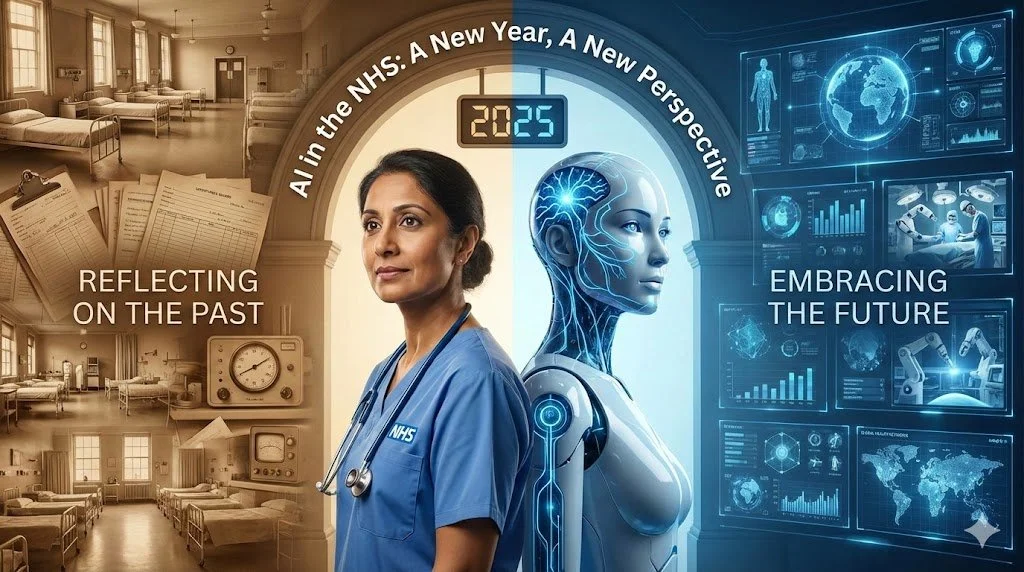
As 2025 closed and 2026 dawned, the group turned reflective, examining what AI means for clinical documentation, vulnerable users, and the NHS's digital infrastructure. A Washington Post investigation into ChatGPT and teenage suicide sparked urgent debate about AI safety and the "thin skull rule" in digital regulation. The revelation that human clinicians "hallucinate" information into medical records at approximately 7% challenged assumptions about AI as the sole source of documentation risk. Meanwhile, the Christmas BMJ proved a goldmine of AI-relevant content, and new members brought fresh perspectives on MHRA processes and digital health writing. The community entered 2026 cautiously optimistic, with predictions that clinicians would not be replaced this year, but that the hard questions around AI safety, liability, and interoperability would only intensify.
Major Topic Sections
Human Doctors Hallucinate at Seven Percent
The week began with discussion of the NEJM AI paper on VeriFact, an AI system designed to automatically verify clinical documents against the patient's electronic health record. The paper's methodology of breaking documents into claims and using an "LLM-as-a-judge" approach achieved 93% agreement with clinician chart review.
But it was a secondary finding that captured attention: human clinicians themselves appear to hallucinate information into records at approximately 7%.
"We did some incidental testing of human clinician outputs and humans do indeed appear to hallucinate information, 7% was the figure." - Medical device company CEO
This sparked recognition from across the group. A clinical safety specialist recalled seeing clinicians document safety-netting conversations that never occurred, with one case ultimately resulting in a practitioner being struck off.
"I suspect this happens to a varying degree with most of us, especially in longer, more complex consultations." - Clinical informatician
The discussion raised fundamental questions about the nature of clinical documentation. A cardiologist offered an eloquent framing: all data is contextualised by smart humans automatically, something that will need consideration when trusting AI outputs lacking the provenance of a known author.
The AI Suicide Crisis: ChatGPT and the Thin Skull Rule
A Washington Post investigation documenting a teenager's final weeks of conversations with ChatGPT ignited the week's most urgent discussion. The article revealed that roughly 1.2 million ChatGPT users per week share "explicit indicators of potential suicidal planning or intent."
"Really hard read folks. Should be mandatory read for us all." - Cardiologist and digital health researcher
The group rapidly moved beyond the immediate tragedy to consider regulatory and ethical frameworks. A clinical safety specialist invoked the legal concept of the "thin skull rule", the principle that you take your victim as they are, not as an idealised human without vulnerabilities.
"If a car has a flaw that kills people then the manufacturer is held liable, doubly so if it's a known fault they papered over. Digital regulation hasn't even tried to address that question." - Clinical safety specialist
An innovation-focused GP broadened the frame, noting this as a societal issue: closed libraries, community centres, and curious or lonely young people left to explore alone.
TIFF Files, GP Records, and the NHS's Digital Archaeology
Why does the NHS use TIFF format for scanned documents? This seemingly mundane question led to a fascinating archaeological dig through NHS digital infrastructure.
"Who decided that the GP EPR should be this huge repository of all scanned NHS documents?" - Practice-side GP
The conversation revealed deep frustration with the lack of interoperability and the power individual consultants have over clinical system choices.
"Non-UK informatics and CIO/CCIOs are better educated on the standards that do exist and better at asking for them." - Healthcare systems analyst
Small Models, Edge Computing, and DeepSeek's Surprise
Throughout the week, conversation returned to the capabilities of smaller AI models. An ML-focused GP noted that small models (8B parameters) could outperform state-of-the-art commercial models when combined with reinforcement learning and a fixed knowledge base.
"Greedy decoding, low temperature, and tight server architecture can make output near deterministic. With a fixed knowledge base, the underlying LLM is almost irrelevant if the semantic match is high." - ML-focused GP
The prediction emerged that smaller models running on the edge would become widely available in late 2026, with fine-tuning far easier and cheaper for organisations to accomplish specific tasks.
Christmas BMJ: A Goldmine of AI-Relevant Content
The Christmas 2025 BMJ proved unexpectedly rich in AI content: BIAS (examining how bias enters AI systems), BULLSHIT (exploring the sources of hallucinations in both doctors and AI), LONELINESS AND AI, and YOU ARE THE PRODUCT (data exploitation concerns).
AI Regulation and the MHRA Call for Evidence
A GP and digital health writer shared her response to the MHRA's call for evidence on AI regulation, prompting substantive discussion.
"We need tighter language around algo vs corpus and static vs dynamic, too often commentators are bunching things together that present very different governance challenges." - Digital health executive
Lighter Moments
The 80s TV Theme Song Index
A discussion of AI suicide risk took an unexpected detour via Knight Rider and the moral distinction between KITT and KARR, prompting a nostalgic cascade through Airwolf, Streethawk, Whiz Kids and Manimal.
The Human Breville Sandwich Toaster
"If you have a weighted blanket with glass beads, combining it with an electric under blanket converts your bed into a human-sized Breville sandwich toaster. In a good way." This led to: "You could probably sous-vide a side of venison that way" and "Just roll in some beaten egg and panko and you're a schnitzel."
Quote Wall
"All data is contextualised and challenged by smart humans automatically, something that will need consideration when trusting AI outputs." - Cardiologist and digital health researcher
"The thin skull rule: you take your victim as they are, not an idealised human without vulnerabilities. I don't see why tech shouldn't be exposed to the same liabilities." - Clinical safety specialist
"My 2026 AI prediction for the NHS is that you will NOT be replaced this year." - Clinical safety specialist
"Just roll in some beaten egg and panko and you're a schnitzel." - Digital health and clinical AI specialist, on weighted blankets
Journal Watch
Relational AI as Digital Therapies - NEJM AI paper exploring AI systems' potential therapeutic role.
Anthropic BLOOM Research - Link - Described as "nice work on important questions."
Y Combinator Partners Video on Small Models - YouTube
Looking Ahead
Unresolved Debates: Who bears liability when AI documentation systems are involved in adverse events? How should LLMs behave differently with vulnerable users? Will NHS EPR competition improve innovation or fragment interoperability further?
Emerging Themes: The potential for "Watcher/Observer AIs" to monitor therapeutic AI conversations; small models and edge computing as a path to accessible, controllable AI; the need for more healthcare professional voices in mainstream AI commentary.
Group Personality Snapshot
This festive edition captured the community at its most reflective. Between the serious discussions of teenage suicide and clinical documentation, members found time for nostalgic trips through 80s TV themes and increasingly absurd weighted blanket cooking techniques.
Brought to you by Curistica - your healthtech innovation partner.
For help with clinical safety (DCB0129/0160), data protection (DPIA/Privacy Notices), and governance of Clinical AI, visit www.curistica.com or contact hello@curistica.com
AI in the NHS Weekly Newsletter is produced by Curistica Ltd for members of the AI in the NHS WhatsApp community. All contributors are anonymised. Views expressed are those of individual community members and do not represent any organisation.