


Executive Summary
Week 26 delivered a high-octane blend of research analysis, policy alarm bells, and frontline frustration. New NEJM papers on ambient scribes prompted deep examination of AI's psychological dimensions--particularly the notion that wellbeing gains stem from "not being alone" rather than mere productivity. Financial Times coverage of insurers getting nervous about AI sparked liability concerns, whilst a parallel debate on NHS data monetisation exposed a fundamental community split between "unethical not to share" and "national security risk." Thursday erupted when an ICB-mandated prescribing tool vendor engaged directly with sharp criticism, whilst Friday's revelation that NHSE plans to "turn funding off" when productivity targets aren't met left many questioning whether policymakers understand technology's role as foundation rather than profit centre.
Major Topics
1. NEJM AI Scribe Research: Beyond Productivity
Sunday's analysis of three New England Journal of Medicine papers on ambient scribes prompted thoughtful examination of AI's psychological dimensions in clinical settings.
A Digital Health Specialist dissected the Nabla/DAX comparison study, noting: "I am very pleased to see the discussion explicitly call out the tension between productivity improvements and reduced burnout." The observation that these might be separate outcomes--not automatically linked--challenged assumptions many held about scribe implementation.
The most provocative insight concerned the psychological experience of clinician-AI collaboration. As the analysis noted, wellbeing improvements may stem not merely from "offloading typing" but from a deeper sense of "not being alone"--AI functioning as collaborative team member rather than mere tool.
"We're now just MDT partner with an LLM," suggested one contributor, drawing parallels to multidisciplinary team working. The concept of developing a "theory of AI mind"--understanding how your particular AI performs and adapts--generated considerable interest.
A Clinical Safety Officer added practical context: "The personalised feedback loop improves AI performance specific to individual clinicians. That's the bit vendors need to emphasise."
Why It Matters: The research suggests AI adoption success may depend as much on psychological integration as technical performance--a dimension rarely addressed in procurement decisions.
2. The Insurance Timebomb
Saturday's Financial Times article on insurers "getting the jitters over AI" sparked urgent discussion about liability frameworks.
"Until there's a headline case that actually settles the matter, we're all in a grey zone," warned a Clinical Safety Officer, outlining dual liability paths: provider vicarious liability plus individual practitioner accountability.
GP practices face particular exposure. "Unlimited liability partnerships," noted one contributor grimly. The risk of test cases setting low bars for negligence over inadequate AI supervision was flagged as a genuine concern--particularly given the pace of adoption outstripping guidance.
Discussion turned to indemnity providers' likely response. Current intelligence suggests a preference for training requirements over differentiated premiums: "Free or discounted training to reduce the overall risk pool rather than pricing people out."
For vendors, the message was clear: "Ensure your high-risk customers are properly covered. This isn't just a nice-to-have anymore."
Why It Matters: Liability uncertainty creates a chilling effect on adoption. Without clarity, risk-averse organisations will delay implementation regardless of clinical benefits.
3. Data Monetisation: The Great Divide
Few topics exposed community divisions quite like Sunday's debate on selling NHS data.
One camp argued forcefully: "If done right, it's unethical NOT to do it. This could save millions of lives." Properly anonymised, consented data sharing could accelerate research, improve treatments, and generate revenue for cash-strapped services.
The opposition was equally passionate. "Health data is too valuable from a national security perspective," argued a Recently Qualified GP. "It's like giving away nuclear secrets." Multiple data breaches were cited--Capita, HSE Ireland, global cyber incidents--as evidence that trust in government's ability to execute safely is fundamentally compromised.
A Healthcare IT Specialist staked middle ground: "I agree it should be done--I slightly despair at the same arguments chasing circles ad nauseam--BUT I have little faith in how HMG operates. They'd just flog personalised data to Google."
The impasse reflected a deeper tension: theoretical public good versus observed institutional competence. Neither side shifted significantly.
Why It Matters: This debate will only intensify as AI training demands grow. The community's inability to reach consensus mirrors broader societal divisions that policymakers must navigate.
4. AVT Implementation: Time Saved, Time Taxed
Throughout the week, ambient voice technology discussions revealed a troubling pattern: productivity gains being immediately recaptured by increased workload.
"Median consult time reduced from 16 minutes to 10.2 minutes," reported one GP with implementation data. The gains were real. But what happens next?
"Once extra patients are booked, you can't refuse to see them if the AI scribe fails," observed a GP Partner. The asymmetry is stark--technology reduces time per patient, templates expand to fill capacity, and the safety margin disappears.
An Innovation-Focused GP posed the uncomfortable question: "Why add extra patients versus going home on time? AVT doesn't save THAT much time." The Health Foundation's May 2024 finding--that roughly 75% of clinicians would use released time for non-patient contact activities--suggests frontline preferences diverge sharply from management expectations.
Cost barriers added complexity. Part-time clinicians face disproportionate expense: "AVT is expensive, especially for someone who only does 1 day a week seeing patients," noted a GP Partner. The risk of creating an "AVT divide"--with locums, salaried staff, nurses, and AHPs left behind--was raised repeatedly.
One Salaried GP's experience crystallised tensions: saved 1.5 hours daily, partners suggested adding 6 extra patients--met with "silence" when the suggestion was declined.
Why It Matters: Technology adoption without workflow protection transforms efficiency tools into exploitation mechanisms. Policy frameworks must address this explicitly.
5. NHS Funding Policy: "Turning It Off"
Friday's bombshell from NHSE's Director of Transformation arrived with significant implications.
The announcement outlined a new dashboard for 2026-27 tracking IT implementation and "cash value generated." When productivity gains aren't achieved? "Turning funding off." Quarterly accountability for both cash and non-cash benefits. Technology must become "profit centre" rather than "cost centre."
Criticism was swift. "That's a misunderstanding of the role of IT," countered a Clinical Safety Officer. "Yes, it can be an efficiency enabler and multiplier, but it can also be a foundation that should be non-negotiable. Modern capital-funded hardware should be high importance rather than something to be switched off."
The framework's implications troubled many. Requiring demonstrable workflow changes and clinicians "seeing more patients" as the metric for success ignores technology's role in safety, quality, and sustainability--benefits that resist simple quantification.
Also announced: a radical shift in funding allocation, with 95-98% acute sector focus moving toward increased community and mental health investment.
Why It Matters: Metrics shape behaviour. Funding frameworks built on narrow productivity measures may inadvertently discourage investments in resilience, safety, and long-term transformation.
6. When Vendors Meet Critics
Thursday's 133-message peak included an unusual dynamic: a vendor representative engaging directly with sharp community criticism.
ICB-mandated prescribing software--particularly FDB OptimiseRx and ScriptSwitch--had accumulated significant grievances. "Demonstrably slows EMIS, significant cognitive load surge, additional burden, little or no savings," summarised one Innovation-Focused GP. "When ICBs commission software without understanding wider impact..."
Another added: "ScriptSwitch is worse--absolutely no intelligence, same alert repeatedly." Multiple contributors confirmed disabling both systems after demonstrating they were unnecessary--though many remained trapped by Local Enhanced Services funding tied to usage.
The vendor's Clinical Product Lead entered the conversation directly: "Thank you to those who have shared your thoughts and pain points. I completely appreciate your honesty." It was a rare moment of direct engagement--acknowledged positively even by critics.
The exchange highlighted a broader issue: "The savings ICBs shout about are not actual NHS savings," noted one contributor. Procurement decisions divorced from frontline workflow understanding create systems nobody wants but everybody must use.
Why It Matters: Vendor-clinician dialogue is essential but too rare. This exchange, however uncomfortable, modelled constructive engagement.
7. Regulatory Reality Check
Sunday's EU MDR discussion challenged prevailing narratives about regulatory burden.
A LinkedIn post claiming to have "watched EU MDR kill innovation in real-time" prompted pushback from those with direct certification experience. "This is very much a 2022 problem," argued a Regulatory Specialist. "My experience has been approximately 12 months from decision to seek certification through to getting Class 2b certificate. We've also seen Class IIIs done in 6 months."
The diagnosis focused elsewhere: poor quality assurance leadership, conflation of commercialisation with regulation, and need for better Notified Bodies.
Separately, discussion of DevOps practices in NHS development revealed tensions between agile methodology and safety-critical requirements. "Why isn't automated testing and DevOps a thing in NHS yet?" asked one contributor. The response: it works well with Clinical Safety Officers "on-call" for relevant squads--"product-informed compliance"--but iterative release cycles don't suit all medical device environments.
Why It Matters: Regulatory timelines have improved substantially. Persistent myths about impossible compliance may discourage innovation unnecessarily.
Quote Wall
"We're now just MDT partner with an LLM." -- Digital Health Specialist on the evolving clinician-AI relationship
"If done right, it's unethical NOT to do it--this could save millions of lives." -- Digital Health Specialist on data sharing
"Health data is too valuable from a national security perspective--it's like giving away nuclear secrets." -- Recently Qualified GP on the same topic
"Once extra patients are booked, you can't refuse to see them if the AI scribe fails." -- GP Partner on implementation realities
"Genuinely the most responsive supplier I've ever worked with. Safest platform I've used." -- Practice Manager on a positive vendor experience
"Every day is truly a school day in this group." -- Practice Manager on community value
"Why pay Palantir when we can give data away free?" -- Clinical Safety Officer on open-source models
Journal Watch
Academic Papers & Research
NEJM AI Papers on Ambient Scribes (November 2025) Three papers examining AI scribe effectiveness, including Nabla/DAX comparison. Critical reading for anyone involved in scribe procurement or evaluation. Discussion highlighted tension between productivity and wellbeing outcomes.
Nuffield Trust: How Are GPs Using AI? https://www.nuffieldtrust.org.uk/research/how-are-gps-using-ai-insights-from-the-front-line Frontline insights into GP AI adoption patterns and experiences.
Health Foundation: How Would Clinicians Use Time Freed Up by Technology? https://www.health.org.uk/reports-and-analysis/briefings/how-would-clinicians-use-time-freed-up-by-technology May 2024 briefing finding ~75% would use released time for non-patient contact activities--directly relevant to AVT implementation debates.
BMJ Article on Healthcare Technology https://www.bmj.com/content/391/bmj-2025-085324.full Referenced in Tuesday discussions on healthcare AI developments.
Lancet Pacific Clinical Medicine https://www.thelancet.com/journals/lanprc/article/PIIS3050-5143(25)00060-3/fulltext Shared Sunday in context of AI clinical applications research.
Policy & Regulatory
NICE Cost-Effectiveness Threshold Changes https://www.nice.org.uk/news/articles/changes-to-nice-s-cost-effectiveness-thresholds Confirmed changes with significant implications--"Cue torrent of folk that missed out by less than 10k."
OHE: Cost-Effectiveness Thresholds https://www.ohe.org/insights/cost-effectiveness-thresholds-and-expert-elicitation/ Technical background on threshold methodology.
NHS England Medium-Term Planning Framework https://www.england.nhs.uk/wp-content/uploads/2025/10/medium-term-planning-framework.pdf Context for funding policy discussions.
UK Medical Devices Consultation https://www.gov.uk/government/consultations/consultation-on-medical-devices-regulation Regulatory framework developments discussed Sunday.
News & Analysis
Financial Times: Insurers Getting Nervous About AI https://www.ft.com/content/abfe9741-f438-4ed6-a673-075ec177dc62 Sparked Saturday's liability discussion.
FT: Data Monetisation https://www.ft.com/content/0531e76b-a800-450f-8a10-ac5ada1b2695 Triggered Sunday's heated data sharing debate.
FT: Google/Microsoft AI Competition https://www.ft.com/content/7a42396f-487a-47b0-8121-8d8f2112fa53 Tuesday analysis of enterprise AI market dynamics.
LinkedIn: EU MDR Impact https://www.linkedin.com/posts/natalia-szychulska-18956a9b_i-watched-eu-mdr-kill-innovation Post that sparked regulatory reality-check discussion.
Medscape: AI-Human Hybrid Scribe Model https://www.medscape.com/viewarticle/ai-hybrid-model-human-scribe-may-cut-physic Alternative approach to pure AI documentation.
Wired: AI Hearing Aids https://www.wired.com/story/hearing-aid-startup-ai-fortell/ "This is the sort of use case for AI that I want to see more of for health."
Cybersecurity & Data
CyberDaily: NHS/UK Military Data Risk https://www.cyberdaily.au/government/8955-nhs-uk-military-data-at-risk-following Context for data security discussions.
Irish Times: HSE Data Breach https://www.irishtimes.com/news/crime-and-law/hse-confirms-data-of-520-patients Irish healthcare data breach--520 patients affected.
CSIS: Significant Cyber Incidents https://www.csis.org/programs/strategic-technologies-program/significant-cyber-incidents Global cybersecurity incident tracking.
Reuters: India Cyber Safety App Mandate https://www.reuters.com/sustainability/boards-policy-regulation/india-orders-mobile India mandating government cyber safety apps pre-loaded on mobiles.
Tools & Resources
Health Orbit AI https://healthorbit.ai AVT platform described as "most responsive supplier ever worked with, safest platform used."
Thames Freeport Health AI Mobilisation Centre https://thamesfreeport.com/health-ai-mobilisation-centre/ At-scale AVT provision opportunity shared Thursday.
Health Literacy Map https://healthliteracy.geodata.uk/ UK health literacy mapping tool.
BJGP Life: The Art of AI Conversation https://bjgplife.com/the-art-of-ai-conversation-why-gps-need-systems-that-embrace Article on GP-AI interaction design.
Group Personality Snapshot
This week showcased the community's ability to toggle between rigorous research analysis and righteous indignation about software that slows down EMIS. The willingness of a vendor representative to engage directly with criticism--and the community's ability to remain constructive whilst being honest--demonstrated maturity rarely seen in professional forums.
Statistical Insights
Peak Engagement Windows:
- Sunday morning (73 messages 6am-12pm) -- NEJM paper analysis
- Monday morning (39 messages 6am-12pm) -- newsletter audio feedback
- Thursday morning (65 messages 6am-12pm) -- ICB software debate
- Thursday afternoon (48 messages 12pm-5pm) -- vendor engagement
Activity Spikes Correlated With:
- Newsletter #25 release and feedback (Saturday/Sunday)
- NEJM paper analysis and insurance/data debates (Sunday)
- AI telephone handling and policy discussions (Monday)
- ICB prescribing software criticism and vendor response (Thursday)
- NHSE funding policy announcement (Friday)
Weekend vs Weekday Pattern:
- Weekends saw 26.4% of traffic but covered only 25% of days
- Weekend discussions skewed toward strategic/research topics
- Weekday activity dominated by practical implementation issues
Top 10 Contributors
Rank: 1 Role Description: Digital Health & Clinical AI Specialist (Group Moderator) Messages: 92 Rank: 2 Role Description: Healthcare IT & Clinical Safety Specialist Messages: 49 Rank: 3 Role Description: Clinical Safety Officer Messages: 40 Rank: 4 Role Description: Innovation-Focused GP Messages: 38 Rank: 5 Role Description: Recently Qualified GP Messages: 20 Rank: 6 Role Description: GP Partner Messages: 20 Rank: 7 Role Description: GP with Digital Health Interest Messages: 18 Rank: 8 Role Description: Healthcare IT Specialist Messages: 16 Rank: 9 Role Description: Digital Health Specialist Messages: 15 Rank: 10 Role Description: Regulatory & Compliance Expert Messages: 12
Note: 63 unique contributors participated this week
Hottest Debate Topics (by message volume and duration)
Rank: 1 Topic: AVT Implementation & Productivity Est. Messages: ~80 Days Active: 5 Rank: 2 Topic: Data Monetisation Ethics Est. Messages: ~60 Days Active: 2 Rank: 3 Topic: ICB Prescribing Software Est. Messages: ~50 Days Active: 2 Rank: 4 Topic: NEJM Scribe Research Analysis Est. Messages: ~40 Days Active: 2 Rank: 5 Topic: Insurance & Liability Est. Messages: ~35 Days Active: 3 Rank: 6 Topic: NHS Funding Policy Est. Messages: ~30 Days Active: 2 Rank: 7 Topic: Regulatory Frameworks Est. Messages: ~25 Days Active: 2
Discussion Quality Indicators
Evidence-Based Contributions:
- 49 URLs shared across the week
- Academic sources: 6 (Lancet, BMJ, NEJM, Nuffield Trust, Health Foundation, ScienceDirect)
- Policy documents: 4 (NICE, NHS England, UK Government)
- News analysis: 8 (FT, BBC, Reuters, Wired)
- Technical resources: 12
Cross-Expertise Engagement:
- Clinical + Technical: High (AVT discussions)
- Clinical + Regulatory: High (insurance, MDR)
- Technical + Policy: Medium (NHSE funding)
- All three: Medium (data monetisation)
Debate Characteristics:
- Substantive disagreement with maintained respect
- Direct vendor-clinician engagement (rare)
- Multiple perspectives consistently represented
- Evidence cited to support positions
Daily Theme Summary
Saturday, 29 November 2025
Primary Theme: Newsletter #25 Release & Feedback Key Discussion: Publication of Newsletter #25 sparked immediate positive feedback about format and comprehensiveness. Discussion focused on audio version creation via NotebookLM and potential for podcast distribution via RSS feed. Fax machine discovery during office clearout prompted intergenerational technology reflection. Secondary Discussions:
- Newsletter audio feedback and format suggestions
- Health Orbit platform endorsement ("safest I've used")
- Group dynamics and "school day" community value
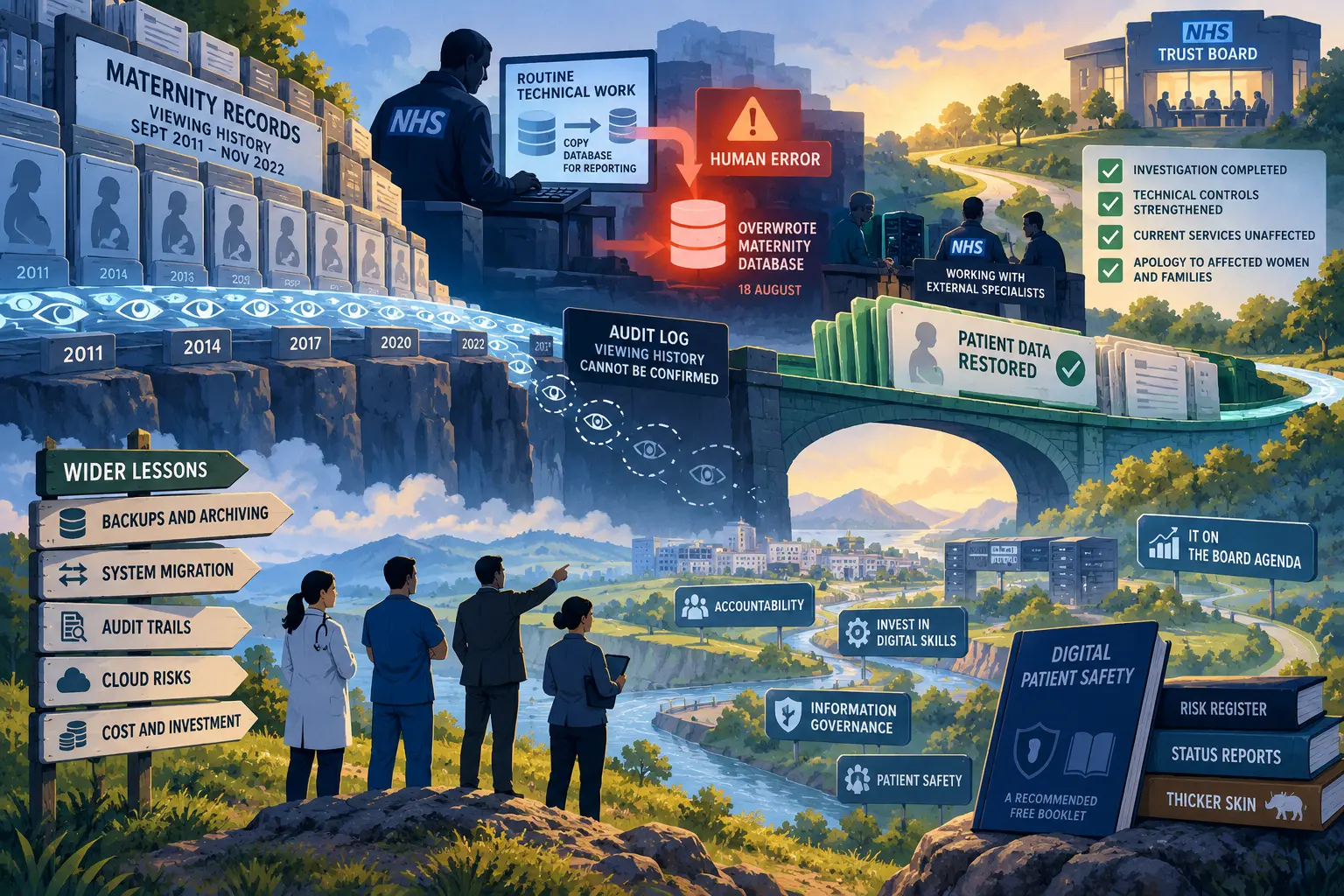
Notable: Newsletter image generated using Nano Banana with full newsletter as prompt. Plan announced to convert all 25 back-catalogue newsletters to audio.
Sunday, 30 November 2025
Primary Theme: NEJM AI Scribe Research & Insurance Concerns Key Discussion: Detailed analysis of three NEJM papers on ambient scribes dominated morning activity. Tension between productivity gains and burnout reduction explored. Concept of AI as "MDT partner" rather than tool gained traction. Parallel FT coverage of insurer nervousness sparked liability framework discussion. Secondary Discussions:
- Data monetisation debate (deeply divided)
- EU MDR regulatory reality check
- Cybersecurity incidents and data breach context
- NHS data as "national security" asset
Notable: 109 messages--joint peak for the week. Data sharing debate exposed fundamental community divisions unlikely to resolve.
Monday, 1 December 2025
Primary Theme: AI Telephone Handling & Newsletter Audio Key Discussion: Practice Manager inquiry about AI telephone handling systems prompted vendor engagement and practical implementation discussion. Newsletter audio version embedded on Curistica website received positive feedback. Demand management and online consultation patterns analysed. Secondary Discussions:
- NICE cost-effectiveness threshold changes confirmed
- Community vs acute funding rebalancing
- X-on Health omni-modal consultation platform
- Strategy Unit demand projections (25-50% increases)
Notable: 109 messages--matched Sunday's peak. Significant cross-pollination between policy and practical implementation discussions.
Tuesday, 2 December 2025
Primary Theme: Digital Inclusion & Demand Management Key Discussion: Examination of whether online consultations tap "unmet need" or create new demand. Discussion of ensuring technology doesn't leave vulnerable populations behind. 107-year-old patient vaccination story illustrated frontline outreach value. Secondary Discussions:
- VR in healthcare applications (Pico VR for anxiety)
- Google vs Microsoft AI enterprise competition
- Health literacy mapping tool shared
- GP access pressure data analysis
Notable: Activity dropped to 54 messages--reflective pause after intense weekend/Monday discussions.
Wednesday, 3 December 2025
Primary Theme: Gaming Industry AI Perspectives & Lab Test Warnings Key Discussion: Video games industry AGM insights revealed defensive attitudes toward AI, contrasting with healthcare's more constructive engagement. Stanford/Harvard study on widely-used models shared. Lab testing AI warning context requirements discussed. Secondary Discussions:
- Royal Mail GDPR policy for Santa letters
- AI hearing aid developments
- Medscape AI-human hybrid scribe model
- China AI capabilities report
Notable: 38 messages--lowest weekday activity. Several contributors at external events.
Thursday, 4 December 2025
Primary Theme: ICB Prescribing Software Criticism & Vendor Engagement Key Discussion: Sharp criticism of FDB OptimiseRx and ScriptSwitch prompted direct vendor engagement--rare and notable. Clinical Product Lead acknowledged pain points and appreciated honesty. Discussion of Local Enhanced Services funding tying practices to unwanted software. Thames Freeport AVT opportunity shared. Secondary Discussions:
- AVT cost barriers for part-time clinicians
- "AVT divide" risk for locums/salaried/AHPs
- CSO Coffee and Chat meeting (152 attendees)
- Microsoft Copilot safety case requirements
Notable: 133 messages--week's peak. Vendor engagement modelled constructive criticism handling.
Friday, 5 December 2025
Primary Theme: NHSE Technology Funding Policy Key Discussion: Director of Transformation announcement that NHS will "turn funding off" when productivity targets aren't met sparked concern. New dashboard for 2026-27 tracking "cash value generated." Criticism focused on misunderstanding IT as foundation vs profit centre. Radical funding shift from acute to community announced. Secondary Discussions:
- eGPlearning AVT livestream announcement (17 Dec)
- Dictate.it user experience shared
- SystmOne to Medicus transition evidence needs
- Salaried GP vs partner AVT benefit dynamics
Notable: 34 messages--significant drop after Thursday peak, but high-impact policy content.
Saturday, 6 December 2025
Primary Theme: Minimal Activity Key Discussion: Only 2 messages--system notifications for privacy settings and new member addition. Notable: Natural weekend pause before next week's activity.
Whether it's clinical safety (DCB0129/0160), data protection (DPIA/Privacy Notices), or the ongoing governance of Clinical AI that integrates with your ways of working,
visit www.curistica.com or contact hello@curistica.com
Brought to you by Curistica - your healthtech innovation partner.
For help with clinical safety (DCB0129/0160), data protection (DPIA/Privacy Notices), and governance of Clinical AI that integrates with your ways of working,
visit www.curistica.com or contact hello@curistica.com
AI in the NHS Weekly Newsletter is produced by Curistica Ltd for members of the AI in the NHS WhatsApp community. All contributors are anonymised. Views expressed are those of individual community members and do not represent any organisation.