


📋 Executive Summary
This week's discussions spanned the full range of NHS digital health preoccupations, from a French tech giant's acquisition of a GP system challenger to the uncomfortable revelation that patients are seeing their cancer test results on the NHS App before their consultants. A bank holiday debate about Palantir's recruitment of 32+ former public officials turned into one of the group's most searching conversations about the revolving door between government and industry. The group debated the cognitive load implications of AI voice transcription, wrestled with the economics of NHS savings claims, and watched with a mixture of alarm and amusement as Chrome silently installed a 4GB local language model on NHS computers. Saturday's Clinical Game Jam at Unity's offices offered a glimpse of health gaming's potential, a Hitchhiker's Guide-themed satire on EMIS became the week's viral moment, a bot attack on AccuRx exposed the fragility of national-scale triage infrastructure, and a member vibe-coded a clinical note-taking app from his phone in the sunshine. An exceptionally busy week, with 480+ messages, sharp debate on health economics, and the usual blend of regulatory rigour and gallows humour.
---
🏥 Doctolib Acquires Medicus: A New Force in GP IT
Wednesday morning's biggest news was the announcement that Doctolib, Europe's largest health technology company, had acquired Medicus, the UK GP electronic patient record challenger. The news drew immediate and wide-ranging reaction.
"It certainly brings a huge amount of firepower for the task of challenging incumbents" -- a clinical AI specialist
A GP whose practice had been planning to switch from EMIS to Medicus expressed concern about the loss of UK ownership: "One of the attractions was UK based. For me EU is better than US but another leak of UK public finance." The Medicus team responded directly, explaining that there were no equivalent UK investors aligned to the NHS vision, and that the partnership was specifically chosen to avoid the two outcomes most VC and PE investors pursue -- "starving the UK of investment and milking legacy products."
An NHS commissioning specialist saw strategic merit: "I do think the NHS is not a fair environment for new and innovative providers or their investors. The Medicus move is quite clever, should give a larger corporate punch." A health informatics leader noted their one remaining objection would be resolved if Doctolib invested in building an equivalent to EMIS Enterprise for at-scale federation working. The Medicus team confirmed this was already underway.
The same day brought an HSJ report on a French GP IT company seeking to crack the duopoly, adding further competitive pressure. And by Thursday, the news that a US equity firm had bought EMIS -- the UK's largest GP IT supplier -- prompted one member to observe: "US buy EMIS, French buy Medicus... Chinese buy TPP?!" Rumours that TPP's owner was also considering a sale added fuel to the fire.
"If every UK company that is foreign owned closed their doors, we'd be back in the dark ages before the last light was turned off" -- an NHS commissioning specialist
---
📱 NHS App Patient Records: Cancer Results Before Consultants
Thursday's most concerning clinical thread emerged when a GP reported that patients were now seeing positive cancer test results on the NHS App before their hospital consultants had reviewed them.
"We are having patients see their positive cancer test results before Consultants and coming to see the GP who has no idea what test was ordered by who and what the result was" -- a GP digital health leader
The group quickly identified the tension between transparency and patient safety. An NHS commissioning specialist argued for a two-tier record: a precise clinical view available only to registered healthcare professionals, alongside a filtered patient-facing version that removes terminology routinely misinterpreted or experienced as insensitive. Another GP agreed: "Requirements and sensitivities are very different."
A policy contributor noted that the imposed DHSC contract required the NHS App view to mirror a subject access request, which several members felt went too far. Discussion turned to the practical challenge of blood test reporting, where marking a single abnormal result in a battery incorrectly flags all results as abnormal. A radiologist proposed that LLM-powered translation layers could convert clinical language into patient-friendly summaries -- an idea they had advocated since the early days of patient-friendly radiology reporting.
---
🧠 AVT Cognitive Load: The BJGP Study and the Savings Debate
Friday opened with a BJGP study on whether AI voice transcription tools genuinely reduce clinician cognitive load, sparking one of the week's most substantive debates.
"Having studied cognitive load in VR space for over 10 years, I find the narrative that AVT reduces cognitive load misleading. In my experience it increases total cognitive load if we monitor long-term impact on clinician" -- a health technology strategist
A clinical AI specialist noted the need for studies comparing AVT users with those using non-AI scribes, and observed that AVT "needn't stop the clinician taking notes on paper but at a lower level of multitasking load." The discussion broadened into whether the ROI narrative around health technology is fundamentally flawed.
A health economics researcher shared evidence that NHS primary care produces health at roughly six to eight thousand pounds per QALY, compared to the NICE threshold of twenty-five to thirty-five thousand, arguing that additional investment in primary care is likely to be the most productive use of NHS spending.
"I have a long time gripe with ROI as the only driver for change in the NHS... If we examined the ROI of district nursing, would it be positive? General practice? A&E? There are lots of vital parts of our system which may or may not secure overall savings, but are recognised as vital" -- an NHS digital transformation leader
An NHS commissioning specialist recounted being invited to a meeting where a consultancy promised two million pounds in savings over five years: "I asked the question about which quarters we could see savings so I can plan for my cash spend to reduce. I was somehow missed off the distribution for the next meeting."
A clinical outcomes specialist summarised the problem: "There's a huge pressure to deliver impact and ROI that everyone latches on to the latest clinical value narrative and then tries to shoehorn their data and evidence to support that."
---
🔒 Mythos and the Mozilla Bug Hunt
Friday's early morning thread examined Mozilla's use of Anthropic's Mythos model to discover and fix vulnerabilities in Firefox, with the group debating whether this represented a genuine capability leap or sophisticated marketing.
"Imagine this level of bug-fixing in the care we provide?" -- a clinical AI specialist
A health technology strategist drew a sharp parallel: "Mythos bugs discovery could also be equated to incidentalomas discovered from whole body MRI in asymptomatic patients." The same contributor extended the analogy: "It's basically anthropogenic harm -- the act of discovering an exploit realises the latent potential of the exploit causing harm."
A GP digital health leader offered historical context, noting the original security audit tool SATAN from Sun Microsystems created similar controversy about whether such tools should exist. The same contributor quipped: "Why not ANGEL? Autonomous Network Gap Evaluation Logic. Branding matters."
One member was more sceptical, suggesting the "too dangerous to serve" pitch was desperation from a company whose competitors were gaining ground, whilst a blog post questioning whether open source repositories needed to be shut down in the Mythos era was shared and discussed.
---
⚠️ AccuRx Bot Attack: National Infrastructure Vulnerability
Wednesday brought a sobering incident report: AccuRx, used by roughly half of English GP practices for online triage, had suffered a bot attack where a single device attempted to load one practice's patient triage form over one million times within minutes.
"For context, this is similar to the volume we would typically see across all practices nationally over the course of a week" -- AccuRx incident report, shared by a GP digital health leader
Members speculated whether it was "an agent gone rogue" or deliberate reverse engineering. A clinical AI specialist noted the clinical safety implications: "Well, looking forward to the CSO update post-incident to all deployment sites and hazard log update." The incident highlighted the fragility of national-scale triage infrastructure dependent on a single vendor.
---
🔐 Chrome's Silent LLM and the NHS Security Question
Thursday brought an unexpected cybersecurity discussion when a member shared a Register article revealing that Chrome had been silently installing a 4GB local language model on users' computers.
"Now, imagine you're a CSO or jobbing NHS IT security person, what do you do with this? Especially given Chrome is the default for quite a few things NHS these days" -- an NHS commissioning specialist
The implications for NHS information governance were immediately apparent. With Chrome widely used across NHS estate, the silent installation of an AI model capable of local inference raised questions about data protection, asset management, and shadow AI that most trusts were unlikely to have anticipated.
---
🚪 The Revolving Door: Palantir and NHS-to-Industry Migration
Monday's bank holiday brought a thread that ran longer and cut deeper than almost anything this week. A member shared a Morning Star investigation reporting that Palantir had recruited more than 32 former public officials, including individuals from AI strategy, the Ministry of Defence, and NHS leadership. The group's response was immediate and deeply personal.
"Shocking, needs full investigation and transparency" -- a clinical safety specialist
The debate quickly moved beyond Palantir itself into broader territory: the ethics of NHS staff joining vendors, redundancy clawback policies that punish rather than retain, and the structural conflicts of interest that arise when public servants move to private companies bidding for public contracts. A digital transformation leader described the revolving door starkly: "You boot me out, you lose say over where I go to pay bills." The same contributor noted that NHS redundancy clawback -- where staff who rejoin the NHS within twelve months must repay their settlement -- was "shameful politically driven scumbaggery" that actively pushed talent towards industry.
A clinical safety specialist drew a distinction between individuals seeking employment after redundancy and those potentially compromised whilst still in post: "Did they carry out work whilst in NHS to help company win contracts?" Another member argued that mission could be pursued regardless of employer, sharing their experience at Babylon as an eye-opener after years of NHS assumptions. Others pushed back, insisting that some companies' values were incompatible with public service.
"No single ideology should decide the fate of the NHS... it was brought into being free at the point of care, and that must be preserved" -- an NHS governance specialist
The thread concluded with a shared IEEE Spectrum article on AI alignment and whose values AI systems should reflect, extending the revolving door debate into the governance of technology itself. Notably, the group maintained a tone of respectful disagreement throughout, with one member observing that "the ethical standards of this group are incredibly high."
---
🎮 Clinical Game Jam: Building Health Through Play

Saturday afternoon brought a dispatch from an unlikely corner of NHS innovation: the Clinical Game Jam Grand Final at Unity's London offices. A clinical AI specialist reported back from the event, where clinicians and developers used Unity's no-code AI game-building tools to create health games in a single session.
"What is a Clinical Game Jam? What makes it more fun than sunshine?" -- a practice manager
The winning entry was a game designed for child mental health, tackling social media bullying through interactive play. The group learned that Unity's latest AI-powered development tools allow non-coders to build functional game prototypes without writing a line of code. Images from the event drew admiration for Unity's offices and the calibre of the work produced. A Unity facilitator was welcomed into the group, with members invited to direct-message for future Unity health projects.
The thread touched on a broader question: whether gaming and interactive media represent an underexplored channel for health interventions, particularly for younger populations where traditional health messaging struggles to land. One member summarised the day's enthusiasm: kudos to Unity for supporting the initiative and opening their tools to the clinical community.
---
📊 Enhanced Statistics Section
Activity Metrics
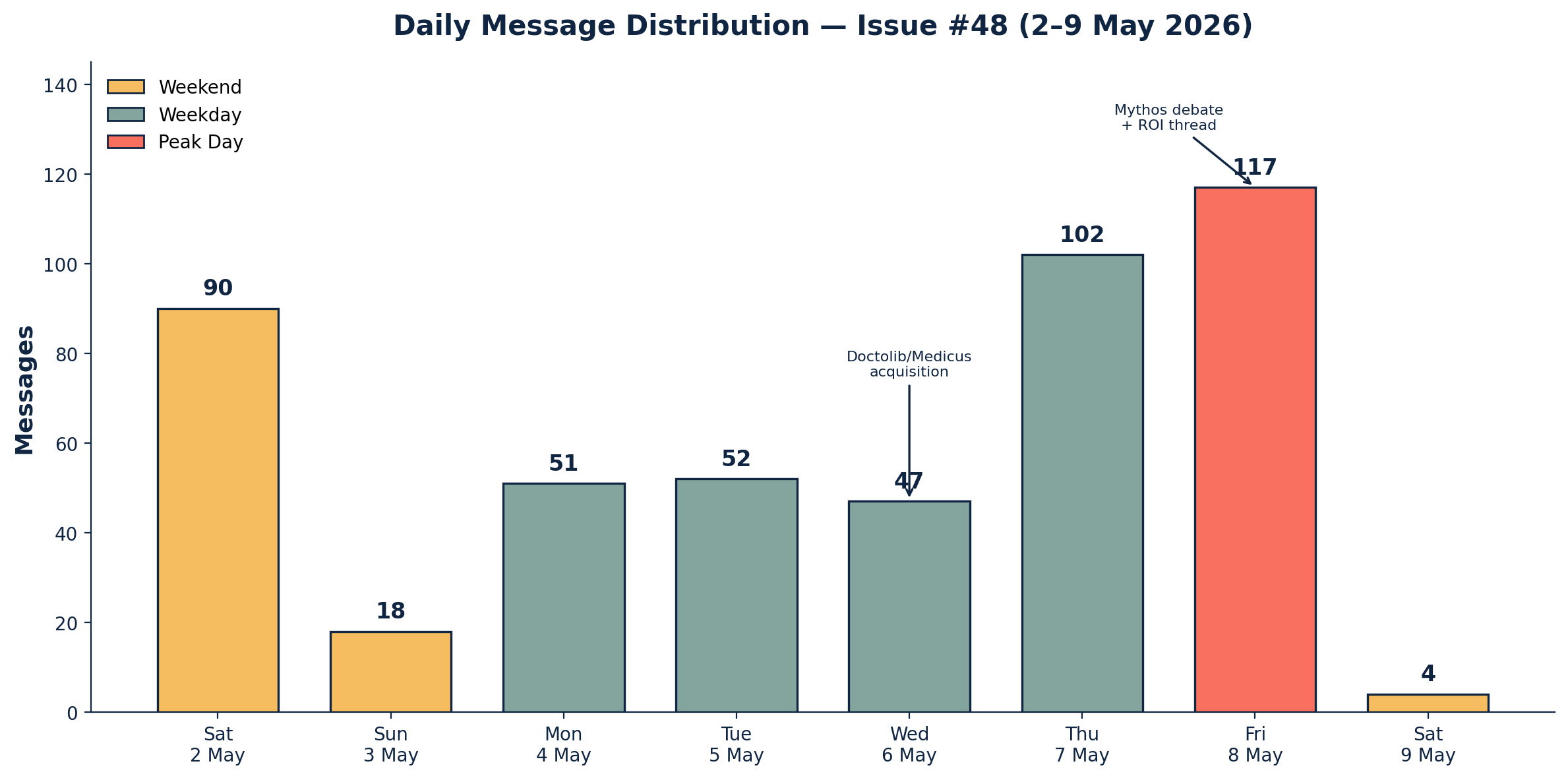
Total messages (approx.): 480+
Active days: 8/8 (full coverage)
Peak day: Friday 8 May
Links shared: 30+
Images/videos shared: 15+

Top Contributors by Role
Clinical AI specialist: 65+
NHS commissioning specialist: 35+
Health technology strategist: 20+
GP digital health leader (various): 20+
Digital health specialist: 18+
Clinical safety / regulatory specialist: 15+
Health tech entrepreneur: 10+
Hottest Debate Topics
1. NHS savings and ROI narrative (30+ messages)
2. Palantir revolving door and NHS-to-industry ethics (25+ messages)
3. Doctolib/Medicus acquisition and GP IT market (25+ messages)
4. AVT cognitive load and clinical note-taking (20+ messages)
5. NHS App patient record access (20+ messages)
6. Mythos capabilities and cybersecurity (15+ messages)
Discussion Quality Indicators
• Regulatory references cited: DCB0160, DHSC contract terms, NICE QALY thresholds, BJGP study
• Actionable outputs produced: TimeNote app vibe-coded and published, Mayor of London talent board expressions of interest gathered
• Cross-sector participation: clinicians, vendors, commissioners, academics, health economists, policy advisors
---
😄 Lighter Moments
The Hitchhiker's Guide to EMIS
The week's standout comedic moment was an AI-generated Hitchhiker's Guide pastiche featuring Deep Thought computing the answer to "Life, the Universe, and EMIS." After seven and a half million years of computation, the answer: "Have you tried turning it off and on again." The satire hit every NHS IT pain point from Ardens templates to DCB0160 hazard logs, concluding with the revelation that the computer designed to calculate the Question would be called "the System One Migration." The group's collective sob was audible.
LinkedIn AI Slop
"I decided to look through LinkedIn content and oh dear... the unmitigated and unedited AI slop that people put out and pretend is their own content is just embarrassing" -- an NHS commissioning specialist
This prompted the observation that viewing LinkedIn required "a glug of Gaviscon" first, a debate about peppermint versus aniseed flavour, and one member noting: "Revenue is for the weak when you are a thought leader."
McDonald's AI
When someone suggested using McDonald's free chatbot as a Claude alternative, a member immediately asked: "Anyone got a Maccies receipt so I can find out the meaning of life?" The answer, naturally, was 42.
The MRI Social Club
After a member shared their experience of a Neko Health AI body scan, MRI discussion took an unexpected turn. One member confessed that two hours in an MRI scanner "would give me a hypertension spike so bad I'd be whistling from my ears," whilst an MRI provider offered tours of scanners nationwide. A consultant's suggestion of snoring prompted the response: "You get charged extra for that."
Vibe-Coding in the Sun
A clinical AI specialist vibe-coded TimeNote -- an open-source web app that lets clinicians take timestamped notes during consultations alongside their AI voice transcription tool, exporting a markdown file with an LLM instruction header for post-consultation synthesis -- entirely from his phone whilst having a beer in the sunshine. Published to GitHub and deployed to timenote.curistica.com within the hour: "My work here is done. Happy Friday all!"
---
💬 Quote Wall
1. "We are having patients see their positive cancer test results before Consultants and coming to see the GP who has no idea what test was ordered" -- a GP digital health leader, on NHS App record access
2. "If every UK company that is foreign owned closed their doors, we'd be back in the dark ages before the last light was turned off" -- an NHS commissioning specialist, on the EMIS acquisition
3. "Having studied cognitive load in VR space for over 10 years, I find the narrative that AVT reduces cognitive load misleading" -- a health technology strategist, on AI voice transcription
4. "I asked the question about which quarters we could see savings so I can plan for my cash spend to reduce. I was somehow missed off the distribution for the next meeting" -- an NHS commissioning specialist, on savings claims
5. "Mythos bugs discovery could also be equated to incidentalomas discovered from whole body MRI in asymptomatic patients" -- a health technology strategist, on AI vulnerability scanning
6. "Revenue is for the weak when you are a thought leader" -- a health tech entrepreneur, on LinkedIn culture
7. "If Heidi has saved 4 million hours this group must have saved at least eleventy billion hours" -- a GP digital health leader, on vendor savings claims
8. "I have an advanced first aid certificate which expired in 1995, if that counts as clinician" -- an NHS commissioning specialist, on MRI anxiety
9. "US buy EMIS, French buy Medicus... Chinese buy TPP?!" -- a GP digital health leader, on the GP IT ownership question
10. "My work here is done. Happy Friday all!" -- a clinical AI specialist, after vibe-coding an app from his phone in the sunshine
---
📚 Journal Watch
Clinical & Research
• BJGP study on AVT and cognitive load -- Study examining whether AI voice transcription tools reduce clinician cognitive load https://bjgp.org/content/76/766/223
• Eric Topol on whole body MRI -- JAMA review by two radiologists on the evidence for screening MRI https://www.linkedin.com/posts/eric-topol-md-b83a7317_at-jama-today-2-radiologists-publish-what-activity-7457829373031735296-0BB_
• NHS marginal productivity study -- Martin, Claxton et al on where NHS spending is most productive (primary care) https://www.sciencedirect.com/science/article/pii/S0168851023000854
• Opportunity cost in health economics -- Substack post inspired by the group's ROI discussion https://open.substack.com/pub/amcunningham72/p/we-need-to-talk-about-opportunity
Policy & Regulation
• Doctolib acquires Medicus -- French health tech giant partners with UK GP EPR challenger https://about.doctolib.com/news/doctolib-and-medicus-join-forces-to-build-the-leading-next-generation-gp-platform-in-the-uk/
• US equity firm buys EMIS -- HSJ report on acquisition of UK's largest GP IT supplier https://www.hsj.co.uk/technology-and-innovation/us-equity-firm-buys-biggest-supplier-of-gp-it/7041674.article
• French tech giant seeks to crack GP IT duopoly -- HSJ analysis https://www.hsj.co.uk/technology-and-innovation/french-tech-giant-seeks-to-crack-gp-it-duopoly/7041653.article
• BMJ analysis: UK tech startup investment patterns -- Why UK startups end up with foreign acquirers https://www.bmj.com/content/393/bmj-2025-086295
• AI alignment and values -- IEEE Spectrum analysis of whose values AI systems should reflect https://spectrum.ieee.org/ai-alignment
Industry & Tools
• Mozilla uses Mythos to harden Firefox -- Behind-the-scenes look at AI-driven vulnerability discovery https://hacks.mozilla.org/2026/05/behind-the-scenes-hardening-firefox/
• Does Mythos mean you need to shut down Open Source repos? -- Terence Eden's analysis https://share.google/tmLXkA2dIDVYV0QCx
• Chrome silently installs 4GB local LLM -- The Register investigation https://www.theregister.com/ai-and-ml/2026/05/07/chrome-silently-installs-a-4-gb-local-llm-on-your-computer/5230893
• TimeNote: vibe-coded note-taking app -- Open-source web app for timestamped clinical note-taking alongside AVT, with markdown export and LLM instruction headers https://github.com/DrKGrimes/TimeNote
• AgentDeck for Stream Deck -- Control Claude Code from a Stream Deck https://github.com/puritysb/AgentDeck
• The Claude Show -- Interactive Claude demonstration https://www.khaledeltokhy.com/claude-show
• RCSEd: Writing clinic letters to patients -- Guidance on patient-friendly communication https://www.rcsed.ac.uk/media/gdfk4s3v/please-write-to-me-writing-outpatient-clinic-letters-to-patients-guidance.pdf
• Eve Appeal: Get Lippy campaign -- ICB-promoted cancer awareness campaign using AI https://eveappeal.org.uk/campaigns/get-lippy/
---
🔮 Looking Ahead
Upcoming Events
• HLTH Conference -- Group members preparing for attendance; tips for first-timers shared
• Saudi Medtech Webinar -- WHV Pavilion, September 28-31
• Mayor of London Health Talent Board -- GLA seeking input from health employers (NHS and non-NHS) for skills and training development; several group members have expressed interest
Ongoing Threads
• GP IT ownership question -- With EMIS, Medicus, and potentially TPP all changing hands, the future ownership and governance of UK primary care IT remains a live concern
• NHS App patient record access -- The tension between transparency and clinical safety in patient-facing records shows no sign of resolution
• AVT evidence base -- The group continues to debate whether savings claims are substantiated and whether cognitive load effects are being properly studied
• Medicus first-of-type migration -- The first SystmOne-to-Medicus practice migration is imminent, with the group watching closely
---
👥 Group Personality Snapshot
This was one of those weeks where the group's dual personality was on full display. Monday's Palantir recruitment thread and the ensuing debate about NHS-to-industry migration was raw and personal -- people talking about real career pressures, real ethical lines, real bills to pay. By Wednesday, the Doctolib/Medicus acquisition had the vendor and commissioner members engaged in the kind of nuanced market analysis you would struggle to find in any formal publication. Thursday's NHS App thread showed the group at its clinical best: clinicians, informaticists, and policy specialists all bringing different lenses to a problem that affects real patients right now. And Friday's extraordinary range -- from Mythos vulnerability scanning through health economics to vibe-coding in the sunshine -- captured the group's unique ability to hold serious technical discussion and playful creativity in the same breath. The Hitchhiker's Guide to EMIS will be quoted for weeks. The community's role as an informal cross-sector advisory group, part regulatory seminar, part innovation lab, part comedy panel, has never been clearer.
---
📅 Appendix C: Daily Theme Summary
Saturday 2 May
The week opened with the Clinical Game Jam at Unity's offices, with a clinical AI specialist reporting back on "no code gaming for health games." Hardware pricing dominated the afternoon -- Apple Mac Mini price increases, GPU costs, and Costco deals. The open-evidence-versus-alternatives debate continued, with one member challenging the evidence base for AI clinical evidence tools and another reporting a survey of 1,200+ clinicians showing 89% perceived positive value. A science.org study on AI diagnostic performance was shared. The evening brought discussion of OpenAI's sandbox architecture and data centre investment, alongside a light-hearted exchange about AI-generated sprites.
Sunday 3 May
Newsletter Issue #47 was published. HLTH conference tips were shared for a first-time attendee. A Saudi Medtech webinar was promoted. The afternoon saw an interesting thread on whether companies would ditch LLMs due to error rates, with one member predicting "no-one will ditch anything, they'll optimise and continually enhance." Anthropic's chip acquisition rumours and GPU hardware purchases featured. The evening brought a thread on companies hiring cheap labour to be the "AI" -- the modern Mechanical Turk.
Monday 4 May (Bank Holiday)
The dominant thread was the Morning Star's report on Palantir recruiting 32+ public officials including AI strategy, MoD, and NHS leaders. This sparked a passionate debate about the revolving door between government and industry: the ethics of NHS staff joining vendors, redundancy clawback policies, conflicts of interest, and whether mission can be pursued regardless of employer. The debate was civil but deeply felt, with one member noting that "if all routes closed and bills ugly, would have to consider" and another arguing that "no single ideology should decide the fate of the NHS." An IEEE Spectrum article on AI alignment extended the discussion into values and governance. The group notably maintained a tone of respectful disagreement throughout.
Tuesday 5 May
LinkedIn AI slop dominated the morning, with members sharing their frustration at AI-generated content flooding the platform. A practice manager suggested RAG-style ratings for AI-generated content. The afternoon brought Perplexity Pro discount deals and a humorous exchange about McDonald's free AI chatbot. The Claude Show was shared. The evening brought an HSJ article on a French GP IT company seeking to break the EPR duopoly, and a BMJ article on UK tech startup investment patterns.
Wednesday 6 May
The Doctolib/Medicus acquisition broke early and dominated the morning. Discussion ranged from competitive dynamics to investment patterns, with contributions from the Medicus team, federation leaders, GPs, and health economists. A BMJ article on UK tech investment patterns added context. The AccuRx bot attack was reported at midday, raising clinical safety and infrastructure vulnerability questions. The afternoon and evening saw discussion of Ardens templates and a new book on AI in healthcare.
Thursday 7 May
The busiest day of the week (102 messages). The NHS App patient record access thread ran from mid-morning, with the cancer results revelation sparking sustained clinical and policy debate. Chrome's silent LLM installation was flagged as an NHS cybersecurity concern. The Mayor of London's health talent board call for expressions of interest drew multiple responses. Neko Health AI body scans prompted a wider MRI discussion. The US equity firm EMIS acquisition and TPP sale rumours dominated the late afternoon. NotebookLM voices and British English accents for AI were discussed. An AVT impact report was shared in the evening, prompting early scepticism about savings claims.
Friday 8 May
The most active day (117 messages). Mythos and Firefox bug-fixing opened the morning, with a nuanced debate about whether AI vulnerability discovery represented genuine capability or marketing. The Hitchhiker's Guide to EMIS satire went viral within the group. The BJGP study on AVT cognitive load prompted a substantive thread on clinical evidence. The NHS savings and ROI debate was one of the week's deepest discussions, drawing on health economics research and real-world commissioning experience. Granola AI and Plaud note-taking tools were compared. The same contributor vibe-coded TimeNote and published it to GitHub. AgentDeck for Stream Deck was shared. The week closed with participants reflecting on opportunity cost.
Saturday 9 May
A quiet close. An arxiv paper was shared early morning, and a Substack post on opportunity cost -- directly inspired by the previous day's health economics discussion -- was published and warmly received.
---