

Having a clinical safety case is a statutory requirement under DCB0129 and DCB0160. Having a good one is a different question. A document that exists and a document that actually demonstrates safe development or deployment are not always the same thing.
Two peer-reviewed studies make this plain. A 2025 JMIR study found widespread non-compliance across NHS GP practices. A 2026 BMJ Innovations paper went further, identifying the structural drivers of low-quality safety cases across NHS organisations. The research found that compliance on paper does not reliably predict safety in practice.
The question that follows is: how do you tell the difference? Until recently, there was no standardised way to answer it.
Introducing the CSC-QT
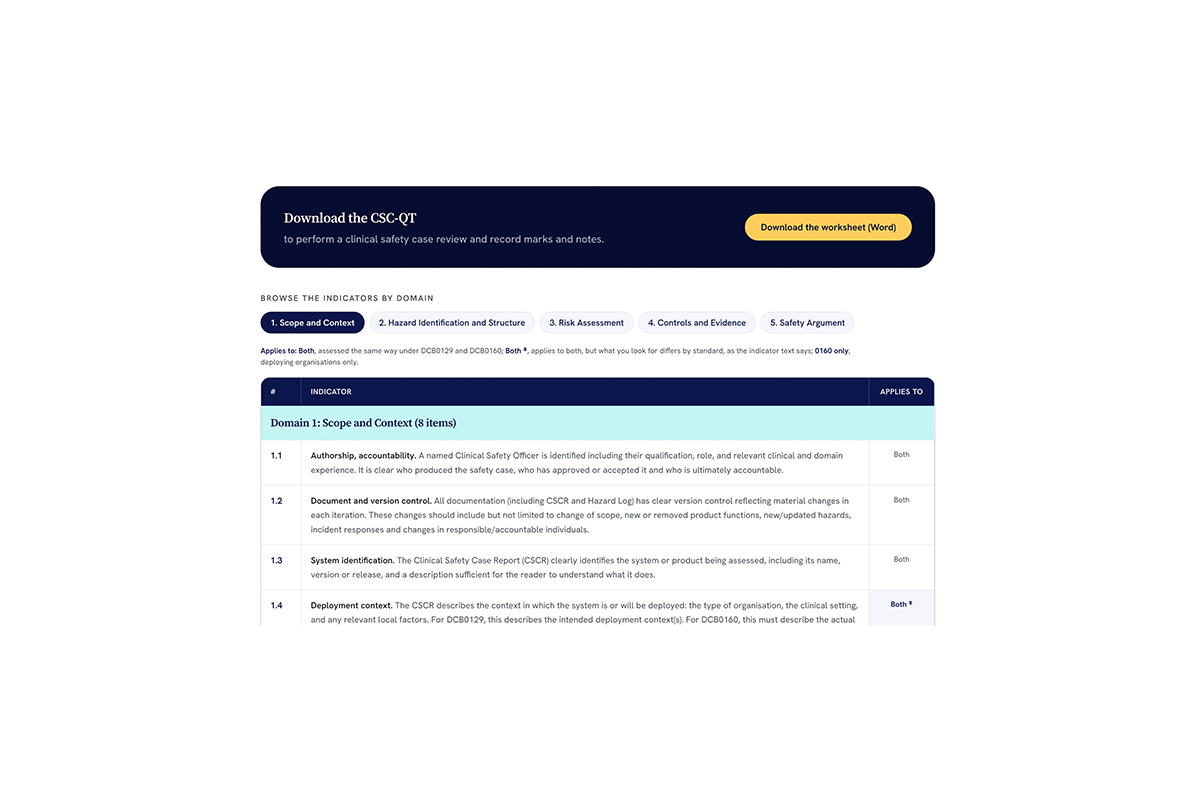
The Clinical Safety Case Quality Tool (CSC-QT) is a free, peer-reviewed instrument for assessing the quality of a clinical safety case from documents alone. It covers both DCB0129 (suppliers) and DCB0160 (NHS organisations), and comprises 36 structured indicators across five domains.
The five domains are:
- Scope and Context: whether the safety case clearly defines what the system does, who it affects, and under what conditions it is being deployed.
- Hazard Identification and Structure: whether hazards have been systematically identified, recorded, and structured in line with NHS England clinical safety assurance guidance.
- Risk Assessment: whether each hazard has been assessed for likelihood and severity, with a defensible rationale.
- Controls and Evidence: whether mitigations are specific, implemented, and evidenced, rather than stated.
- Safety Argument: whether the safety case presents a coherent, auditable argument that residual risk is acceptable.
The tool is licensed under CC BY 4.0. You can use it independently as a topline tool or Curistica can review your safety case and advise on any gaps.
Who should use it
The CSC-QT is useful to inform your next steps in three situations. Suppliers preparing for procurement can use it as a first step in stress-testing their safety case before it reaches an NHS buyer's due diligence process. NHS organisations can use it after a system update or significant change to check whether the safety case has kept pace. And clinical safety officers can use it to start a structured internal audit, rather than relying on informal review.
In each case, the tool surfaces the same issue: whether the safety case holds up to scrutiny, not just whether it exists.
Try the CSC-QT
Access the tool free at csc-qt.curistica.com as a first step, and get in contact to discuss your results or for an indepth applied review of your safety case - book a call here